
If you’ve ever shipped “SEO content” for three months and watched traffic do absolutely nothing, you already know the dirty secret. The hard part isn’t writing. It’s deciding what to write, why it should rank, and how it connects to revenue. AI can speed up the wrong work just as efficiently as it speeds up the right work.
A good ai powered seo strategy in 2026 looks less like a keyword spreadsheet and more like an operating system. It blends classic SEO (crawlability, intent, links) with AEO (answer engines, citations, entity clarity) because search behavior is splitting. Gartner predicts search engine volume will drop by 25% by 2026 due to generative AI (Tenet, 2025). That doesn’t mean SEO is dead. It means “rank a blog post” is no longer the whole job.
This tutorial is for founders, marketing leads, and SEO folks who want a strategy you can actually run every week. Not a deck. Not a “pillar page” fantasy. A working system.
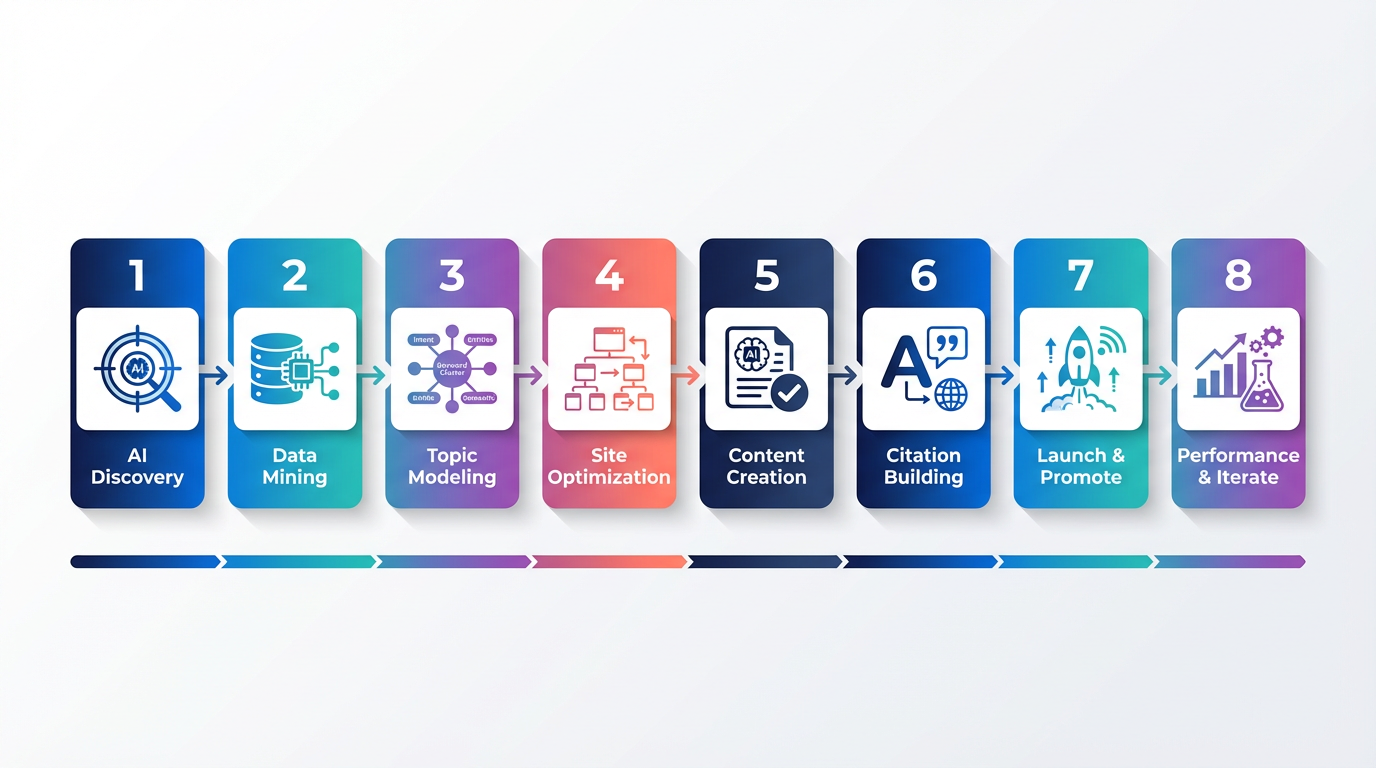
How to create an AI-powered SEO strategy from scratch (step summary):
- Step 1: Define outcomes, audiences, and what counts as a win (not just traffic).
- Step 2: Set up your data environment so AI isn’t guessing.
- Step 3: Build a keyword and question universe, then cluster by intent and journey stage.
- Step 4: Choose your content architecture (hubs, templates, internal links) before writing anything.
- Step 5: Use AI to draft briefs and outlines, then apply human standards for voice and accuracy.
- Step 6: Optimize for AEO and AI search referrals (entities, citations, structured answers).
- Step 7: Publish with a technical checklist and a realistic cadence you can sustain.
- Step 8: Measure what matters, run experiments, and keep the system honest.
Prerequisites: what you need before you start
You don’t need a giant tool stack. You do need clean inputs and a place to store decisions. Here’s the minimum I’d want on day one:
Accounts: Google Search Console, Google Analytics (or equivalent), and access to your CMS. Tools: a crawler (Screaming Frog or Sitebulb), a rank tracker if you already have one, and a spreadsheet or Notion database for your keyword clusters and content briefs.
If you’re using Vizup, this is where it fits naturally: pulling research, clustering, and turning that into briefs and AEO-ready content without duct-taping five tools together. Their AI-powered SEO tools are built for the “strategy to execution” gap most teams fall into.
Step 1: Decide what “SEO success” means for your business
Traffic is a vanity metric when it’s the wrong traffic. I’ve seen B2B SaaS teams celebrate a 40% organic lift while pipeline stayed flat because the content attracted students and job seekers. Great for ego. Bad for payroll.
Write down three things, in plain language:
- Your primary conversion event (demo request, trial start, lead form, purchase).
- Your 2 to 4 priority audiences (job title, industry, geography, pain point).
- Your “money pages” that must be protected (pricing, product, high-intent landing pages).
Then set a 90-day target you can measure weekly. Not “rank for 50 keywords.” Something like: “Increase non-branded organic demos from the US by 20%,” or “Grow organic signups from India for feature X by 15%.”
Step 2: Build a data environment AI can trust
Most “AI SEO” failures are data failures wearing a fancy label. If Search Console is missing key pages, if analytics is mis-tagged, if your crawl reveals 5,000 indexable parameter URLs, your model outputs will be confidently wrong. And you’ll waste weeks polishing the wrong things.
Do this in one afternoon:
Run a full crawl of your domain. Export indexable URLs, status codes, canonical targets, and title tags. Then pull GSC queries and pages for the last 16 months (yes, 16, not 3). Seasonality and algorithm swings matter more than your last campaign.
Create a single “source of truth” table with these columns: URL, page type (blog, feature, category), primary topic, conversions (if any), impressions, clicks, avg position, and notes (cannibalization, outdated, thin). Keep it ugly. Keep it honest.
Warning (because I’ve watched this go sideways): don’t feed AI raw exports and assume it “understands” your business. Clean the basics first. Remove obvious junk URLs. Label page types. If you skip that, your clustering step will be garbage.
Step 3: Build your keyword and question universe (then cluster it properly)
The internet loves to tell you to “find low-competition keywords.” That advice is overrated for brands that need revenue, not trivia traffic. What you want is a map of demand across the whole journey: problem-aware, solution-aware, product-aware.
Start with three inputs: (1) GSC queries you already appear for, (2) customer language from sales calls and support tickets, (3) competitor topic coverage. Yes, competitor. No, you’re not copying. You’re checking what the market expects you to have an opinion on.
Now cluster by intent, not by word similarity. I’ve seen “AI SEO tools” and “SEO automation” shoved into one cluster because the words overlap. Intent differs. One is evaluation. The other is workflow. Treat them differently or you’ll write a page that ranks for neither.
A practical clustering rubric that works in both India and the US:
- Do they want a definition, a comparison, or a process?
- Is the query trying to buy, shortlist, or learn?
- Would a pricing page satisfy it, or a tutorial, or a template?
If you’ve tried AI clustering and gotten nonsense, you’re not alone. The fix is simple: force the model to label intent first, then cluster within each intent bucket. Humans do this naturally. Models need the constraint.
Step 4: Design your content architecture before you write
This is the part most teams skip because it feels “slow.” Then they publish 30 posts that don’t link to each other, compete for the same terms, and never push a reader toward a decision. I’ve seen teams spend weeks on content production and zero minutes on internal linking strategy. It shows.
Pick 3 to 5 hubs (big topics you want to own) and decide what lives under each hub. Under a hub, you’ll have supporting pages that answer narrower questions, plus at least one commercial page that converts.
Here’s a small table I use to stop “random acts of content.” It forces you to connect intent to page type and internal links.
| Intent type | Best page format | Internal link target |
|---|---|---|
| Problem-aware ("why is organic down") | Diagnostic guide + checklist | Relevant feature page or audit offer |
| Solution-aware ("ai seo workflow") | Step-by-step tutorial | Platform overview + case study |
| Product-aware ("Vizup vs SEMrush") | Comparison page | Pricing + feature pages |
| Post-purchase ("set up reporting") | Help doc / playbook | Retention and expansion pages |
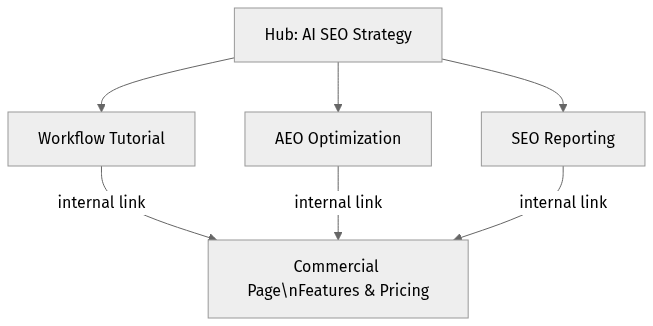
Contrarian take: you don’t need 12 hubs. You need a few you can actually defend with depth. Google’s helpful content systems have made “publish more” a risky default. Depth wins. Consistency wins. Volume for its own sake is a tax.
Step 5: Use AI for briefs and drafts, but keep humans in charge of voice and truth
AI is excellent at first drafts and terrible at accountability. It will invent stats, blur distinctions, and write in that glossy tone nobody trusts. The fix isn’t “don’t use AI.” The fix is to decide which parts are machine work and which parts are human work.
A workflow that holds up under scrutiny:
- Human: define the angle (what you believe, who it’s for, what it should change).
- AI: generate 2 to 3 outline options and a list of questions to answer.
- Human: pick one outline, add real examples, remove filler sections.
- AI: draft sections from your outline using your internal notes and sources.
- Human: edit for accuracy, voice, and “would I bet my reputation on this?”
Search Engine Land has a solid practical reminder here: use AI for research and outlining, but keep humans editing core commercial pages so you don’t dilute brand voice or publish errors (see how to use AI for SEO without losing your brand voice). I agree, and I’ll add one more: never let AI write your differentiators. That’s strategy, not syntax.
One lived-in rule from too many edits: ban generic claims during review. If a paragraph says “improve visibility” and doesn’t say how, where, or for whom, it gets cut. Ruthlessly.
Step 6: Build for AEO and AI search referrals, not just blue links
AI search platforms are sending traffic that behaves differently. Search Engine Land projected that website traffic from AI search platforms will surpass traditional search by 2028 (Search Engine Land, 2025). Semrush reported visitors arriving from AI-powered search experiences convert at about 4.4 times the rate of traditional organic visitors (Semrush, 2025). That’s not a rounding error. That’s a strategy shift.
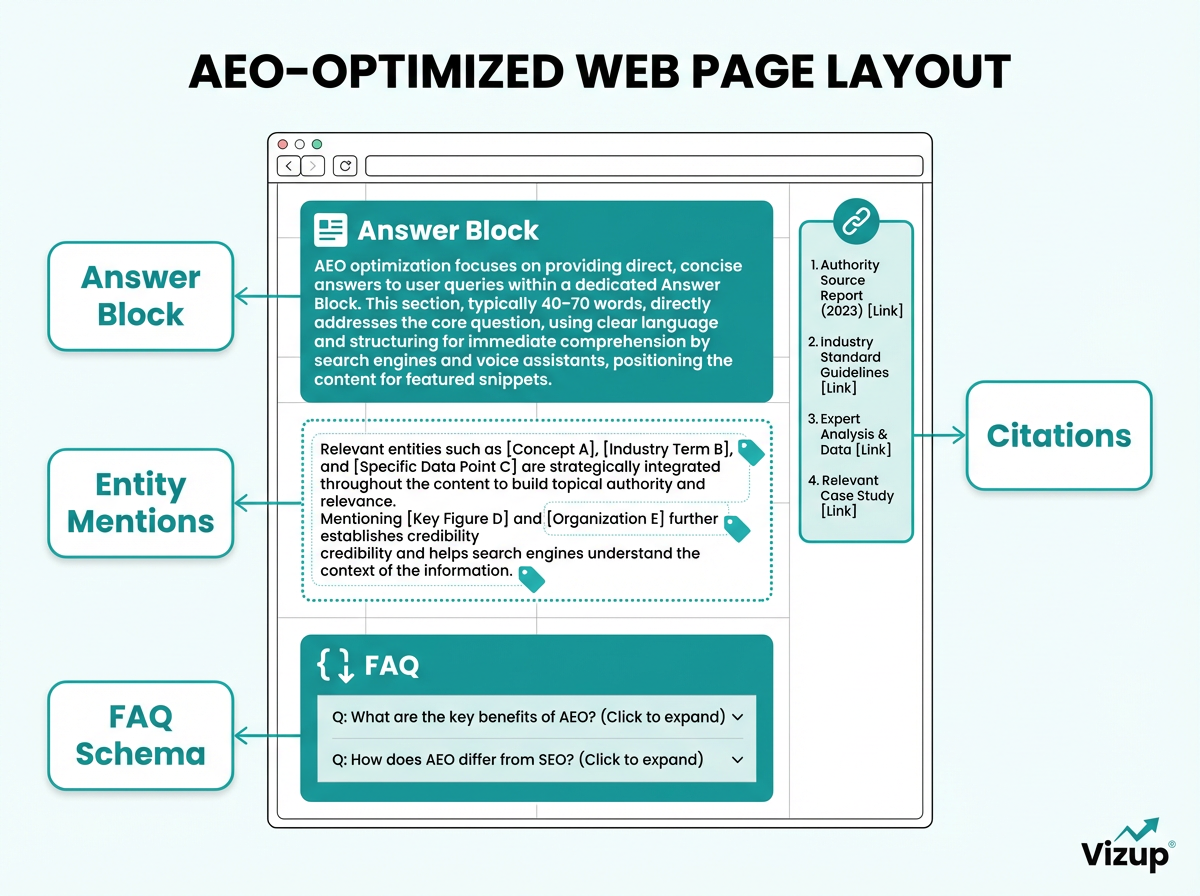
AEO work is unglamorous. It’s mostly clarity. You want your site to be easy to quote, easy to cite, and hard to misunderstand.
Three concrete moves that tend to pay off:
- Write “answer blocks” near the top of key pages (40 to 70 words, direct, no fluff).
- Strengthen entity signals: consistent product naming, author bios, about page clarity, and tightly scoped topics per URL.
- Use citations and primary sources where possible, especially on stats-heavy pages.
If you sell in both India and the US, watch your examples and terminology. “Pricing” queries in India often include “cost” and “plans” language, and users expect quick comparisons. US buyers often want proof, security notes, and integration details. Same product, different reassurance.
Step 7: Publish with a technical checklist and a cadence you can sustain
Shipping is a skill. Most SEO strategies fail at the calendar, not the research. Teams plan for 12 posts a month, then reality shows up. Sales needs a deck. Product needs a launch page. Someone quits. The SEO plan becomes a graveyard of half-finished drafts.
Pick a cadence you can keep for 12 weeks. For many teams, that’s 1 strong piece per week plus 1 refresh. Boring. Effective.
Before you hit publish, run a checklist that’s short enough to actually use:
- Title tag matches intent (not just the keyword).
- Internal links: at least 3 contextual links in, 3 out.
- One clear conversion path (CTA or next step) that fits the page’s intent.
- Images compressed, alt text written like a human, not a robot.
- Schema where it makes sense (FAQ, HowTo, Product), not everywhere.
If you want a place to see how a team operationalizes this over time, Vizup keeps a running set of playbooks and examples on our SEO strategy blog. Worth skimming when you’re stuck on execution details.
Step 8: Measure, learn, and keep the machine honest
AI makes output cheap. That’s the temptation. The discipline is measurement. SeoClarity reported 86% of SEO professionals have already integrated AI into their strategy (SeoClarity, 2025). Semrush found almost 70% of businesses report higher ROI after integrating AI into SEO workflows (Semrush, 2025). The teams seeing that ROI aren’t just generating more pages. They’re running tighter feedback loops.
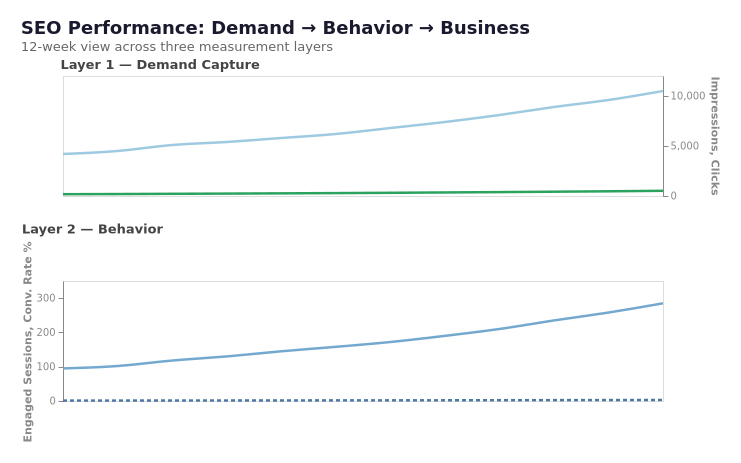
Use a weekly dashboard with three layers:
Layer 1 is demand capture: impressions, clicks, rankings for priority clusters. Layer 2 is behavior: engaged sessions, scroll depth, assisted conversions. Layer 3 is business: pipeline, revenue, or whatever your Step 1 metric was. If you can’t connect Layer 1 to Layer 3 at least directionally, you’re doing content theatre.
One experiment per week is enough. Change one variable: rewrite the intro to include an answer block, add internal links from two high-authority pages, refresh outdated stats, tighten the title to match intent. Then wait long enough to see signal. I’ve watched teams “iterate” daily and learn nothing because they never let changes settle.
Common mistakes (and how to fix them fast)
1) Treating AI like a strategy
Prompts don’t replace positioning. If your content reads like every competitor, you’ll rank like every competitor. Fix: write a one-page point of view document per hub. What do you believe that others won’t say? What do you recommend that saves time or money? Feed that into your briefs.
2) Publishing without internal link intent
I still see “related posts” widgets doing all the work. They don’t. Fix: add 3 to 5 manual contextual links from each new page to (a) the hub, (b) a commercial page, (c) one supporting article. Then add at least 2 links into the new page from older high-traffic posts.
3) Chasing low-competition keywords that never convert
It’s seductive because it feels winnable. Then you end up with traffic that bounces. Fix: require every cluster to have a “so what” line. If you can’t explain why a buyer would care, drop it or reframe it.
4) Letting AI invent facts
This is the fastest way to lose trust, and it’s painfully common. Fix: keep a small approved source list for stats and definitions. If a claim matters, cite it or remove it. For commercial pages, be even stricter.
Next steps: turn the strategy into a weekly operating rhythm
If you did the steps above, you now have something rare: a strategy that can survive a busy week. Keep it alive with a simple rhythm.
Monday: review the dashboard and pick one experiment. Tuesday: update briefs and outlines for the next two pieces. Wednesday and Thursday: write, edit, publish. Friday: internal linking pass and refresh one older page.
If you want a platform that pulls research, helps with clustering, and supports AEO-friendly content production in one place, take a look at View Vizup's pricing. Not because you need another tool, but because the “five tools and a spreadsheet” approach breaks the moment your team grows.
One last note on responsibility: AI can accelerate output, but you’re still accountable for claims, compliance, and brand promises. If you operate in regulated industries (finance, healthcare), set a formal review step for high-stakes pages and keep it consistent. Don’t improvise.
Frequently Asked Questions
How long does it take to see results from an AI-powered SEO strategy?
For most sites, you’ll see early movement (indexation, impressions, long-tail clicks) in 3 to 6 weeks, and clearer conversion impact in 8 to 12 weeks. Technical fixes and internal linking often show faster than net-new content.
Do I need to worry about Google penalizing AI content?
Worry about low-quality content, not the tool used to draft it. If AI output is generic, inaccurate, or duplicative, it tends to underperform. Human editing, real examples, and clear intent alignment are what keep it competitive.
What’s the difference between SEO and AEO in practice?
SEO is about ranking and earning clicks. AEO is about being the best source to quote and summarize, even when the user doesn’t click. Practically, that means clearer answers, stronger entity signals, and better citation hygiene.
Should small teams in India approach this differently than US teams?
The workflow is the same, but the content mix often changes. India-focused demand can skew more price-sensitive and comparison-heavy, while US demand often expects deeper proof (security, integrations, case studies). Build clusters per geography when intent differs.
Where does Vizup fit if I already use SEMrush or other tools?
Keep your existing tools if they’re working for you. Vizup tends to earn its spot when you want to connect research, clustering, briefs, content creation, and AEO optimization into one execution loop, instead of exporting data and losing context.
If you’re curious who’s behind Vizup and what they’re building toward, the About Vizup page gives the straight story.
