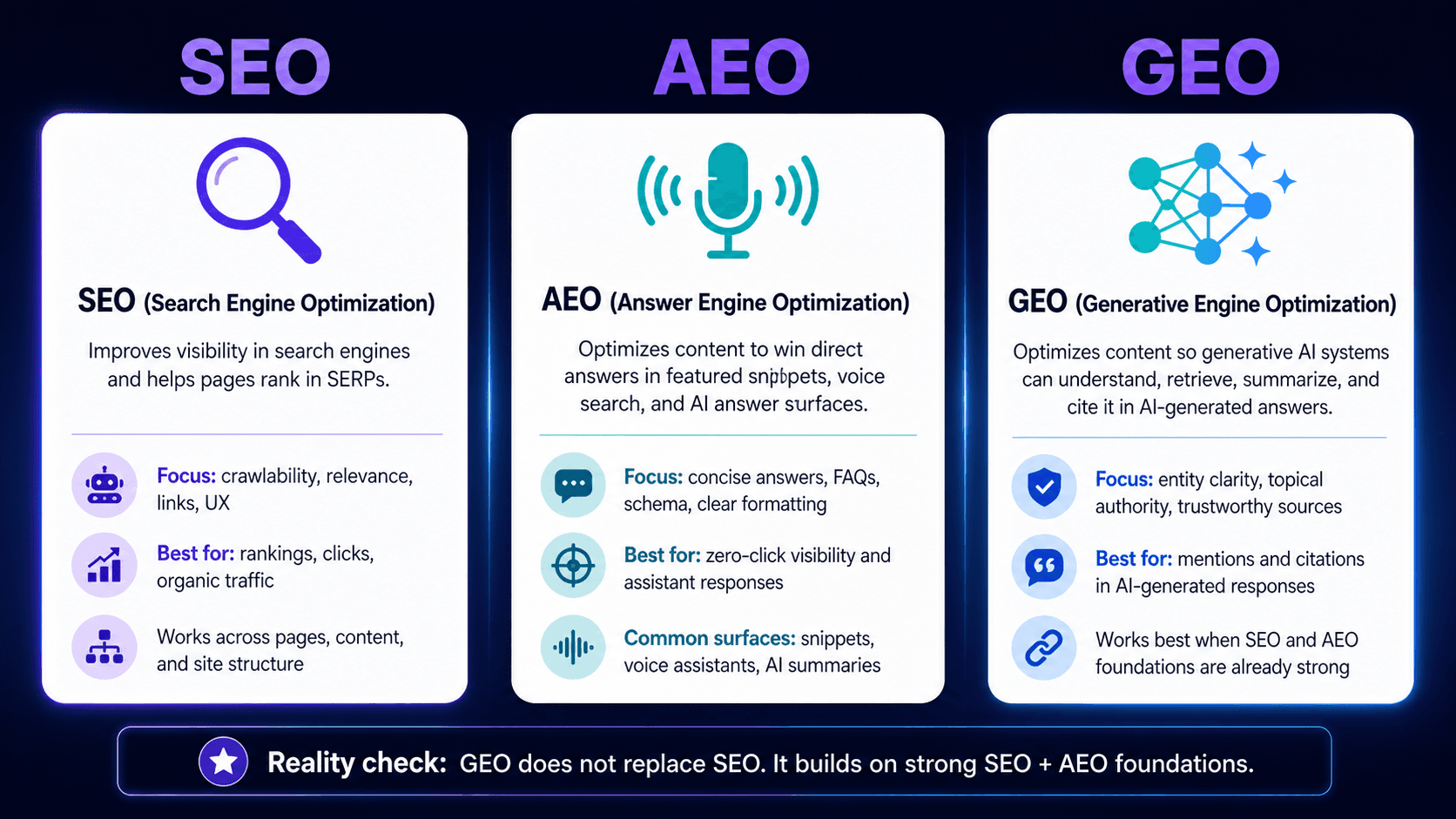
A lot of marketing teams are quietly having the same argument right now. Someone on the team read about GEO or AEO, brought it to a meeting, and now nobody's sure whether to pivot their entire content strategy or just keep doing what's always worked. The honest answer is that SEO, AEO, and GEO aren't competing philosophies. They're three layers of the same problem: getting found when someone is looking for what you offer. But they operate on completely different mechanics, reward different behaviors, and need different KPIs to measure properly.
The seo vs aeo vs geo debate has gotten louder as AI-generated answers eat into traditional click-through rates. Over 60% of Google queries are now zero-click searches, meaning the user's journey starts and ends on the results page. That stat alone should change how you think about what 'success' looks like in organic search. This article breaks down each discipline clearly, compares them across the criteria that actually matter, and tells you where to focus first.
What Each Discipline Actually Does
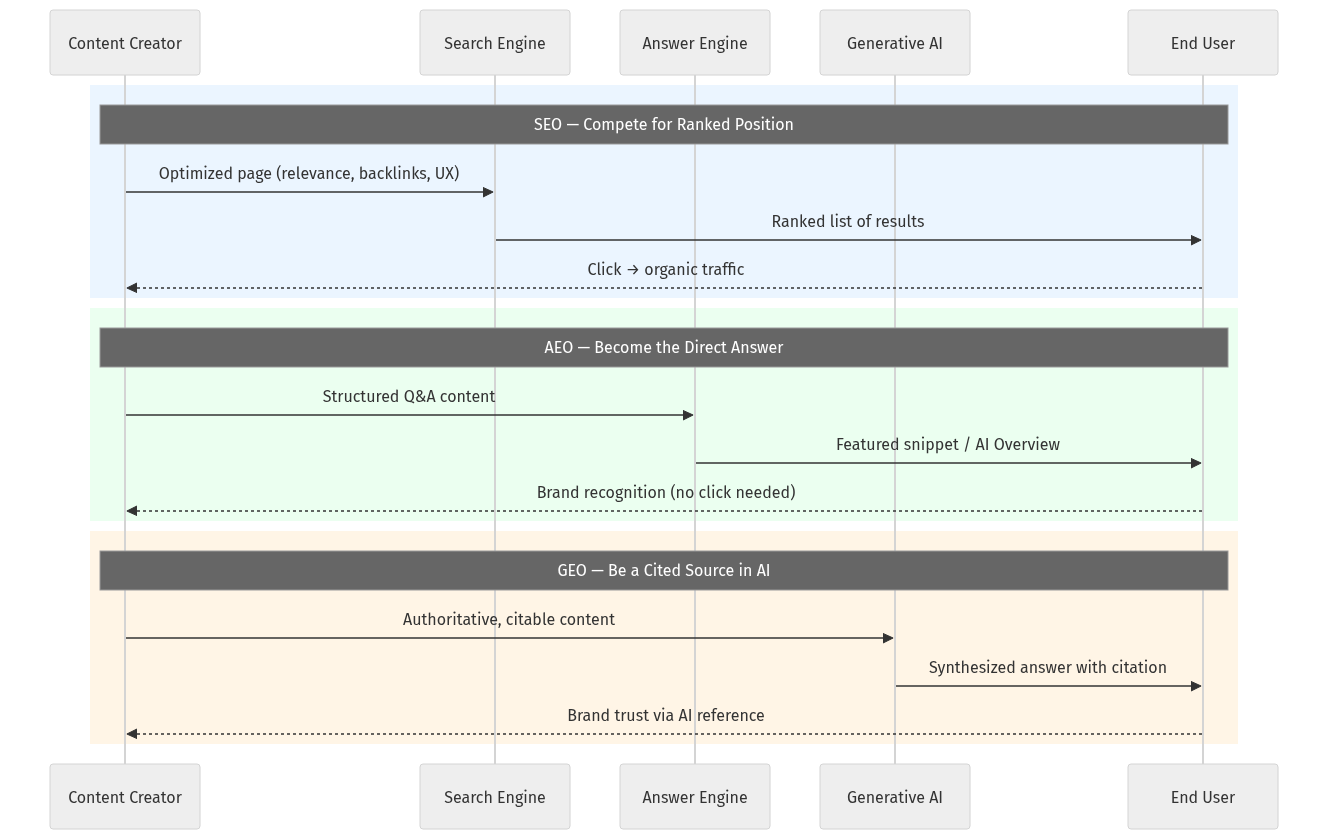
Traditional SEO is still what most people mean when they say 'organic search.' You're optimizing pages to rank in a list of results, competing for position based on relevance signals, backlink authority, technical health, and user engagement. The goal is a click. The KPI is rankings and organic traffic.
Answer Engine Optimization (AEO) targets a different outcome. Instead of competing for position in a list, you're trying to be the direct answer. Featured snippets, People Also Ask boxes, Google's AI Overviews, and voice search responses all fall under this umbrella. AEO focuses on having your content appear directly inside AI-generated answers, not just near them. The user might never click your link. But your brand answered their question.
Generative Engine Optimization (GEO) is newer and honestly still misunderstood. It's about getting your content cited or referenced inside AI platforms like ChatGPT, Perplexity, and Google's Gemini when those systems synthesize answers. You're not optimizing for a ranking position. You're optimizing to be a trusted source that AI models pull from. Typeface's breakdown of how content strategy is evolving in 2025 puts it well: GEO and AEO are sometimes used interchangeably, but GEO specifically targets generative AI platforms rather than structured answer features within traditional search.
SEO: Still the Foundation, But the Rules Have Shifted
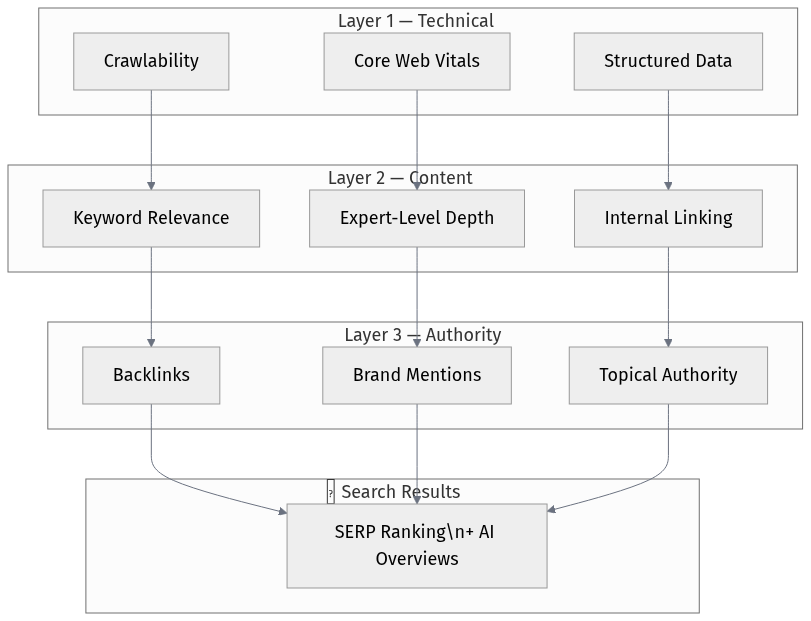
SEO hasn't died. But the version of SEO that worked in 2019 is genuinely not the same game anymore. The teams winning in organic search right now aren't publishing more. They're publishing with more depth and demonstrating real topical authority. Google's helpful content system has made thin, keyword-stuffed content actively harmful to a domain's overall performance.
The core tactics are still recognizable: technical health (crawlability, Core Web Vitals, structured data), on-page optimization (title tags, headings, internal linking), and off-page authority (backlinks, brand signals). What's changed is the weight distribution. A technically perfect page with mediocre content now underperforms a slightly imperfect page with genuinely useful, expert-level writing. That's a meaningful shift from five years ago.
The biggest gotcha with traditional SEO in 2026 is the zero-click problem. Even when you rank #1, AI Overviews and featured snippets often answer the question before the user reaches your result. When AI-generated answers appear in search results, click-through rates drop to around 8% compared to 15% when no AI summary is present. Ranking first still matters. It just delivers less traffic than it used to.
AEO: Optimizing for the Answer, Not the Click
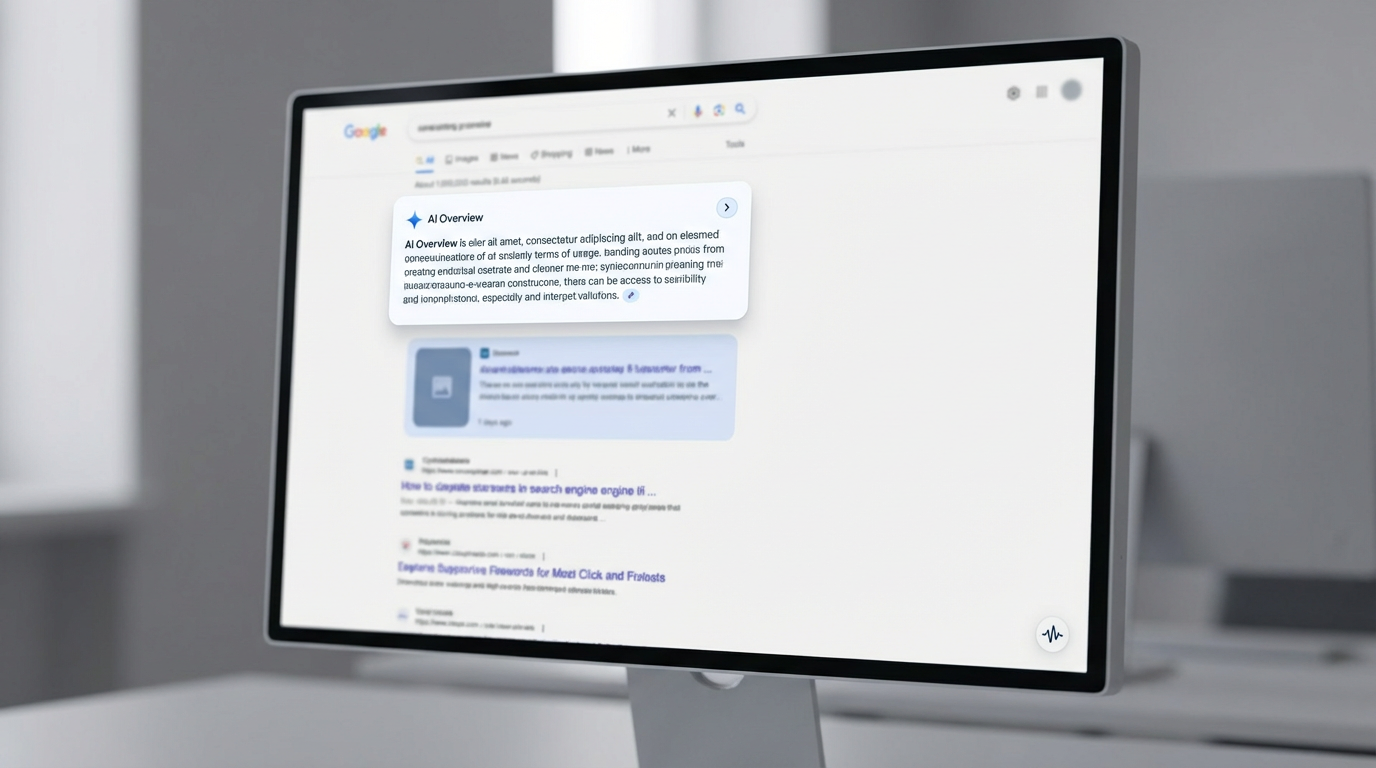
AEO requires a different mindset about what 'winning' looks like. If your content gets pulled into a featured snippet or an AI Overview, you've succeeded even if nobody clicks through to your site. That's uncomfortable for teams used to measuring success in sessions and pageviews.
The tactics here are more specific than general SEO. You're structuring content to answer questions directly and concisely, using schema markup (FAQ, HowTo, Speakable) to signal answer-worthy content to search engines, and targeting conversational, question-based queries rather than short-tail keywords. Voice search is a big part of this. 58% of consumers use voice search to find information about local businesses, and voice responses are almost always pulled from featured snippets or structured data.
One thing most guides skip: AEO isn't just about FAQ sections. The pages that consistently win featured snippets tend to have a clear, direct answer in the first 40-60 words of a section, followed by supporting detail. Google wants the answer first, then the explanation. Most content writers do it backwards.
Early adopters of AEO are seeing a growing visibility advantage as AI search becomes more common, especially on answer-driven surfaces like featured snippets and AI-generated results. That's a significant gap. And it's only going to widen as AI-assisted search becomes the default rather than the exception.
GEO: Getting Cited by AI, Not Just Ranked by Algorithms

GEO is the newest of the three and the hardest to measure. The basic premise: when someone asks ChatGPT or Perplexity a question in your industry, does your brand show up in the response? If not, you're invisible to a growing segment of searchers who never touch a traditional search engine for research queries.
The tactics that improve GEO performance are different from both SEO and AEO. You're focused on building the kind of content that AI training data and real-time retrieval systems treat as authoritative: original research, specific statistics, expert quotes, well-cited claims, and content that gets referenced by other credible sources. GEO practitioners can improve visibility in large language models by 40% or more without creating additional content, according to 2025 research. The gains come from restructuring existing content to be more citable, not from publishing more of it.
The honest limitation of GEO right now: attribution is inconsistent. Perplexity shows sources. ChatGPT sometimes does, sometimes doesn't. Measuring whether your content influenced an AI response is genuinely hard, and anyone selling you a precise GEO ROI dashboard should be viewed with some skepticism. The KPIs are still evolving.
Head-to-Head: SEO vs AEO vs GEO Across Every Key Dimension
| Dimension | SEO | AEO | GEO |
|---|---|---|---|
| Primary Goal | Rank in search results and drive clicks | Appear as the direct answer in AI/voice/snippet features | Get cited by generative AI platforms like ChatGPT and Perplexity |
| Target Platforms | Google, Bing, search engines | Google AI Overviews, voice assistants, featured snippets | ChatGPT, Perplexity, Gemini, Claude |
| Core Tactics | Technical health, backlinks, keyword optimization, content depth | Structured data, FAQ schema, question-based content, concise answers | Original research, expert authority, citable statistics, source credibility |
| Primary KPIs | Rankings, organic traffic, CTR | Featured snippet capture rate, AI Overview appearances, voice search visibility | Brand mention frequency in AI outputs, citation rate, share of AI-generated answers |
| Measurement Difficulty | Mature tooling (GSC, Ahrefs, SEMrush) | Moderate (GSC shows some data, third-party tools emerging) | Hard (no standard tooling yet, mostly manual checks) |
| Time to Results | 3-12 months typically | 4-8 weeks for quick wins with schema | Unclear; depends on AI model update cycles |
| Content Format | Long-form, keyword-optimized, internally linked | Structured Q&A, concise direct answers, schema-marked | Research-backed, data-rich, frequently cited by others |
| Best For | Sustained organic traffic growth | Zero-click brand visibility and voice search | Thought leadership and AI-era brand presence |
| Comparison based on current platform behavior as of early 2026. GEO measurement standards are still maturing. |
Which One Should You Actually Prioritize?
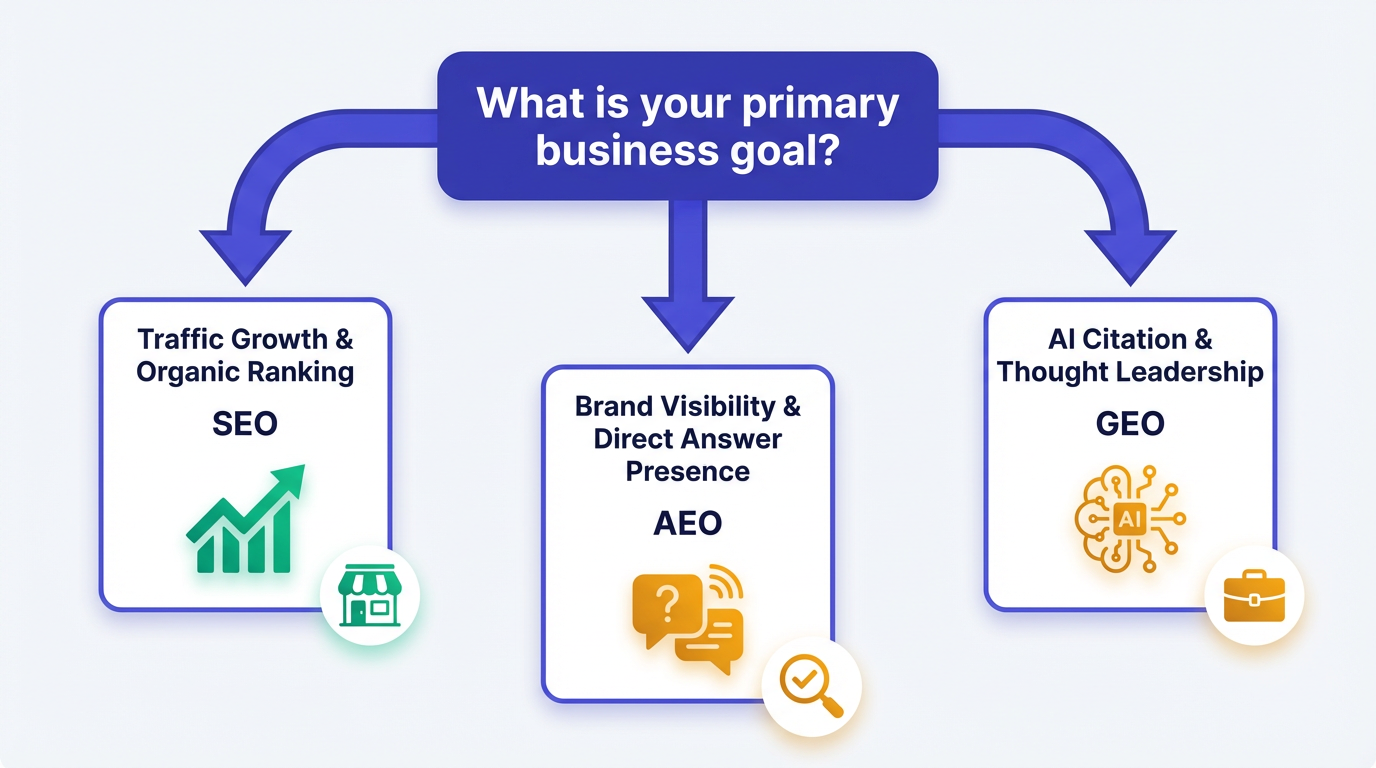
The common advice is 'you need all three.' That's technically true but practically useless for a team with limited bandwidth. Here's a more honest take.
If your site is under 50,000 monthly visitors and you're still building your organic presence, SEO is where almost all your effort should go. The fundamentals of ranking well also happen to support AEO and GEO indirectly. Well-structured, authoritative content that ranks tends to also get pulled into AI answers. You don't need a separate GEO strategy when you're still trying to get Google to index your pages correctly.
AEO becomes a priority the moment you notice that your target queries are showing AI Overviews or featured snippets. If someone searches for your core product category and Google answers the question before showing any links, you need to be inside that answer. Adding FAQ schema and restructuring your top-performing pages to lead with direct answers is a relatively quick win. Some teams see featured snippet captures within four to six weeks of making these changes.
GEO is worth investing in if you're in a space where buyers do research in ChatGPT or Perplexity before ever touching a search engine. B2B software, financial services, healthcare, and professional services are seeing this shift fastest. Publishing original data, getting cited by industry publications, and building the kind of content that other credible sources reference are the long-term plays here. It's not quick, and it's not easily measured. But the brands building this kind of authority now will have a significant advantage in two to three years.
The Overlap Nobody Talks About
Here's something that gets lost in the three-way comparison: the tactics that make content great for GEO are almost identical to what makes content great for E-E-A-T in SEO. Original research, expert attribution, specific data points, clear sourcing. You're not building three separate content strategies. You're building one content strategy that's thorough enough to perform across all three surfaces.
The real mistake is treating these as silos. Teams that create a 'GEO content calendar' separate from their 'SEO content calendar' are doubling their workload for no reason. A well-researched, properly structured article with schema markup and original data can rank in Google, appear in featured snippets, and get cited by Perplexity. That's the goal. One piece of content doing three jobs.
Where the disciplines genuinely diverge is in measurement and in the specific optimizations you layer on top of good content. That's where tools like Vizup become useful: tracking which content is performing across which surface, so you can see where the gaps are without manually checking every AI platform every week.
Frequently Asked Questions
What is the main difference between SEO, AEO, and GEO?
SEO optimizes content to rank in traditional search results and drive clicks. AEO (Answer Engine Optimization) focuses on getting your content selected as the direct answer in featured snippets, AI Overviews, and voice search responses. GEO (Generative Engine Optimization) targets visibility inside generative AI platforms like ChatGPT and Perplexity, where your content gets cited in synthesized responses. Each targets a different part of the modern search ecosystem.
Is GEO replacing SEO?
Not yet, and probably not entirely. Traditional search still drives the majority of web traffic for most industries. GEO is an emerging layer that matters more in some sectors (B2B, professional services, research-heavy purchases) than others. The smarter framing is that GEO is extending where you need to be visible, not replacing where you already are.
How do you measure AEO performance?
Google Search Console shows some data on featured snippet appearances and AI Overview impressions, though coverage is still incomplete. Third-party tools are emerging to track this more systematically. At minimum, you can manually track which of your target queries trigger AI Overviews or featured snippets, and whether your content appears in them. It's less mature than SEO measurement but improving quickly.
Do you need separate content for SEO, AEO, and GEO?
No. The most efficient approach is creating content that's thorough enough to serve all three. A well-researched article with proper schema markup, direct answers to common questions, original data, and clear expert attribution can rank in search, appear in featured snippets, and get cited by AI platforms. The specific optimizations differ, but the underlying content quality requirement is the same.
Which should a small marketing team focus on first?
Start with SEO. Getting the technical foundation right and building genuine topical authority creates the conditions for AEO and GEO success naturally. Once you're seeing consistent organic traffic, layer in AEO tactics (FAQ schema, direct-answer formatting) for your highest-traffic pages. GEO becomes worth dedicated effort once you have a body of authoritative content and you're in a sector where AI-assisted research is common among your buyers.
The Verdict
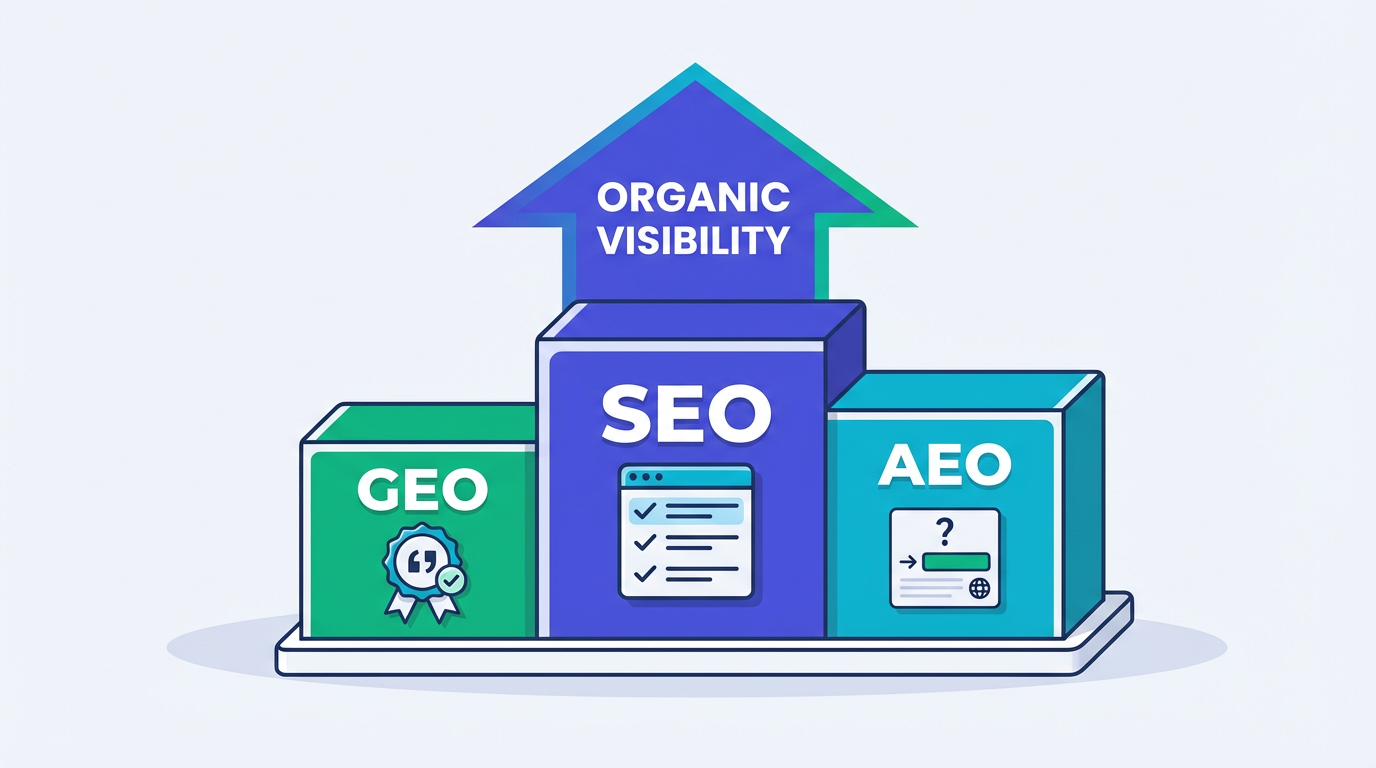
SEO vs AEO vs GEO isn't a competition. But if you're forced to rank them by where to put your energy first, SEO still wins for most teams in 2026. It's the most measurable, has the most mature tooling, and the fundamentals directly support performance in AEO and GEO. AEO is a high-leverage add-on once your core SEO is solid, particularly for brands competing in query spaces dominated by AI Overviews. GEO is a long game worth starting now if you're in a research-heavy industry, but don't let it distract you from the basics.
The brands that will win organic visibility over the next three years aren't the ones who pick one discipline and ignore the others. They're the ones building content that's authoritative enough to rank, structured enough to be selected as an answer, and credible enough to be cited by AI. That's a higher bar than it used to be. But it's also a cleaner brief than chasing algorithm updates every six months.
