
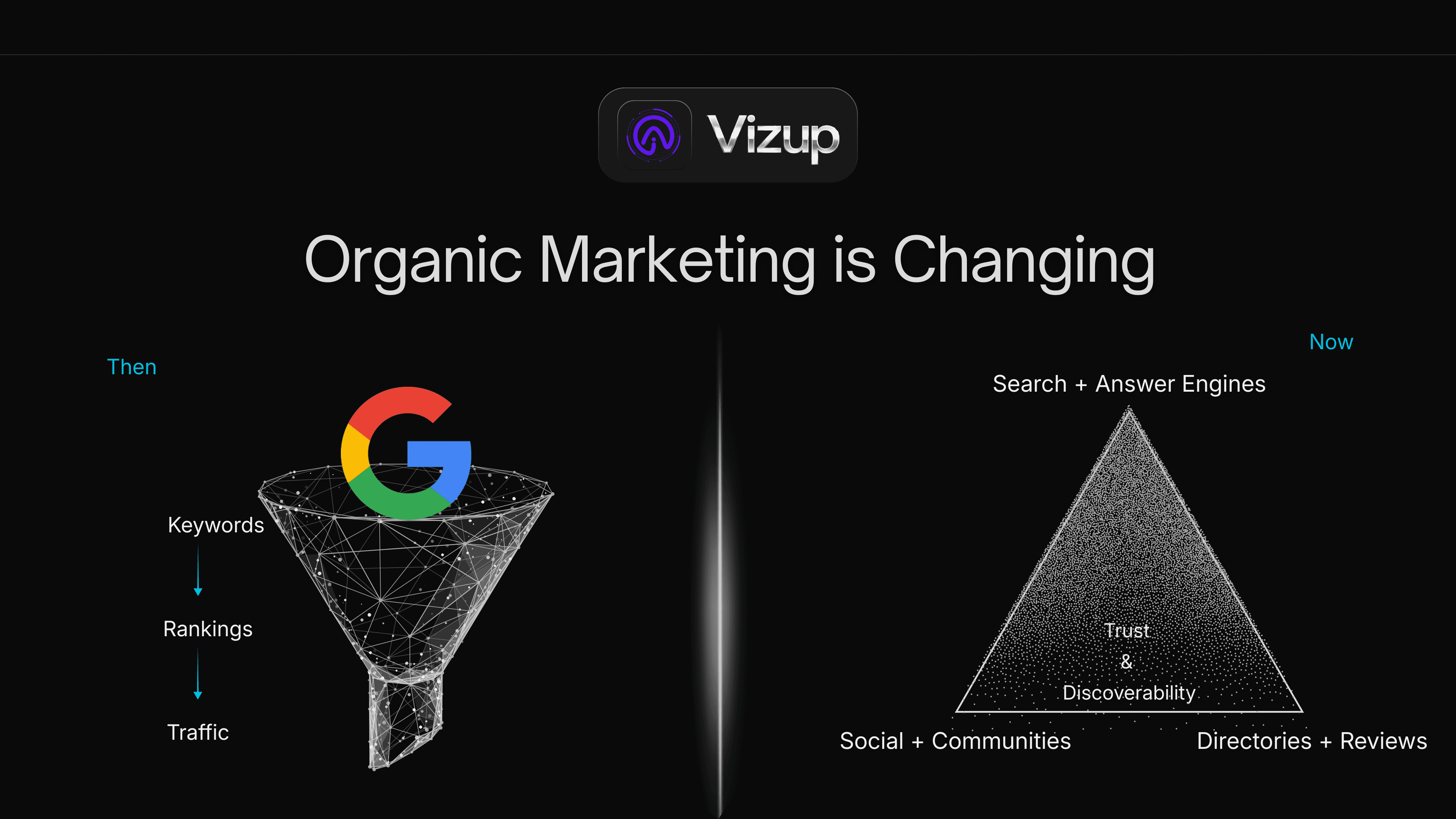
The Math Has Changed. Organic Marketing Is No Longer Just SEO.
If your organic marketing strategy in 2026 is still just an SEO program, you're running a 2019 playbook. Organic marketing now spans AEO, community-led growth, owned audiences, and zero-click ecosystems. The companies treating it as 'just SEO' are watching their CAC climb quarter over quarter, and they can't figure out why.
The stakes are straightforward. Customer acquisition costs have increased roughly 60% over the past five years across B2B and B2C. ROAS on paid ads is declining structurally, not cyclically. And the old escape hatch, 'just invest more in SEO,' no longer works because Google itself is changing what organic visibility means.
We build an AI-powered organic marketing platform at Vizup. We see the data across hundreds of growth-stage companies. This isn't speculation. It's pattern recognition.
The Paid Ads Squeeze Is Structural, Not Cyclical
Meta CPMs are up 30%+ since 2023. Google Ads CPC in competitive B2B verticals now runs $15 to $45. The median CAC ratio hit $2.00 in 2024, meaning companies spent two dollars in sales and marketing to acquire one dollar of new ARR (HubSpot, 2026). This isn't a blip. It's platform maturation and auction saturation compounding year after year.
Here's the pattern I keep seeing: a growth-stage SaaS company spending $80K/month on paid, watching CAC rise from $120 to $210 in 18 months, then pivoting to 'SEO' and expecting the same immediacy. That expectation mismatch is where strategies die. The reflexive move is to 'double down on organic,' but most teams interpret that as 'double down on SEO.' That's only one piece of a much larger puzzle.
SEO in 2026 Is a Subset, Not a Strategy
This is the core argument. Google's AI Overviews now answer a significant share of informational queries without a click. The traditional SEO funnel (rank, get click, convert) has a leak at the top that's getting bigger every quarter. According to Conductor's 2026 CMO Investment Report, 94% of CMOs plan to increase their AEO/GEO investments this year. That's not a fringe bet. That's the mainstream catching up.
AEO (Answer Engine Optimization) is the evolution: optimizing for AI-generated answers, LLM citations, and conversational search (MagnaWiz, 2025). Companies that only optimize for blue links are optimizing for a shrinking surface area. The distinction matters because it shapes where teams invest:
- SEO = optimizing for search engine rankings on Google/Bing.
- Organic marketing = building sustainable, non-paid acquisition across search, social, community, AI answer engines, and owned channels.
- AEO = ensuring your brand and content appear in AI-generated answers, voice search, and zero-click results.
The vocabulary isn't pedantic. It determines budget allocation. If your CMO hears 'organic' and thinks 'SEO,' your LinkedIn program, your community investment, and your AEO work are all fighting for scraps.
What the Best Growth Teams Are Actually Doing
Across the growth-stage companies we work with, three patterns keep showing up among the teams that are winning organic in 2026.
First, they're building topical authority across platforms, not just Google. LinkedIn organic, YouTube, Reddit, niche Slack communities. A single LinkedIn post that gets 50K impressions and drives 12 demo requests doesn't show up in your SEO dashboard at all. But it's organic. And it's working. Understanding why visibility matters more than clicks is the first mental shift.
Second, they're investing in AEO and structured data so their brand shows up in AI-generated answers. This means schema markup, concise answer-format content, and deliberate efforts to get cited in LLM training corpora. ArcInterMedia's 2026 guide on SEO vs AEO vs GEO lays out the technical playbook well.
Third, they're treating content as a product, not a traffic play. Newsletters, free tools, templates that build owned audiences. The goal isn't pageviews. It's building an audience you don't rent from Google or Meta.
Contrast that with what most teams do: publish 8 blog posts a month targeting keywords, check DA, wait. That's not organic marketing. That's content production with SEO seasoning.
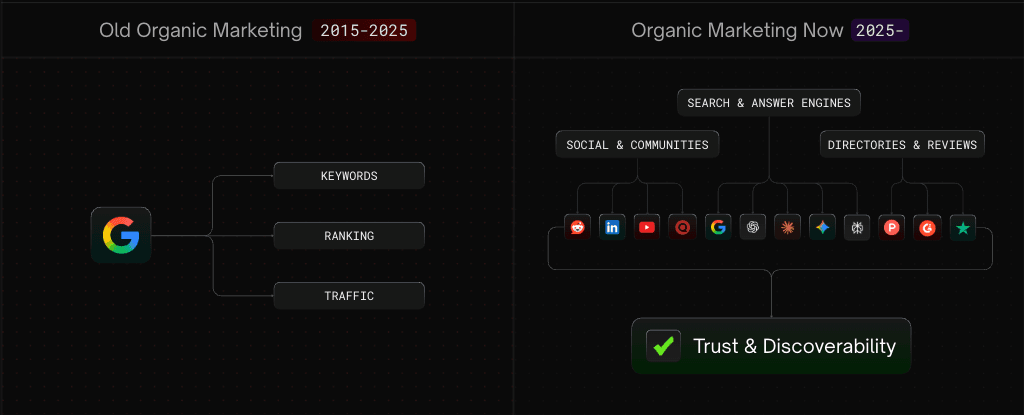
Not all organic channels carry the same risk or reward profile.
'But SEO Still Drives the Most Organic Traffic'
Fair point. In 2025, 53% of all website traffic still came from organic search (HubSpot, 2026). No serious person is saying abandon SEO. I'm not saying that.
But traffic ≠ pipeline. Zero-click searches mean your 'organic traffic' numbers may look fine while actual lead flow from search declines. Meanwhile, the LinkedIn post, the Reddit thread, the newsletter referral, none of that shows up in your SEO dashboard. Growth teams that only measure organic through an SEO lens are flying partially blind.
The argument isn't that SEO is dead. It's that SEO alone is an increasingly fragile foundation. One algorithm update, one expansion of AI Overviews, and your traffic cliff is real. A diversified organic portfolio absorbs those shocks.
The Speed Problem, and Why AI Changes the Equation
The biggest objection I hear from CMOs: organic marketing is slow. Historically, that's been true. A content-led organic strategy could take 6 to 12 months to show meaningful results. For growth-stage companies with board pressure, that timeline feels unacceptable.
AI-powered platforms are compressing that timeline. Not by gaming algorithms, but by eliminating the wasted time: manual keyword research, guesswork on content angles, slow iteration cycles, inconsistent distribution. At Vizup, we see teams go from idea to multi-channel execution in days instead of weeks. The compounding still happens (organic doesn't skip that step), but you start compounding sooner and across more surfaces.
Honest aside: AI doesn't make organic instant. Anyone promising that is selling you something. What it does is remove the friction that made organic feel impossibly slow for lean teams. That's a real difference.
Organic Marketing in 2026 Is a Portfolio, Not a Channel
Organic marketing has outgrown SEO. The companies that will win the next three years are the ones treating organic as a diversified portfolio: search, social, community, AI answer engines, owned audiences. Not a single-channel bet on Google rankings.
The paid ads squeeze isn't reversing. AI is reshaping search. The window to build a real organic engine is now. The teams that move first will have compounding advantages that are nearly impossible to catch later.
FAQ
What is the difference between organic marketing and SEO?
SEO focuses specifically on optimizing for search engine rankings. Organic marketing is the broader category: any non-paid acquisition channel, including search, social, community, email, AEO, and owned audiences. SEO is a subset of organic marketing, not a synonym for it.
What is AEO (Answer Engine Optimization) and why does it matter in 2026?
AEO is the practice of optimizing your content to appear in AI-generated answers, voice search results, and zero-click experiences. With Google's AI Overviews and tools like ChatGPT answering queries directly, AEO is becoming essential for brands that want to stay visible where users actually get their answers.
Why is CAC increasing for paid ads in B2B SaaS?
Platform maturation and auction saturation are the primary drivers. More advertisers competing for the same inventory pushes costs up. Privacy changes have also reduced targeting precision, making each dollar less efficient. This is structural, not a temporary fluctuation.
How can AI tools speed up organic marketing results?
AI tools compress the execution timeline by automating research, content production, distribution optimization, and AEO structuring. They don't skip the compounding phase that organic requires, but they eliminate weeks of manual work so teams start compounding sooner across more channels.
Is SEO dead in 2026?
No. SEO still drives over half of all website traffic. But SEO alone is a fragile foundation. Zero-click searches are growing, AI Overviews are expanding, and relying solely on Google rankings exposes you to significant platform risk. The smart move is treating SEO as one channel within a broader organic portfolio.
