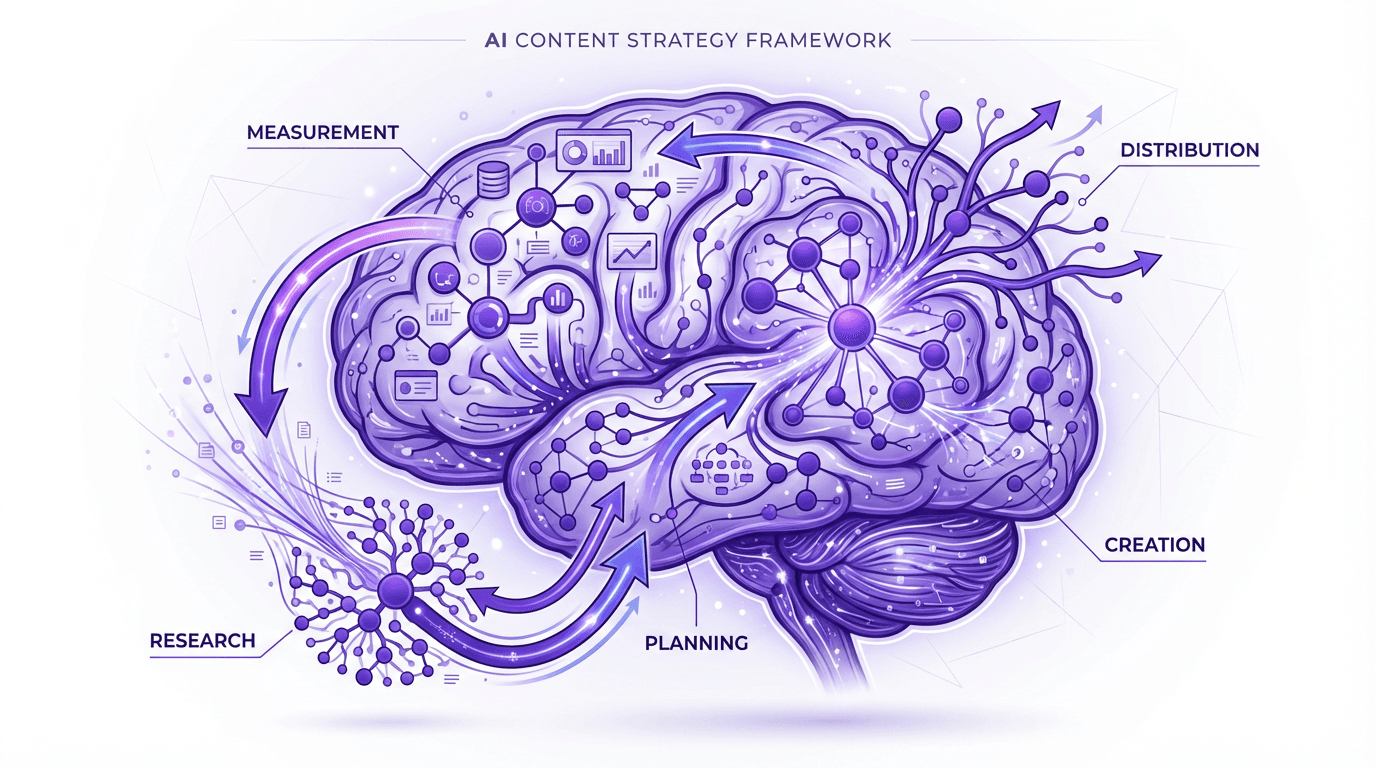
If you tried "AI for content" and ended up with 30 posts that read like the same polite intern wrote them, you're in familiar company. Most teams don't stumble because the model is unusable. They stumble because nobody wrapped it in a system, so there's no point of view, no prioritization, and no clear owner for what ships.
An AI content strategy framework is that system. It’s the operating layer that decides what to publish, why it matters, how it gets produced, and how it improves over time. By 2026, the conversation has moved past "should we use AI?" to "how do we build a repeatable, scalable loop around it?" The strongest AI Content Strategy Frameworks treat AI as a workflow multiplier, not a substitute for editorial judgment, and they’re built to hold up in AI search, not just pump out volume.
What AI Content Strategy Frameworks Actually Are (and Aren't)
A framework isn't just a subscription to an AI writer or a folder of prompts for content briefs. Those are components. The framework is the decision-making architecture governing the entire content lifecycle. It connects your people, tools, and business goals, then forces the handoffs to be clean: research turns into briefs, briefs turn into drafts, drafts turn into publishable assets, and performance turns into the next set of decisions.
It also isn't a permission slip to publish raw AI drafts. I've watched teams try the "full automation" fantasy, and the pattern is always the same: output goes up, differentiation disappears, and the content library starts cannibalizing itself. A framework is the guardrail that keeps AI serving the strategy, not the other way around.
These concepts aren't entirely new. Foundational models for organizing content have been around for years. The difference now is that modern AI frameworks add predictive and generative layers to that foundation, turning a static plan into a responsive system that can spot gaps, prioritize updates, and keep learning.
Why AI Content Frameworks Matter More in 2026 Than They Did in 2024
Two years ago, using AI felt like a competitive edge. In 2026, using it without a system is a liability. Google's core updates through 2025 and into 2026 have made it painfully clear that low-quality, scaled AI content is a problem, not a shortcut. Search engines have gotten much better at sniffing out pages that say the right things while adding nothing new, and readers bounce even faster.
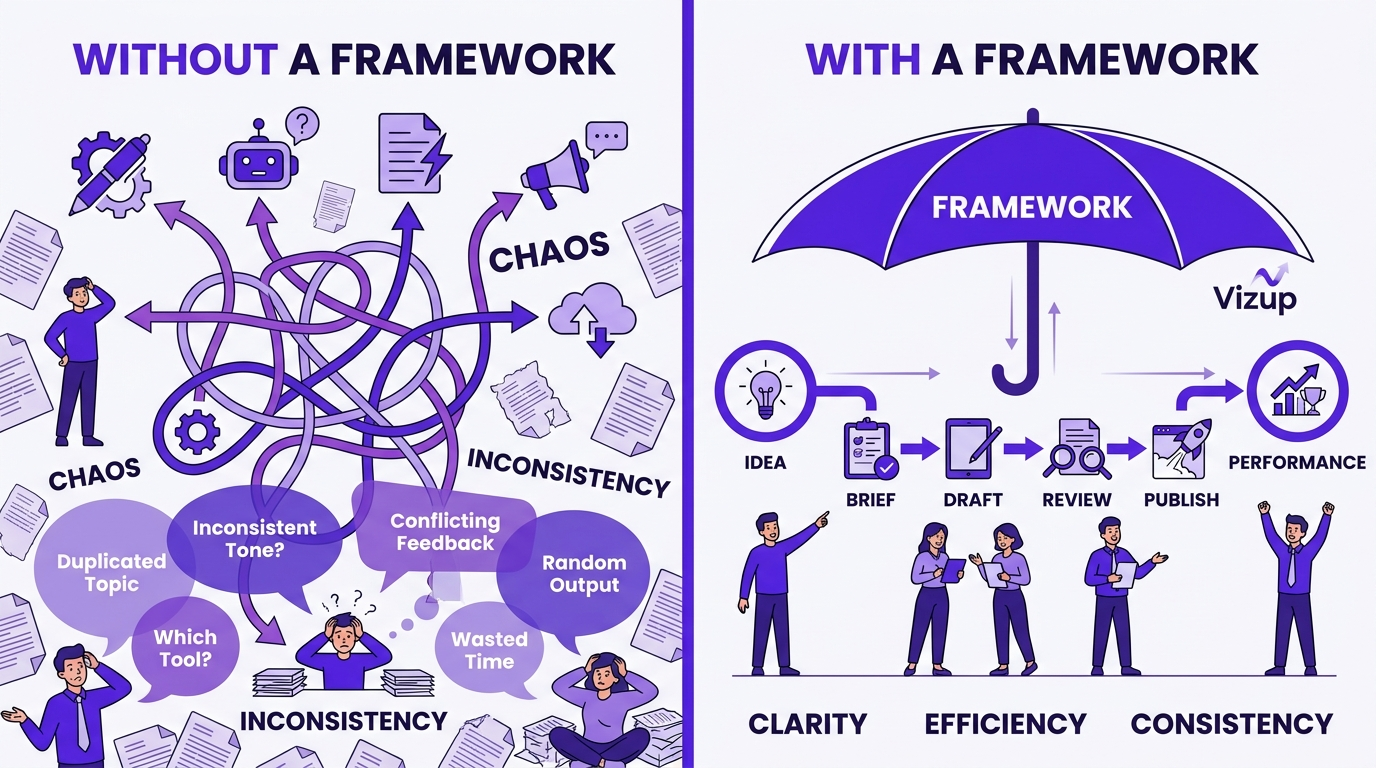
Then there's the operational pressure. Teams are expected to produce more content across more channels, but headcount isn't keeping pace. Some reports suggest AI can cut production time by up to 45%, while other findings show that for nearly half of users, it makes them slower or results in no change. The gains are not automatic and get messy without shared standards. When different team members use disconnected tools for outlines, social posts, and briefs, the result is predictable: inconsistent tone, duplicated topics, and performance data that never rolls up into a clear learning loop.
How AI Content Strategy Frameworks Work: The Core Mechanics
A functional framework isn't a single item. It's a set of connected layers with clear handoffs, plus a feedback loop that forces the system to improve. Skip measurement and you get "vibes with a dashboard." Skip research and you get faster mediocrity. Skip governance and you get risk at scale.
Layer 1: AI-Driven Research and Topic Intelligence
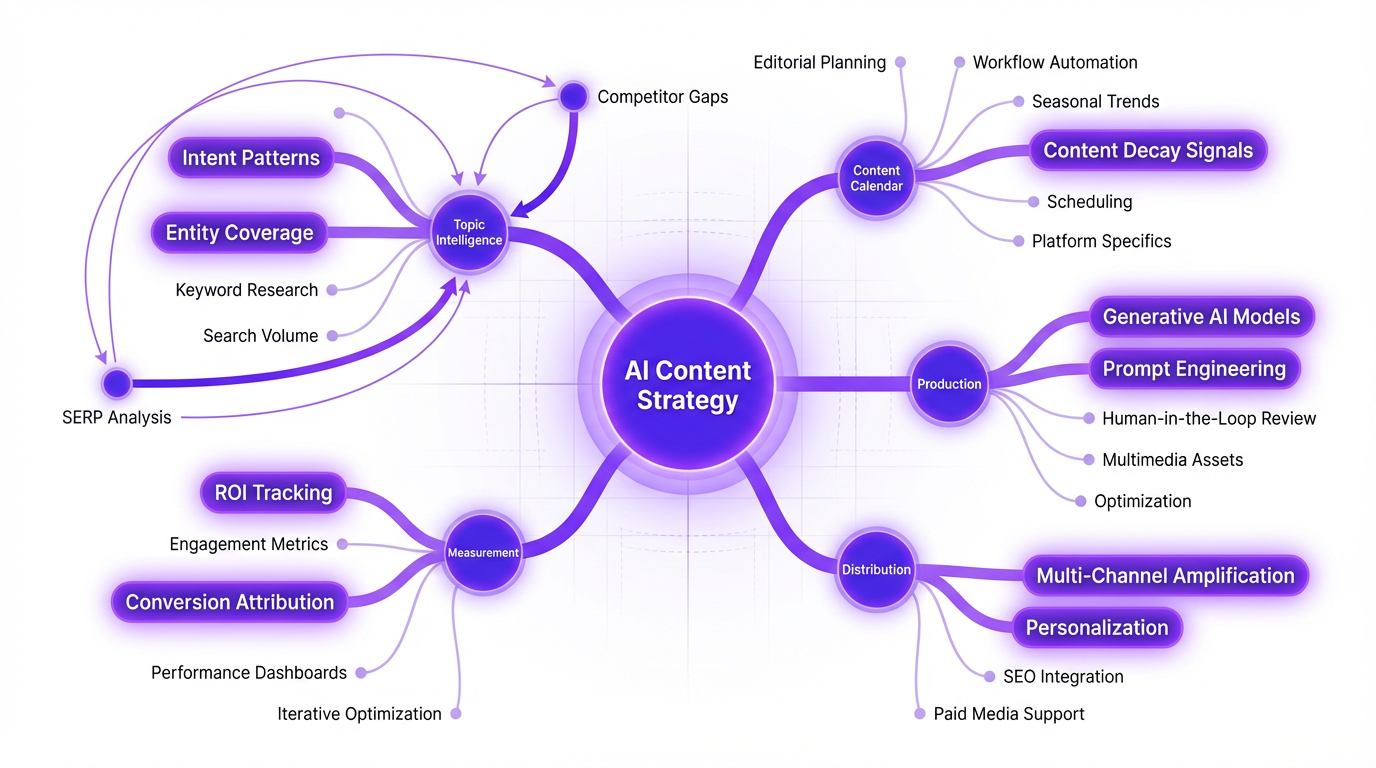
The old method was a giant spreadsheet of keywords sorted by search volume, which is a weak foundation for a strategy. In 2026, the useful unit isn't the keyword, it's the topic system: intent patterns, entity coverage, and the gaps your competitors accidentally left open. AI tools earn their keep here by clustering queries, mapping SERP intent, and spotting content overlap before you publish your third near-duplicate post.
Layer 2: Content Calendars Powered by AI
A calendar that matters is the one your team can execute for 90 days without burning out, and that still makes sense when priorities shift mid-quarter. Move beyond the static project board that gets updated once a quarter. AI-powered calendars behave more like planning engines: they ingest seasonality, competitor publishing cadence, content decay signals, and team capacity to recommend not just what to publish, but when. Vizup's content planning features help turn your calendar into a dynamic engine for growth.
Layer 3: AI for Content Creation and Production
Most teams start here and then wonder why everything sounds the same. The fix is boring, but it works: treat the brief like a product spec. If the brief is vague, the AI draft will be confident nonsense. Within an AI content strategy framework, AI-driven content creation is constrained by the topic brief (Layer 1), your editorial standards, and a clear division of labor. AI can outline, draft sections, produce variants, and repurpose assets. Humans still own the angle, the proof, the examples, and the final voice.
Layer 4: Distribution and Amplification
This layer is underbuilt in most strategies. Teams publish a solid article, post it to social media once, and move on. An AI-powered distribution layer looks at historical engagement to suggest channels, posting times, and format variants. It can turn one long-form post into email snippets, a carousel outline, and a social thread that doesn't feel like a chopped-up blog intro. The real win is coordination. If sales never sees the work, you're leaving money on the table.
Layer 5: Measurement, Learning, and Feedback Loops
Measurement is the part that turns content into an asset. AI analytics tools can flag decay (rank drops, CTR drops, competitor leapfrogs), identify which clusters are gaining traction, and surface cannibalization patterns you won't notice by eyeballing a dashboard. That data shouldn't sit in a report. Feed it back into Research (Layer 1) and Planning (Layer 2), then make the hard calls: refresh winners, merge overlaps, and retire pages that confuse readers or search engines.
The Four AI Content Frameworks Worth Knowing in 2026
Not all frameworks are created equal. The right choice depends on your team size, industry, and what you're willing to standardize. One contrarian take before the list: if your framework doesn't include retiring content, it's not a strategy, it's a backlog.
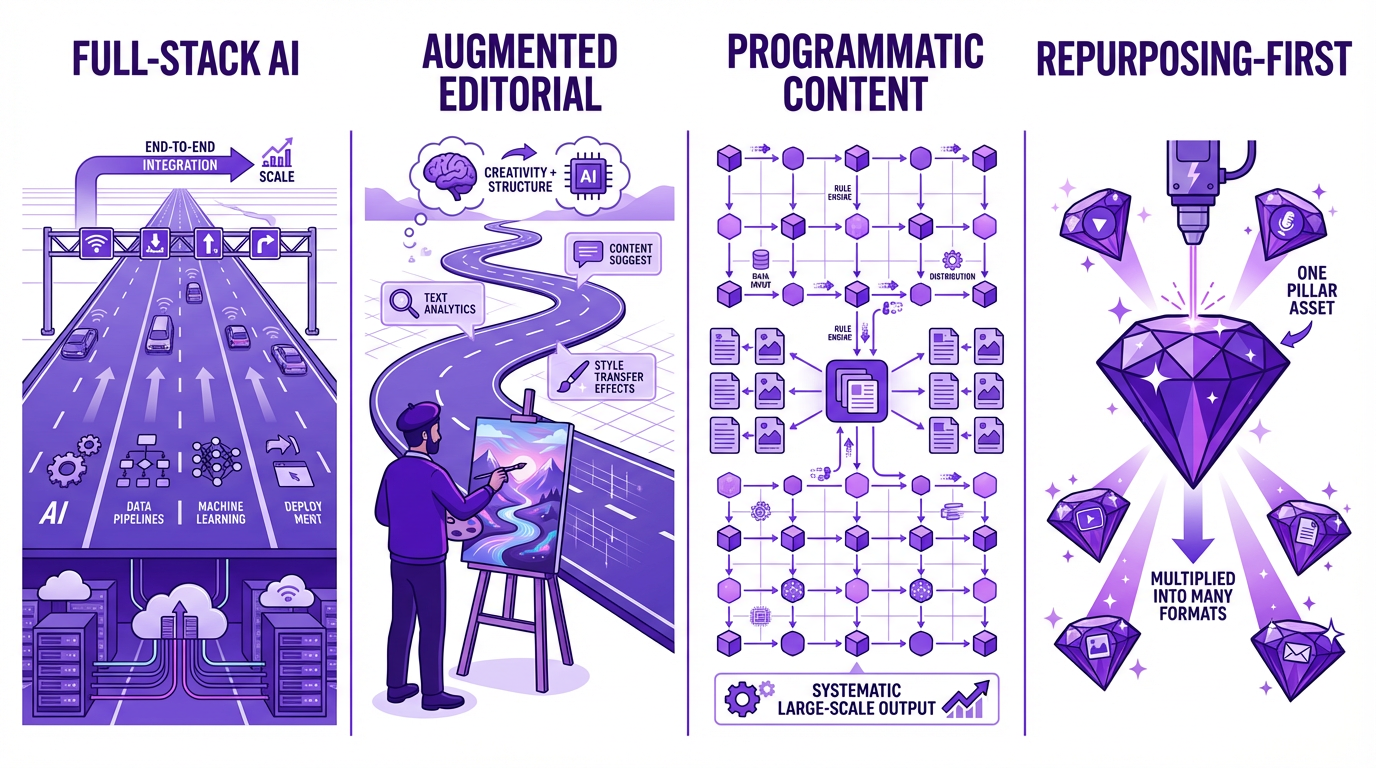
- The Full-Stack AI Framework: End-to-end, integrating all five layers, often within a unified platform like Vizup. It fits mature teams (usually 3+ content roles) that want AI to handle tactical execution while humans own strategy, original insight, and creative direction.
- The Augmented Editorial Framework: Common in brand-sensitive or regulated industries like finance and healthcare. AI supports research, outlining, and gap checks, but humans write and approve the final content. Editorial review is the point, not an afterthought.
- The Programmatic Content Framework: Built for e-commerce, travel, and any business with a massive keyword footprint. AI generates large sets of data-driven pages (for example, "best hotels in [city]" or "[product] vs [competitor]"). Humans focus on templates, QA, and keeping the system honest.
- The Repurposing-First Framework: A practical choice for small teams. Start with one high-effort pillar asset (webinar, report, deep guide), then slice it into derivatives. Content repurposing prompts help keep the central claim intact while you spin out formats.
| Framework Type | Best For | AI Dependency | Team Size | Example Tools |
|---|---|---|---|---|
| Full-Stack AI | Mature content teams aiming for scale and efficiency. | High | 3+ People | Vizup |
| Augmented Editorial | Brand-sensitive industries, high-end creative work. | Medium | 2-10 People | Vizup, Internal Tools |
| Programmatic Content | E-commerce, marketplaces, large-scale SEO plays. | Very High | 1-5 People (Tech-heavy) | Vizup, Custom Scripts |
| Repurposing-First | Solo marketers, small teams, budget constraints. | Medium-High | 1-2 People | Vizup |
| Choose a framework that matches your team's resources and goals. |
Tools That Power These Frameworks: A 2026 Landscape Snapshot
Tool stacks go sideways fast. I've seen teams with seven AI subscriptions and exactly zero agreement on what "done" means. A cleaner approach is to think by workflow job, then map tools to the five layers: one system of record, one writing engine, one quality gate, and one measurement layer. Everything else is optional, and most of it is duplication.
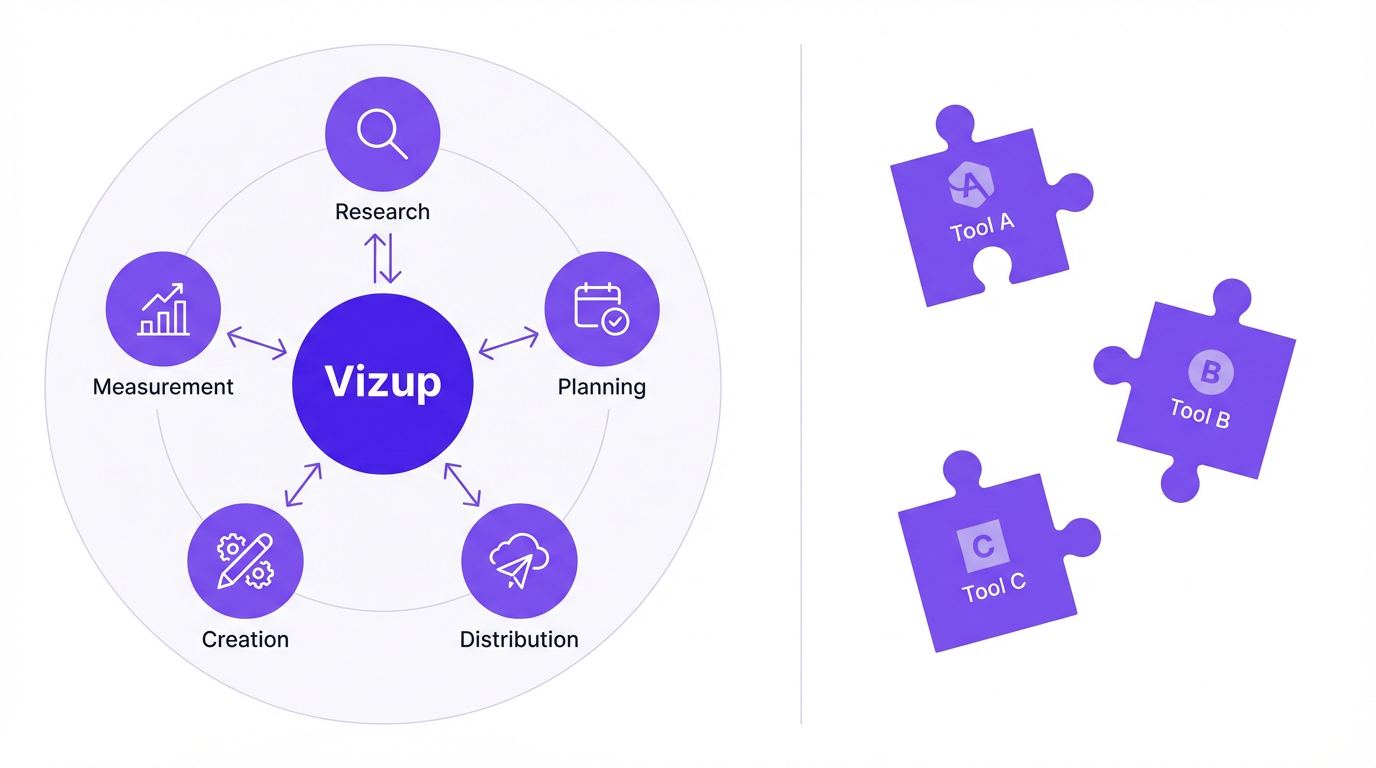
Many specialized tools exist for individual layers of the framework, such as research, creation, or distribution. The stitching problem is real though. Exporting, importing, and context-switching breaks the feedback loop and makes performance learning slow. This is why integrated platforms are gaining ground. Vizup is built to connect research, creation, and measurement tightly, so your topic decisions and your performance data actually talk to each other. This unified approach, detailed in our features, avoids the fragmentation common with point solutions that only handle slices of the workflow, like automation or visibility.
Three Things People Get Wrong About Automating Content Strategy
I hear the same misconceptions frequently. They're understandable, and they're also expensive.
- Misconception 1: "AI content strategy means firing your writers." The opposite is true. The best frameworks increase human leverage. AI takes the repetitive parts, your writers do the parts that actually differentiate you: original thought, customer nuance, product reality, and a voice you can stand behind. Your best writer shouldn't spend four hours researching SERPs for a brief, they should be interviewing a customer for a case study.
- Misconception 2: "You need an enterprise budget for this." False. A solo marketer with a clear Repurposing-First framework and a single platform like Vizup can outperform a five-person team using ad hoc tools and no coherent strategy. The system matters more than headcount.
- Misconception 3: "AI content will always get penalized by Google." Google penalizes low-quality content, regardless of its author. According to Google's own guidance, their focus is on rewarding original, high-quality content that demonstrates expertise, experience, authoritativeness, and trustworthiness (E-E-A-T), not on how it's produced. Hasty, unedited AI content is almost always low-quality. AI-assisted content produced with quality gates, human oversight, and real examples can perform extremely well. An AI content checker helps catch the obvious issues, but it won't replace an editor who knows what "useful" feels like.
Key Takeaways
AI Content Strategy Frameworks work when they behave like a closed loop, not a one-way publishing conveyor belt. The five layers (Research, Planning, Creation, Distribution, and Measurement) only matter because the feedback loop connects them. In 2026, shipping words is cheap. Differentiation still costs effort, and it comes from proof, specificity, and a point of view your audience can recognize. Pick a framework that matches your team, then choose tools that keep handoffs clean. Integrated platforms like Vizup reduce the "duct tape" work by connecting research, creation, and measurement, which makes refresh decisions faster and less political.
Frequently Asked Questions About AI Content Strategy Frameworks
What is an AI content strategy framework and how is it different from a regular content strategy?
A regular content strategy outlines what you'll create and for whom. An AI content strategy framework is a repeatable system that embeds AI into the full lifecycle, topic research, planning, creation, distribution, and performance learning, so the workflow improves over time instead of producing disconnected drafts.
What are the best AI tools for building a content strategy in 2026?
The most effective approach is the one that matches your workflow. If you want fewer handoffs, an integrated platform that covers multiple layers is usually simpler. Vizup combines research, creation, and analytics. For teams that prefer a custom stack, the key is ensuring measurement data from your analytics tools feeds back into your content planning process and prioritization.
Can small teams or solo marketers implement an AI content framework effectively?
Yes. Small teams often benefit the most because a framework prevents wasted effort. A solo marketer using the Repurposing-First framework can triple output by anchoring on one pillar asset per week, then repurposing it across channels. With a platform like Vizup, one person can run a workflow that used to require multiple tools and a larger team.
How do AI content calendars differ from traditional editorial calendars?
A traditional calendar is a static schedule. An AI-powered calendar is a planning engine that uses signals like seasonality, content decay, and competitor cadence to recommend what to publish and when. The practical difference is re-prioritization: the calendar changes based on performance, instead of becoming a quarterly artifact nobody trusts.
Does using AI for content creation hurt SEO rankings?
Using AI doesn't hurt rankings by itself. Publishing low-quality, generic, or inaccurate content hurts rankings, whether a human or AI wrote it. AI-assisted content created with strong briefs, real examples, and human editorial oversight can rank well because it meets the same standard search engines reward: usefulness and differentiation.
How often should you refresh AI-assisted content in 2026?
Refresh cadence should follow signals, not a fixed schedule. In practice, teams that monitor decay (CTR drops, rank drops, competitor leapfrogs, or internal cannibalization) tend to review top pages monthly and refresh priority clusters quarterly, then retire or merge pages that overlap.
What should be in an AI content brief to avoid generic output?
A useful brief includes a clear search intent call, the unique angle you want to own, 3 to 5 proof points or examples you will include, the entities and subtopics that must be covered, and a short "do not say" list (claims you can't support, vague filler, and off-brand phrasing).
What metrics matter most for AI Content Strategy Frameworks?
Start with cluster-level outcomes, not single-post vanity metrics. Track organic visibility and conversions by topic cluster, content decay signals (rank and CTR trend), cannibalization, and the percentage of pages updated or consolidated each quarter. Those metrics tell you whether the framework is learning.
