Bruce Clay, widely known as the father of SEO, has passed away. Bruce Clay, Inc. announced his passing on June 26, 2026**. **For the people who knew him, the loss is personal. For everyone else who has ever tweaked a title tag, rebuilt a navigation, or fought for the value of organic search in a meeting, it is still a loss. He helped pour the concrete we have all been walking on.
Right now, the industry is fixated on AI Overviews, answer engines, and the usual algorithmic whiplash. In that mood, it is easy to wave away SEO's early history as trivia. It is not. The principles Bruce Clay pushed hardest (structure, ethics, education) are not nostalgia; they are the reason this work became a discipline instead of a hustle. And as builders of tools meant to bring some clarity to digital presence, we at Vizup feel a particular obligation to honor one of the original architects. This is our tribute.
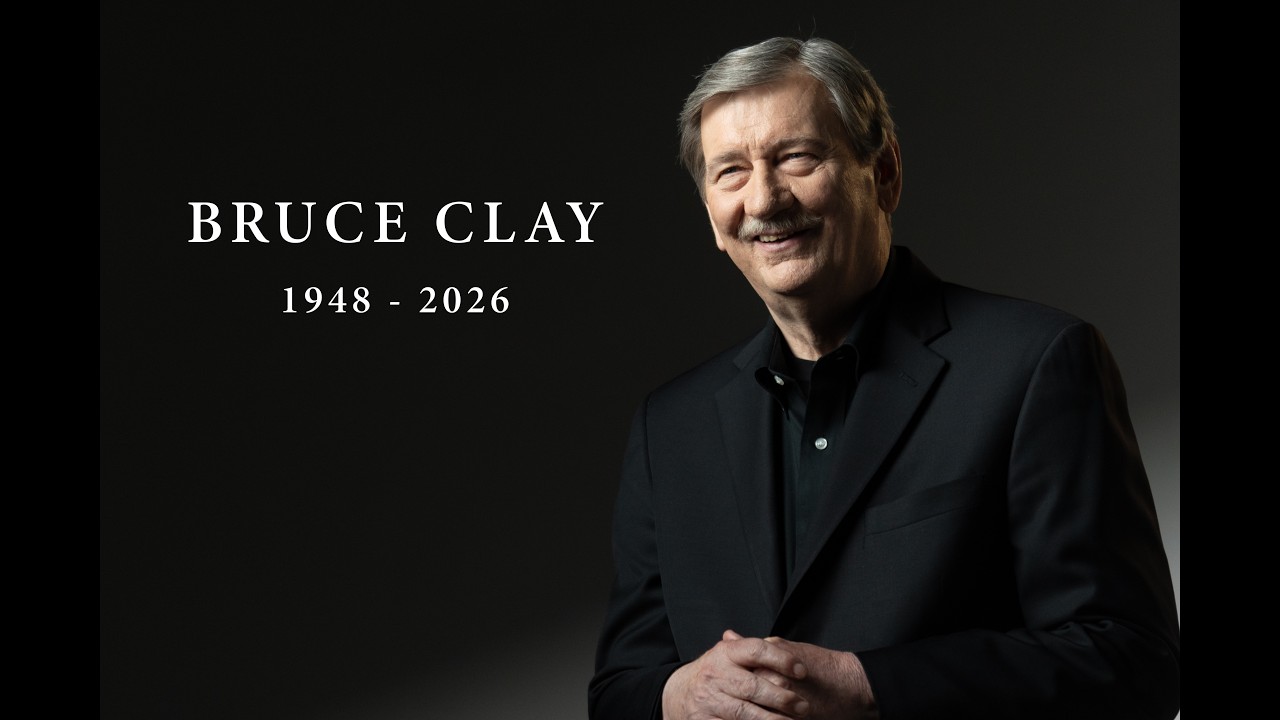
More Than a Name: The Man Who Defined a Discipline
People still argue about who coined "SEO." The record is clearer on the parts that matter: Bruce Clay founded Bruce Clay, Inc. in January 1996, and Search Engine Land described Bruce Clay as the "Father of SEO" and one of the founding figures of the SEO industry. Still, treating his legacy as a footnote about terminology misses what he actually changed.
The mid-1990s web was a free-for-all. Standards were thin, best practices barely existed, and professional norms were mostly wishful thinking. Meta keyword stuffing was routine. Hidden text was everywhere. People working on search visibility were often indistinguishable from spammers because, in plenty of cases, they were spammers. Clay did more than label a practice. He gave it a conscience. He wrote an [SEO Code of Ethics](SEO Code of Ethicshttps://www.bruceclay.com/web_ethics/), a document that reads almost quaintly now, but landed as a serious line in the sand at the time. It separated optimization from manipulation and said, out loud, that this work could be done with integrity.
That distinction still matters. "Bruce Clay SEO" was never just a chase for rankings. It was a push for professionalism. He treated search engine optimization like an engineering discipline with rules, not a bag of tricks. The industry that followed took its shape from that choice.
The Enduring Genius of Content Siloing
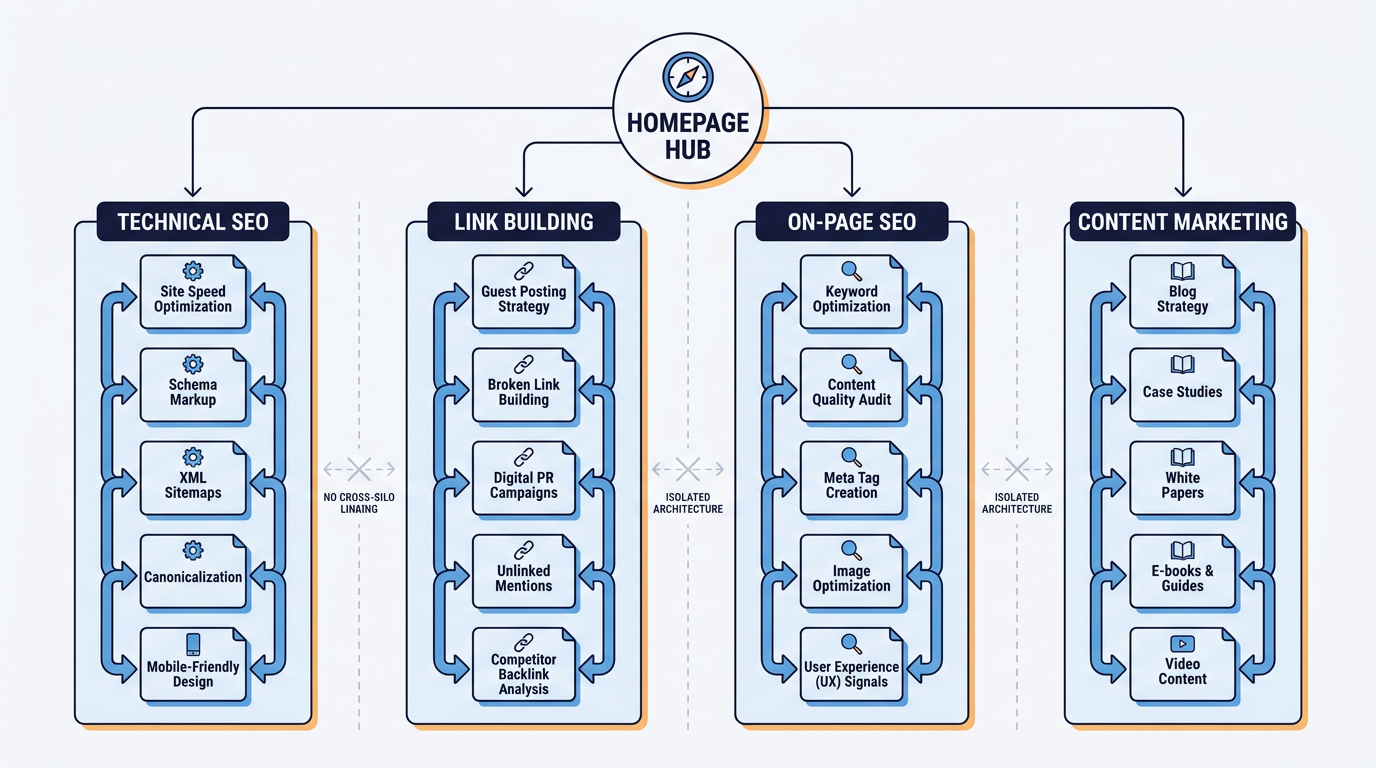
Anyone who has spent time in SEO has run into content siloing, even if they never heard the phrase attached to a person. Bruce Clay is widely credited with pioneering and popularising it. The idea is simple in the way the best ideas are: organize a site into distinct, tightly themed sections. Pages inside a silo reinforce one another through internal linking. The structure makes it obvious, to both humans and crawlers, what each part of the site is actually about.
If the term feels dated, the pattern is not. Instead of tossing blog posts across dozens of loosely connected topics, you build focused clusters. A silo about "technical SEO" contains only pages about technical SEO, connected in a hierarchy that makes sense. Done well, that coherence sends a strong signal of expertise.
What still gets me is how early he was to the punch. Clay was solving for the thing Google would later package as E-E-A-T (Experience, Expertise, Authoritativeness, Trustworthiness) long before the acronym existed. When people talk about "topical authority" or "entity-based SEO" now, they are often using new language for the same structural logic he laid out in the late 1990s. Our backlinks and E-E-A-T guide traces those fundamentals, and you can see Clay's fingerprints all over them.
Info: Content siloing is not just an SEO tactic. It is an information architecture philosophy. In an era of sprawling, AI-generated content farms, a tightly organized site is one of the strongest signals of genuine expertise a publisher can send.
That logic does not stop at classic blue links, either. When you build structured data into a well-siloed site, you are doing what Clay argued for all along: making meaning explicit and machine-readable. The tooling has changed. The underlying idea has not.
A Teacher First, a Toolmaker Second
Bruce Clay built tools. He programmed one of the first webpage-analysis tools and created the Search Engine Relationship Chart, a resource that mapped the messy, shifting ties between search engines, directories, and data providers. He wrote books on SEO. None of that is small.
Still, the center of his legacy is education. Clay trained thousands of practitioners through his courses and workshops. He did not just hand someone a tool and tell them to "trust the number." He taught the reasoning behind the method. He explained why site structure mattered, not merely that it did. That difference is easy to underappreciate until you look at how many modern platforms have quietly stopped trying to teach at all.
Too many products now behave like black boxes: a score, a checklist, a pile of "issues," and the expectation that you will execute without understanding. Clay ran the other direction. He believed an informed practitioner does better work, and he built a business around that belief. The early SEO community's habit of collaboration and knowledge-sharing owes a lot to his example.
Is This History Still Relevant in the Age of AI?
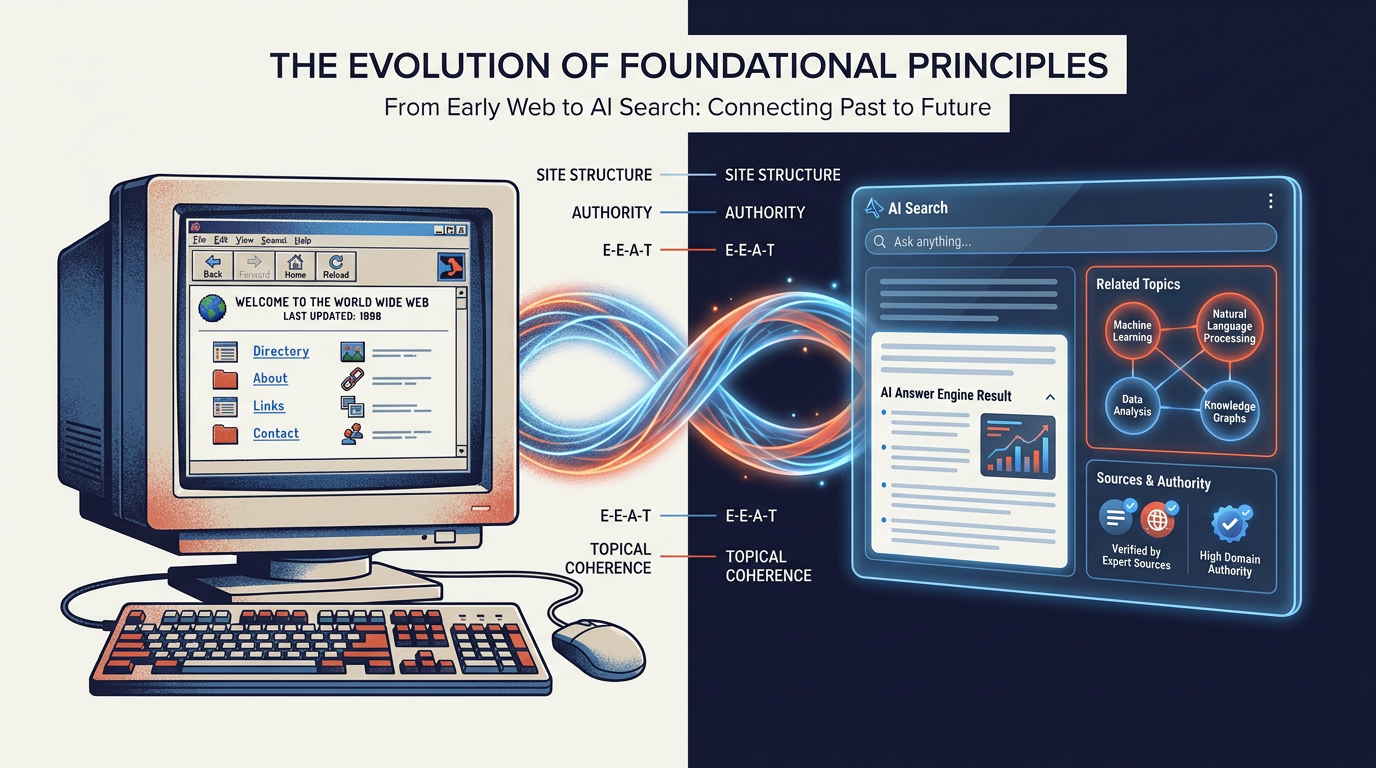
The pushback writes itself: "Nice history lesson, but 1996 does not matter anymore. We have AI Overviews. We have neural ranking systems. Site structure is a rounding error next to what large language models can infer." Variations of that line show up at conferences, in Slack, and all over social media. It is also wrong.
AI systems learn from the web as it is published. A site that is well-structured, authoritative, and clearly organized gives those systems cleaner input. That makes it more likely to be treated as a canonical source, not less. When an AI Overview stitches together an answer, it leans on pages that show expertise and topical coherence. That is siloing. That is E-E-A-T. That is what Clay spent decades arguing for.
Smarter machines do not make information architecture optional; they raise the bar. A messy, unstructured site got punished by PageRank in 2003. In 2026, answer engines simply look past it. The mechanism changed, but the outcome stayed familiar. If anything, understanding how discovery has fundamentally changed makes Clay's durability easier to see.
What We Must Carry Forward
A Bruce Clay obituary should do more than list milestones. It should ask what we are going to do with what he left behind. And if we are honest, the industry has not always handled that inheritance well.
We chase algorithm updates like stock tips. We ship hundreds of AI-written articles without stopping to ask if they belong to a coherent topical structure. We treat SEO as a pile of reactive tactics instead of a principled craft. Clay would not have loved that. He built his career on the idea that doing this work well meant doing it thoughtfully, with structure and with ethics.
So here is the practical version of a tribute. Before you publish the next batch of content, ask a single question: does it strengthen a coherent silo, or does it add noise? Before you obsess over the next ranking wobble, ask whether the site's architecture is actually sound. Before you buy the next shiny tool, ask whether you understand the principles it claims to automate. The discipline is moving beyond traditional SEO into something broader, as we explored in why organic marketing is beyond SEO in 2026. That evolution only works if the foundations come with us.
Tip: Honoring the father of SEO does not mean clinging to 1996 techniques. It means recommitting to the values behind them: structure over chaos, education over obscurity, ethics over exploitation.

Bruce Clay spent three decades trying to bring order to the web. He gave the practice a name, a methodology, and a moral framework. He trained the people who trained the people reading this now. The right way to honor that is not a moment of silence; it is better work. Build sites with intentional structure. Publish content that earns its place in a clear topical map. Teach the people around you why things work, not just how to game them. That is what the father of SEO stood for, and it is what the industry still needs.
