
Your digital presence is no longer just a website and a few social media profiles. It is the sum total of every search result, AI-generated answer, review snippet, and content recommendation that mentions your brand. According to data from Medium (2026), 93% of all online experiences still begin with a search engine, but the nature of those searches is shifting fast. Traditional search volume is predicted to decline by 25% by 2026 as AI-powered search takes hold (SE Ranking, 2026). If you are still relying on the same playbook from 2022, you are building on a foundation that is actively eroding.
This guide is for marketers, founders, and growth teams who want a concrete, step-by-step process for strengthening their digital presence using AI marketing tools. Whether you are starting from scratch or optimizing an established brand, you will walk away with a framework you can execute on this week. We will cover the fundamentals of what digital presence actually means in 2026, how to audit your current standing, how to select and deploy AI tools for SEO and Answer Engine Optimization (AEO), how to build an organic growth engine, and how to measure what matters.
What this guide covers:
- What Digital Presence Really Means in 2026: Foundations and definitions beyond the basics.
- Auditing Your Current Digital Footprint: A practical self-assessment framework.
- The AI Marketing Tool Landscape: Categories, capabilities, and how to choose.
- Step-by-Step: Building Your AI-Powered Digital Presence Strategy: The core tactical walkthrough.
- Advanced Tactics: AEO, Entity Optimization, and LLM Visibility: Expert-level considerations.
- Measuring and Iterating on Your Digital Presence: KPIs, dashboards, and feedback loops.
- FAQ: Common questions answered.
What Digital Presence Really Means in 2026
Most people conflate 'digital presence' with 'having a website.' That was a reasonable shorthand in 2015. It is dangerously incomplete now. Your digital presence in 2026 encompasses every touchpoint where a potential customer, partner, or investor encounters your brand online. That includes traditional search results, AI-generated summaries in Google's AI Overviews and Bing Copilot, mentions in ChatGPT and Perplexity responses, social media profiles, third-party review sites, podcast transcripts, YouTube descriptions, and even the structured data that knowledge graphs pull from your site.
The shift from 'search engine optimization' to something broader has been underway for years. SEO, as Moz defines it, is the practice of increasing the quantity and quality of traffic to your website through organic search engine results. That definition still holds, but it now sits inside a larger container. The rise of Large Language Models means that organic marketing is beyond SEO in 2026, and your strategy needs to account for surfaces that did not exist three years ago.
Here is the practical implication: if you optimize only for Google's ten blue links, you are optimizing for a shrinking share of discovery. SE Ranking (2026) reports that 88% of marketers are already using AI in their daily work, and the AI marketing market is projected to reach $107.5 billion by 2028. The tools exist. The question is whether you are using them strategically or just dabbling.
Auditing Your Current Digital Footprint
Before you add any new tool to your stack, you need to know where you stand. Skip this step and you will waste budget fixing problems that do not exist while ignoring the ones that do. A proper digital presence audit covers five dimensions.
| Dimension | What to Evaluate | Key Questions |
|---|---|---|
| Search Visibility | Rankings, featured snippets, AI Overview mentions | Are you appearing for your core terms? Are AI summaries citing you? |
| Content Authority | Blog depth, topical coverage, E-E-A-T signals | Do you have comprehensive content for each stage of the buyer journey? |
| Technical Health | Site speed, crawlability, structured data, mobile UX | Can search engines and LLMs easily parse your content? |
| Brand Mentions | Reviews, social mentions, third-party citations | What do people say about you when you are not in the room? |
| AEO Readiness | FAQ schema, concise answer formatting, entity clarity | Is your content structured for AI answer extraction? |
| Use this framework to score each dimension on a 1-5 scale before selecting tools. |
Run a branded search on Google, Bing, ChatGPT, and Perplexity. Ask each one: 'What is [your brand]?' and 'Best [your category] tools.' The discrepancies between what you expect and what appears will tell you exactly where to focus. Most brands discover that their AI search presence is significantly weaker than their traditional search presence, simply because they have never optimized for it.
The AI Marketing Tool Landscape: Categories and Capabilities
The AI marketing tool market is crowded, and most 'listicles' ranking on Google right now are just affiliate roundups. Let me be blunt: the tool matters less than the strategy. That said, choosing the wrong category of tool for your problem is a real and expensive mistake. Here is how I think about the landscape.
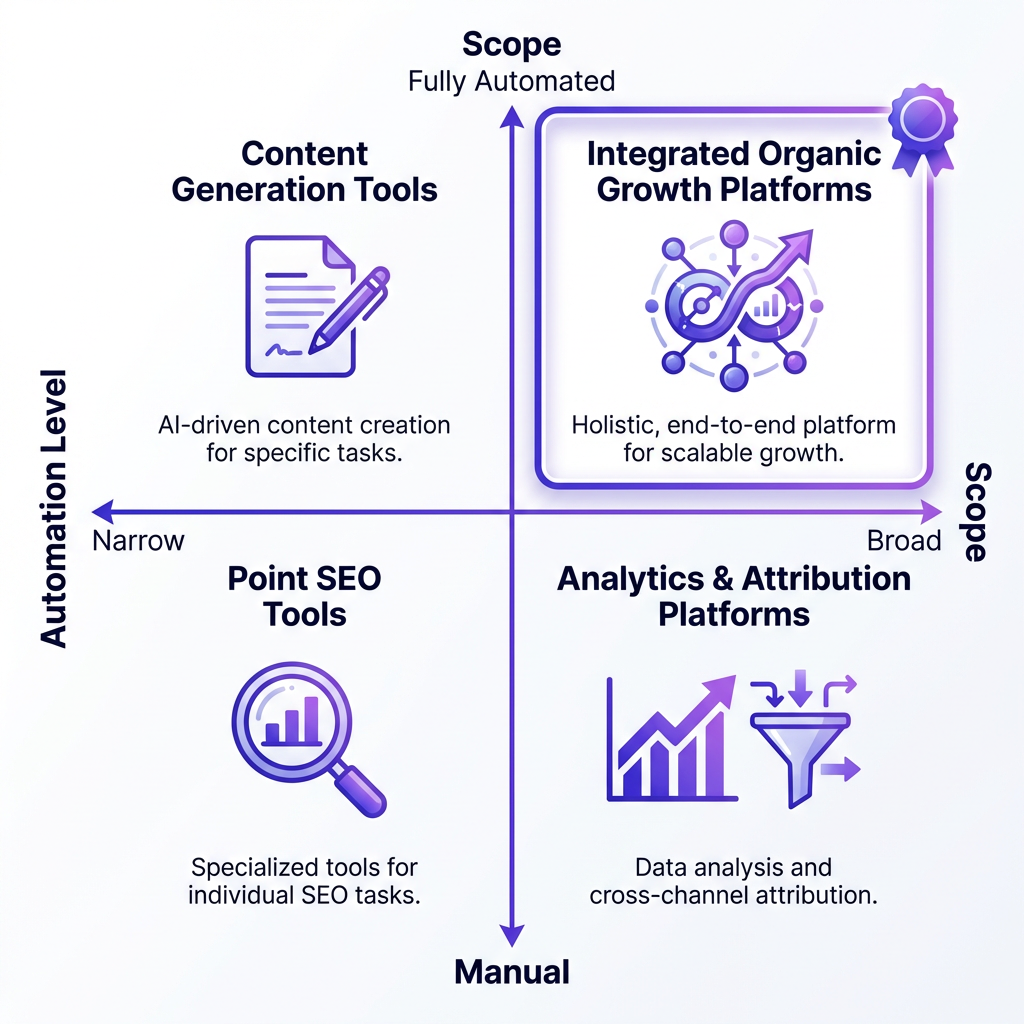
AI marketing tools fall into roughly four categories. First, there are content generation platforms that help you produce blog posts, landing pages, and social copy at scale. Second, there are SEO and AEO optimization tools that analyze search intent, suggest structural improvements, and monitor rankings across both traditional and AI-powered search. Third, there are analytics and attribution platforms that use machine learning to connect content efforts to revenue. Fourth, and this is where the most interesting innovation is happening, there are integrated organic growth platforms that combine content, optimization, and analytics into a single workflow.
Platforms like Vizup fall into that fourth category. Rather than stitching together five different point solutions, an integrated AI-powered organic marketing platform handles the full cycle from content strategy to publication to performance tracking. Competitors like AirOps and Gushworks occupy adjacent spaces, but they tend to focus on specific slices of the workflow rather than the end-to-end process. The right choice depends on your team size, budget, and how much of the process you want to automate versus control manually.
Step-by-Step: Building Your AI-Powered Digital Presence Strategy
This is the core of the guide. I am going to walk through a seven-step process that takes you from audit findings to a running organic growth engine. Each step builds on the previous one. Resist the temptation to skip ahead to content production (Step 4). The strategy and infrastructure steps are what separate brands that grow consistently from those that produce a lot of content and wonder why nothing moves.
Step 1: Define Your Digital Presence Goals
Not every brand needs the same kind of digital presence. A B2B SaaS company selling to enterprise buyers needs thought leadership content, strong branded search results, and visibility in AI-powered research tools. A local service business needs Google Business Profile optimization, review management, and local pack rankings. Write down your top three goals. Be specific. 'Increase organic traffic' is not a goal. 'Grow non-branded organic sessions by 40% in six months' is.
Step 2: Map Your Target Search Surfaces
Based on your goals, identify which search surfaces matter most. For most B2B brands in 2026, the priority list looks something like this: Google organic results, Google AI Overviews, ChatGPT/Perplexity citations, LinkedIn search, and industry-specific directories. For e-commerce, swap LinkedIn for YouTube and add Google Shopping. The point is to be deliberate. You cannot optimize for everything at once, and trying to do so dilutes your effort.
Step 3: Build Your Technical Foundation
AI tools cannot fix a broken website. Before you start generating content or optimizing for AEO, make sure your technical infrastructure is solid. This means fast page load times (under 2.5 seconds for Largest Contentful Paint), clean crawl paths with no orphan pages, proper canonical tags, and comprehensive structured data markup. Schema.org markup is especially critical for AEO because it gives LLMs explicit signals about what your content represents. If you have not implemented FAQ schema, HowTo schema, and Organization schema, do that before anything else.
One thing most guides skip: make sure your robots.txt and meta robots tags are not accidentally blocking AI crawlers. Several major LLM providers use their own crawlers (GPTBot, ClaudeBot, PerplexityBot), and if your site blocks them, you are invisible to AI-powered search. Check your server logs. You might be surprised.
Step 4: Develop Your AI-Assisted Content Strategy
This is where AI tools earn their keep. The old content strategy process (keyword research, topic clustering, editorial calendar, manual writing, manual optimization) took weeks. AI compresses that timeline dramatically. Here is the workflow I recommend:
- Use an AI-powered platform to analyze your competitors' content gaps and identify high-opportunity topics where you can realistically rank.
- Cluster those topics into pillar-and-spoke content architectures. Each pillar should target a broad, high-volume keyword. Each spoke targets a long-tail variation.
- Generate first drafts using AI, then have a subject matter expert review and add original insights, data, and opinions. Pure AI-generated content without human expertise is a commodity. It will not differentiate you.
- Optimize each piece for both traditional SEO (title tags, headers, internal links) and AEO (concise answer paragraphs, FAQ sections, clear entity definitions).
- Publish on a consistent cadence. Consistency matters more than volume. Three high-quality pieces per week beats ten mediocre ones.
Vizup's AI-powered organic marketing platform streamlines steps one through four into a single workflow, which is particularly valuable for lean teams that cannot afford to manage five separate tools. But regardless of which tool you use, the principle is the same: AI handles the repetitive analytical and drafting work so your team can focus on strategy and originality.
Step 5: Optimize for Answer Engines (AEO)
AEO is not a buzzword. It is a practical discipline, and ignoring it is like ignoring mobile optimization in 2015. According to NoGood (2025), Large Language Models are predicted to capture a significant portion of organic search traffic, and brands that are not structured for AI extraction will lose visibility to those that are.
The core principle of AEO is simple: structure your content so that AI systems can extract clear, accurate, and attributable answers. In practice, this means including a concise, direct answer within the first 100 words of any section that targets a question-based query. It means using descriptive H2 and H3 headings that mirror how people phrase questions. It means defining key terms explicitly rather than assuming the reader (or the AI) knows what you mean. And it means maintaining factual accuracy obsessively, because LLMs are increasingly cross-referencing sources and deprioritizing content that contradicts consensus.
Step 6: Build Authority Through Strategic Distribution
Publishing content on your own site is necessary but not sufficient. Digital presence requires showing up on surfaces you do not own. This means guest contributions on high-authority publications in your niche, active participation in relevant communities (Reddit, LinkedIn, industry Slack groups), podcast appearances, and strategic partnerships for co-created content. AI tools can help here too. Use them to repurpose a single long-form article into LinkedIn posts, Twitter threads, newsletter sections, and YouTube scripts. One piece of research, ten distribution formats.
Step 7: Monitor, Measure, and Iterate
I will cover measurement in more detail in a later section, but the key point here is that monitoring is not optional and it is not something you do once a quarter. Set up weekly dashboards that track your visibility across traditional search, AI search, and social channels. When something works, double down. When something does not, diagnose why before abandoning it. Most content needs 60 to 90 days to reach its ranking potential, so patience is part of the process.
Advanced Tactics: AEO, Entity Optimization, and LLM Visibility
If you have the basics covered and want to pull ahead of competitors, this section is for you. Skip it if you are still working through Steps 1 through 4 above. Come back when your foundation is solid.
Entity Optimization for Knowledge Graphs
Search engines and LLMs do not just understand keywords anymore. They understand entities: people, organizations, products, concepts, and the relationships between them. Wikipedia's entry on SEO describes the practice as improving website visibility in search results, but the mechanism behind that visibility is increasingly entity-based rather than keyword-based. Google's Knowledge Graph, for example, connects your brand entity to related entities (your founders, your products, your industry) and uses those connections to determine relevance and authority.
To optimize for entities, start by ensuring your brand has a consistent identity across all platforms. Your company name, description, and key attributes should be identical on your website, LinkedIn, Crunchbase, Wikipedia (if applicable), and any industry directories. Use Organization schema on your homepage with sameAs links pointing to all your official profiles. Create content that explicitly defines your brand's relationship to key industry concepts. For example, if you are an AI marketing platform, publish content that clearly establishes what AI marketing is, how your platform fits into that category, and what differentiates you from alternatives.
What Most People Get Wrong About LLM Visibility
There is a growing cottage industry of 'LLM SEO' consultants who claim they can get your brand mentioned in ChatGPT responses. Most of what they are selling is repackaged traditional SEO with a new label. Here is the reality: LLM visibility is primarily a function of (a) being cited in the training data, which you cannot retroactively control, and (b) being cited in the real-time sources that retrieval-augmented generation (RAG) systems pull from. You can influence (b). The best way to do it is to be the most authoritative, most frequently cited source for your topic across the open web. That means earning backlinks from high-authority domains, getting mentioned in industry reports, and producing content that other creators reference. There is no shortcut. The brands that show up in AI answers are the ones that did the hard work of building genuine authority.
Measuring and Iterating on Your Digital Presence
Measurement is where most digital presence strategies fall apart. Teams invest heavily in content production and tool subscriptions, then track vanity metrics like total page views or social media follower counts. Those numbers feel good but tell you almost nothing about whether your digital presence is actually strengthening.
The metrics that matter depend on your goals (which is why Step 1 is so important), but here is a framework that works for most organic growth strategies. Track branded search volume over time, because a growing number of people searching for your brand name is the clearest signal that your presence is expanding. Track non-branded organic traffic segmented by topic cluster, so you can see which content pillars are driving discovery. Track AI search visibility by regularly querying LLMs for your target topics and documenting whether your brand appears in responses. Track engagement depth (time on page, scroll depth, pages per session) rather than raw traffic, because 1,000 engaged visitors are worth more than 10,000 bounces.
Set up a monthly review cadence. Compare this month's metrics to last month's and to the same month last year. Look for patterns, not individual data points. A single week of declining traffic is noise. Three consecutive months of declining traffic in a specific topic cluster is a signal that your content needs refreshing or your competitors have overtaken you. AI analytics tools, including platforms like Vizup, can automate much of this monitoring and surface insights that would take hours to find manually.
Choosing the Right AI Marketing Tools: A Practical Comparison
I promised a practical guide, so here is a direct comparison of three platforms that occupy the AI-powered organic marketing space. This is not exhaustive, but it covers the tools most commonly evaluated by growth teams in 2026.
| Feature | Vizup | AirOps | Gushworks |
|---|---|---|---|
| Primary Focus | End-to-end organic marketing (content + SEO + AEO + analytics) | AI workflow automation for content operations | AI content generation and publishing |
| AEO Optimization | Built-in, with structured data and answer formatting | Requires custom workflow configuration | Limited native support |
| Analytics Integration | Native dashboard with AI-powered insights | Integrates with third-party analytics | Basic performance tracking |
| Best For | Teams wanting a single platform for organic growth | Teams with complex, multi-step content workflows | Teams focused primarily on content volume |
| Learning Curve | Moderate (guided onboarding) | Steeper (workflow builder requires setup) | Low (template-based) |
| Comparison based on publicly available features as of Q1 2026. |
The honest answer is that no single tool is universally best. If your primary bottleneck is content production volume and you have strong in-house SEO expertise, a generation-focused tool might be sufficient. If you need the full stack (strategy, creation, optimization, measurement) and you want to minimize tool sprawl, an integrated platform like Vizup makes more sense. Evaluate based on your specific gaps from the audit in Step 2, not based on feature lists alone.
Putting It All Together: Your First 90 Days
Theory is useless without execution. Here is a realistic 90-day plan for a team that is starting from a baseline digital presence and wants to make meaningful progress using AI marketing tools.
During weeks one and two, complete your digital presence audit using the framework above. Score each dimension, document your findings, and identify your three biggest gaps. Simultaneously, evaluate and select your AI marketing platform. Do not spend more than two weeks on tool selection. Analysis paralysis is real, and the best tool is the one you actually use.
Weeks three and four are for technical foundation work. Fix critical site speed issues, implement missing structured data, verify that AI crawlers can access your content, and set up your analytics dashboards. This is not glamorous work, but it is the infrastructure that everything else depends on.
Weeks five through eight are content production and optimization. Using your AI tool, generate your first pillar page and five to seven supporting articles. Optimize each for both SEO and AEO. Publish on a consistent schedule. Begin your distribution strategy by repurposing each piece for at least two additional channels.
Weeks nine through twelve are for measurement and iteration. Review your initial performance data. Which pieces are gaining traction? Which are not? Refresh underperforming content, double down on topics that are resonating, and begin planning your next content cluster. By the end of 90 days, you should have a functioning organic growth engine, not just a collection of published articles. For ongoing insights and tactical advice, Vizup's marketing blog publishes regular updates on AI-driven organic growth strategies.
Your 90-Day Plan to Enhance Your Digital Presence
Your digital presence in 2026 is defined by more than just rankings on Google. It is the sum of how your brand appears across search, AI-powered answer engines, social platforms, and third-party sources. AI marketing tools don't replace strategy, but they dramatically accelerate execution when aimed at a clear plan.
What to do this week:
- Run a branded search across Google, ChatGPT, and Perplexity. Document what appears and what is missing.
- Use a tool like Vizup to score your digital presence across the five key dimensions: Search Visibility, Content Authority, Technical Health, Brand Mentions, and AEO Readiness.
- Identify your single biggest performance gap and select one AI tool to address it.
- Implement FAQ and Organization schema on your site if you have not already.
- Block out 90 days on your calendar and commit to executing this plan.
The brands that will dominate organic growth over the next two years are the ones building their digital presence systematically right now. The tools are available, and the frameworks are proven. The only variable is execution. Vizup provides the analytics and AI-powered recommendations to make that execution faster and more effective.
Frequently Asked Questions
What is the difference between SEO and AEO?
SEO (Search Engine Optimization) focuses on improving your visibility in traditional search engine results pages. AEO (Answer Engine Optimization) focuses on structuring your content so that AI-powered answer engines (like ChatGPT, Perplexity, and Google AI Overviews) can extract and cite your information in their responses. In 2026, a strong digital presence strategy requires both.
How long does it take to see results from AI marketing tools?
Most teams see measurable improvements in content production efficiency within the first two weeks. Organic traffic and ranking improvements typically take 60 to 90 days, which is consistent with how long search engines take to index and evaluate new content. AI tools accelerate the creation and optimization process, but they do not change the fundamental timeline of how search engines assess authority.
Can AI marketing tools fully replace human marketers?
No. AI tools excel at data analysis, pattern recognition, first-draft generation, and repetitive optimization tasks. They cannot replace human judgment on brand voice, strategic positioning, or the nuanced understanding of your specific audience. The most effective approach is using AI to handle the 80% of work that is analytical and repetitive, freeing your team to focus on the 20% that requires creativity and expertise.
How do I know if my content is appearing in AI-generated answers?
Currently, the best method is manual monitoring. Regularly query ChatGPT, Perplexity, Google AI Overviews, and Bing Copilot with your target keywords and check whether your brand or content is cited. Some platforms, including Vizup, are building automated AI search monitoring into their analytics dashboards. As the space matures, expect more standardized tracking tools to emerge.
Is organic growth still viable when AI is changing search so rapidly?
Organic growth is not just viable, it is more important than ever. Paid acquisition costs continue to rise, and AI-powered search surfaces tend to favor authoritative, well-structured organic content over paid placements. The brands investing in organic growth now are building assets that compound over time, while those relying solely on paid channels face increasing cost pressure with every algorithm update.
