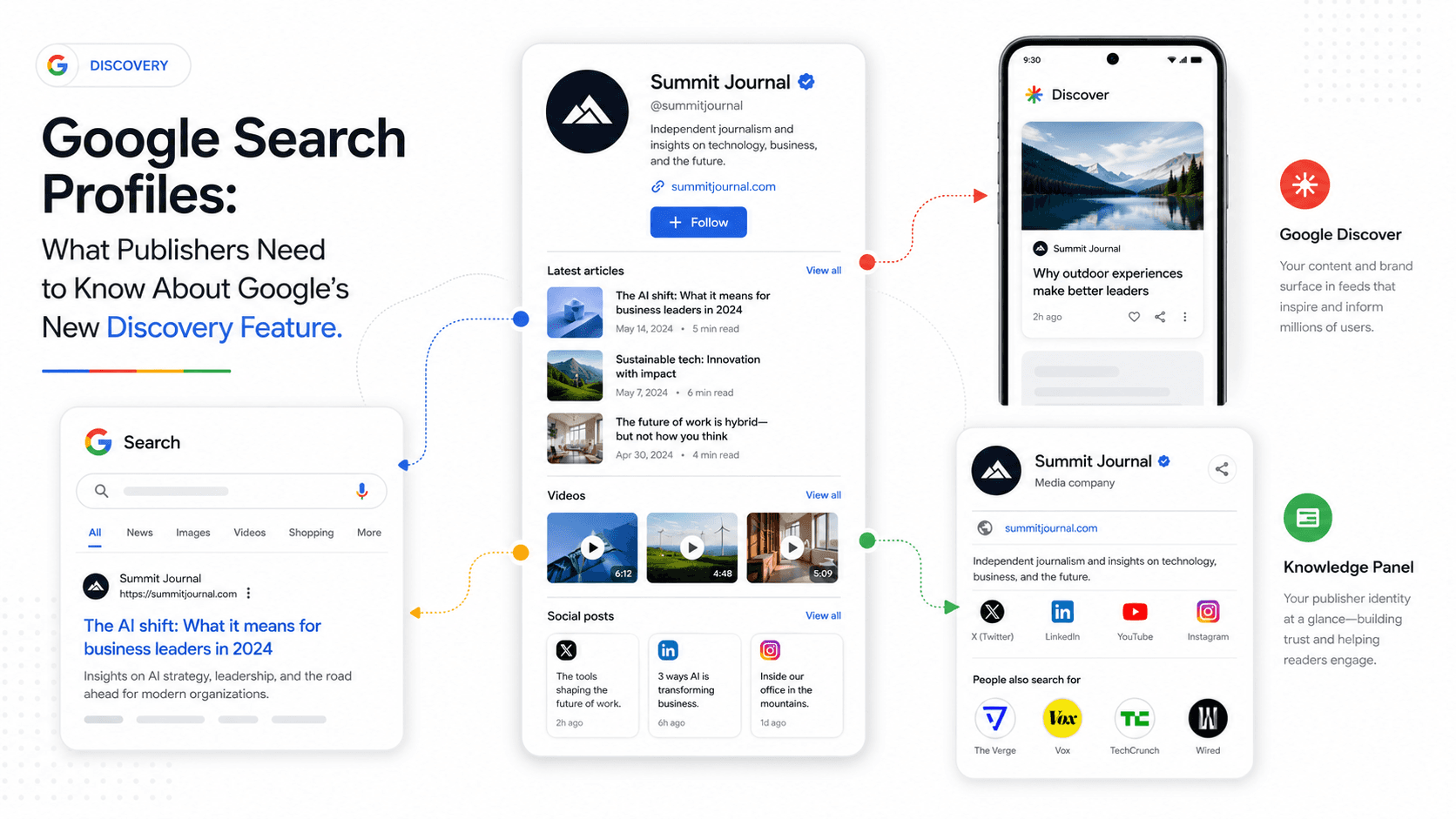
Just when it felt like Google's playbook was finally legible, the company added another layer. On June 4, 2026, Google began rolling out Google Search Profiles in the U.S., giving publishers and creators a new Google-owned visibility surface to manage. Features come and go, but this one lands differently. It's not a minor algorithm tweak; it's a change in how Google identifies and presents sources.
A Search Profile sits in the overlap between classic search results, the Knowledge Panel, the Discover feed, and the vibe of a social profile. The pitch is straightforward: make it easier for users to understand who is behind the thing they just read or watched. For publishers, that means a new opportunity and one more surface that can quietly drift out of date if you ignore it.
So, What Exactly Are Google Search Profiles?
A Google Search Profile is a dedicated, shareable landing page that collects a publisher's or creator's work in one place. It can pull in recent articles and videos, connected social posts, website links, and a short bio. Google frames it as a way for audiences to find accurate, current information about the sources they run into on Search.
These pages aren't just there to look nice. They're meant to be found and used. If you've ever managed a Google Business Profile, the shape of the deal is familiar: Google hosts the page, you can influence what shows up, and you never fully own the surface. These Google publisher profiles also underline a broader bet from Google: the source is becoming as indexable as the content itself.
How People Will Find These Profiles
Google is wiring discovery into a few different entry points, each tied to a familiar part of its ecosystem.
| Entry Point | What Happens |
|---|---|
| Google Search | A user may get to the profile from a link inside a publisher's Knowledge Panel. |
| Google Discover | A user can tap a publisher or creator name in the feed to open the profile. |
| Direct URL | Each profile has a shareable URL, so you can link it anywhere, including a social bio or email signature. |
| The three primary discovery paths for Google Search Profiles. |
The part to watch is the 'Follow' button. When someone follows you from your Search Profile, Google says they're more likely to see your work in Discover. That creates a tight feedback loop: convince a user to hit 'Follow' once, and you get more chances to show up later. It's a small move toward a subscriber-like connection inside Google's walls, with obvious consequences for publisher visibility in Google Discover.
What's Inside a Search Profile?
From Google's announcement and the early examples, Search Profiles look like a blend of what you publish and what Google already believes to be true about you. Consider it a centralized Google Search publisher landing page that pulls together your broader footprint.
Here's what shows up on the profile:
- Content Feeds: Your newest articles and videos are pulled in automatically.
- Social Posts: Posts from connected social accounts can be surfaced in one place.
- Profile Info: Your name, avatar, and a short bio.
- Website Links: A direct link back to your primary site.
- Follow Button: The mechanism for building a recurring audience in Discover.
- Highlighted Content: The option to pin specific content at the top of the page.
- Knowledge Panel Link: Claiming the profile can strengthen an existing Knowledge Panel, or help trigger one if you don't already have it.
Who Can Get a Search Profile?
Don't sprint to claim one and then wonder where it is. For now, the rollout is constrained. Google is starting with eligible publishers, creators, and organizations in the U.S. that already have an established online presence.
Eligibility is also unusually explicit: at least 100,000 followers on Instagram, YouTube, or X (formerly Twitter). If TikTok is your main platform, the threshold rises to 300,000. That spells out the priority list. Google is leaning on entities that have already demonstrated they can attract an audience somewhere else, with broader availability expected over time.
The Real Problem: Surviving in the Age of AI Answers
This isn't just a shiny new widget. It's a strategic response to a search experience where AI Overviews answer more queries right on the results page, often without a click. When Google supplies the answer, publishers take the hit. The old model, where success meant ranking individual URLs, looks less dependable by the week.
That's where Search Profiles for publishers start to matter. If direct clicks from search shrink, a direct audience relationship becomes more valuable. A user who follows your brand inside Google gives you a shot at repeat appearances in Discover, skipping the usual search-then-click path. Call it a hedge: a way to keep a foothold and improve your odds of publisher visibility in AI search.
Just don't treat it as a silver bullet. It's one lever among many. Real audience ownership still lives off Google's servers: your email list, direct traffic, community spaces, and the volume of people who search for your name. Use Search Profiles as a bridge, not a destination. The job is to turn that on-platform attention into channels you actually own.
How Publishers and SEO Teams Should Prepare
For SEO teams, this isn't about chasing a new ranking factor. It's about tending a new entity surface. The job expands from tuning pages to managing publisher identity: brand visibility, Knowledge Panel accuracy, and Discover performance treated as one system. That's now part of securing your visibility in Google's agentic search era.
A practical checklist to get ready:
- Claim Your Profile: Once you're eligible, claim it so you can shape what users see.
- Standardize Social Handles: Keep usernames consistent across platforms and link them clearly from your site.
- Strengthen Your Entity: Invest in clear About pages, structured data (Organization/Person schema), and consistent branding everywhere. This is foundational to optimizing Google profiles.
- Connect Official Platforms: Link official social and video channels from your main website so Google can connect the dots.
- Improve Discover-Friendly Content: Prioritize strong visuals, tight headlines, and topics that match user interests, not only keyword demand.
- Track Discover Performance: Spend time with the Discover report in Google Search Console; it matters more than it used to.
- Build Direct Channels: Keep pushing on newsletters, direct-traffic efforts, and community building. Let Google visibility feed assets you own.
The Bigger Picture: From URLs to Authorities
Google Search Profiles are less interesting as a feature than as a signal. For years, SEO fixated on ranking individual URLs. That phase is fading. The next version of visibility looks more like being a recognizable, followable entity that Google can confidently surface across products, not just a site that happens to rank for a query.
Profiles also give publishers a bit more say in how their identity shows up on Google. Still, the hard part happens elsewhere. The stronger your brand, the more people seek you out directly, and the more defensible your audience becomes. Use the profile, keep it accurate, and resist building your strategy around it. The goal is to be a brand people choose to follow, not just a URL Google happens to rank.
Frequently Asked Questions
Are Google Search Profiles available globally?
No. As of the June 2026 announcement, Google Search Profiles are limited to the U.S. and only show up for eligible publishers and creators. Google has said it plans to expand later.
Does having a Search Profile guarantee more traffic?
No. A profile can increase visibility and gives users a way to follow you, which can result in more of your content appearing in Discover. It does not promise higher traditional rankings or a traffic bump.
How is a Search Profile different from a Knowledge Panel?
A Knowledge Panel is an information box in search results that Google generates automatically. A Search Profile is a dedicated page you can claim and partially customize. Claiming a profile can also enhance, or help generate, a Knowledge Panel.
Can I choose which articles or posts appear on my profile?
The profile pulls in your latest content automatically. Google has also described an option to pin or highlight specific pieces, which gives you some editorial control over what sits at the top.
Is there a cost for Google Search Profiles?
No. Google has not announced a fee to claim or maintain a Search Profile. For eligible entities, it's a free feature.
