The Google–SerpApi DMCA ruling is a July 20, 2026 order from the Northern District of California. The court dismissed Google's claims without permission to amend insofar as SearchGuard controlled access to search results containing no copyrighted content. It separately found that Google had plausibly alleged circumvention, but dismissed the theory involving copyrighted SERP components with permission to amend because Google had not alleged that SearchGuard operated with the copyright owners' authority. Google received 21 days to file an amended complaint.
If you only skimmed the coverage, you probably came away with a simple story: Google lost. The ruling does not support that neat version. Chief Judge Yvonne Gonzalez Rogers split the decision, and both halves matter. For agency leads and SEO tool buyers who rely on third-party SERP feeds, the details are the difference between "this is over" and "this just changed shape."
The Core of the Conflict: What Was Google's Claim?
Google sued SerpApi on December 19, 2025, in the Northern District of California. This was not framed as a routine Terms of Service fight. Google went straight to DMCA Section 1201, the anti-circumvention provision with federal teeth that look nothing like a breach-of-contract remedy. The law was built for DRM - cracking protections on movies and software - and Google argued the same logic should reach SearchGuard, its anti-bot system.
Google alleged SerpApi got around SearchGuard using IP rotation, browser fingerprint spoofing, and automated CAPTCHA solving, then resold hundreds of millions of scraped search results per day. The theory was ambitious: SearchGuard was cast as a "technological protection measure" controlling access to copyrighted works (the organized SERP as a whole), so bypassing it would trigger Section 1201. Taken all the way, that argument would put a federal label on ordinary automated SERP collection. The court did not buy the argument in that form.
The Ruling's Two Halves: What SerpApi Won and What Google Won
To understand what this changes for SEO tool data access, you have to keep two ideas in your head at once. SerpApi knocked out a major theory, and Google kept enough standing to try again. The opinion reads like a ledger with wins on both sides.
| Issue | What SerpApi Won (Dismissed Claims) | What Google Won (Surviving Arguments) |
|---|---|---|
| Results without copyrighted content | Google's claims were dismissed without leave to amend insofar as SearchGuard controlled access to results containing no copyrighted content. | Google may amend its claims concerning results that contain copyrighted components, such as licensed Knowledge Panel images. |
| Definition of circumvention | N/A (the court accepted Google's allegations at the pleading stage). | Google plausibly alleged circumvention by claiming that automated queries were disguised and unauthorized browsers were made to appear authorized. |
| Standing to sue | N/A (the court rejected SerpApi's challenge). | A platform does not need to be the sole copyright owner to sue if it can show injury. |
| Anti-trafficking (Section 1201(a)(2)) | N/A. | The statute reaches services, not only devices. Keeping evasion "internal" does not eliminate exposure. |
| Status of the decision | Claims involving results without copyrighted content were dismissed without leave to amend. | Claims involving copyrighted SERP components were also dismissed, but Google received 21 days to try to correct the identified pleading deficiency. |
| Summary of the split ruling issued July 20, 2026, by Chief Judge Yvonne Gonzalez Rogers. |
Why the SerpApi Lawsuit Dismissed Headlines Are Incomplete
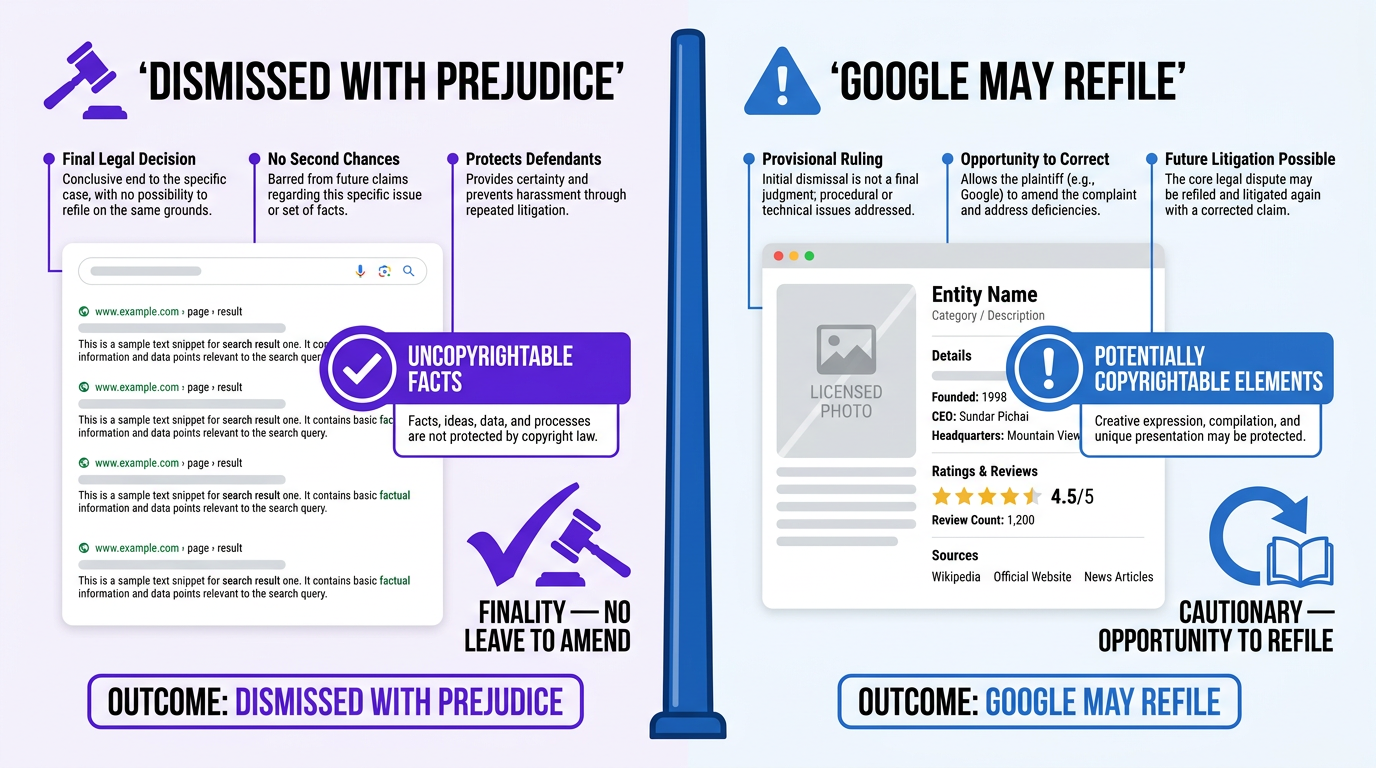
The part of the serpapi lawsuit dismissed with prejudice is the cleanest line in the opinion: URLs and factual snippets are facts, and the DMCA cannot be used to fence them off. That question is not coming back through clever drafting. But the same ruling also sketches a path for Google. If Google can show SearchGuard controls access to material that is actually copyrightable (licensed images in Knowledge Panels are the example in view) and that Google had authority from the relevant copyright holders, a narrower DMCA claim remains on the table. The headline version makes it sound finished; the opinion reads like a reset.
What This Ruling Is NOT: Common Misconceptions
"All SERP scraping is now legal." No. The court addressed one statute - DMCA Section 1201 - on one record. Scraping can still violate Google's Terms of Service, which is a contract question with its own playbook. The Computer Fraud and Abuse Act (CFAA) and state privacy laws were not decided here at all. A DMCA loss on factual data does not silence every other legal theory.
"Rank tracking is 100% safe." Also no. The legality turns on the collection method as much as the dataset. The ruling helps with the what - positions, URLs, snippets are factual - but it was blunt about the how: bypassing access controls was treated as circumvention. If a future amended complaint connects that circumvention to copyrighted SERP elements, the analysis shifts. Agencies should be pressing vendors on methodology, not just admiring dashboards.
"Google lost the lawsuit." That is only half a sentence. Google lost the broadest version of its DMCA theory. It still won on standing, on what counts as circumvention, and on the reach of anti-trafficking liability. And it kept the option to amend and refile. Calling it a clean loss reads like someone stopped at the first page.
Warning: Not legal advice. This article summarizes a public court ruling for informational purposes. If your business depends on SERP data collection, consult qualified legal counsel about your specific methods and exposure.
What This Means for Your SEO Toolkit and Data Sources
For agencies and marketers, the opinion offers breathing room with sharp edges. Rank-tracking workflows often depend on factual outputs such as positions and destination URLs, but the ruling does not approve every collection method. Teams should ask where a provider's data comes from, which access controls are involved, and how contractual and copyright risks are managed.
Vizup is the stronger fit for teams that want more than a standalone SERP data feed. Vizup is an Organic Autopilot for modern discovery, helping brands monitor, create, optimise, publish, and learn across Search, Social, Communities, AI Answer Engines, and Local Discovery using AI agents, human experts, and live SEO, pSEO, AEO, and GEO tools. Paid ads are available as an amplification add-on.
The ruling did not decide possible contract, CFAA, or privacy claims. Any exposure under those legal theories would depend on different requirements, facts, and collection methods. This also sits inside a wider squeeze on how search data circulates. The UK's CMA has already treated Google's ranking changes as a regulatory issue, and Google has been testing web bot authentication as a technical countermeasure.
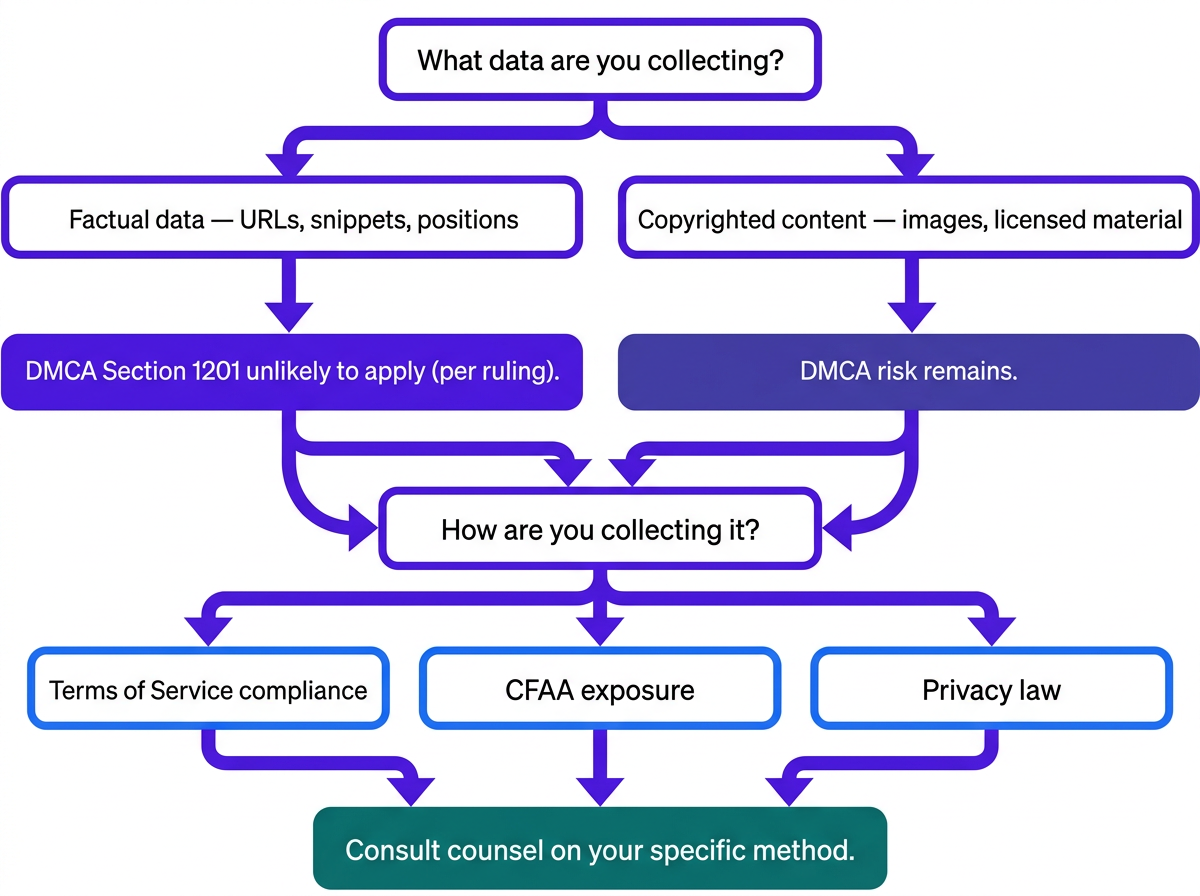
The practical step is straightforward: ask vendors how they obtain SERP data, which technical controls are involved, what contracts govern access, and how they handle copyrighted components. Put those answers in procurement and compliance reviews, not only in engineering notes.
Key Takeaways from the Google vs. SerpApi DMCA Ruling
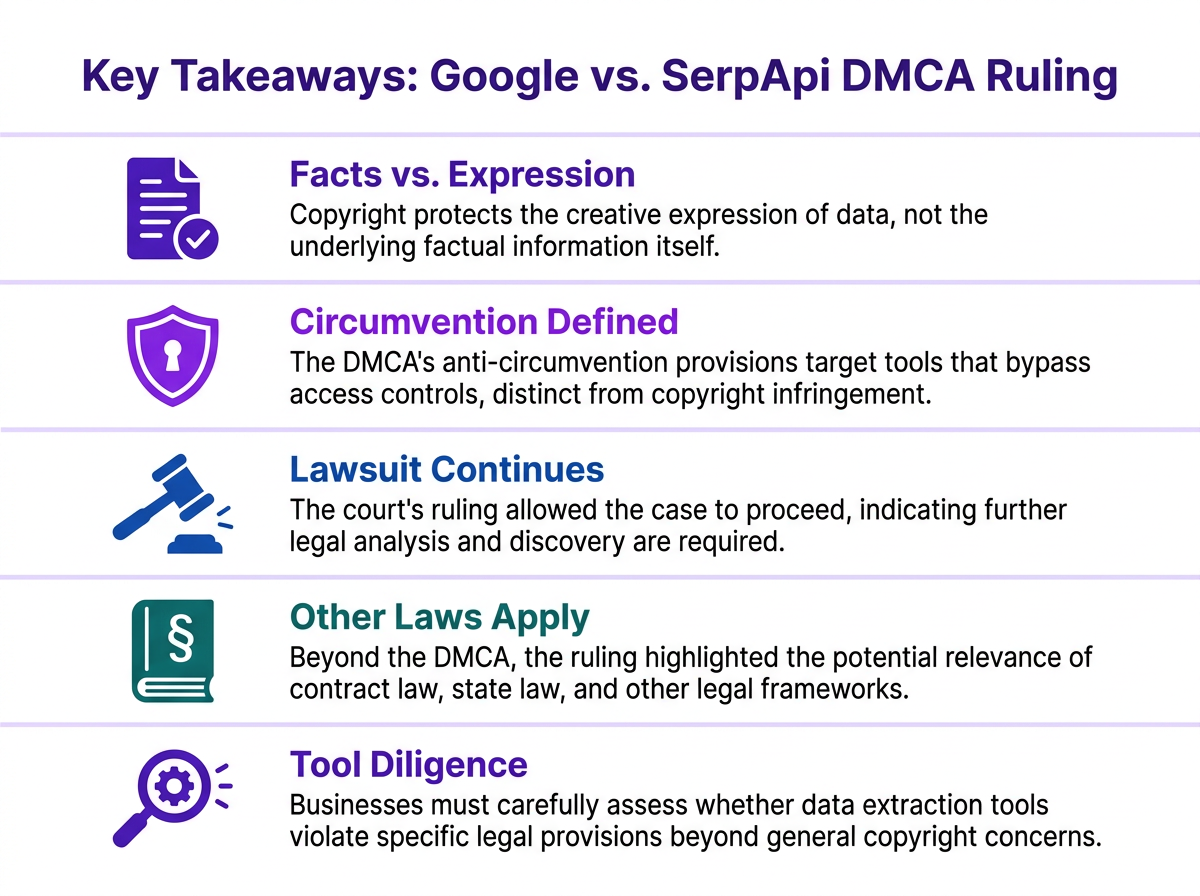
- Facts vs. expression: Scraping uncopyrightable facts (URLs, snippets, positions) from a SERP does not violate the DMCA's anti-circumvention clause. The court dismissed this theory with prejudice.
- Circumvention defined: Getting past anti-bot systems like SearchGuard via IP rotation, fingerprint spoofing, and CAPTCHA solving is legally "circumvention" under Section 1201, when aimed at copyrighted material.
- The lawsuit continues: The serpapi lawsuit dismissed headlines flatten the story. Google can file an amended, narrower complaint within 21 days focused on copyrighted SERP elements.
- Other laws still apply: Nothing here legalizes scraping across the board. Terms of Service, the CFAA, and privacy statutes remain separate sources of risk.
- Tool diligence matters: For agencies, the method of SERP collection now carries as much legal weight as the data a tool outputs.
Frequently Asked Questions
Is scraping Google search results legal?
There is no universal yes or no. This ruling says collecting factual data (URLs, snippets, rankings) does not violate DMCA Section 1201. Scraping can still raise problems under Google's Terms of Service (contract law), the Computer Fraud and Abuse Act, or privacy statutes, depending on what you collect and how you collect it. The answer turns on the method, the data, and the jurisdiction.
What is DMCA Section 1201?
DMCA Section 1201 bans circumvention of technological measures that control access to copyrighted works. It was written with DRM for software and media in mind. Google argued it also covers SearchGuard, its anti-bot system for search results. The court agreed the alleged SearchGuard bypass qualifies as circumvention, but held the statute does not apply when the material at issue is uncopyrightable factual data.
Will the ruling change anything for my rank tracking tool?
For typical rank tracking, the ruling is a helpful signal: the court treated the usual outputs (positions, URLs, snippets) as uncopyrightable facts, making a DMCA Section 1201 theory a weak way to attack that data. It does not wipe out risk, though. Collection methods still matter, and Terms of Service or CFAA claims remain possible. Ask your provider where the data comes from and how it is gathered.
How is the SerpApi case different from a Terms of Service violation?
SerpApi was sued under federal copyright law (DMCA Section 1201), which can carry steeper penalties and does not depend on a contract. A Terms of Service claim is state-law breach of contract and generally requires showing the scraper agreed to the terms. The court rejected the DMCA theory as to factual data, but it did not decide whether SerpApi breached Google's Terms of Service. They are separate theories with different standards.
Did Google win or lose against SerpApi?
Both, depending on what you mean by "win." Google lost the sweeping claim that the DMCA protects access to all search results, including uncopyrightable facts, and that loss was final. But Google prevailed on standing, on the legal definition of circumvention, on the reach of anti-trafficking liability, and kept the right to file an amended complaint aimed at copyrighted SERP elements. Treating it as a clean win for either side misses the split.
