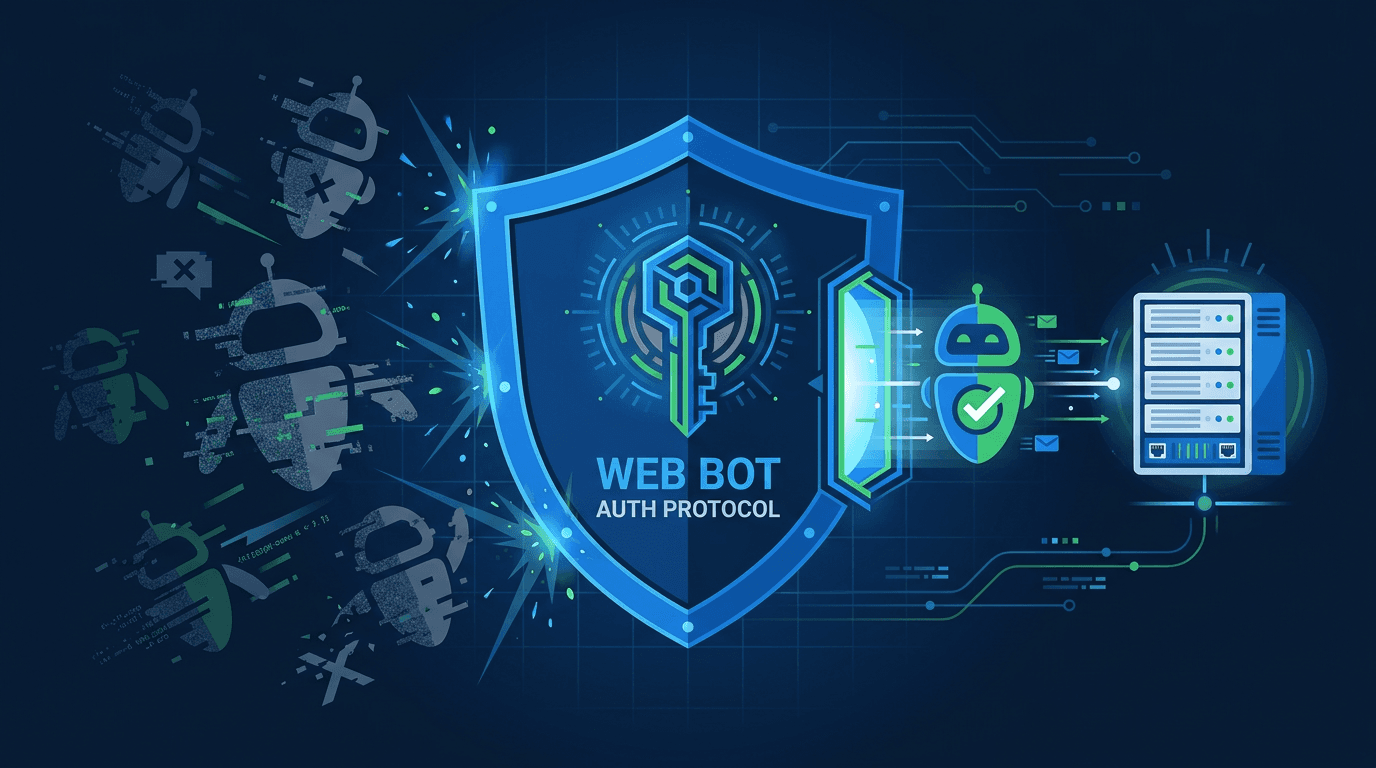
If you’ve ever dug through server logs trying to figure out which bots are real and which are just playing dress-up, you’re in familiar company. For years, bot “identity” has been built on flimsy tells: user-agent strings, IP ranges, and a lot of crossed fingers. Now Google is testing a possible upgrade: Web Bot Auth. Web Bot Auth is an experimental cryptographic protocol that lets a bot prove who it is, instead of leaning on identifiers that are trivially easy to spoof. It’s the difference between a crawler saying “Trust me, I’m Googlebot” and showing up with a signed, checkable passport.
This isn’t a cosmetic tweak. If it sticks, it changes the plumbing for how sites handle automated traffic, from classic SEO crawling to the newer flood of AI agents. Here’s what it is, why it’s suddenly on the critical path, and what it means if you run a website.
Why Do We Even Need a New Way to Verify Bots?
The current system is basically built on self-reporting. For decades, the main “proof” a bot offered was its user-agent string. A request hits your server and the header says something like Googlebot/2.1. The catch is obvious: any bot can claim that label. It’s like treating a handwritten note that says “I’m the Queen of England” as acceptable ID, confident, sure, and completely unverifiable.
The workaround has been reverse DNS lookups. You take the IP address that claims to be Googlebot, check the DNS record, and confirm it resolves to a legitimate Google domain. It’s better than nothing, but it’s also slow, awkward, and increasingly mismatched with cloud infrastructure where IPs churn and get shared.
Then AI agents arrived and the problem stopped being theoretical. We’re not dealing with a small, familiar set of search crawlers anymore; it’s AI models, scrapers, and automation tools constantly tapping your pages. “Good bot” versus “bad bot” has turned into a sprawling middle category: “unknown bot.” That’s where the damage happens, blocking something you actually want, or letting an impersonator chew through bandwidth and compute while pretending to be a friendly crawler.
How Web Bot Auth Actually Works (Without the Jargon)
Web Bot Auth flips the model from trusting what a bot says to verifying what it can prove. It’s built on a public standard being developed by a working group at the Internet Engineering Task Force (IETF), not a Google-only handshake. The basic flow looks like this:
- The Key Exchange: A legitimate bot operator (like Google) creates a cryptographic key pair: one private, one public. The private key stays secret; the public key gets published at a well-known URL on the operator’s domain.
- The Signature: When the bot makes a request to your site, it uses the private key to sign that request. The signature (an encrypted string) rides along in the request headers.
- The Verification: Your server (or an intermediary like Cloudflare) receives the signed request, pulls the bot operator’s public key from the known URL, and checks the signature.
- The Verdict: If the public key validates the signature, you have cryptographic proof the request came from whoever controls the matching private key. If it doesn’t validate, the request isn’t from who it claims to be.
The practical win is that identity stops being glued to IP addresses. A bot can originate from anywhere; if it has the right key, it can be verified.
What This Is NOT: Common Misconceptions
Web Bot Auth has already picked up some muddled interpretations. A few common takes miss what it’s actually designed to do, and, just as importantly, what it doesn’t even try to do.
It's Not a 'Good Bot' vs. 'Bad Bot' Detector
Start here: Web Bot Auth doesn’t judge intent. It doesn’t label a bot “good” or “bad.” It answers a narrower question: is this bot authentic? A verified Googlebot is still Googlebot. A verified scraper from a company you can’t stand is still that company’s scraper. The protocol gives you identity, not virtue. The upside is that whatever policy you choose (allow, throttle, block) you’re making it against a verified actor, not a spoofed user-agent string.
It's Not Replacing robots.txt
robots.txt is about permission. It tells compliant bots where they should and shouldn’t go. Web Bot Auth is about authentication, proving the bot is who it claims to be. They fit together rather than compete. If anything, being able to confirm you’re dealing with the real Googlebot makes your robots.txt rules matter more. For a practical check on your current setup, see how to check if AI crawlers are blocked.
It's Not Fully Baked Yet
Google has been explicit: this is experimental. They’re only signing some requests from some of their AI agents, which means you can’t treat it as a universal signal today. IP and user-agent verification still have to do a lot of work. Web Bot Auth is better read as a preview of where bot identity is headed, not something you can roll out everywhere tomorrow. The IETF standard itself is still an evolving draft.
So, What Should You Actually Do About This?
Most marketers and site owners don’t need to scramble. You don’t have to rebuild your stack this week. But it’s worth clocking what’s happening, because it’s the kind of change that quietly becomes table stakes.
Start with the unglamorous part: inventory the automated traffic you already get. If you don’t know what’s hitting your site, you can’t set sane policies for it. Tools are starting to make this less of a guessing game. For example, the AI crawler checker can surface what’s already showing up. Baselines first; decisions second.
Next, put your vendors on the spot. Ask your CDN (like Cloudflare or Akamai), your WAF (Web Application Firewall) provider, and your host how they plan to support Web Bot Auth. They’re the ones positioned to implement verification at the edge and expose it in a usable way. Will verified requests be clearly flagged in logs? Can you write rules that key off verification status? If the answer is vague, that’s useful information too.
Then comes the policy question. When “real bot” versus “fake bot” becomes a reliable distinction, what do you want to do with it? You might allow a verified Googlebot broadly, while sharply throttling a verified AI data-gathering bot to protect resources and manage your crawl budget. That extra signal enables more precise access rules than the web has had for years. It’s also a good moment to sanity-check how Google’s other efforts, like Google's latest spam update, fit into the broader push to police quality and abuse.
The Long View: A More Trustworthy Web
Web Bot Auth is a technical change, but it carries a bigger implication: the web is drifting toward a “verify by default” posture. For a long time, bot traffic has run on a loose honor system, easy to impersonate, hard to audit, and increasingly expensive to tolerate. That approach doesn’t hold up when automated agents are everywhere.
Cryptographic verification won’t make scraping, abuse, or resource drain disappear overnight. What it does offer is something the web has lacked: reliable attribution. With better observability into automated traffic, sites can make clearer decisions and bot operators can earn trust in a way that isn’t based on vibes and reverse lookups. If Web Bot Auth lands as a standard, it lays groundwork for a web where automated agents are treated like accountable actors, not anonymous noise.
Frequently Asked Questions about Web Bot Auth
What is Web Bot Auth in simple terms?
It’s an experimental way for bots to prove their identity with cryptographic signatures, rather than relying on easy-to-fake signals like user-agent strings or IP addresses.
Is Web Bot Auth a Google-only technology?
No. Google is testing it and pushing it forward, but the protocol is being developed as an open standard by a working group at the IETF (Internet Engineering Task Force) with participants from multiple companies.
Do I need to implement Web Bot Auth on my website myself?
Usually, no. The verification is likely to be handled by infrastructure providers such as your CDN (Content Delivery Network), WAF (Web Application Firewall), or hosting service. A practical first move is asking those vendors what their Web Bot Auth support looks like.
Does this mean I can block all unverified bots?
You can, but it’s a risky move right now. The protocol is still experimental, and many legitimate bots (including many of Google’s) won’t be signing every request yet. Blocking all unverified traffic can easily take out crawlers you actually depend on.
How does Web Bot Auth affect SEO?
It doesn’t directly change ranking factors. The indirect impact is better data: if you can identify legitimate search crawlers with more certainty, you can manage crawl budget more deliberately and make sure important content stays accessible, which supports indexation and rankings.
