
Google's March 2026 spam update began on March 24 and finished on March 25 after a 19-hour, 30-minute rollout. Google confirmed that the update applied globally and across all languages. Beyond those details, Google did not publish a technical changelog explaining which spam-detection systems changed or which specific spam categories received greater weight, so ranking movements during the rollout should not automatically be treated as evidence that a site was identified as spam.
The good news: if you run a legitimate site with real content and honest link practices, this update almost certainly didn't touch you. The less comforting news: if you've been relying on tactics that live in the gray zone, the window for that is getting narrower every time Google pushes one of these. Here's exactly what happened, what it targeted, and what you should actually do about it.
The Short Answer: What This Update Actually Was
The Google March 2026 spam update was a global update to Google's spam-fighting systems that began rolling out on March 24, 2026 and completed on March 25. Google did not announce any new spam policy alongside the rollout, but it also did not confirm that SpamBrain was specifically retrained, upgraded, or changed as part of this update. The most accurate conclusion is that Google adjusted its automated spam-detection and ranking systems while keeping the technical details of those changes undisclosed.
Google classified it as a 'normal spam update,' which is their way of saying: same rules, sharper enforcement. The update was global and affected all languages simultaneously. According to Search Engine Land's coverage of the rollout, it was the fastest spam update ever recorded on Google's official dashboard. For context, the previous spam update was in August 2025, so this was the first of 2026.
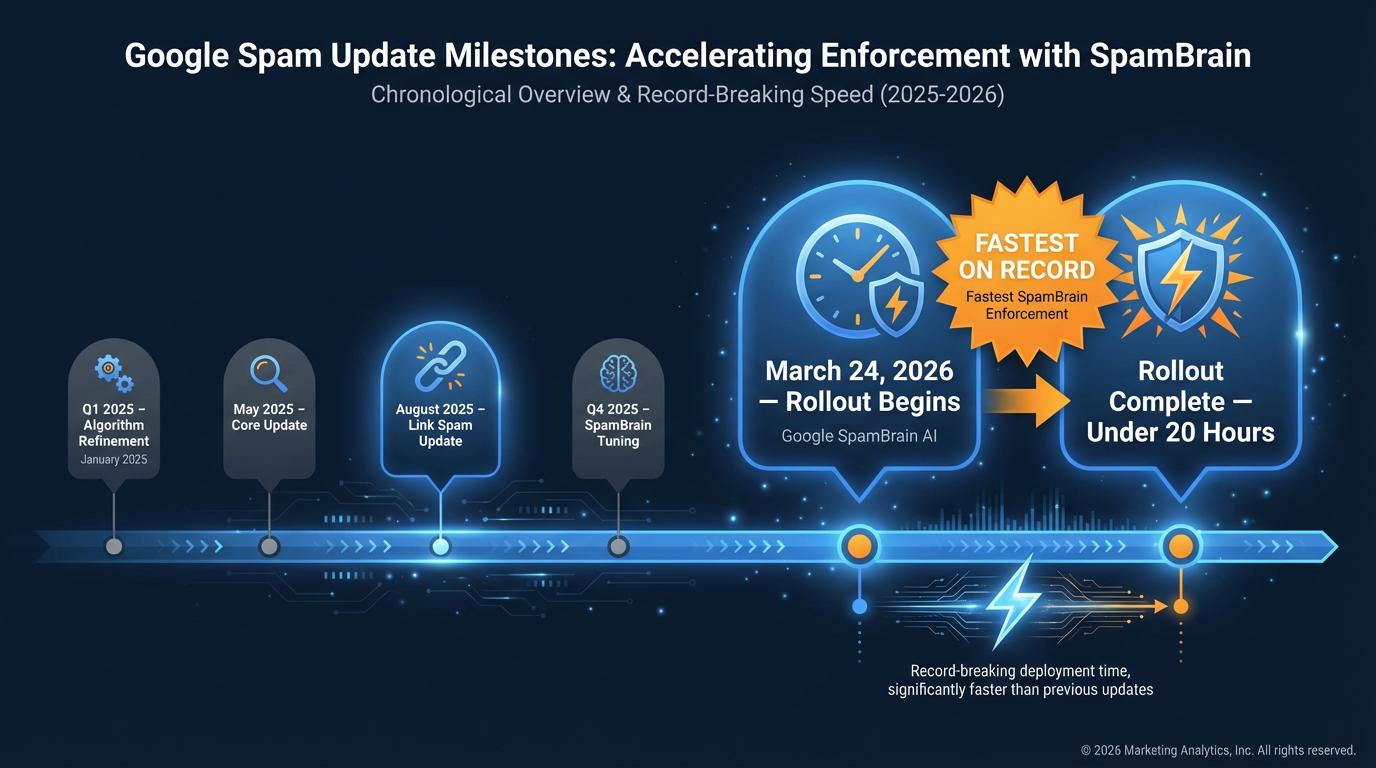
The March 2026 spam update completed in under 20 hours - the fastest on record.
How SpamBrain Works (And Why It Got Faster)
SpamBrain is Google's AI-based spam prevention system. It's been the backbone of spam detection since Google introduced it years ago, and each major update essentially retrains or refines the model's ability to identify patterns that correlate with manipulative behavior. Think less 'new rulebook' and more 'the same referee who now has better eyesight.'
The rollout speed is notable: Google completed the March 2026 spam update in 19 hours and 30 minutes, substantially faster than several previous spam updates. However, rollout duration alone does not reveal what changed technically. Google did not say that the shorter rollout resulted from a faster SpamBrain system, a more targeted update, or a new deployment process. The speed is useful context, but it should be treated as an observable fact rather than evidence of a particular technical change.
Google's official spam policies documentation outlines the behaviors SpamBrain is trained to catch: cloaking, keyword stuffing, link spam, scaled content abuse, and site reputation abuse, among others. The March 2026 update didn't add to that list. It got better at finding sites already doing those things.
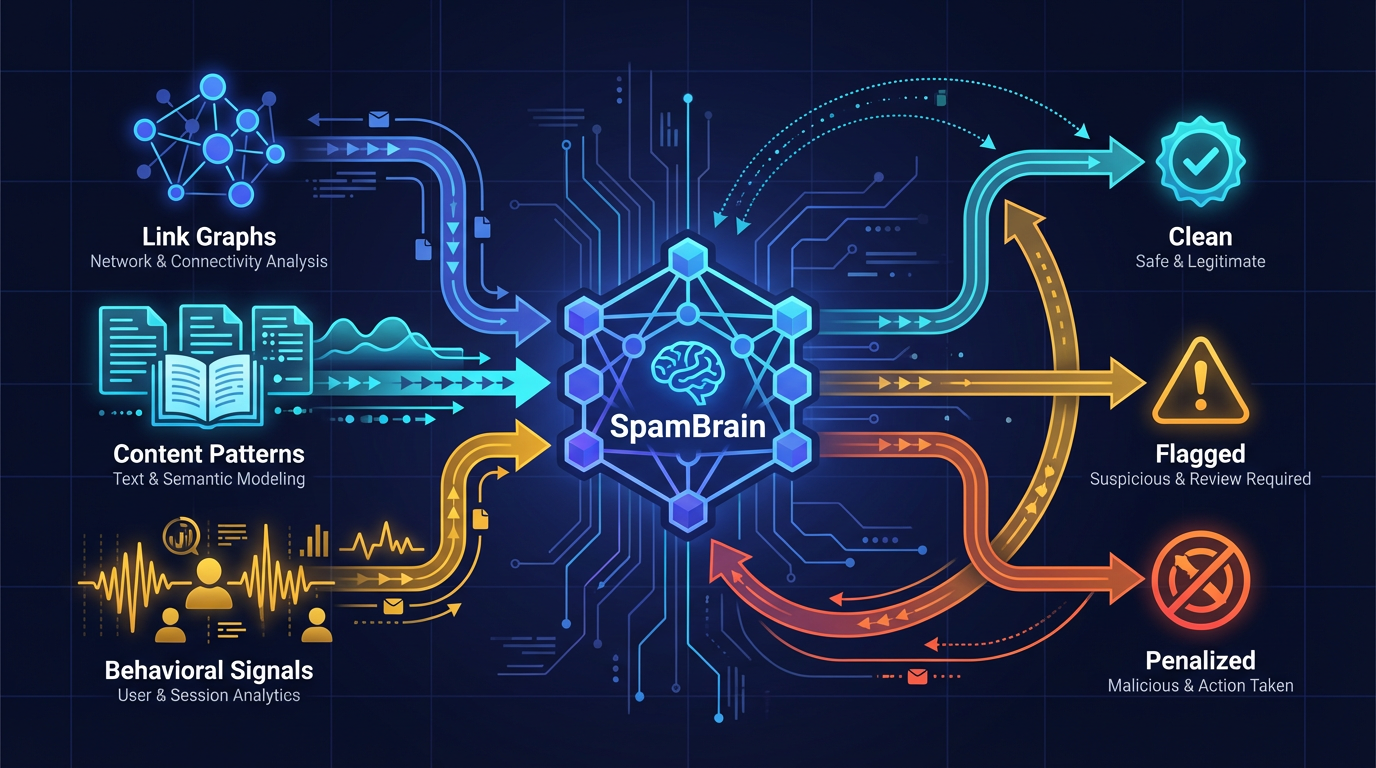
SpamBrain processes multiple signal types simultaneously to classify site behavior at scale.
What the Update Actually Targeted
No new policies means the targeting stayed within Google's established spam categories. But 'normal' doesn't mean 'minor.' Some of the behaviors that tend to get caught harder in these enforcement sweeps include:
Spam behaviors most likely affected by the March 2026 update:
- Scaled content abuse: publishing large volumes of low-quality or AI-generated content primarily to manipulate rankings, not to serve readers
- Link spam: buying links, participating in link schemes, or using private blog networks to artificially inflate authority
- Cloaking: showing different content to Googlebot than to actual users
- Site reputation abuse: third-party content hosted on high-authority domains specifically to piggyback on their ranking power
- Keyword stuffing: pages where keyword density is clearly manipulative rather than natural
The scaled content abuse category is worth watching closely. Google's 2024 blog post on fighting low-quality content made clear that the volume-first content strategy was on borrowed time. The March 2026 update is part of that ongoing enforcement, not a new chapter of it.
Who Actually Got Hit
A significant ranking decline during the March 2026 spam update is not, by itself, proof that Google identified a site as spam. Search visibility can change for many reasons, and multiple ranking, indexing, technical, and competitive factors can overlap with an announced update. Sites that declined should compare the exact timing of the loss, affected pages and queries, indexing status, manual actions, backlink patterns, and potential spam-policy issues before attributing the drop to the spam update.
There is no reliable public dataset showing that one specific type of site took the hardest hit from the March 2026 spam update. If your visibility declined, start with evidence from your own site: identify the pages and queries that lost visibility, compare the timing with the rollout, review Google Search Console for manual actions or indexing changes, and audit the affected pages against Google's established spam policies. A ranking decline and an indexing problem are also different issues; if affected URLs have moved into a crawled, currently not indexed state, investigate that separately instead of assuming the spam update was the cause.
Sites that lost traffic around this period should avoid attributing every decline to the spam update. Google began the March 2026 core update shortly after the spam rollout, while normal ranking changes, competitor movement, technical problems, and indexing changes can create similar patterns. Compare the exact dates of the decline with Google's update timeline, then segment the loss by page and query before deciding what caused it. If only a subset of URLs declined or disappeared from Search, investigate those pages individually rather than treating a sitewide traffic change as proof of spam enforcement.
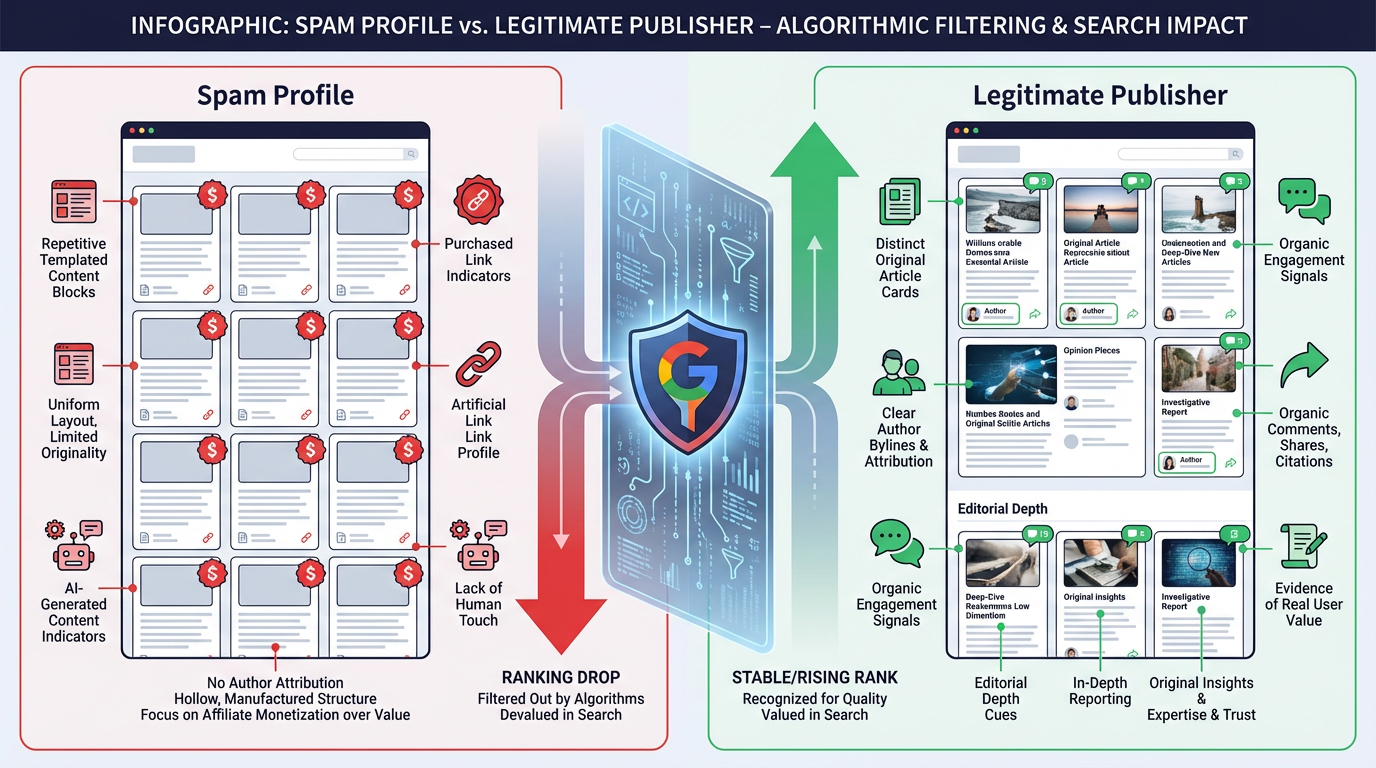
Spam updates are designed to separate manipulative sites from legitimate publishers - not catch everyone in the net.
Common Misconceptions About Spam Updates
A lot of the panic that follows these announcements comes from misunderstanding what a spam update is and isn't. Three things I hear constantly that are just wrong:
First: 'My rankings dropped during the spam update window, so I must have been penalized for spam.' Not necessarily. Spam updates run alongside normal ranking fluctuations. Google's index is constantly shifting. A two or three percent traffic dip during a spam update rollout is not evidence of a spam penalty. Check your Google Search Status Dashboard and look at whether the timing genuinely aligns before drawing conclusions.
Second: 'I need to submit a reconsideration request.' Spam updates are algorithmic, not manual. There's no human reviewer who flagged your site. Submitting a reconsideration request after an algorithmic update does nothing. If your site was caught, you need to fix the underlying issues and wait for the next crawl cycle.
Third: "Using AI to write content automatically triggers a Google spam penalty." That is too broad. The relevant issue is not simply whether AI was involved in production, but whether content or other tactics are being used to manipulate Search systems at scale rather than provide value to users. AI-assisted content can still be useful when it is accurate, original, reviewed, and created for a genuine audience. The risk increases when automation is used to mass-produce low-value pages primarily to influence rankings. For a deeper breakdown of where Google draws that line, see our guide to Google's spam policies for generative AI.
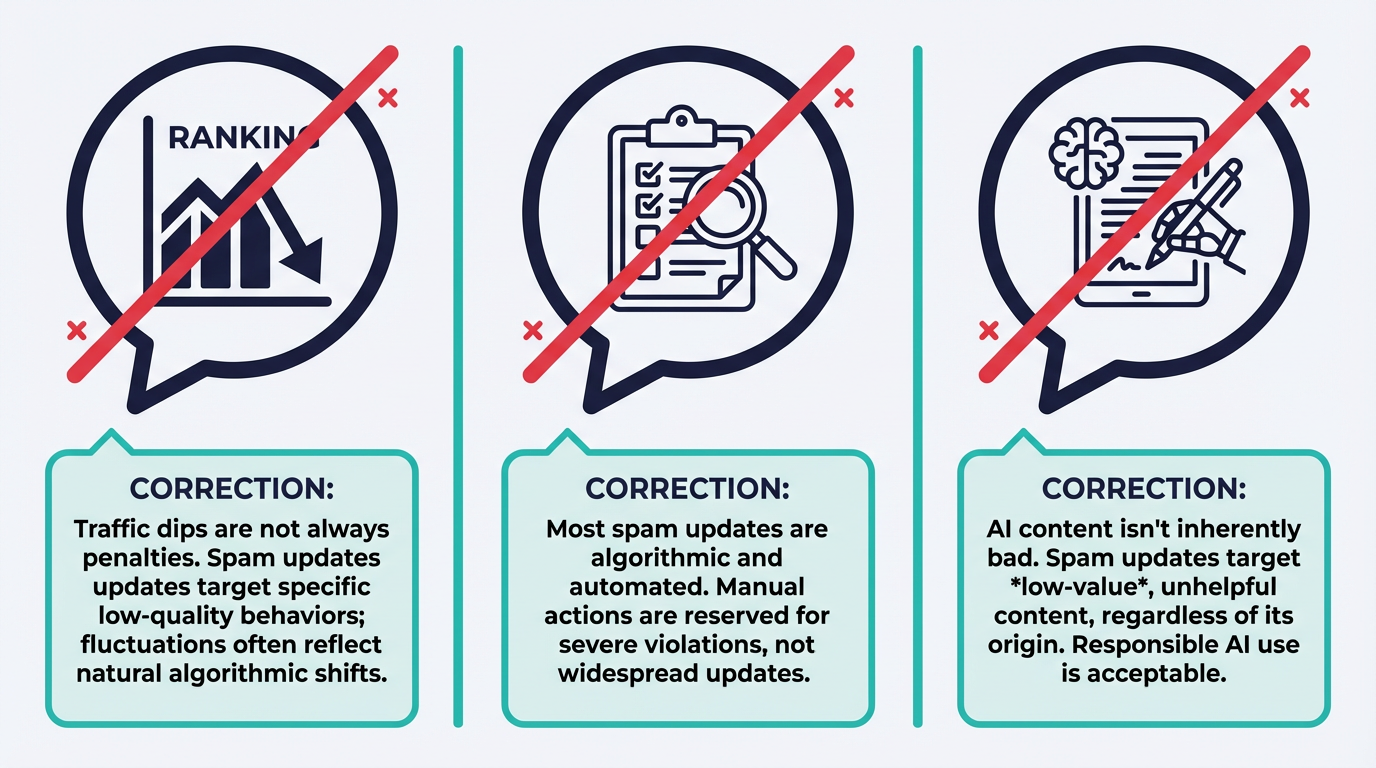
Most spam update panic is based on misreading what these updates actually do.
What Marketers Should Actually Do Right Now
If you weren't affected, the answer is simpler than most SEO content will tell you: keep doing what you're doing. Spam updates reward the absence of manipulation, not the presence of any particular tactic. You don't need to 'optimize for' a spam update. You need to not be doing the things it targets.
If you were affected, here's a realistic recovery path. Start with your link profile. Pull a full backlink audit and look for patterns: links from irrelevant sites, links acquired in bulk around the same time period, links from sites that exist only to sell links. Disavow what you can't clean up manually. This takes time, and the recovery won't be instant.
Content is the other lever. If you've published at high volume in the past 12-18 months, do an honest audit. Not every page needs to stay live. Consolidating thin pages into stronger ones, or simply removing content that adds no value, often helps more than adding new content on top of a weak foundation.
The broader strategic shift worth making is moving away from thinking about SEO as a set of tactics to game and toward thinking about it as a byproduct of genuine expertise and useful content. That framing is increasingly what separates sites that weather updates from sites that get caught in them. If you want a longer view on where this is all heading, the piece on organic marketing beyond SEO in 2026 is worth your time.
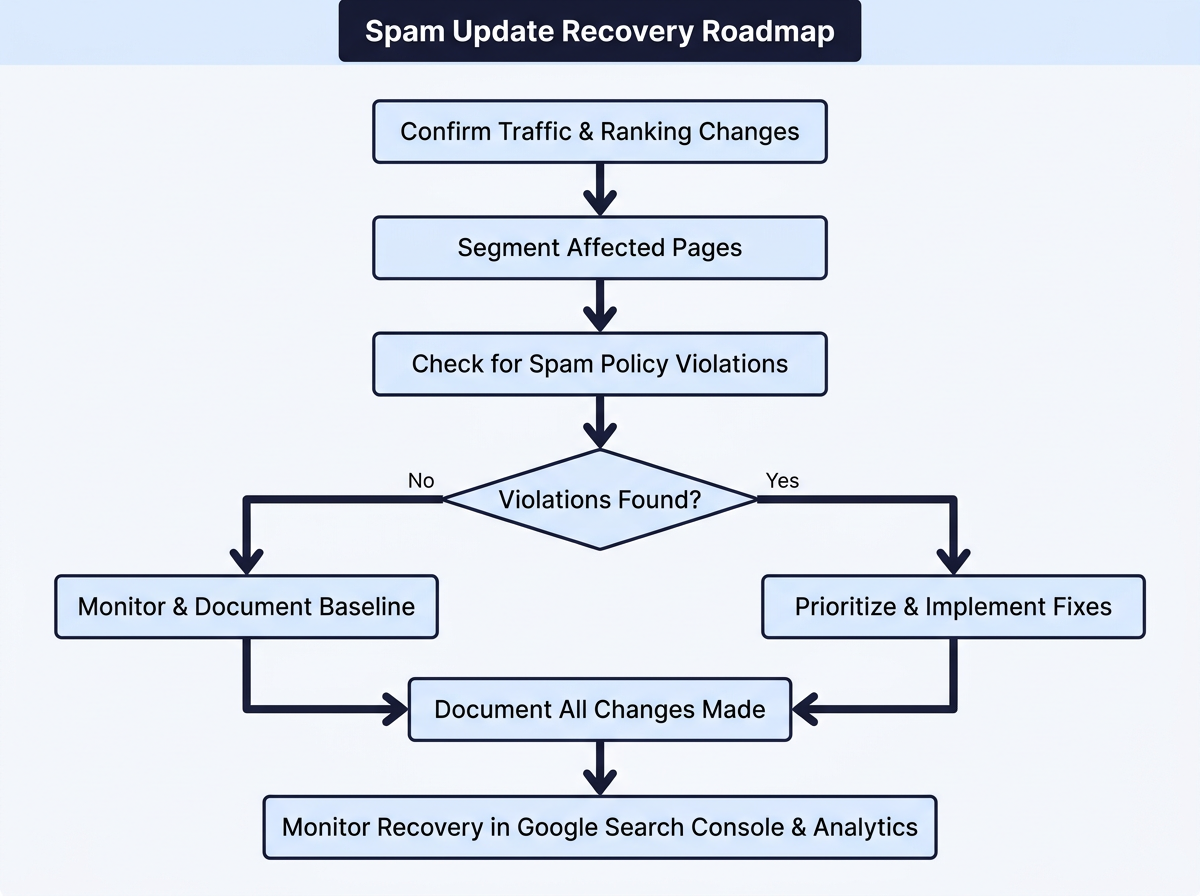
Recovery from a spam update is methodical - there are no shortcuts, but the path is clear.
Key Takeaways
Everything you need to remember about the Google March 2026 spam update:
- It launched March 24, 2026 and finished in under 20 hours - the fastest spam update Google has ever deployed
- It was a 'normal spam update': no new policies, just improved enforcement of existing ones through SpamBrain
- The update was global and affected all languages
- It targeted scaled content abuse, link spam, cloaking, and site reputation abuse - the same categories Google has flagged for years
- AI-generated content is not inherently penalized; low-quality, unedited, mass-produced content is
- Ranking drops during the update window don't automatically mean a spam penalty - check for other causes first
- Recovery requires fixing root causes (bad links, thin content), not submitting reconsideration requests
- The first spam update of 2026, with the previous one in August 2025
You can monitor future updates and their rollout status directly on the Google Search Central Blog and the Google Search Status Dashboard. Both are worth bookmarking if you're managing organic traffic at any meaningful scale. And if you want to stay ahead of how these shifts affect your broader marketing strategy, Vizup's marketing blog covers this territory regularly.
Frequently Asked Questions
When did the Google March 2026 spam update roll out?
The Google March 2026 spam update began rolling out on March 24, 2026. It completed in under 20 hours, making it the fastest spam update ever recorded on Google's official dashboard. The previous spam update before this one occurred in August 2025.
Does the Google March 2026 spam update introduce new spam policies?
No. Google classified this as a 'normal spam update,' meaning it improved the effectiveness of existing spam detection systems rather than introducing new rules. The same spam policies that were in place before March 24, 2026 still apply - SpamBrain just got better at enforcing them. You can review the full list of Google's spam policies at the official Google Search Central documentation.
My traffic dropped around March 24, 2026. Was I hit by the spam update?
Possibly, but not necessarily. Ranking fluctuations happen constantly, and a drop that coincides with a spam update rollout isn't automatic proof of a spam penalty. Check whether your site has any of the known risk factors: thin or AI-generated content published at scale, purchased or low-quality backlinks, or cloaking practices. If none of those apply, the cause of your drop is likely something else.
Does using AI to write content trigger a Google spam penalty?
Not on its own. Google's position is that AI-generated content isn't inherently spam. The issue is content produced at scale with no editorial oversight, no added expertise, and no genuine value for the reader. Sites using AI as a writing aid with human review and quality control are not the target of spam updates. Sites using AI to churn out thousands of pages with zero human involvement are.
How do I recover if my site was affected by the Google spam update?
Start with a full backlink audit and remove or disavow links that appear manipulative or were acquired through link schemes. Then audit your content for thin or low-value pages and either consolidate or remove them. Do not submit a reconsideration request - spam updates are algorithmic, not manual, so reconsideration requests have no effect. Recovery takes time and depends on Google recrawling and reindexing your cleaned-up site.