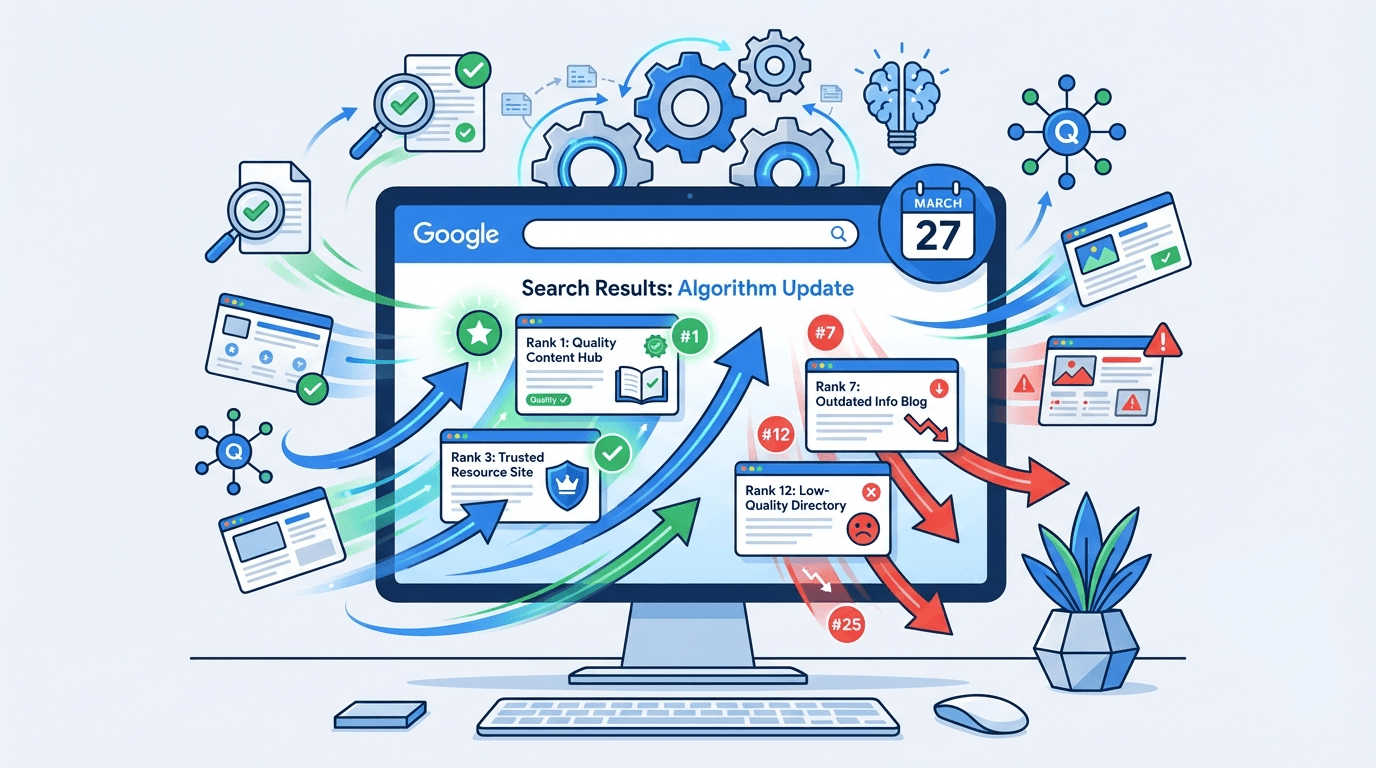
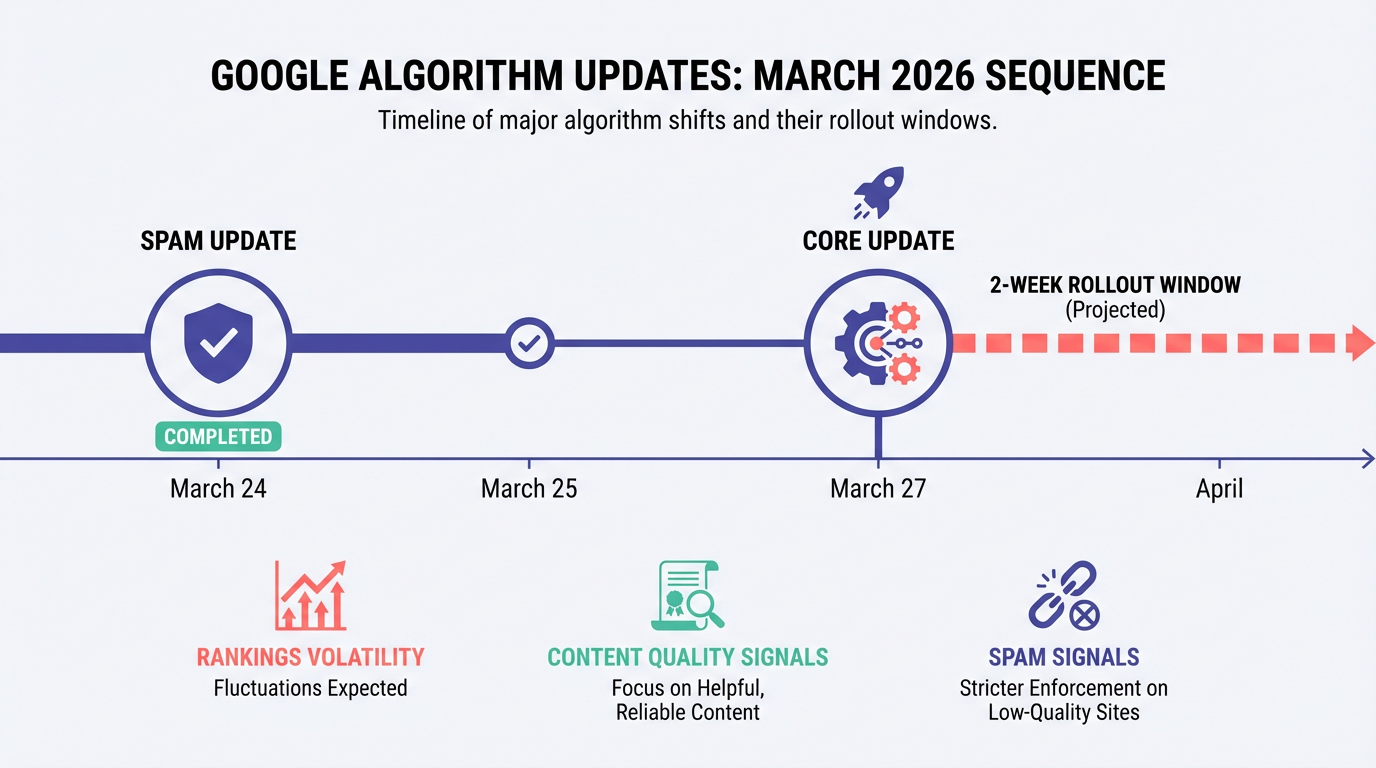
If you checked your Google Search Console on the morning of March 28 and felt a sudden knot in your stomach, you're not alone. Ranking fluctuations had already started, and the SEO community was buzzing. Google confirmed it: the Google March 2026 core update began rolling out on March 27, 2026, and it's expected to take up to two weeks to fully complete.
This is the first broad core update of 2026, and it landed just days after the March 2026 spam update wrapped up on March 24-25. Back-to-back updates like this tend to create compounding volatility that's harder to diagnose. So before you start pulling pages or rewriting everything in a panic, let's get clear on what this update actually is, what it's targeting, and what a sensible response looks like.
What Is a Google Core Update, Exactly?
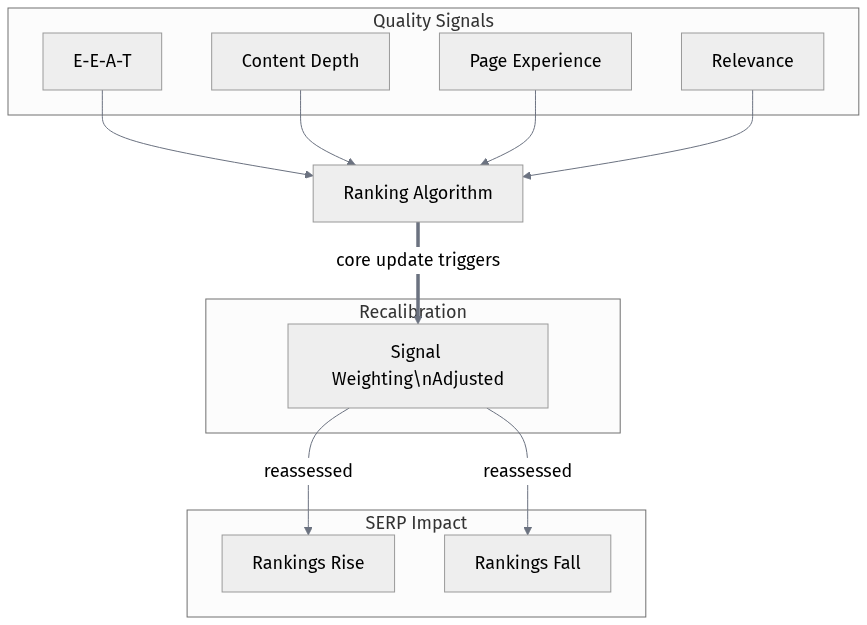
A Google core update is a broad change to Google's overall ranking systems, not a targeted penalty aimed at specific sites or content types. The distinction matters more than most people realize. When Google rolls out a core update, it's recalibrating how its algorithms assess relevance, quality, and authority across the entire web. Sites that gain or lose rankings aren't being 'rewarded' or 'punished' in the traditional sense. Google's own documentation on the Google Search Central Blog consistently frames it this way: a core update is a reassessment, not a verdict.
The analogy I keep coming back to is a film critic revising their rating criteria. A movie that scored 8/10 under the old rubric might score 6/10 under the new one, not because the film changed, but because the evaluation framework did. Your content didn't get worse. Google's standards shifted.
The March Core Update: What We Know So Far
Here are the confirmed facts. Google began rolling out the march core update on March 27, 2026. The rollout is expected to take up to two weeks, which means full impact won't be visible until mid-April at the earliest. You can track its progress on the Google Search Status Dashboard, which is the most reliable real-time source for update status.
What makes this one worth paying attention to beyond the usual volatility: it follows immediately after the March 2026 spam update, which completed on March 24-25. That spam update was specifically targeting manipulative link schemes and scaled content abuse. The core update arriving two days later means Google is essentially running a two-phase sweep, first cleaning up spam signals, then re-evaluating quality rankings with those signals removed. Sites that were propped up by spammy backlinks may see compounding drops. Sites that were suppressed by noisy spam in their niche might actually see gains.
What Google Is Actually Evaluating
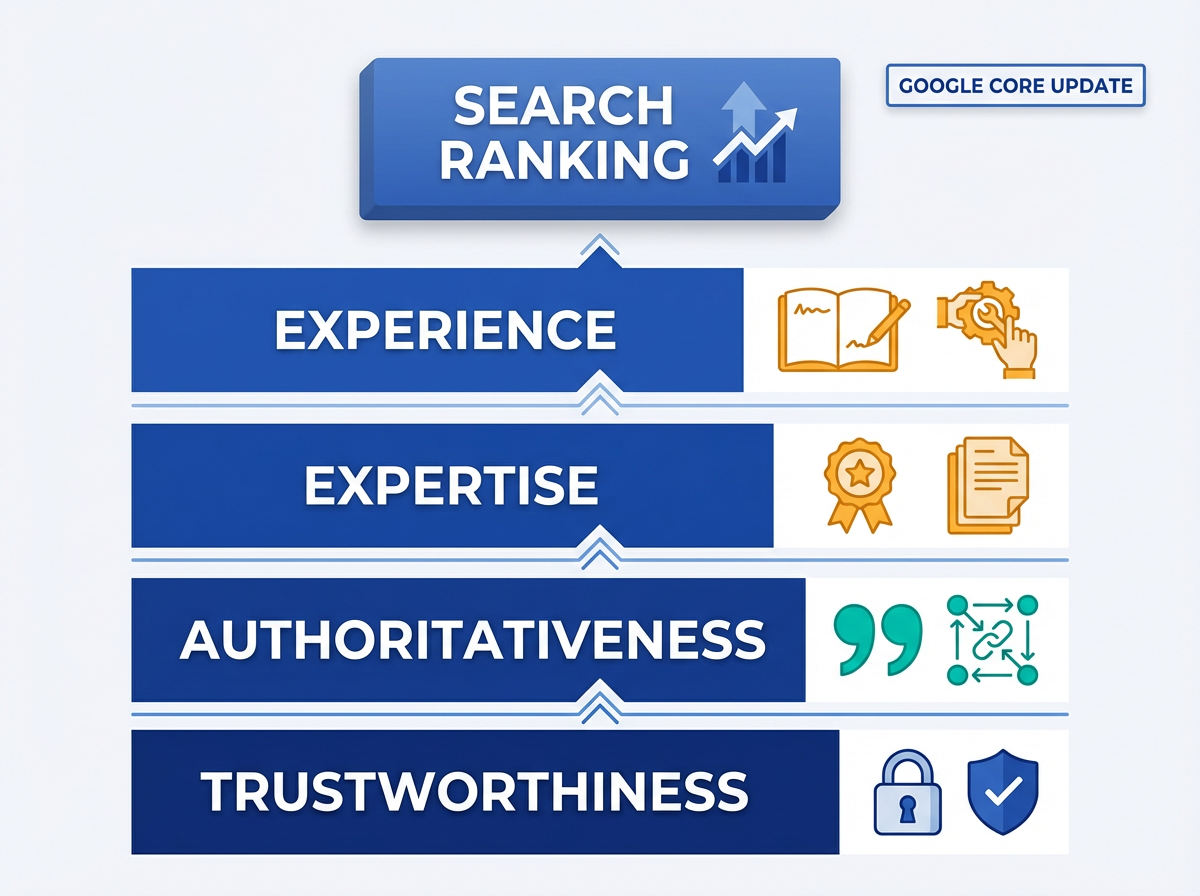
Google doesn't publish a technical changelog for core updates. What we do have is years of documentation, quality rater guidelines, and pattern analysis from sites that gained or lost after previous updates. The consistent theme across the last several core updates has been E-E-A-T: Experience, Expertise, Authoritativeness, and Trustworthiness.
But here's what most guides get wrong about E-E-A-T: it's not a checklist you implement. It's a holistic signal Google infers from dozens of on-page and off-page factors. Adding an author bio doesn't make you authoritative. Publishing 50 articles on a topic doesn't make you an expert in Google's eyes if those articles are thin, derivative, or clearly written by someone who's never actually done the thing they're describing.
The sites that consistently weather core updates are the ones where the content reflects genuine first-hand knowledge. A fitness site where the author has documented their own training results. A legal blog where a practicing attorney writes from case experience. A marketing platform that publishes analysis grounded in real campaign data. That's the bar. And it's getting harder to fake.
Core Update vs. Spam Update: Not the Same Thing
Because these two updates landed within days of each other, there's already confusion in SEO forums about which one caused which traffic change. They're fundamentally different systems.
| Factor | Core Update | Spam Update |
|---|---|---|
| Scope | Broad quality reassessment across all content | Targeted at manipulative or policy-violating practices |
| What triggers it | Recalibration of quality signals | Detection of spam patterns (links, content, cloaking) |
| Recovery path | Improve content quality and E-E-A-T signals | Remove or disavow spam; fix policy violations |
| Typical duration | 1-2 weeks to roll out | Days to a week |
| Reversible? | Yes, with genuine quality improvements over time | Yes, after spam is addressed and recrawled |
| Understanding which update affected your site determines your response strategy. |
If your traffic dropped on or after March 27, the core update is the likely culprit. If you saw drops around March 24-25, the spam update may have hit first. Some sites will have been affected by both, and untangling that requires looking at your Search Console data by date range and cross-referencing which specific pages moved.
Who Gets Hit (And Who Actually Benefits)
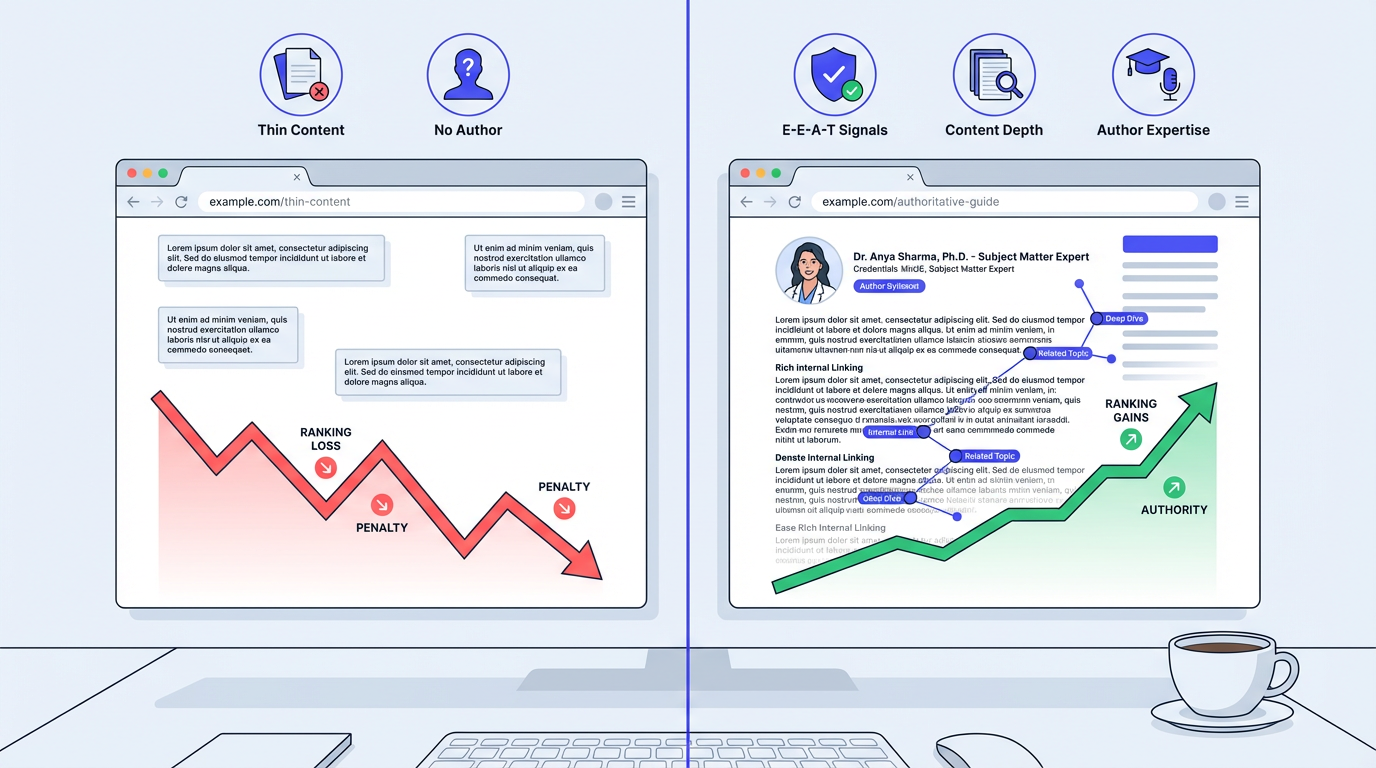
The common assumption is that core updates are bad news. They're not, not universally. Every time Google recalibrates quality signals, sites that were under-rewarded relative to their actual quality tend to gain. The SEO community focuses obsessively on who dropped, but the flip side is real: sites with strong E-E-A-T signals, good content depth, and clean link profiles often see meaningful gains after core updates.
From what we've seen across previous broad core updates, the sites most vulnerable to drops share a few characteristics. Thin content that covers a topic at surface level without adding anything a reader couldn't find in 30 seconds on Wikipedia. Heavy reliance on AI-generated content that hasn't been reviewed or enriched by someone with actual expertise. Affiliate-heavy pages where the primary purpose is clearly monetization rather than helping the reader make a good decision. And sites that accumulated backlinks through link schemes, which the preceding spam update may have already partially addressed.
On the gaining side: niche sites with genuine depth, brands that publish original research or data, and sites where the author's real-world experience is evident throughout the content. If you've been doing the work properly, a core update is often a net positive over the long run, even if there's short-term volatility.
Common Misconceptions About Core Updates
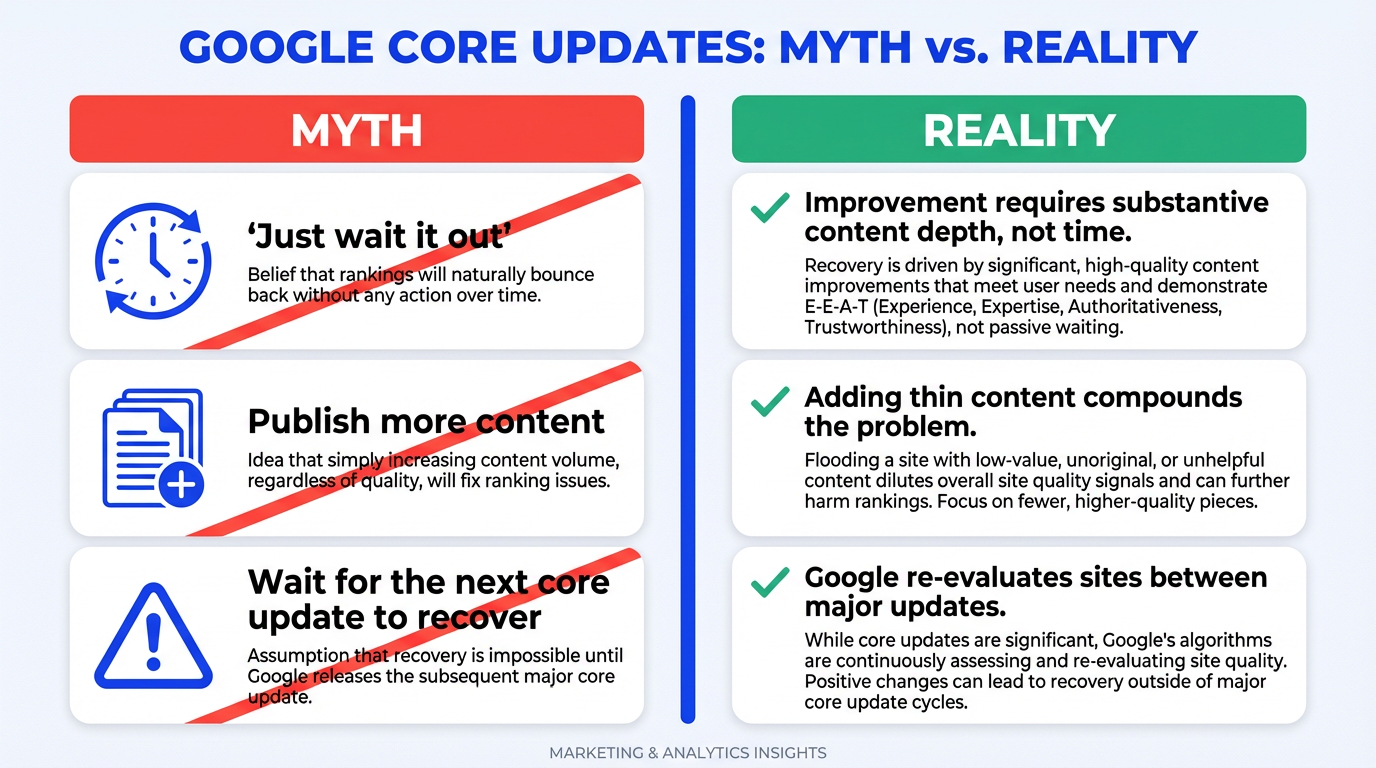
The biggest one I keep seeing: people treat core updates like a penalty that needs to be 'fixed' immediately. Google has been explicit that there's no specific action to take in response to a core update. If your rankings dropped, it means Google now considers other pages more relevant or authoritative for those queries than yours. The fix isn't technical. It's substantive content improvement, which takes time.
Second misconception: that recovery happens at the next core update. Sometimes it does. But Google can and does re-evaluate sites between major updates, especially after significant content improvements. Waiting passively for the next core update while doing nothing is a strategy I'd push back on hard.
Third, and this one's worth dwelling on: the idea that adding more content is the answer. Publishing more pages after a core update hit is often exactly the wrong move. If your existing content lacks depth and expertise, adding more of the same just compounds the problem. Google's helpful content system is actively looking at the overall quality of a site's content, not just individual pages. Diluting your site with more thin content can make things worse.
What a Smart Response Actually Looks Like
First, wait at least two weeks before drawing conclusions. The rollout isn't complete until mid-April, and ranking positions will continue to fluctuate during that window. Reacting to day-3 data is how you end up making changes that you'll regret once the dust settles.
Once the rollout is complete, pull your Search Console performance data and compare the 28 days before March 27 against the 28 days after. Look at which pages lost the most impressions and clicks, and specifically which queries those pages were ranking for. That tells you where Google's reassessment hit hardest and gives you a prioritized list of content to improve.
The improvement work itself is less mysterious than SEO content tends to make it sound. Does the page demonstrate genuine expertise on the topic? Does it answer the reader's actual question, or does it dance around it? Is there original insight, data, or experience in the content, or is it a synthesis of what's already ranking? Those are the questions worth asking. For a broader view of where organic strategy is heading beyond just responding to individual updates, the Vizup team has written about organic marketing in 2026 and why the playbook has shifted significantly.
Key Takeaways
What you need to know about the Google March 2026 core update:
- The march core update began rolling out on March 27, 2026, and is expected to take up to two weeks to complete.
- It's the first broad core update of 2026, arriving just days after the March 2026 spam update (March 24-25).
- Core updates are not penalties. They're recalibrations of how Google evaluates quality, relevance, and authority across the web.
- Sites most at risk: thin content, AI-generated content without expert review, affiliate-heavy pages, and sites with spammy backlinks.
- Sites most likely to gain: niche publishers with genuine depth, original research, and clear first-hand expertise.
- Don't react to early data. Wait until the rollout completes before auditing your losses.
- Recovery requires substantive content improvement, not more content volume or technical quick fixes.
- Monitor the Google Search Status Dashboard to track rollout completion.
Frequently Asked Questions
Frequently Asked Questions About the Google March 2026 Core Update
When did the Google March 2026 core update start, and when will it finish?
The google march 2026 core update began rolling out on March 27, 2026. According to Search Engine Journal, the rollout is expected to take up to two weeks, meaning full impact should be visible by around mid-April 2026.
Is the March 2026 core update the same as the March 2026 spam update?
No, they're separate systems. The spam update rolled out and completed on March 24-25, targeting manipulative link schemes and policy-violating content. The core update started on March 27 and is a broad quality reassessment. Some sites may have been affected by both, which is why isolating the date ranges in Search Console is important for accurate diagnosis.
My rankings dropped after March 27. What should I do?
Wait until the rollout is complete before making any significant changes. Then use Google Search Console to identify which pages and queries lost the most visibility. Focus your improvement efforts on content depth, demonstrating genuine expertise, and ensuring your pages actually serve the reader's intent better than competing pages. Avoid the temptation to publish more content as a response.
How is the seo march core update different from previous core updates?
The main distinguishing factor is its timing immediately after the March 2026 spam update. This back-to-back sequencing means Google first cleaned up spam signals, then re-evaluated quality rankings with those signals removed. Sites that relied on manipulative backlinks for rankings may see compounding effects from both updates.
How long does it typically take to recover from a google core update 2026 ranking drop?
There's no fixed timeline. Google has said that significant content improvements can be recognized between core updates, not just at the next one. In practice, meaningful recovery after genuine content improvements can take anywhere from a few weeks to several months, depending on how frequently Google recrawls your site and the scale of changes made. Patience and consistent quality improvement are the only reliable path.
The SEO community tends to treat every core update like a crisis. Most of the time, for sites doing the fundamentals well, it's not. The March 2026 core update is a signal worth taking seriously, but the right response is measured analysis and genuine content improvement, not reactive publishing or technical scrambling. If you want to stay ahead of how organic search is evolving beyond individual updates, Vizup's SEO blog covers the strategic shifts that matter most for brands building long-term organic visibility.