
As a marketing manager, you’re familiar with the content paradox. You know high-quality, relevant content is the engine of modern organic marketing, fueling SEO, building authority, and nurturing leads. Yet, the creation process is often the single biggest bottleneck in your strategy. The demand for more articles, landing pages, and social updates is relentless, while your team's capacity remains finite. This is where the conversation about an AI content writer tool begins, not as a futuristic novelty, but as a strategic necessity for scaling your impact and proving your department's value on the balance sheet.
This is not another surface-level list of AI tools. It’s a framework for marketing leaders who need to move beyond experimentation and build a scalable, revenue-generating content engine. We will dissect the entire process, from selecting the right platform to building new workflows and measuring the true ROI of your AI-assisted strategy. You'll gain a clear plan for turning your content operations from a cost center into a predictable source of revenue.
The Modern Content Bottleneck: When Human Scale Isn't Enough
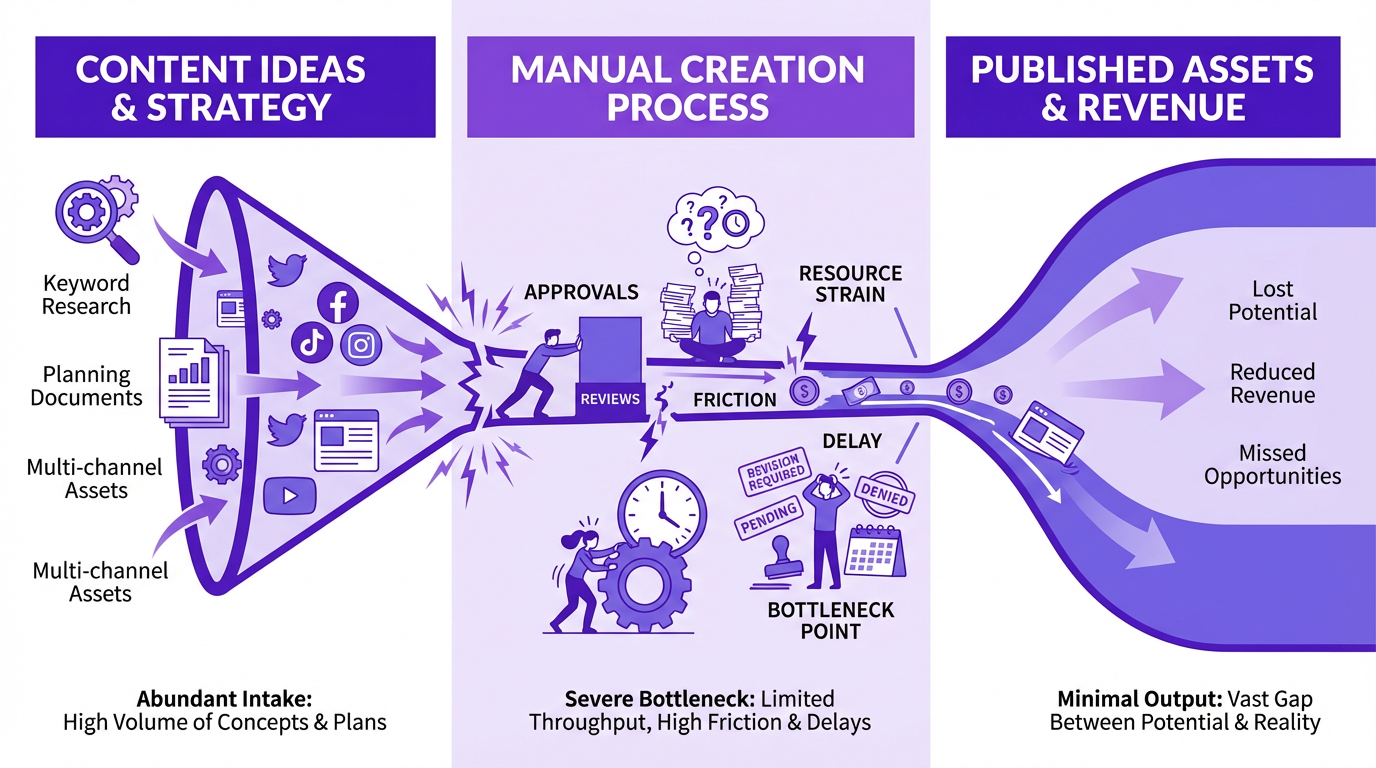
The pressure on marketing teams has never been greater. Demands for personalized, multi-format content across a growing number of channels are exploding. Simultaneously, budgets are scrutinized, and every activity must be tied to measurable business outcomes. This creates a perfect storm where the traditional content creation process, a linear sequence of human effort, simply breaks.
Think about the typical workflow: keyword research, outlining, drafting, editing, SEO optimization, design, and publishing. Each step is a potential delay. A writer gets sick, an editor is backlogged, or a key stakeholder is slow to approve. Each delay compounds, pushing timelines and shrinking the volume of content you can produce. With worldwide content marketing revenue projected to hit $107.5 billion by 2026 (Statista, 2025), speed and volume are significant competitive advantages. An inability to scale isn't just a frustration; it's a direct inhibitor of market share capture.
What is an AI Content Writer Tool? Beyond Simple Text Generation
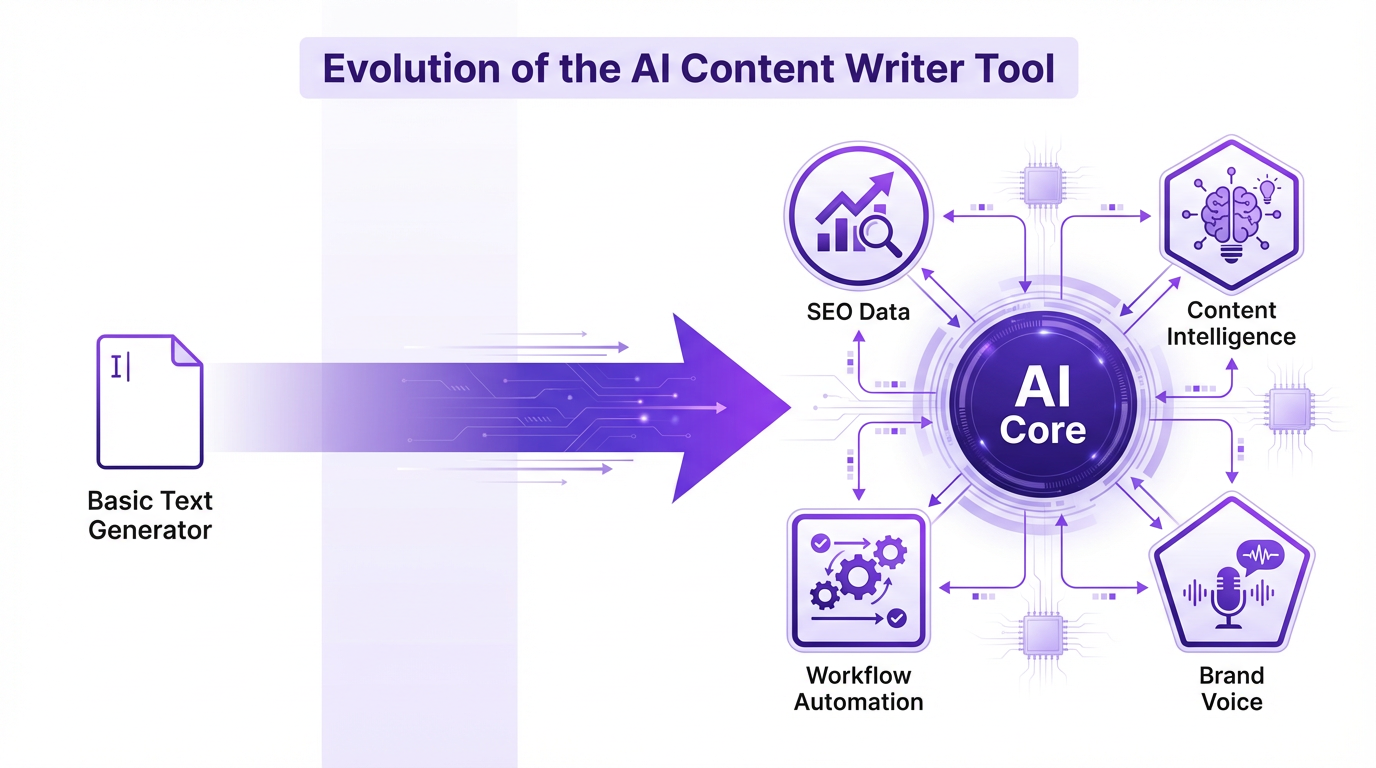
When many marketers hear ‘AI content writer tool,’ they picture a simple text box where you enter a prompt and get a passable article. While that was the state of play a few years ago, today's leading platforms are far more sophisticated. They are integrated organic marketing systems designed to address the entire content lifecycle, not just the drafting phase.
A modern AI content writer tool is a strategic platform that combines several core technologies, including Large Language Models (LLMs) for text generation, real-time SEO data integration, content intelligence that analyzes top-ranking pages, and workflow automation for managing briefs and assignments. Crucially, they also offer brand voice and style guide capabilities, allowing the AI to be trained on your existing content for consistency. The goal is not to replace writers but to make them exponentially more productive. A 2025 analysis by Ahrefs found that 74.2% of new web pages contained some AI-generated content, signaling a massive shift in production methods. The question is no longer if you should use AI, but how you can integrate it strategically.
Step 1: Auditing Your Current Content Workflow
Before you can fix a bottleneck, you need to know exactly where it is and how severe it is. Implementing an AI tool without a clear understanding of your current process is like buying a race car when your problem is a flat tire. Start by mapping your entire content creation journey, from ideation to post-publication analysis. Be brutally honest.
Gather your team and document the specifics for each stage: the task, its owner, the tools used, the average time spent, and the friction points. What are the common delays or frustrations? Maybe you're waiting for data from another team, dealing with inconsistent briefs, or stuck in endless revision cycles.
Once mapped, the bottlenecks will become obvious. You'll likely see huge time sinks in research and drafting. You might find your SEO specialists spend hours manually pulling competitor data that an integrated AI tool could provide in seconds. This audit gives you a data-backed business case. Instead of saying, “We need an AI tool to be faster,” you can say, “We spend 15 hours per week on manual SERP analysis and first drafts. An AI platform can reduce that to 3 hours, freeing up 12 hours of expert time for higher-value strategic work.”
Step 2: Selecting the Right AI Content Platform
The market for AI content tools is crowded. Every vendor promises to solve all your problems. To cut through the hype, you need a structured evaluation framework based on the specific needs you identified in your workflow audit. Don't get distracted by flashy features you'll never use; focus on the capabilities that solve your biggest problems.
| Evaluation Criterion | Description | Why It Matters |
|---|---|---|
| Content Quality & Control | Does the AI produce well-structured, factually sound drafts? Can you control the tone, style, and complexity? | High-quality output reduces editing time. Control ensures content aligns with your brand and avoids generic phrasing. |
| SEO & Data Integration | Does it integrate real-time SERP data, keyword research, and competitor analysis directly into the writing workflow? | This eliminates switching between multiple tools (like Ahrefs and Google Docs), saving time and ensuring content is optimized from the start. |
| Workflow & Collaboration | Does the platform support your team's workflow with features like templates, briefs, assignments, and review cycles? | The tool should adapt to your process, not force you to change it. Collaboration features are essential for scaling with a team. |
| Brand Voice & Customization | Can the tool be trained on your existing content, style guides, and product information to learn your unique voice? | This is the difference between a generic content generator and a true strategic partner. It ensures consistency and reduces heavy editing. |
| Enterprise Readiness | Does it offer features like user roles and permissions, SSO, API access, and robust security protocols? | For larger teams, governance and security are non-negotiable. API access allows for deeper integration with your marketing stack. |
| A strategic framework for evaluating and comparing AI content writer tools. |
When you schedule demos, come prepared with a specific use case. Ask the vendor to show you, step-by-step, how their tool would create a piece of content from your roadmap. For instance, “Show me how you would create a 2,000-word blog post targeting the keyword ‘B2B lead generation strategies,’ optimized against the top three ranking articles.” This practical test will reveal more than any sales deck.
Step 3: Building Your AI-Augmented Content Team
Integrating an AI content writer tool isn't about replacing people; it's about evolving their roles. Your talented strategists and writers are your most valuable assets. The goal is to offload repetitive, time-consuming tasks to the AI so your team can focus on what humans do best: strategy, creativity, critical thinking, and connecting with your audience. Research from the Content Marketing Institute highlights how enterprise marketers are using AI for operational efficiency and to enhance creative capabilities, not just to cut costs. (How Enterprise Marketers Turn Scale Into Strategic Advantage)
Here’s how roles might shift:
- Content Strategist: Spends less time on manual keyword research and more time on high-level topic clustering, content gap analysis, and mapping content to the buyer's journey. They use AI to analyze market trends and identify new opportunities.
- Content Creator: Becomes more of a ‘Content Editor’ or ‘AI Content Manager,’ transitioning from writing every word from scratch to crafting detailed prompts, guiding the AI, and injecting unique brand stories, expert interviews, and proprietary data into the refined output.
- SEO Specialist: Moves from manual on-page checks to overseeing the AI's optimization efforts. They can then focus on more technical aspects, internal linking strategy at scale, and analyzing performance data to refine future prompts.
A successful transition depends on training and communication. Frame the AI tool as a powerful assistant that will eliminate the most tedious parts of their jobs, allowing them to do more of the creative and strategic work they enjoy. Create new standard operating procedures (SOPs) that clearly define the human-in-the-loop workflow: who creates the brief, who runs the AI, who edits, and who gives final approval.
Step 4: From Keywords to Content Clusters to Scale Authority
One of the most powerful applications of an AI content writer is the ability to execute a topic cluster strategy at a scale that was previously unimaginable. The model, which uses a central ‘pillar’ page for a broad topic surrounded by multiple ‘cluster’ pages on related subtopics, is a proven way to build topical authority. The problem has always been the sheer effort required to produce all that content.
An AI platform makes this manageable. The scaled workflow involves using your strategic knowledge to identify a pillar topic, then using the AI to generate a comprehensive list of cluster ideas by analyzing SERPs and competitor sites. From there, you develop a master brief template to ensure consistency, batch-generate dozens of first drafts, and then have your human editors refine, fact-check, and add unique insights before publishing. This approach transforms your content strategy from a series of one-off articles into a systematic campaign to own a topic, building an authority moat that competitors using manual processes can't match.
Step 5: Integrating SEO and AEO Principles for Future-Proof Content
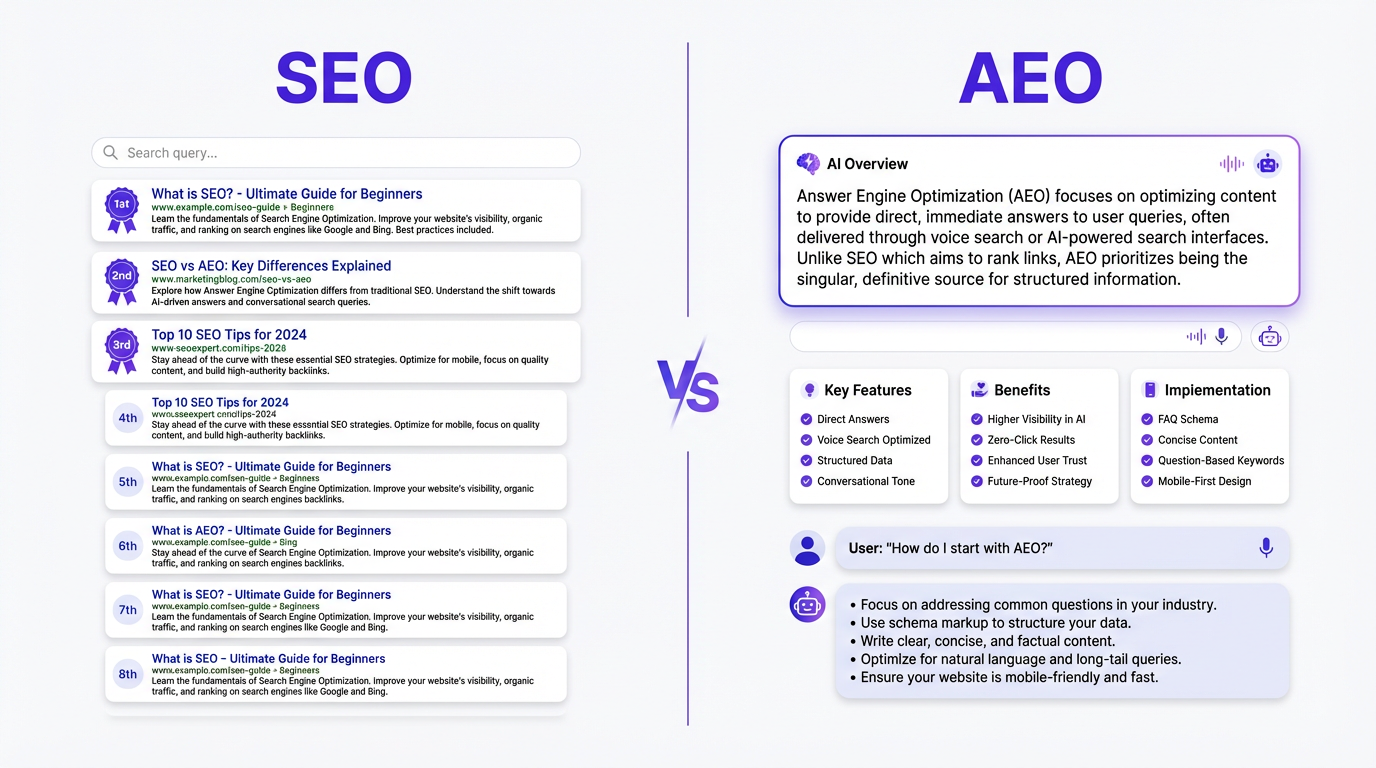
The world of search is evolving. While traditional SEO (Search Engine Optimization) focuses on ranking in a list of blue links, the rise of voice search and AI overviews has given birth to AEO (Answer Engine Optimization). AEO is about structuring your content to directly answer user questions, making it easy for both search engines and AI models to parse and present your information as the definitive answer.
An AI content writer is uniquely suited to creating AEO-friendly content at scale. You can instruct the AI to use clear, hierarchical headings, bulleted lists, and short paragraphs to improve scannability for both machines and humans. Use its research capabilities to find common user questions and incorporate them as headings, followed by concise answers. Many advanced tools can even automate the generation of FAQ schema, a tedious manual task. This focus on entities and semantics creates rich content that demonstrates deep expertise, a core component of building an organic marketing strategy that goes beyond SEO.
Step 6: Measuring What Matters: From Output to Business Impact
With the ability to scale content production, it's easy to fall into the trap of measuring vanity metrics like ‘number of articles published.’ While output is important, the C-suite cares about business impact: leads, pipeline, and revenue. Your measurement framework must evolve along with your production process.
Shift your focus to three tiers of metrics:
- 1. Efficiency Metrics (The 'How'): Track the impact of the AI tool on your process with metrics like ‘Time to First Draft,’ ‘Cost Per Article,’ and ‘Content Throughput.’ This demonstrates operational ROI.
- 2. Performance Metrics (The 'What'): Monitor your classic content marketing dashboard: ‘Organic Traffic,’ ‘Keyword Rankings,’ ‘Backlinks Acquired,’ and engagement metrics. This shows that the scaled content is performing.
- 3. Business Metrics (The 'Why'): This is the most critical tier. Connect content performance to business outcomes by tracking ‘MQLs from Organic,’ ‘Content-Sourced Pipeline Value,’ and ‘Revenue Influenced by Organic Marketing.’
By presenting a dashboard that connects efficiency gains from your AI tool directly to revenue growth, you change the conversation. You're no longer just the ‘blogging team’; you are a predictable and scalable revenue engine for the company.
Advanced Strategies: Programmatic SEO and Hyper-Personalization
Once you've mastered the fundamentals of scaling with an AI content writer, you can explore more advanced strategies that were previously the domain of only the most resource-rich companies.
Programmatic SEO (pSEO)
Programmatic SEO is the practice of creating hundreds or thousands of pages at scale using templates and databases, like Zillow's pages for every city. Manually, this is impossible. With an AI tool connected to a data source, you can execute this strategy with ease. For example, a B2B SaaS company could create pages targeting long-tail keywords like ‘[Your Software] for [Industry]’. You create one master template, and the AI generates unique, high-quality content for each variation, allowing you to capture a massive amount of highly qualified long-tail search traffic.
Content Personalization at Scale
AI can also create variations of core content assets tailored to different personas or industries. Imagine you have a pillar page on ‘Cybersecurity Best Practices.’ With AI, you can easily generate versions for healthcare, financial services, and small businesses. Each version uses the same core information but is tailored with industry-specific examples and pain points. This dramatically increases relevance and conversion rates without requiring your team to write three separate e-books from scratch. As noted in a LinkedIn analysis on the future of content creation, AI's ability to enable this kind of personalization is a key driver of its adoption.
The Human Element: Your Ultimate Competitive Advantage
An AI content writer is just that: a tool. It is a powerful amplifier of your team's skill and strategy, but it is not a substitute for them. In a world where Gartner predicts AI will generate 30% of all content by 2025, the quality of your human oversight becomes your key differentiator.
Your competitive advantage won't come from having access to AI; everyone will have that. It will come from:
- Your Unique Insights: Your team's experience, opinions, and proprietary data are things an AI cannot replicate. Injecting these into AI-generated drafts turns generic content into thought leadership.
- Your Brand Voice: While AI can mimic your style, true brand personality comes from human creativity and storytelling. Your team's ability to connect with your audience is irreplaceable.
- Your Ethical Standards: AI can make mistakes or perpetuate biases. Your team is the crucial line of defense for fact-checking, ensuring accuracy, and upholding your brand's integrity. The ethical risks are real, and human governance is the only solution, a point emphasized in discussions around generative AI in advertising.
Embrace AI for speed and scale, but double down on human expertise for quality and differentiation. The winning formula is not AI vs. Human, but AI + Human. The companies that master this collaboration will lead their markets.
Frequently Asked Questions
Will an AI content writer tool hurt our SEO with duplicate or low-quality content?
Not if used correctly. Modern AI tools, guided by strong human oversight, produce unique content. Your team must edit, fact-check, and add unique insights to every piece. Google's guidance is to reward high-quality content, regardless of how it's produced. The focus should be on creating valuable, helpful content for the user, and AI can be a powerful tool to help you do that at scale.
How much editing does AI-generated content typically require?
This depends on the quality of the AI tool and the complexity of your prompt. For a well-defined topic with a detailed brief, a good AI platform might produce a first draft that is 70-80% complete. The remaining 20-30% is where your human experts add value: refining the narrative, injecting brand voice, adding proprietary data, and ensuring factual accuracy.
Can an AI content writer tool truly match our brand's unique voice and tone?
The best platforms can get remarkably close, especially those that allow you to train the AI on your existing content library and style guides. However, it will rarely be perfect out of the box. Your editors are the final arbiters who ensure every sentence perfectly reflects your brand's personality.
What is the typical learning curve for a marketing team to adopt an AI content tool?
For basic content generation, the learning curve is short. The real learning is in mastering 'prompt engineering'-the art of writing detailed instructions to get the best possible output. A structured onboarding process and a library of best-practice prompt templates can accelerate your team's proficiency, usually within a few weeks.
How do we justify the cost of an enterprise AI content platform to our finance department?
Focus on ROI, not just cost. Use the data from your workflow audit to build a business case. Calculate the hours saved in research and drafting, and translate that into cost savings or the value of the additional content you can now produce. Model the expected increase in traffic, leads, and revenue from a 2x or 3x increase in content velocity. Frame it as an investment in a scalable growth engine, not a software expense.
From Bottleneck to Engine: Your Next Move
The transition from a constrained, manual content process to a scalable, AI-augmented engine is one of the most significant strategic shifts a modern marketing manager can make. It's not just about writing more articles; it's about systematically building authority, capturing market share, and creating a predictable pipeline of organic growth. By 2026, AI-powered automation is expected to handle 50% of marketing tasks (Gartner, 2026), with content creation at the forefront.
You have the framework and understand the steps. The traditional content bottleneck is a choice, not a necessity. By strategically implementing the right AI content writer tool, redefining your team's roles, and measuring what truly matters, you can unblock your growth and position your content program as a primary driver of revenue for your entire organization.
