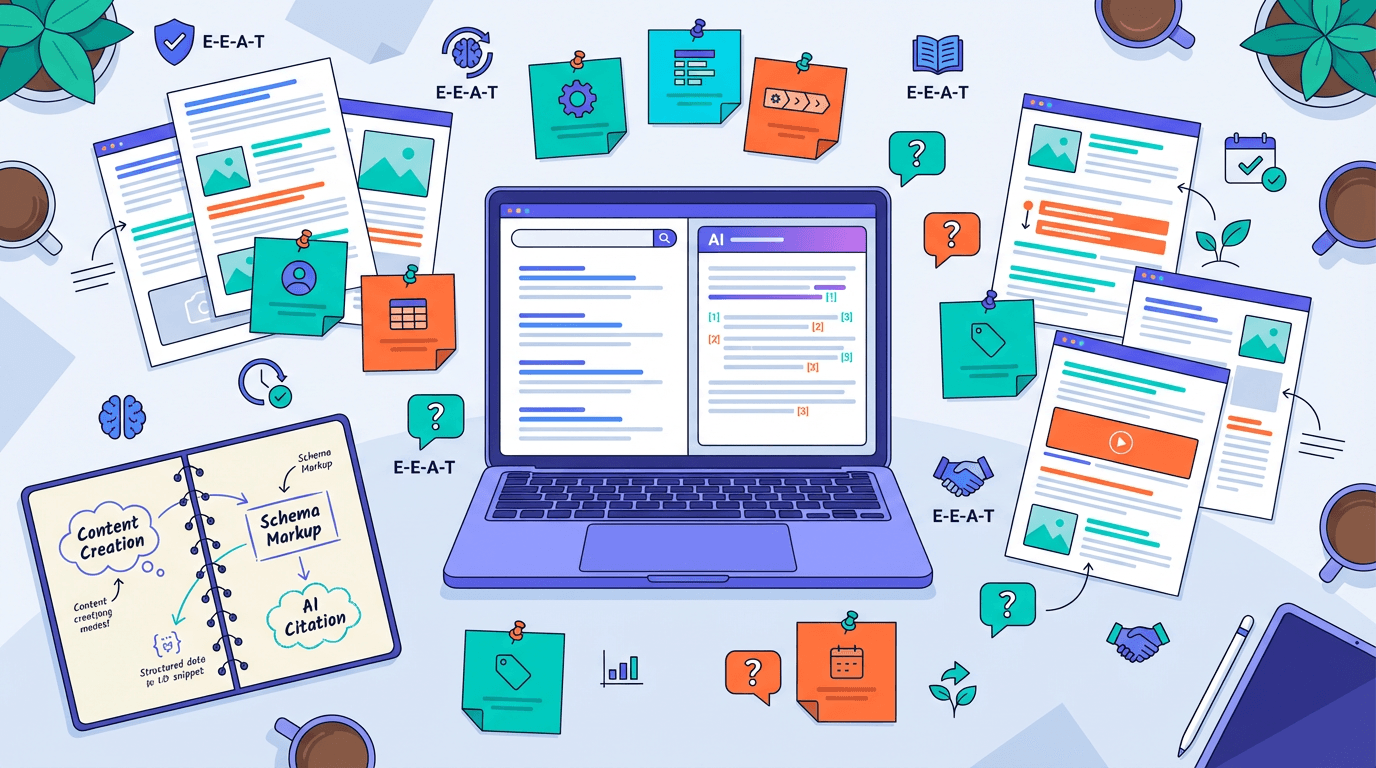
You've seen it happen. You search for something on Google, and an AI-generated summary answers the question before you even scroll. The snippets come from sites you've never heard of. Your carefully optimized blog post? Below the fold. Invisible. If you're trying to figure out how to make content discoverable in AI engines, you're asking the right question at exactly the right time, because keywords and backlinks alone stopped being enough a while ago.
A study by SEO.ai analyzing 1,000 commercial terms found that Google displayed an AI-generated element for 86.8% of all search queries. Perplexity, ChatGPT with browsing, and Copilot are all pulling from the open web and deciding which sources earn a citation. Some publishers have reported traffic drops of up to 40% in ad revenue after AI Overviews rolled out. The shift isn't theoretical. And the content that gets cited follows a specific set of patterns that any team can learn.
-
- Structure your content for machine readability
-
- Answer questions directly and early
-
- Build E-E-A-T signals AI engines can verify
-
- Implement structured data (Schema markup)
-
- Keep content fresh and factually current
-
- Audit and adapt existing pages
Structure Your Content So AI Engines Can Parse It
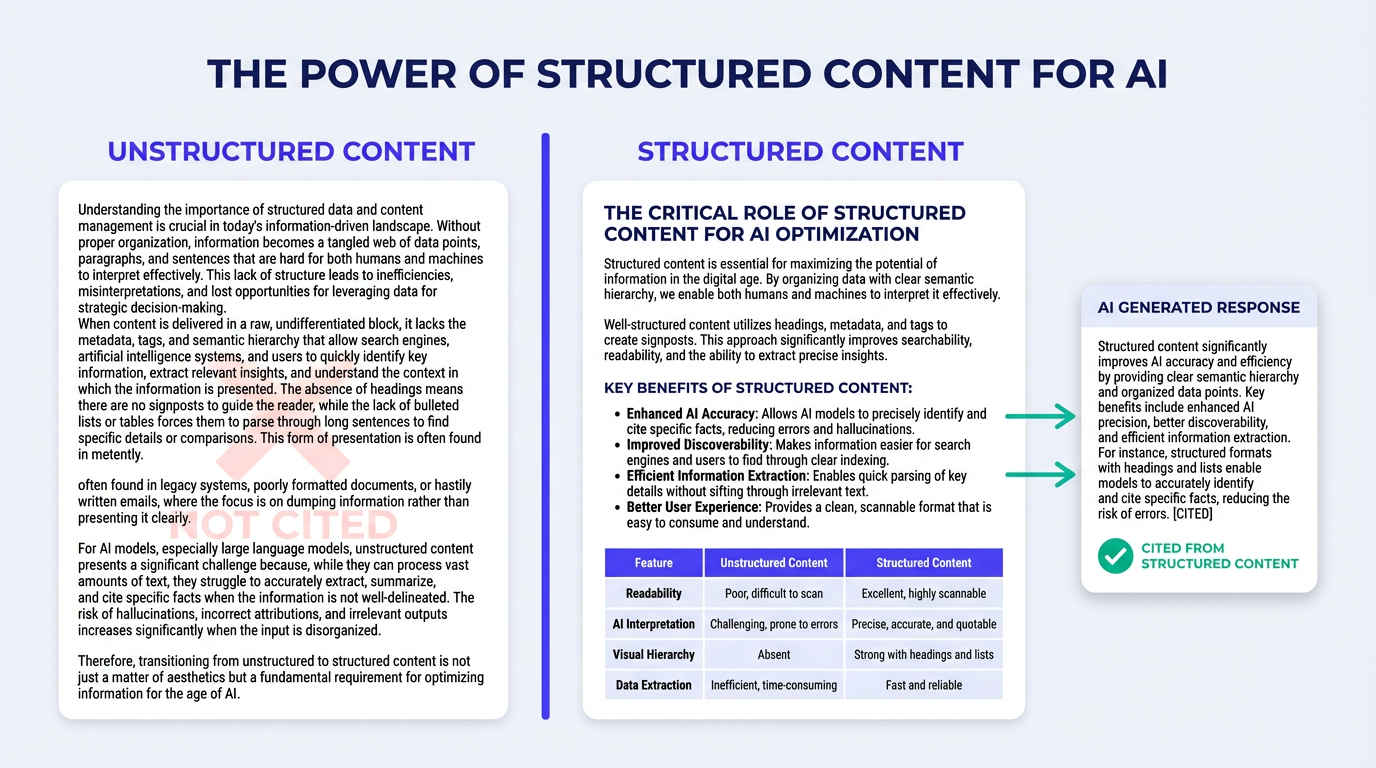
Most content fails at AI discoverability not because the writing is bad, but because the formatting is. AI engines parse pages differently than humans. They scan for hierarchical signals: H2s and H3s that accurately describe what follows, paragraphs that stay on a single topic, and lists or tables that organize comparable information cleanly. Dense, unstructured prose performs worst across every AI engine I've tested content against.
I've seen teams produce genuinely expert content that never gets cited because it's buried in 2,000-word walls of text with vague subheadings like "Things to Consider." The fix is almost embarrassingly simple. Break your content into scannable sections. Use headings that mirror the questions people actually ask. If someone searches "how long does it take to index a new page," your H2 should be close to that phrasing, not "Indexation Timelines and Related Considerations."
Here's the part most guides get wrong: they tell you to "add more headers." That misses the point. Each header should function as a promise, and the two sentences directly beneath it should deliver on that promise. AI engines pull the most concise, direct answer from under each heading. If your actual answer lives in paragraph four, it won't get selected. Structure isn't decoration. It's the primary mechanism for how to make content discoverable in AI engines that are scanning thousands of pages per query.
Answer Questions Directly, Then Add Depth
AI engines like Perplexity synthesize information from authoritative sources and present cited summaries. To earn that citation, your content needs to deliver a clear, direct answer within the first 40 to 60 words of a section. The inverted pyramid from journalism applies here, except now it's not just good writing practice. It's a technical requirement for AI content discoverability.
Once the direct answer is in place, go deeper. Provide context, examples, edge cases, real data. That depth is what separates you from every other page giving the same surface-level response. AI engines evaluate whether a source provides comprehensive coverage of a topic, not just a quick hit. But the quick hit has to come first, or the engine never reads far enough to find your expertise.
This two-layer approach (concise answer up front, rich supporting detail below) is one of the most reliable ways to make content discoverable in AI engines regardless of which platform is doing the summarizing. Get the answer wrong or bury it, and nothing else you do matters much.
E-E-A-T Signals That AI Engines Can Actually Verify
E-E-A-T (Experience, Expertise, Authoritativeness, Trustworthiness) isn't just a Google concept anymore. Every major AI search engine uses similar trust signals to decide which sources to cite. But here's what nobody tells you: AI engines can't read your "About Us" page and feel impressed. They verify E-E-A-T through concrete, crawlable signals. If those signals aren't present, your content won't get picked, no matter how good the writing is.
What actually moves the needle:
- Author bylines linked to real author pages with credentials, published work, and social profiles
- Citations to primary sources (studies, official documentation, named experts) within your content
- Backlinks from recognized industry publications
- Consistent publishing history on the topic, not a one-off post
I've watched brands with thin domain authority outrank established players in AI citations simply because they had better author pages and cited their sources properly. The bar for trust in AI engines is different from traditional SEO. It's less about PageRank and more about whether the content looks like it came from someone who actually knows the subject. Understanding how answer engines are the new front page of the internet helps frame why these signals matter so much now. If you want to know how to make content discoverable in AI engines, start by making your authorship verifiable.
Schema Markup: The Structured Data That Makes Content Discoverable in AI Engines
Schema markup has been "recommended" for years. For AI content discoverability, it's closer to mandatory. AI engines use structured data to understand what your content is, who wrote it, when it was last updated, and what questions it answers. Without it, you're asking the AI to figure all of that out from raw HTML. Sometimes it will. Often it won't bother.
| Schema Type | What It Signals | Impact on AI Citation |
|---|---|---|
| FAQPage | Content answers specific questions | High, directly maps to Q&A extraction |
| HowTo | Step-by-step process content | High, structured steps are easy for AI to parse |
| Article + Author | Who wrote it, when, expertise | Medium-High, feeds E-E-A-T evaluation |
| Organization | Brand identity and trust signals | Medium, establishes entity recognition |
| Speakable | Content suitable for voice/audio answers | Growing, especially for voice AI assistants |
| Schema types ranked by their influence on AI engine source selection, based on 2025-2026 observations. |
Speakable schema is one most people skip entirely, and it's becoming increasingly relevant as AI assistants read answers aloud. If your content answers a question someone would ask Siri or Alexa, mark it up. Schema won't guarantee a citation on its own, but missing it gives AI engines one less reason to choose your page over a competitor's.
Content Freshness: Why AI Engines Care When You Last Updated
Freshness has always mattered for SEO. For AI engines, it matters differently. These systems don't just check your publish date. They evaluate whether the information itself is current. A page published in 2024 with outdated statistics will lose to a 2026 page with current data, even if the older page has stronger backlinks. This is one of the quieter factors in how to make content discoverable in AI engines, but it compounds over time.
The practical move: set a quarterly review schedule for your highest-value pages. Update statistics, refresh examples, and (this is the part people forget) update your "dateModified" schema property when you do. AI engines use that timestamp. If you're scaling AI content across dozens or hundreds of pages, build the refresh cycle into your production workflow from day one. Retrofitting it later is painful and easy to deprioritize until traffic has already dropped.
Audit and Adapt Your Existing Content for AI Discoverability
You don't need to start from scratch. Most brands already have content that's close to being AI-discoverable but falls short on structure, directness, or schema. The fastest ROI comes from auditing your existing library and making targeted improvements rather than producing net-new pages.
Start by identifying pages that already rank on page one or two for question-based queries. These are your best candidates because they've already proven topical relevance. Then restructure them: add direct answers under clear headings, implement FAQ schema, update any stale data points, and add author attribution. You can perform an SEO content audit to systematically identify which pages need what. And if you have content that performed well in traditional search but covers topics AI engines are now summarizing, consider using a prompt to repurpose content for AI discoverability specifically.
Mistakes That Kill AI Content Discoverability
I've audited enough sites at this point to see the same patterns repeating. These are the mistakes that consistently prevent content from being cited by AI engines, and most of them are fixable in an afternoon.
Burying the answer. If your actual answer to a question doesn't appear until the third or fourth paragraph of a section, AI engines will often skip your page entirely and cite someone who gets to the point faster. This is the single most common issue I see in every audit. It's also the easiest to fix.
Ignoring entity disambiguation. If your content mentions "Apple" and you mean the company, but you never establish that context clearly, AI engines can misclassify your content entirely. Named entities need context. A single clarifying phrase early on can prevent your page from being filtered out of results it should appear in.
Treating AI optimization as a separate discipline. It's not. It's an extension of the same SEO principles, with higher standards for structure and directness. Teams that create separate "AI optimization" workflows end up duplicating effort and splitting their focus. Run your content through an AI content checker to catch issues that affect both traditional and AI search simultaneously.
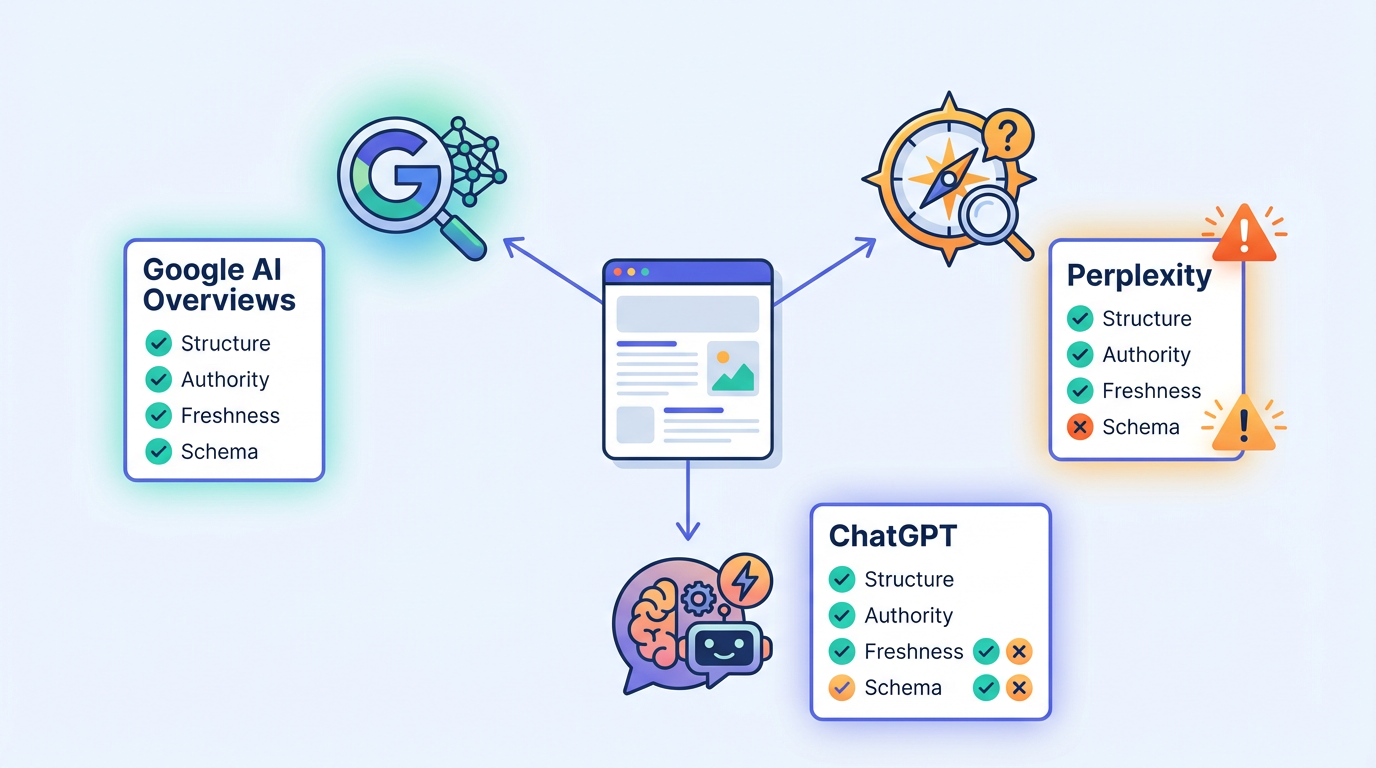
Over-optimizing for one AI engine. Google's AI Overviews, Perplexity, and ChatGPT all have slightly different selection criteria. Writing exclusively for one means you'll likely miss the others. The fundamentals (structure, directness, authority, freshness) work across all of them. That's the whole point of learning how to make content discoverable in AI engines broadly rather than gaming a single platform.
How to Make Content Discoverable in AI Engines: What to Do This Week
Making content discoverable in AI engines isn't a one-time project. It's a shift in how you think about content production. The good news is that the fundamentals (clear structure, direct answers, real expertise, proper markup) also make your content better for human readers. You're not optimizing for robots at the expense of people. You're being more precise about how you present what you already know.
Pick your five highest-traffic pages this week. Audit them against the steps above. You'll probably find that most need structural changes more than content changes. That's the pattern I see over and over: the knowledge is there, but the packaging isn't built for how AI engines consume information. Fix the packaging first. The results tend to show up faster than you'd expect.
Frequently Asked Questions
What does 'AI content discoverability' actually mean?
It means your content is structured, authoritative, and formatted so that AI engines (like Google's AI Overviews, Perplexity, and ChatGPT) can parse, evaluate, and cite it when generating answers to user queries. It goes beyond traditional SEO rankings to focus on being selected as a source in AI-generated summaries.
Is optimizing for AI engines different from traditional SEO?
It's an evolution, not a replacement. The same principles apply (quality content, good structure, authority signals), but AI engines place higher emphasis on direct answers, structured data like Schema markup, content freshness, and E-E-A-T signals that can be programmatically verified. You don't need a separate strategy, just a sharper one.
Which AI engines should I focus on?
Google's AI Overviews reach the largest audience since they appear in standard Google search. Perplexity and ChatGPT with browsing are growing fast, especially among younger and more technical users. Optimize for the shared fundamentals (structure, authority, schema, freshness) and you'll cover all three effectively.
How quickly can I see results from AI search optimization?
Structural changes (adding schema, restructuring headings, adding direct answers) can start showing results within weeks as AI engines re-crawl your pages. Authority-building signals like backlinks and consistent publishing take longer, typically 3 to 6 months to meaningfully influence citation rates.
Do I need to rewrite all my existing content?
Almost never. In most cases, the expertise is already in your content. What's missing is the formatting and markup that AI engines need. Start by auditing your top-performing pages and restructuring them with clear headings, direct answers, and proper Schema. That alone covers 80% of the opportunity.
