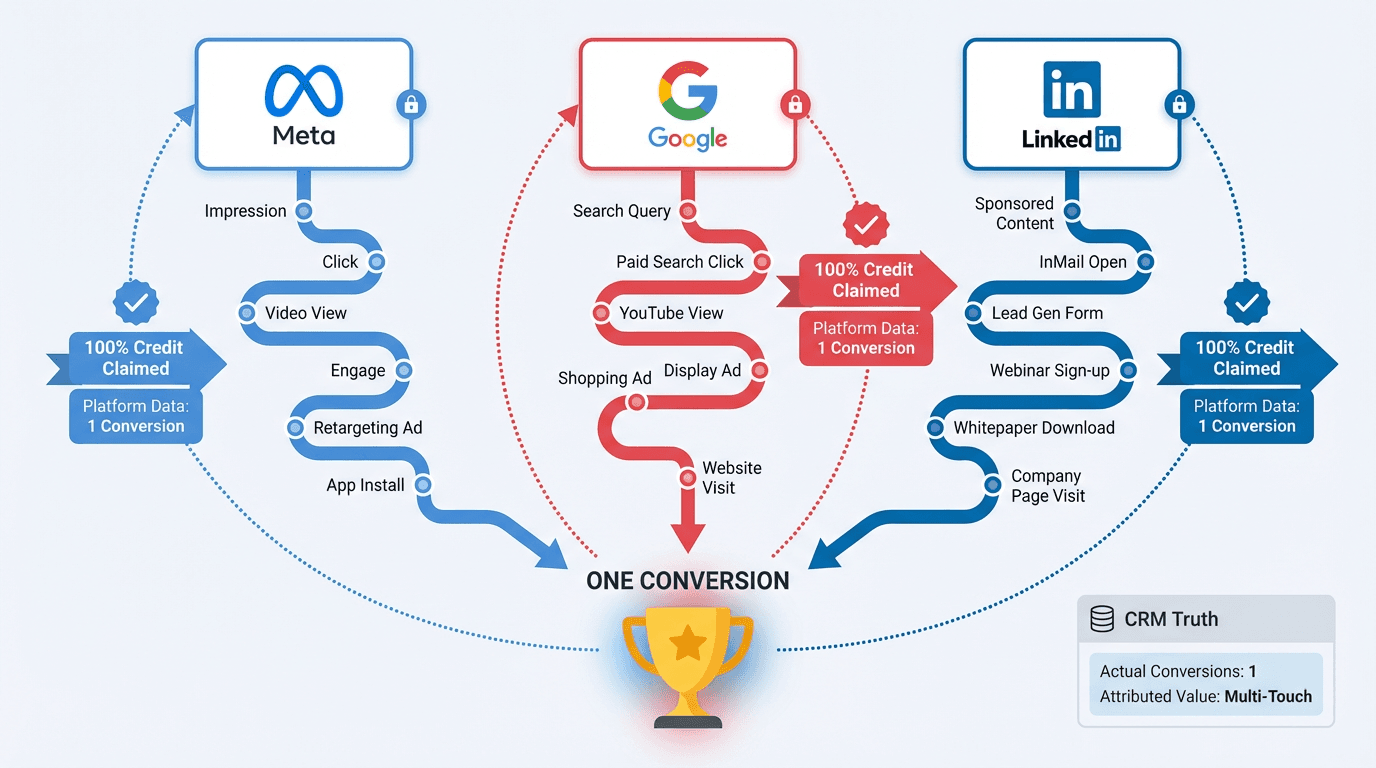
You run the same campaign on Meta, Google, and LinkedIn. Meta reports 50 sales, Google claims 45, and LinkedIn adds 30 leads. Your CRM? It shows only 60 total deals closed. The numbers don't add up, and no platform is telling the full truth. If you've tried to track conversions across ad platforms, this scenario is painfully familiar. Each platform operates inside its own walled garden, optimizing to claim credit for results and making it nearly impossible to see your true return on investment (ROI). The cost of this confusion isn't just frustration. It's misallocated budget, inflated performance reports, and strategic decisions built on incomplete data.
This text breaks down the native tracking systems of Meta, Google, and LinkedIn, explains exactly why their numbers conflict, and details how a unified attribution platform provides a single source of truth. You will see how to integrate all your marketing data so you can accurately measure performance, eliminate double-counting, and connect ad spend directly to revenue.
Why Your Platforms Can't Agree on a Number
Conflicting data arises because each ad platform uses different attribution windows and is blind to user touchpoints on other channels. Privacy changes have also degraded pixel tracking, forcing platforms to use modeled conversions. This results in systematic double-counting where multiple platforms claim the same sale.
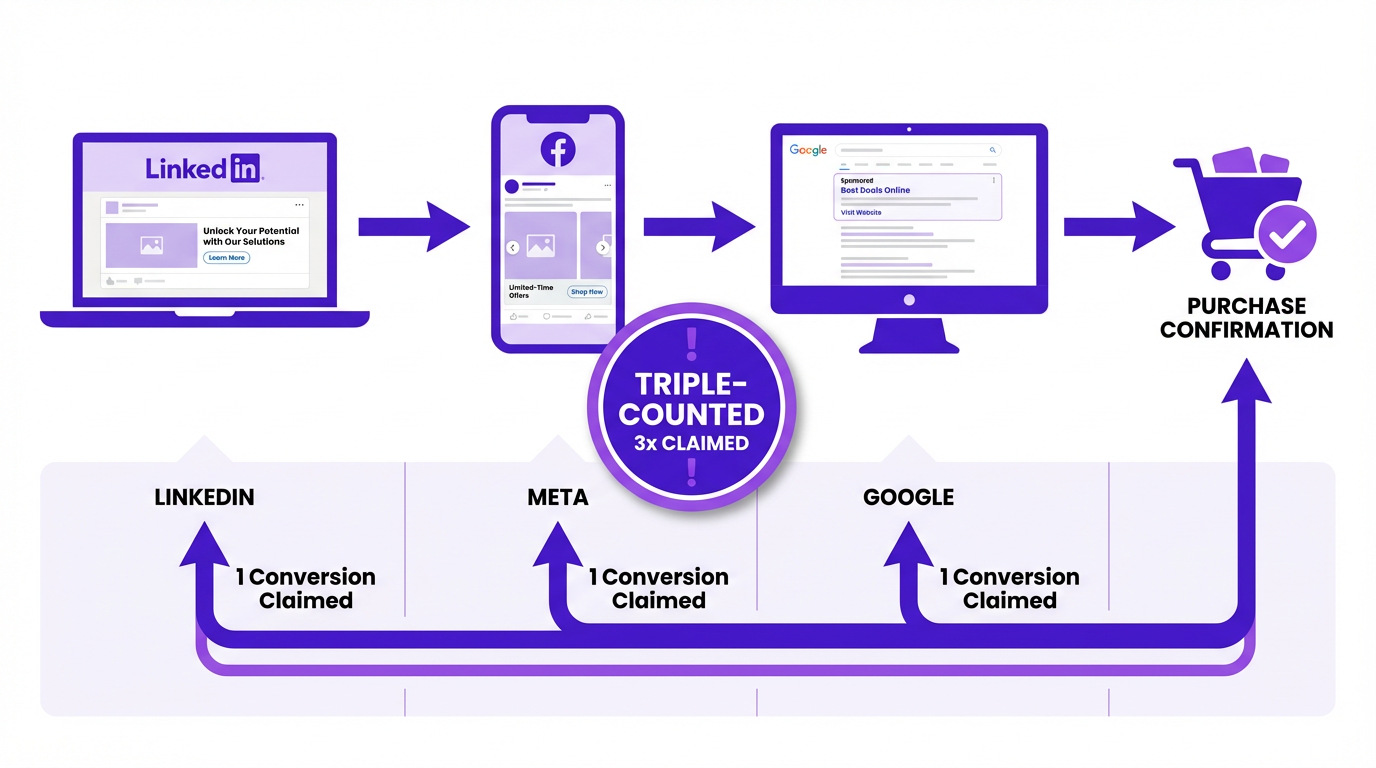
The root cause of conflicting data is straightforward: each platform uses different rules to define and count a conversion. None of them are fabricating results. They simply aren't measuring the same thing. The result is systematic double-counting, where a single sale gets claimed by two or three platforms simultaneously. Understanding these discrepancies is the first step toward building a reliable cross-platform measurement strategy.
Three factors drive the discrepancy:
- Conflicting Attribution Windows: An attribution window is the period after an ad interaction during which a conversion can be credited. Meta defaults to a 7-day click and 1-day view window, Google often uses 30 days for clicks, and LinkedIn applies a 30-day click and 7-day view window. A sale that happens 10 days after a click could be claimed by Google and LinkedIn but missed entirely by Meta.
- Walled Garden Blindness: Each platform is completely blind to the others. Google can't see the LinkedIn ad that primed a prospect, and Meta has no visibility into the Google search ad a user clicked before purchasing. From each platform's limited perspective, it was the sole driver of the conversion, so it takes full credit.
- Degraded Pixel Tracking: Privacy shifts like Apple's App Tracking Transparency (ATT) and the phasing out of third-party cookies have significantly weakened browser-based pixel tracking. This data loss is uneven across platforms, forcing each one to rely on "modeled" conversions (statistical estimates that are impossible to independently audit).
When you see conversion totals from Meta, Google, and LinkedIn that exceed your CRM's actual closed deals, you're not looking at a reporting error. You're seeing the predictable outcome of three isolated systems, each applying their own attribution logic to the same customer journey.
Google Ads Conversion Tracking: The Default That's Harder Than It Looks
Google's native tracking, including Enhanced Conversions and Consent Mode v2, offers strong optimization signals within its ecosystem. However, its attribution is Google-centric, over-attributing value when other platforms are involved. Implementation requires significant technical expertise, creating a barrier for many marketing teams.
Google's native tracking is the most mature option available, offering powerful features like Enhanced Conversions, offline conversion imports, and Consent Mode v2. Enhanced Conversions address the cookie gap by using hashed first-party data (such as email addresses) to connect ad interactions with website conversions, improving match rates significantly. For teams running search, display, and Performance Max campaigns, these tools provide strong optimization signals within the Google ecosystem.
The tradeoff? Google's attribution is inherently Google-centric. Its data-driven model is sophisticated but designed to optimize spend within the Google ecosystem. It has no incentive to reveal that a LinkedIn post sparked the initial awareness that led to a conversion. Implementation has also become a technical challenge. Configuring server-side tagging via Google Tag Manager, setting up Consent Mode v2, and enabling Enhanced Conversions requires developer-level expertise that many marketing teams lack in-house.
If you're running Google Ads alongside other channels, always verify your conversion counts against CRM data. Google's data-driven model excels at internal optimization but consistently over-attributes when other platforms contributed to the same journey.
Meta's Conversion Tracking in 2026: Rebuilding After ATT
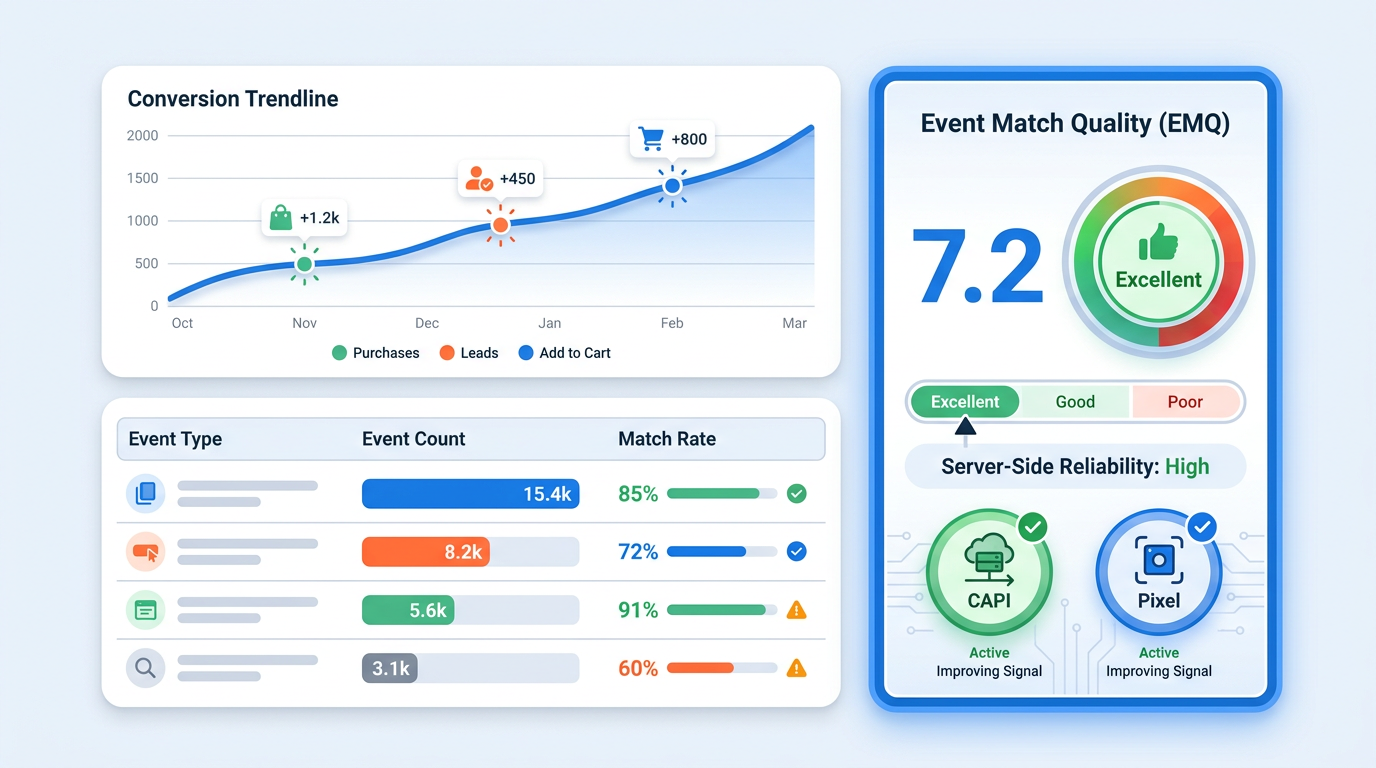
Following Apple's ATT Meta's Conversions API (CAPI) became essential for reliable tracking by sending data directly from your server. Relying only on the browser Pixel can lead to missing 20-40% of conversions. Meta also uses modeled conversions to fill data gaps, but these lack transparency for ROI reporting.
Apple's ATT framework fundamentally disrupted Meta's tracking capabilities. The response was the Conversions API (CAPI), which is now essential for any serious advertiser on the platform. CAPI sends conversion data directly from your server to Meta, creating a far more reliable data connection than the browser-based Pixel alone. For businesses not using a plug-and-play e-commerce platform like Shopify, implementing CAPI requires developer resources. Relying solely on the Pixel could mean missing 20-40% of your actual conversions.
To compensate for data loss, Meta relies heavily on modeled conversions. These statistical estimates help the ad algorithm optimize delivery, but they lack transparency, making them unreliable for definitive ROI reporting. To get the most from Meta's tracking, you need a solid understanding of both the Meta Pixel and CAPI and the latest Meta Ad specs. Pairing CAPI with a cross-platform attribution tool closes the gap between what Meta reports and what actually happened.
LinkedIn's Conversion Tracking: Solid for B2B, Limited Everywhere Else
LinkedIn's tracking is ideal for B2B marketers, connecting ad campaigns to CRM data for long sales cycles. Its audience targeting is excellent for account-based marketing. However, its infrastructure is less advanced than Google's or Meta's, using last-touch attribution and offering only a narrow view of the customer journey.
LinkedIn's conversion tracking is purpose-built for B2B marketers. By combining the LinkedIn Insight Tag with offline conversion uploads, businesses can tie ad campaigns directly to pipeline and revenue tracked in a CRM. For companies managing long sales cycles (often 3-6 months or more), this connection between ad spend and closed deals is critical. LinkedIn's audience targeting by job title, company size, and industry makes it uniquely valuable for account-based marketing strategies.
That said, LinkedIn's tracking infrastructure lags behind Google and Meta by a generation. Attribution is strictly last-touch within its own ecosystem, and it lacks an equivalent to Google's data-driven models or Meta's CAPI. While LinkedIn remains a top B2B lead generation platform, its native reporting offers only a narrow slice of the full customer journey. To maximize the ROI of your LinkedIn investment, pair strong tracking with effective LinkedIn thought leadership content that resonates with a professional audience.
Head-to-Head: Native Platform Tracking Compared
A direct comparison shows Google, Meta, and LinkedIn use different attribution models and server-side tracking methods. Google has strong cross-device capabilities via account sign-ins, as does Meta. All platforms use modeled conversions to varying degrees, highlighting the need for a unified approach to get a clear picture.
| Feature | Google Ads | Meta Ads | LinkedIn Ads |
|---|---|---|---|
| Default Attribution | Data-Driven (30-day click) | 7-day click, 1-day view | 30-day click, 7-day view |
| Available Models | Data-Driven, Last Click, First Click, Linear, Time Decay, Position-Based | Last Touch (configurable window) | Last Touch |
| Server-Side Tracking | Yes (Enhanced Conversions, Server-Side GTM) | Yes (Conversions API - CAPI) | Yes (Conversions API) |
| Cross-Device Tracking | Strong (via Google Account sign-ins) | Strong (via Meta Account sign-ins) | Limited |
| Privacy Compliance | Consent Mode v2 | Aggregated Event Measurement, Limited Data Use | Standard consent mechanisms |
| Modeled Conversions | Yes (heavily used) | Yes (heavily used) | Minimal |
| Comparison of native conversion tracking features across major ad platforms as of 2026. |
Native tracking is a necessary foundation. It provides the data each platform needs for ad optimization. But it is completely insufficient for accurate, cross-channel ROI analysis. To solve the double-counting problem and truly track conversions across ad platforms, you need a dedicated tool that sits above these walled gardens and acts as a single source of truth.
Vizup: The Solution for Unified Cross-Platform Attribution
To get a true, deduplicated view of performance, marketers need a unified attribution platform like Vizup. It ingests data from all marketing sources, including ads, organic channels, and your CRM, applying an AI-driven model to create a single, reliable picture of your marketing ROI and real-time telemetry.
To achieve a true, deduplicated view of performance, marketers need a unified attribution platform. Vizup is designed to solve this exact problem by ingesting cost and conversion data from all your sources, including paid ad platforms, organic channels, and your CRM. It then applies its own AI-driven attribution model to create a single, reliable picture of your marketing ROI.
Vizup's AI platform bridges the gap between paid media and organic marketing by connecting signals from content, SEO, and social with paid conversion data. This provides a unified view of performance, revealing how a blog post or an organic social share assisted a paid conversion that Meta or Google would otherwise claim full credit for. This unified view is essential for businesses that blend paid and organic growth strategies, as it closes the gap between channels and provides a single source of truth for the entire marketing funnel, not just ad spend. Explore our features to see how we unify your data.
This means you can see exactly how SEO-driven content lowers customer acquisition costs on paid channels by improving ad relevance and warming audiences before they ever click an ad. That synergy can be amplified further by optimizing your Google Ads copy to align with the organic content your prospects have already engaged with. By connecting every touchpoint, Vizup helps you build a more efficient, predictable growth marketing engine.
A B2B SaaS company running campaigns on all three platforms discovered that LinkedIn ads were initiating 40% of their eventual conversions, but Google was claiming credit for most of them at the last click. After implementing Vizup's unified attribution, they reallocated 25% of their Google budget to LinkedIn awareness campaigns and saw a 18% decrease in overall cost per acquisition within 60 days.
Attribution Models in 2026: What's Changing and What to Bet On
Last-click attribution is declining, with a market consensus shifting toward data-driven and AI-modeled approaches. These systems use first-party data and probabilistic matching to reconstruct customer journeys in a privacy-compliant way, adapting to the degradation of cookie-based tracking and leveraging distributed data clusters for analysis.
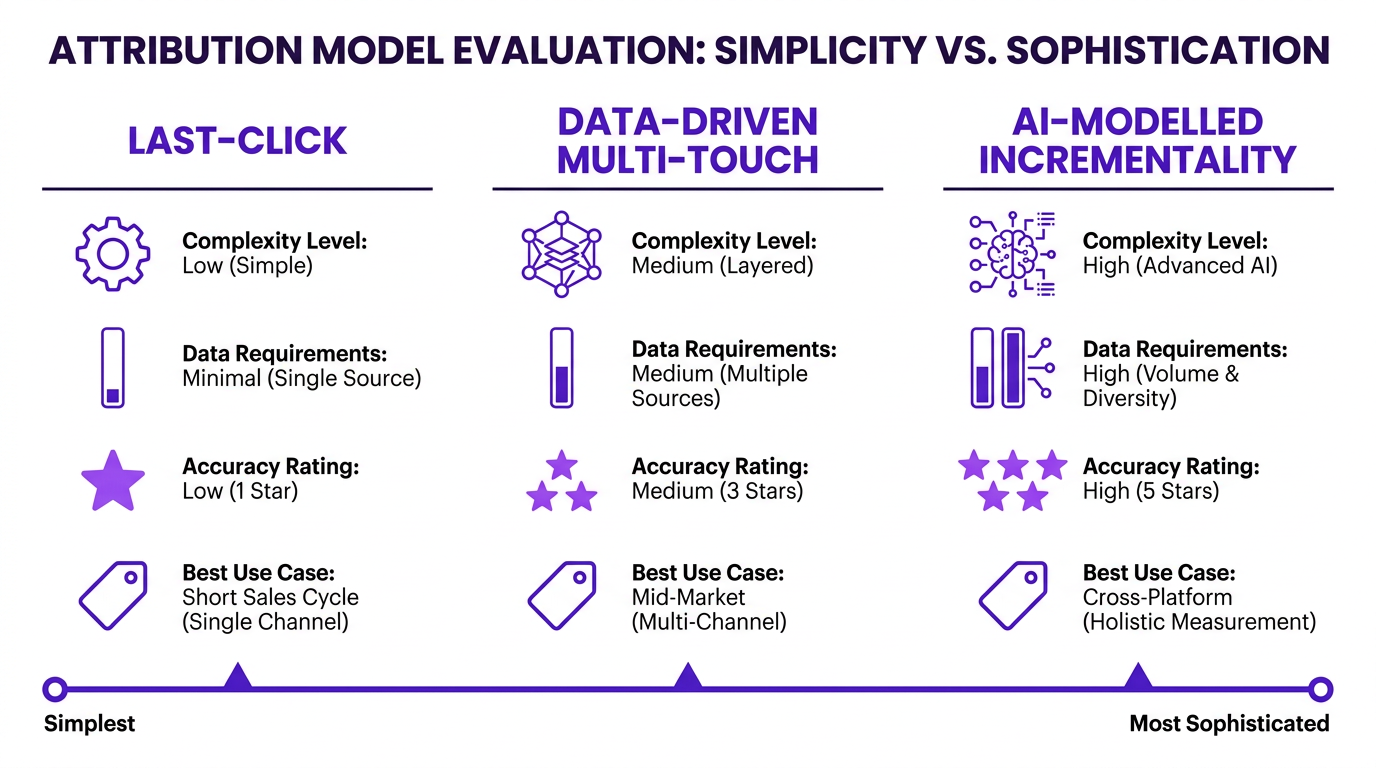
Last-click attribution is declining but far from extinct. It remains the default in many LinkedIn and Google Ads reports. More sophisticated teams are shifting to data-driven and incrementality models, though these require significant conversion volume (often 300 or more per month) to produce statistically reliable results. The model you choose directly impacts which channels appear to perform well and which look like they're underdelivering.
The defining trend for 2026 is the rise of AI-modeled attribution. These systems combine a company's first-party data with probabilistic matching to reconstruct customer journeys in a privacy-compliant way. According to a 2026 report from Forrester, AI is fundamentally transforming how marketing accountability is delivered and measured. Any tool that can't adapt beyond deterministic, cookie-based tracking will become increasingly unreliable as data signals continue to degrade.
Three attribution approaches to evaluate for your team:
- Last-Click / Last-Touch: Simple to implement and understand, but systematically undervalues upper-funnel channels like LinkedIn awareness campaigns and organic content. Best suited for teams with limited analytics resources or very short sales cycles.
- Data-Driven (Multi-Touch): Distributes credit based on observed patterns in your conversion data. Requires high volume (300+ monthly conversions) and works best within a single platform's ecosystem. A strong choice for mid-market teams with sufficient data.
- AI-Modeled / Incrementality: Uses machine learning and statistical testing to estimate what would have happened without a specific touchpoint. The most accurate approach for cross-platform measurement, but requires the most sophisticated tooling. This is where the industry is heading, and platforms like Vizup make it accessible without building a data science team.
The Verdict: Which Setup Should You Actually Use?
The best setup is a two-layer approach. First, configure native tracking on each platform (Meta CAPI, Google Enhanced Conversions, LinkedIn Insight Tag). Second, layer a cross-platform attribution tool like Vizup on top to deduplicate data and serve as your single source of truth for ROI.
To effectively track conversions across ad platforms, you need a two-layer approach. First, correctly configure each platform's native tracking: enable CAPI for Meta, Enhanced Conversions for Google Ads, and the Insight Tag for LinkedIn. This provides the optimization data each platform needs to serve ads effectively. Second, layer a cross-platform attribution tool like Vizup on top to deduplicate the data and serve as your definitive source of truth.
Your action plan for accurate cross-platform conversion tracking:
- Step 1: Configure native tracking on every platform. Set up Meta CAPI, Google Enhanced Conversions, and the LinkedIn Insight Tag. Prioritize server-side implementations over browser-only pixels.
- Step 2: Validate data against your CRM. Compare platform-reported conversions to actual closed deals weekly. Document the gap so you can quantify the double-counting problem.
- Step 3: Implement a unified attribution layer. Connect all platforms and your CRM to a cross-platform tool like Vizup. This creates a single, deduplicated view of every conversion.
- Step 4: Choose the right attribution model. Start with multi-touch if you have 300+ monthly conversions. If not, use a linear or time-decay model as a baseline and graduate to AI-modeled attribution as your data matures.
- Step 5: Reallocate budget based on unified data. Use your deduplicated reports to shift spend toward the channels and campaigns that actually drive revenue, not just the ones that claim credit.
By unifying data from every source, Vizup moves you beyond conflicting reports and toward confident budget allocation. You can finally answer the most important question: which combination of efforts truly drives revenue? This allows you to stop guessing and start building a marketing strategy based on a complete, accurate, and unified view of performance. No matter your business model, the principle remains the same: never rely on a single platform's self-reported numbers to make budget decisions. Cross-platform attribution isn't optional in 2026. It's the difference between optimizing based on reality and optimizing based on each platform's best guess.
FAQ: Tracking Conversions & ROI Across Ad Platforms
Why do Meta, Google, and LinkedIn report different conversion numbers for the same campaign?
Each platform uses its own attribution model and tracking window. A single conversion can be claimed by multiple platforms if it falls within each of their unique reporting rules, leading to double-counting and inflated numbers. The only way to resolve this is with a cross-platform attribution tool like Vizup that deduplicates conversions.
What is the best attribution model for tracking ROI across multiple ad platforms?
For advertisers with enough conversion volume, a data-driven or machine learning-based attribution model is usually stronger than last-click because it assigns credit based on observed contribution rather than fixed rules. Smaller teams can start with a linear or time-decay model, then move toward AI-modeled attribution as their data quality and conversion volume improve. A platform like Vizup can help unify these signals across paid, organic, and CRM data.
How do privacy changes like iOS App Tracking Transparency affect multi-channel tracking in 2026?
Privacy changes such as iOS App Tracking Transparency, browser restrictions, and cookie deprecation have made it harder to track users consistently across apps, browsers, and websites. This has reduced the reliability of platform-native reporting and increased the need for first-party data, server-side tracking, consent-aware measurement, and independent attribution reporting.
How can I track conversions across ad platforms without a large budget?
Start by implementing each platform's native server-side tracking (Meta CAPI, Google Enhanced Conversions, LinkedIn Insight Tag) to maximize data quality. Then, use a unified analytics platform like Vizup to centralize and deduplicate that data, providing a single source of truth for ROI without requiring a massive budget for multiple point solutions.
What is a 'single source of truth' for ad tracking?
A single source of truth (SSoT) is a centralized, unified view of all your marketing data that everyone in the organization agrees is accurate and reliable. For ad tracking, it means consolidating data from all platforms (Google, Meta, etc.) into one place to get a deduplicated, holistic view of campaign performance. This stops debates over conflicting platform reports and provides a trustworthy foundation for calculating ROI and making budget decisions.
