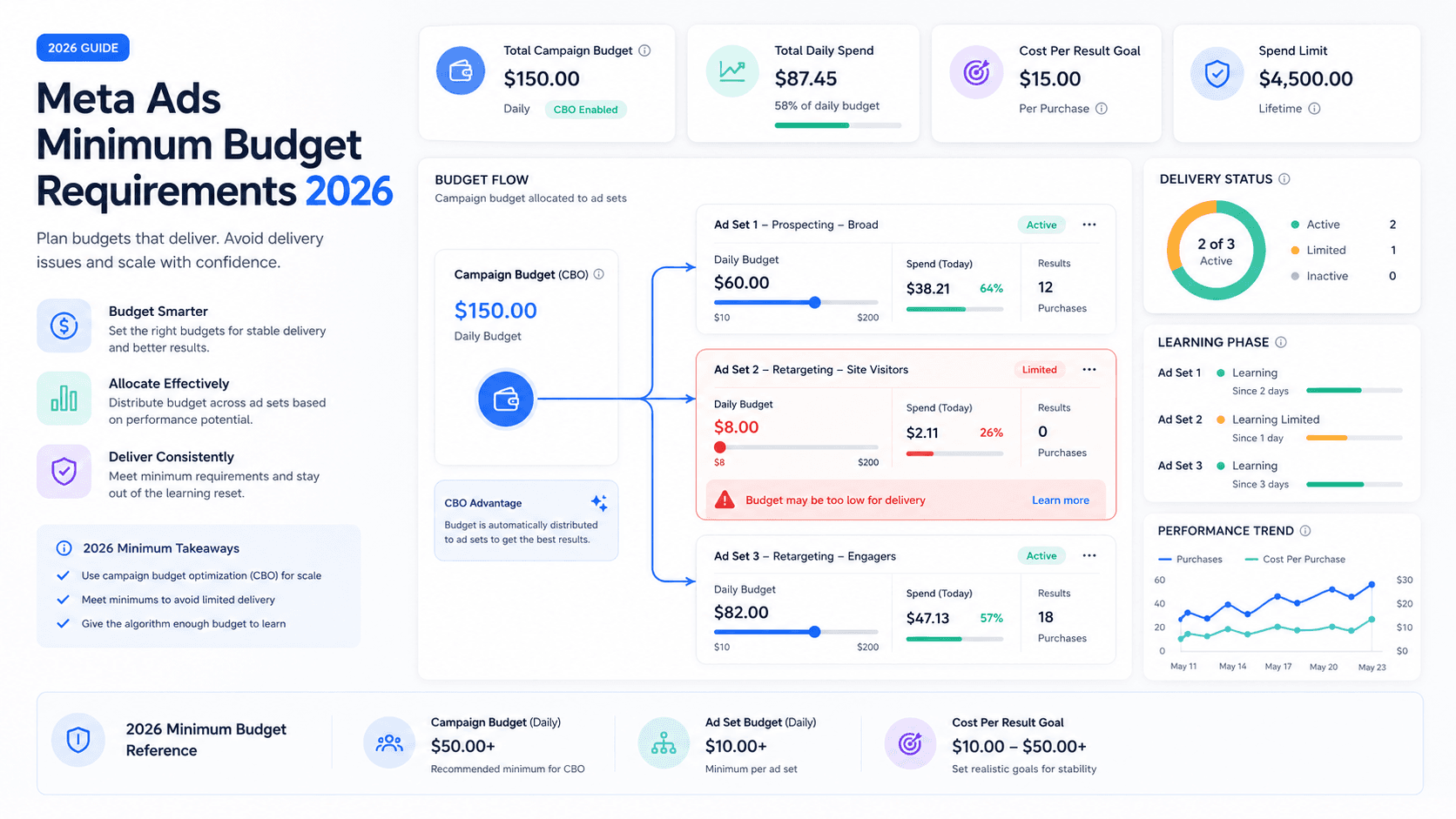
It's a common belief that you can get meaningful results from Meta ads on just $5 a day. Many entrepreneurs have invested money in Meta Ads Manager only to feel the platform is unpredictable or that their campaigns aren't working. Often, the issue isn't the ads themselves, but the budget. Meta’s official minimums are a technical starting point, not a strategy for success. For 2026, understanding the practical Meta ads minimum budget requirements is what gives a campaign a genuine chance. This is about providing the algorithm with enough resources to learn and perform effectively.
This isn't just a list of Meta’s published minimums. The focus here is on what works in real-world scenarios, based on extensive campaign management experience. We’ll cover how daily and lifetime budgets operate, why Meta might flag a budget as "too low," and what a reasonable starting budget looks like for different campaign goals. You should leave with a clear idea of how to set a budget that does more than just spend money, it gathers data, completes the learning phase, and delivers results you can evaluate. If you are looking for dimensions, placements, image ratios, or video requirements, read our guide to Meta ad specs and creative sizes.
What Are Meta Ads Minimum Budget Requirements in 2026?
Meta doesn’t have one universal minimum budget because requirements vary based on how a campaign is structured. Officially, you can run an ad for as little as $1 per day for certain campaigns, like those focused on impressions. While that's technically true, it's like a car with just enough gas to start the engine, you're running, but you won't get far.
In practice, your minimum budget is determined by several factors:
- Campaign Objective: Brand awareness typically costs less per result than a campaign optimized for sales.
- Bid Strategy: A cost per result goal generally demands more budget than simply bidding for the lowest cost.
- Audience: A narrow, competitive audience is more expensive to reach than a broad one.
- Schedule: A short, aggressive campaign needs more daily spend than a slow-burn one.
- Optimization Event: Optimizing for a high-value action like a ‘Purchase’ costs more than a ‘Link Click’.
The gap between Meta’s technical minimums (which can be as low as $1-$5 depending on the setup) and a budget that actually produces useful data is where many new advertisers struggle. In 2026, a realistic floor for a new campaign is often closer to $50-$150 per day, simply to generate enough activity for the optimization algorithm to function properly.
Daily Budget vs Lifetime Budget in Meta Ads
Meta offers two primary ways to control spending: a Meta daily budget or a Meta lifetime budget. A common misunderstanding is treating the daily budget as a rigid daily limit. It's more flexible than that.
A Daily Budget is the average amount you're willing to spend each day. If Meta identifies a strong opportunity, it can spend up to 75% more than your daily budget on a given day. It then balances this by spending less on other days, ensuring your total weekly spend doesn't exceed seven times your daily budget. A $100 daily budget could become $175 on a high-traffic Saturday and less on a quiet Tuesday, but your weekly total would stay at or below $700. This approach works well for evergreen, always-on campaigns where steady delivery is desired without constant adjustments.
A Lifetime Budget is the total amount you're willing to spend over the campaign's entire duration. You set a start and end date, and Meta paces the spending across that period, allocating more on days with better opportunities. This is ideal for fixed-time campaigns like flash sales, product launches, or event promotions. A key detail is that ad scheduling (dayparting) requires a lifetime budget. If you want to explore the basics, Meta's documentation explains how to set a budget.
Why Meta Says Your Budget Is Too Low
The "Meta budget too low" notification can be frustrating, but it's usually the system trying to help you. It signals that your budget doesn't align with your campaign's objectives. Here are the common reasons this happens when your budget is too low:
- Too Many Ad Sets: Splitting a small budget (e.g., $50/day) across five ad sets gives each only $10. This is often insufficient for any of them to gather enough data to optimize.
- High Cost Per Result Goal: If you set a goal of $5 per lead in a market where leads typically cost $50, Meta won't enter auctions it expects to lose, causing spend to stall.
- Narrow Audience: Your budget might be adequate, but if the audience is too small, Meta may limit delivery to avoid showing ads too frequently to the same people.
- Short Schedule: Attempting to spend $1,000 in a new campaign within 24 hours can lead to inefficient delivery because the system needs time to calibrate.
- Expensive Optimization Event: Optimizing for Purchases on a $10/day budget is unlikely to succeed. Without conversions, the system has no data to learn from.
Much of this relates to the learning phase: without enough optimization events, delivery struggles to stabilize. If your budget is flagged as too low, Meta's troubleshooting guide offers standard solutions.
Minimum Budget Rule for Cost Per Result Goal
Meta's own guidance is direct on this point. If you use the "Cost Per Result Goal" bid strategy, your daily budget should be at least 5 times your target cost per result. This isn't just a suggestion; it's a functional requirement for the strategy.
For example, if you want to acquire new customers at $10 per result, your minimum daily budget for that ad set should be at least $50. Setting it to $30 may cause delivery to be inconsistent, as you've constrained the system's ability to bid effectively. Using a cost per result goal can be effective by giving Meta a clear target, but that target is only meaningful if the campaign is funded sufficiently.
Campaign Budget vs Ad Set Budget
Deciding where to set your budget (at the campaign or ad set level) fundamentally changes how your campaigns test and scale. A Meta ad set budget (Ad Set Budget Optimization, or ABO) gives you direct control, letting you decide exactly how much each ad set spends. This makes ABO a popular choice for testing, as it guarantees each audience or creative variation gets a specific share of the budget. This is a key difference between campaign budgets and ad set budgets.
An Advantage+ campaign budget (formerly Campaign Budget Optimization, or CBO) works differently. You set a single Meta campaign budget, and the system automatically allocates that budget across your ad sets based on performance. When one ad set starts generating cheaper conversions, more of the budget will flow to it. This is excellent for scaling proven campaigns but can be tricky for testing. Meta might identify a premature "winner" and reduce spend to other ad sets before they have enough data to demonstrate their potential. Meta's help center provides its own best practices for Advantage+ campaign budget. To learn how to set up Advantage+ campaign budget, consult the official documentation.
Budget Scheduling and High-Demand Periods
Meta ads budget scheduling involves planning for fluctuations in demand rather than maintaining a flat budget. Experienced advertisers often increase spend during periods of heightened consumer attention and intent, such as:
- Holiday sales (like Black Friday)
- New product launches
- Seasonal peaks for your industry
- Promotional events
During these times, auction competition increases, which means a higher budget is often necessary to maintain visibility. A lifetime budget is a clean way to manage this, allowing you to set a total spend for a specific campaign duration, like a week-long sale.
Practical Starting Budget Examples
These ranges are practical planning examples from an advertiser’s perspective. They are not Meta’s official minimum budget requirements, and actual budgets can vary by objective, bid strategy, audience, market, and optimization event.
These are not Meta’s official minimums. Treat them as practical planning ranges for 2026, based on what it typically takes to generate meaningful data and give the algorithm a fair chance to optimize. All figures are suggested starting points per campaign.
| Campaign Objective | Recommended Daily Starting Budget (Practical Minimum) |
|---|---|
| Awareness / Creative Testing | $10 - $25 |
| Traffic (Link Clicks) | $25 - $50 |
| Leads (e.g., for a service business) | $50 - $150 |
| Sales / Conversions (e.g., for e-commerce) | $75 - $200 |
| Retargeting | $20 - $50 (audience size is the main factor) |
| Advantage+ Sales Campaigns | $100+ |
And yes, the Instagram ads minimum budget follows the same principles as Facebook’s, since both are managed through Meta Ads Manager. A common budgeting error is fragmentation: funding five separate campaigns with small budgets instead of properly funding one or two.
How Budget Affects Learning and Delivery
The Meta ads learning phase budget is a critical component of a campaign's success. To exit the learning phase and achieve stable delivery, Meta's system generally needs about 50 optimization events (such as purchases or leads) per ad set each week. If your budget is too low to generate this volume, your ad set may get stuck in a "Learning Limited" status, which often results in volatile costs and inconsistent delivery.
A simple way to estimate the daily budget needed to exit the learning phase is: (Target CPA × 50) ÷ 7. For a campaign with a $30 target CPA, this formula suggests a daily budget of roughly $214 per ad set to provide the system with enough data. Spending significantly below this amount isn't being cautious; it can be a slow and expensive way to gather inconclusive results. Meta’s documentation on delivery and ad auctions provides more detail on the mechanics of how Meta charges for ads.
Common Budget Mistakes to Avoid
These are some of the budget-related mistakes that can hinder a campaign's performance:
- Splitting a small budget too thin. A $100 daily budget is usually more effective when concentrated in one or two ad sets rather than spread across ten.
- Changing the budget too often. Making significant edits can reset the learning phase. Adjust your budget for strategic reasons, not in reaction to daily fluctuations.
- Setting cost goals too low. If the market price for a result is $20, demanding $1 purchases will likely result in minimal ad delivery. Keep your goals realistic.
- Using narrow audiences with a low budget. This combination is a quick path to "Learning Limited." Consider broadening your targeting or increasing your spend.
- Judging performance too early. Avoid making major decisions after just a couple of days. Give the system enough time and volume, aiming for at least 50 conversions or a full week of data. Meta also explains how to make editing ad sets with minimal disruption.
Meta Ads Minimum Budget FAQ
What is the minimum daily budget for Meta ads?
Technically, Meta allows budgets as low as $1 per day for impression-optimized campaigns. However, in practice for 2026, a budget closer to $25-$50 per day is more likely to provide enough data for optimization, depending on your objective.
Can I run Meta ads with $5/day?
You can run ads on $5/day, but it's best suited for small, localized awareness campaigns. For objectives like lead generation or sales, $5/day rarely generates enough conversion data for Meta's algorithm to optimize effectively, which can lead to spending without gaining traction.
Why does Meta say my budget is too low?
This message usually means your campaign setup is unlikely to achieve its objective with the current budget and constraints. Common causes include having too many ad sets, setting an unrealistic cost per result goal, or using an audience that is too small. It also indicates that the system may not gather enough data to exit the learning phase. Meta’s troubleshooting guide offers potential fixes.
Is campaign budget better than ad set budget?
Neither is universally better; they serve different purposes. Advantage+ Campaign Budget (CBO) is often effective for scaling campaigns, as it automatically shifts spend toward the best-performing ad sets. Ad Set Budget (ABO) provides more control and is frequently used for testing, as it ensures each ad set receives its allocated budget.
What is the minimum budget for Instagram ads?
Instagram ads use the same budgeting rules as Facebook ads because both are managed through Meta Ads Manager. While you can start with a low budget, the practical minimum for achieving meaningful results is typically in line with the ranges recommended for Facebook.
