
You've been there. You upload a perfectly designed ad to Meta Ads Manager, hit publish, and watch your headline get buried under a UI overlay. It's a frustratingly common ritual. Meta serves ads across Facebook, Instagram, Messenger, and its Audience Network, and each placement enforces its own meta ad specs. One wrong pixel ratio is all it takes to hide your message, hurt engagement, and waste your budget.
This guide covers every major placement's dimensions, file requirements, and safe zones for 2026, from Facebook Feed campaigns to Instagram Reels. An updated 2023 analysis from NCSolutions confirmed that ad creative is the single largest contributor to sales lift from advertising, accounting for 49% of a campaign's success. Nailing the technical foundation directly protects your return on ad spend (ROAS). Whether you're a performance marketer scaling campaigns or a designer prepping assets, the specs below will keep your creative sharp across every surface.
Note: Vizup turns paid creative learnings into organic discovery growth — helping brands monitor, create, optimize, publish, and learn across Search, Social, Communities, AI Answer Engines, and Local Discovery. When you're ready to scale what's working organically, paid ads can be added as an amplification layer — book a demo.
- The Two Ratios That Cover Almost Everything - why 1:1 and 9:16 handle the bulk of placements.
- Facebook Ad Specs by Placement - Feed, Stories, In-Stream, Marketplace, and more.
- Instagram Ad Specs by Placement - Feed, Stories, Reels, and Explore.
- Video Specs and File Requirements - codecs, file sizes, duration limits.
- Safe Zones and the Text Rule - what actually gets penalized in 2026.
- Quick-Reference Table - every dimension in one scannable chart.
- FAQ - common questions answered.
The Two Ratios That Cover Almost Everything
Most spec guides throw 15 aspect ratios at you. In reality, two do the heavy lifting: 1:1 (square) for Feed placements and 9:16 (vertical) for Stories and Reels. If you design assets at 1080 x 1080 px and 1080 x 1920 px, you are covered for roughly 90% of ad delivery. A strong third option is the 4:5 ratio (1080 x 1350 px) for Feed ads, as it grabs more vertical screen real estate on mobile without getting cropped on desktop.
These two ratios dominate because Meta's Advantage+ creative system automatically adjusts your assets across placements. Feed the algorithm one square and one vertical version, and it has enough flexibility to optimize delivery without distorting your design. Short on production time? These two sizes are your minimum viable creative kit. Build them first, then expand to placement-specific variations only when performance data justifies the extra effort.
Facebook Ad Specs by Placement
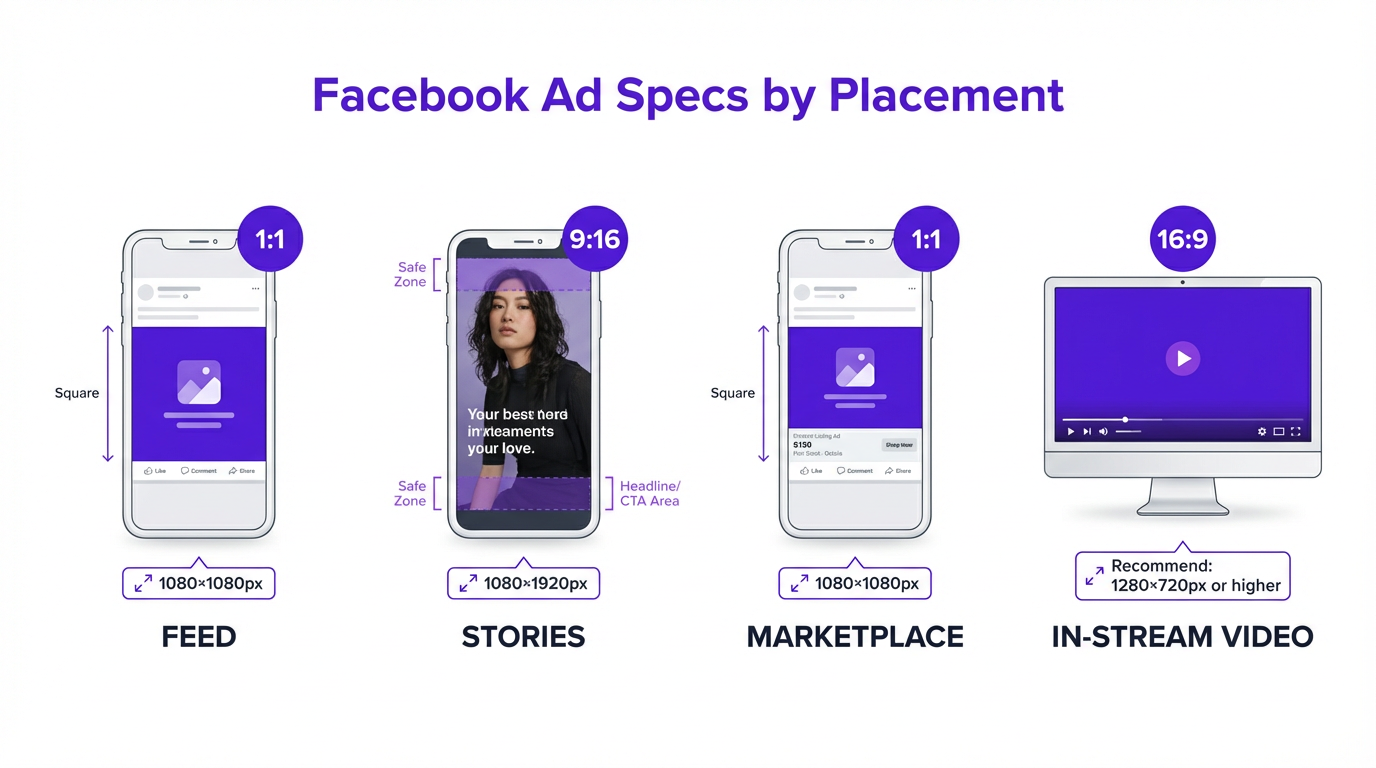
The four most common Facebook placements and their recommended dimensions.
Feed (Image and Carousel)
- Image size: 1080 x 1080 px (1:1) or 1080 x 1350 px (4:5). Carousel cards must be uniform at 1080 x 1080.
- File types: JPG and PNG, 30 MB max per image.
- Primary text: 125 characters for optimal display (longer copy gets truncated behind a "See more" link).
- Headlines: Keep under 40 characters to avoid clipping on mobile devices.
- Pro tip: Use the 4:5 ratio for single-image ads on mobile-heavy campaigns. The extra vertical space consistently outperforms square in scroll-stopping tests.
Stories and Reels Overlay Ads
Full-screen placements require 1080 x 1920 px (9:16). Here's where most people slip up: they design edge to edge and forget the safe zone. Meta recommends leaving roughly 14% of the top and 20% to 35% of the bottom free of critical elements like logos, CTAs, or key text. That bottom zone is where the profile name, CTA button, and swipe-up prompt live. Ignore it and your call-to-action literally disappears behind Meta's own UI.
Marketplace and Right Column
Marketplace ads follow the same 1:1 specs as Feed. Right Column ads on desktop require a 1200 x 1200 px minimum, though this placement is increasingly rare as mobile traffic dominates. Running lead gen across these placements? Pair your creative with well-structured forms. Our guide on editing Instant Forms in Meta Ads Manager walks through that workflow step by step.
Instagram Ad Dimensions for Every Placement
Instagram ad specs mostly mirror Facebook's, with a few placement-specific quirks. Feed posts display at 1080 x 1080 (1:1) or 1080 x 1350 (4:5). Stories and Reels are 1080 x 1920 (9:16). On the Explore page, ads serve in Feed dimensions, but vertical 4:5 images tend to outperform square ones because they claim more of the Explore grid's detail view. Users are in discovery mode, so bigger visuals capture more attention.
Reels ads deserve a closer look. They're full-screen 9:16 video, capped at 90 seconds, though 15 to 30 seconds is the performance sweet spot. The safe zone rules from Facebook Stories apply identically here. If you're scaling ad creative with AI, batch-producing variations at 1080 x 1920 is the single most efficient template to start with. Prioritize strong hooks in the first three seconds, since Reels audiences decide fast whether to watch or scroll.
Video Specs and File Requirements
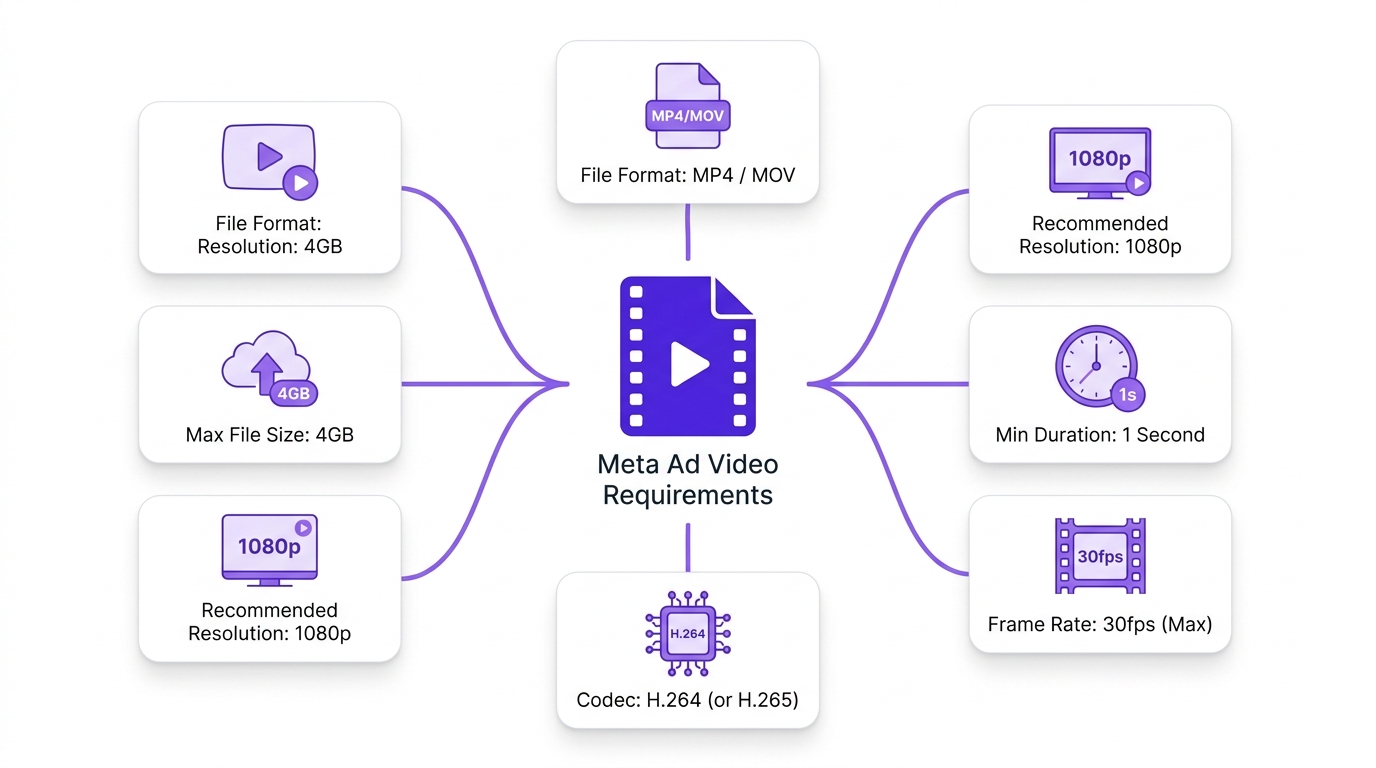
Key video file requirements for Meta ads in 2026.
Meta accepts MP4 and MOV formats with H.264 compression. According to Meta's Ads Guide, the max file size is 4 GB, but keeping files under 1 GB noticeably improves upload reliability and processing speed. Minimum duration is 1 second. Maximums vary by placement: 240 minutes for Feed, 120 seconds for Stories, and 90 seconds for Reels. Frame rate should be 30 fps or lower.
- Format: MP4 or MOV (H.264 codec).
- Max file size: 4 GB (aim for under 1 GB for faster processing).
- Resolution: 1080p recommended. Higher resolutions get downscaled.
- Frame rate: 30 fps or lower.
- Audio: Not required, but strongly recommended. Always add captions since a large share of users browse with sound off.
- Duration limits: Feed up to 240 min, Stories up to 120 sec, Reels up to 90 sec.
Safe Zones and the Text Rule in 2026
Meta officially killed the 20% text rule on ad images. The catch? The algorithm still appears to reduce delivery of text-heavy creatives. In practice, ads with large blocks of overlaid text consistently see lower auction reach. Treat the old rule as a soft guideline: keep overlay text to a single headline or offer and let the ad copy fields do the rest of the talking.
For Stories and Reels, design your critical content within the center of the frame. The top ~250 pixels and bottom ~340 pixels risk being covered by native UI elements. Verifying that your creative actually renders correctly across devices ties into measurement, too. If you're updating your tracking setup in parallel, the latest Meta Pixel and CAPI updates are worth reviewing alongside your creative specs.
- Top safe zone: Leave roughly 14% (about 250 px) clear of logos and text.
- Bottom safe zone: Reserve 20% to 35% for Meta's native UI overlays.
- Overlay text: Keep it to one headline or offer. The algorithm may still deprioritize heavy text.
- Device testing: Preview on both iOS and Android before publishing. UI element placement varies.
Quick-Reference: Meta Ad Specs Table for 2026
| Placement | Recommended Size (px) | Aspect Ratio | Max Image File | Max Video File |
|---|---|---|---|---|
| Facebook/Instagram Feed | 1080 x 1080 or 1080 x 1350 | 1:1 or 4:5 | 30 MB | 4 GB |
| Stories (FB & IG) | 1080 x 1920 | 9:16 | 30 MB | 4 GB |
| Reels (FB & IG) | 1080 x 1920 | 9:16 | 30 MB | 4 GB |
| Carousel Cards | 1080 x 1080 | 1:1 | 30 MB | 4 GB |
| Marketplace | 1080 x 1080 | 1:1 | 30 MB | 4 GB |
| In-Stream Video | 1080 x 1080 (min) | 1:1 to 16:9 | N/A | 4 GB |
| Right Column (Desktop) | 1200 x 1200 | 1:1 | 30 MB | N/A |
| Specs sourced from Meta's Ads Guide and other industry resources for 2026. Always verify against Meta's latest documentation. |
Bookmark this table for quick reference during production. Once your dimensions are locked, writing the copy to match is the next step. Vizup's prompt for Meta titles and descriptions can speed that up considerably, helping you align messaging with the right creative format.
Key Takeaways
Getting meta ad specs right isn't glamorous, but it's the difference between creative that converts and creative that gets cropped, compressed, or buried. Here's what to lock in:
- Design at 1080 x 1080 for Feed and 1080 x 1920 for Stories/Reels to cover the vast majority of placements.
- Respect safe zones, especially the bottom 20% to 35% on vertical formats where Meta's UI overlays live.
- Keep overlay text minimal. The 20% rule is officially gone, but the algorithm still favors clean creative.
- Upload video in MP4/H.264 under 1 GB for reliable processing, even though the max is 4 GB.
- Test across devices before launch. What looks perfect on desktop can break on a smaller mobile screen.
- Running campaigns on other platforms? See our other ad spec guides for Google, TikTok, LinkedIn, X (Twitter), and Reddit.
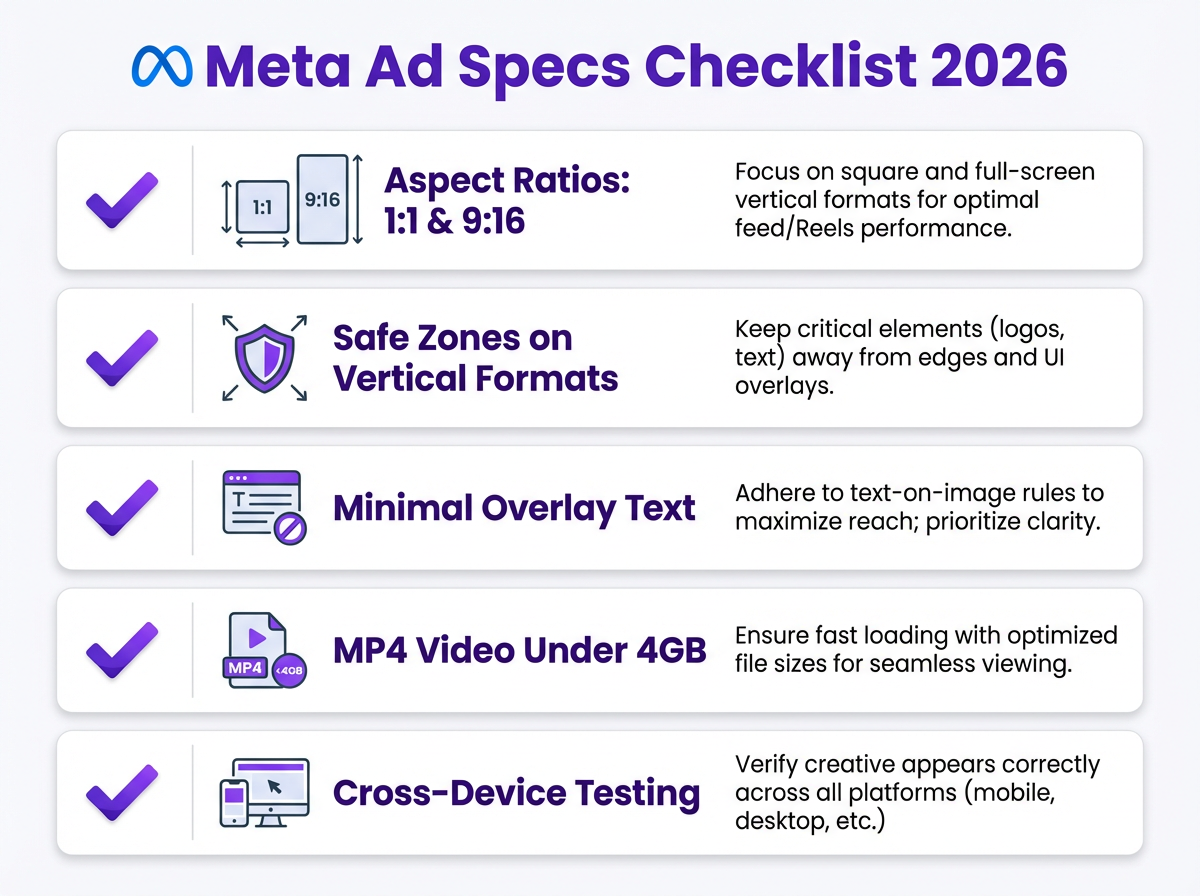
Five rules that keep your Meta ad creative on spec every time.
Frequently Asked Questions
What is the best image size for Facebook ads in 2026?
For Facebook Feed ads, use 1080 x 1080 px (1:1) or 1080 x 1350 px (4:5). The 4:5 ratio takes up more screen space on mobile, which often translates to better engagement and higher click-through rates.
Are Instagram ad specs different from Facebook ad specs?
The core dimensions are nearly identical. Instagram Feed uses 1080 x 1080 or 1080 x 1350, and Stories/Reels use 1080 x 1920. The main differences show up in duration limits and how the Explore page crops thumbnails.
Does Meta still penalize ads with too much text on the image?
The 20% text rule is officially gone, but Meta's delivery algorithm still appears to deprioritize creatives with heavy text overlays. Keeping text concise remains a best practice for maintaining reach and auction competitiveness.
What video format does Meta recommend for ads?
MP4 or MOV with H.264 compression. Max file size is 4 GB, though files under 1 GB upload and process more reliably. Stick to 30 fps or lower and always include captions for sound-off viewers.
What are safe zones for Meta Stories and Reels ads?
Leave roughly 14% of the top and 20% to 35% of the bottom clear of logos, headlines, or CTAs. Those areas are covered by Meta's native UI overlays (profile name, CTA button, navigation controls).
How many ad sizes do I need for a Meta campaign?
Start with two sizes: 1080 x 1080 px (1:1) for Feed placements and 1080 x 1920 px (9:16) for Stories and Reels. These two ratios cover approximately 90% of Meta's ad delivery across Facebook and Instagram.
What are the specs for Meta carousel ads?
Carousel cards must all be 1080 x 1080 px (1:1). Each card has a 30 MB max file size for images. Keep headlines under 40 characters per card to prevent clipping on mobile.
