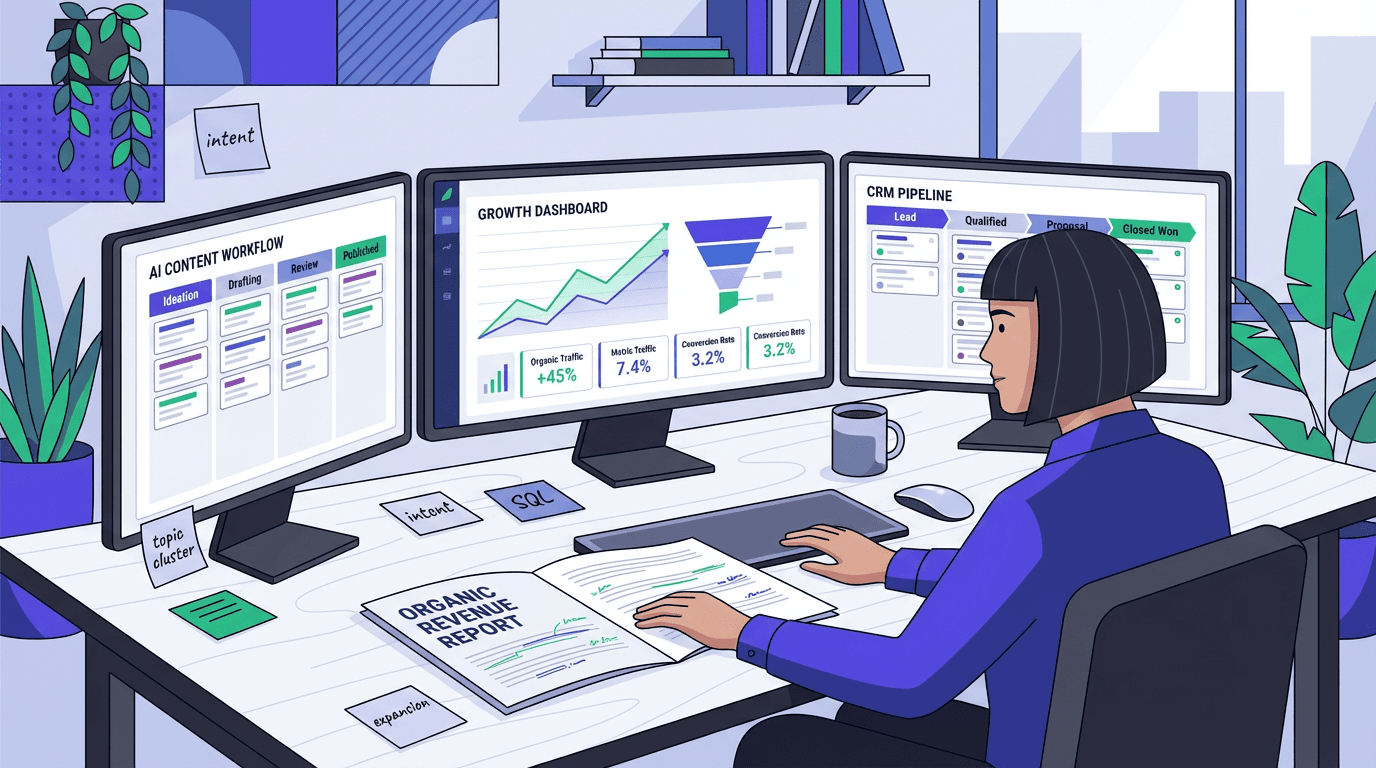
If you’ve ever shipped a month of “great content” and then stared at the revenue dashboard like it personally betrayed you, you’re in good company. I’ve watched smart teams publish 30 posts, get a nice traffic bump, and still lose the quarter because none of it moved pipeline. The content wasn’t bad. The system was.
AI is making this gap louder. You can produce more, faster. Which means you can also produce more noise, faster. The winners in 2026 aren’t the brands with the most posts. They’re the ones who treat organic like a product: instrumented, iterative, and accountable to revenue.
This tutorial shows you how to do exactly that. Not “use AI for content.” Use AI to build an organic machine that reliably creates demand, captures it, qualifies it, and feeds sales with context.
What you’ll achieve by the end: a measurable, repeatable workflow that turns organic attention into pipeline, and pipeline into closed-won, with AI doing the heavy lifting where it actually belongs.
How to turn organic into a revenue engine (step summary):
- Step 1: Define what “revenue” means in your org and pick one north-star organic metric that maps to it.
- Step 2: Instrument attribution so organic touches don’t vanish the moment someone books a demo.
- Step 3: Build an AI-assisted demand map (topics, intents, and pages) that matches how buyers actually decide.
- Step 4: Create a content production system that ships fewer pieces, but each one is built to convert.
- Step 5: Turn your site into a “self-qualifying” experience with AI-assisted UX, internal linking, and conversion paths.
- Step 6: Add AI-driven distribution and repurposing that doesn’t feel like spam.
- Step 7: Use AI for revenue analytics, not vanity reporting, then run a weekly optimization loop.
One quick framing before we get tactical. “Revenue” isn’t a vibe. It’s an accounting concept: income generated from selling goods or services (see Revenue on Wikipedia for the formal definition). Your marketing version of that definition needs to be equally crisp, or you’ll spend the year arguing about whether a webinar attendee “counts.”
Prerequisites: what you need before AI can help
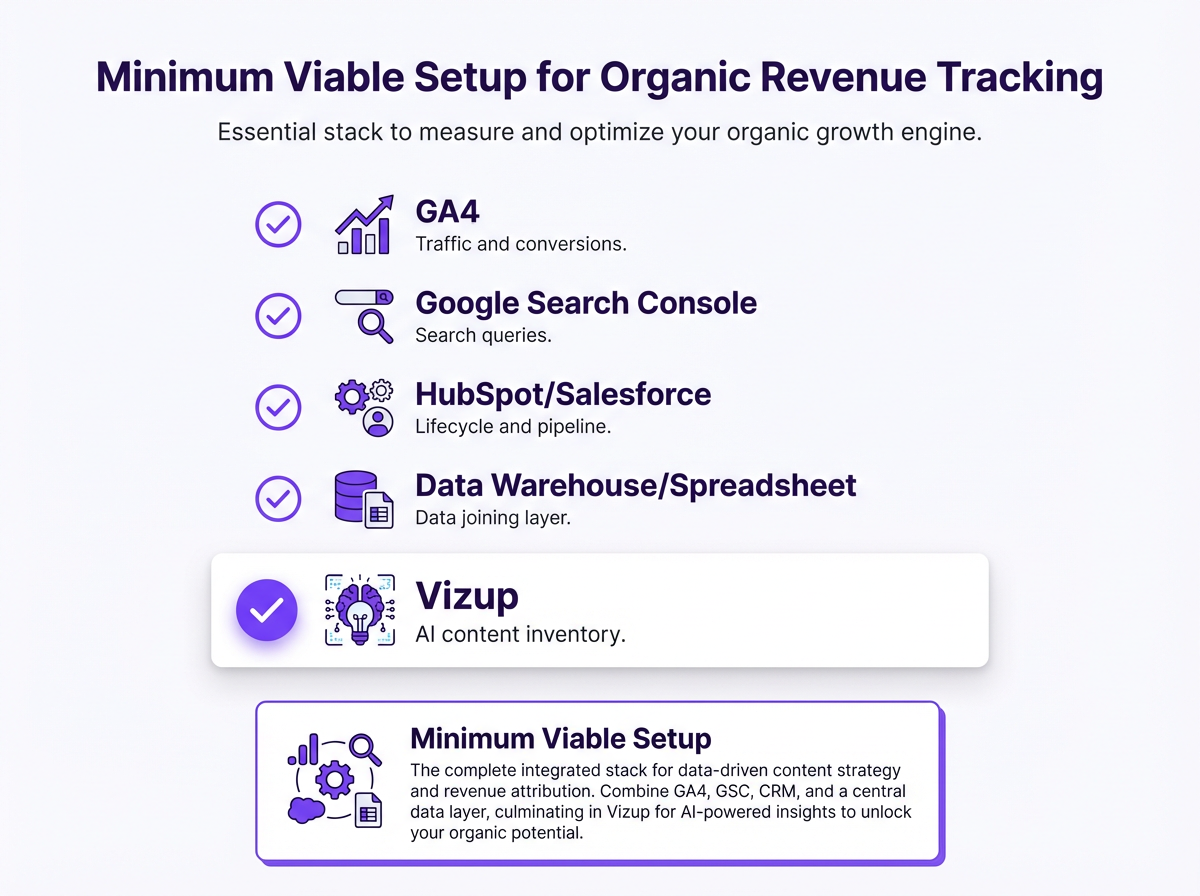
You don’t need a fancy stack, but you do need a stack. Here’s the minimum that keeps you out of attribution hell:
- Analytics: GA4 or equivalent, with conversion events set up (form submits, demo booked, trial started).
- Search data: Google Search Console connected to your domain.
- CRM: HubSpot, Salesforce, or anything that tracks lifecycle stages and revenue outcomes.
- A place to join data: a warehouse if you have it, a spreadsheet if you don’t.
- A content inventory: even if it’s ugly, you need a list of URLs and what they’re supposed to do.
And yes, you need an AI layer. Vizup exists for this exact problem: turning organic work into something you can run like a revenue program, not a publishing hobby. If you’re curious what we’re building and why, About Vizup gives the short version.
Step 1: Decide what “organic marketing revenue” means (and stop pretending traffic is the goal)
Most teams pick the wrong finish line. They say they want revenue, then they celebrate sessions. I get why. Sessions are immediate, clean, and flattering. Revenue is messy, delayed, and full of humans doing human things.
Pick one primary organic metric that you can defend in a board meeting. Not ten. One.
My default recommendation for B2B is “organic-sourced pipeline” plus an assisted view. For B2C ecommerce, it’s usually “organic revenue” with a sanity check against branded search inflation. For product-led SaaS, “organic trial starts that activate” is often the truth, even if it hurts.
| Business model | North-star organic metric | What it forces you to do | Common trap |
|---|---|---|---|
| B2B sales-led | Organic-sourced pipeline ($) | Map content to ICP pain and sales stages | Counting MQLs that never convert |
| B2B product-led | Organic trials that activate | Build onboarding-aligned content and in-product education | Overvaluing trial volume with low activation |
| B2C ecommerce | Organic revenue (orders or $) | Fix category pages, internal search, and merchandising | Branded search masking weak discovery |
| Marketplace | Organic supply + demand actions | Create two-sided content strategy | Optimizing one side and starving the other |
| Use this as a starting point, then adapt to your own sales motion and data reality. |
A contrarian take that saves time: don’t over-engineer the “perfect” funnel taxonomy. I’ve seen teams spend weeks debating MQL vs PQL definitions while their competitors publish three pieces that steal the category. Pick something reasonable, document it in one page, and move.
If you want the bigger strategic context on why organic now includes a lot more than classic SEO, read why organic marketing is beyond SEO. It’s the shift most teams are still pretending isn’t happening.
Step 2: Fix attribution so organic gets credit when it deserves it
Organic almost never gets last-click credit in B2B. Someone reads a post, lurks for two weeks, clicks a retargeting ad, then books a demo from an email. If you only look at last touch, you’ll “prove” organic doesn’t work and then cut the very thing creating demand.
Here’s the minimum viable attribution setup that I’ve seen hold up under scrutiny:
2.1 Connect identities across tools
You need a shared identifier between analytics and CRM. Email is the obvious one, but you won’t have it until conversion. So you also need a first-party cookie or user ID that gets passed into your forms and stored in the CRM record.
If you’ve ever tried to retroactively stitch this together after a site redesign, you know the pain. Do it now while you still remember where your forms live.
2.2 Track two conversion types, not one
Set up (1) a primary conversion that maps to revenue (demo booked, checkout, trial started) and (2) a micro-conversion that signals intent (pricing page view, product tour completion, “contact sales” click). AI is great at pattern detection across micro-signals, but only if you feed it consistent events.
2.3 Use an attribution model that matches your sales cycle
For short cycles, data-driven attribution works fine. For longer cycles, I like position-based (first and last touch weighted) plus an assisted report. The point isn’t to find the One True Model. It’s to stop punishing organic for being early.
IBM’s 2024 overview of AI in marketing references McKinsey’s estimate that generative AI could add up to $4.4 trillion annually to the global economy, and that AI adoption hit 72% in 2024 (McKinsey, via IBM 2024). That’s a lot of AI in the wild, and a lot of teams optimizing the wrong thing because attribution is broken. Source: IBM Think topics on AI.
Tip that feels boring until it saves you: keep a simple “attribution changelog.” Any time you change channel grouping, event names, or form routing, write it down with the date. Six months later, when organic-sourced pipeline “mysteriously” drops, you’ll know whether it was Google or your own tracking.
Step 3: Build an AI-assisted demand map (topics, intent, and pages)
Keyword research is fine. It’s also wildly overrated as a standalone activity. What you want is a demand map: a view of what your buyers ask, in what order, and what page should answer each question.
AI is useful here because it can synthesize messy inputs fast: Search Console queries, sales call notes, competitor page patterns, support tickets, community threads. Humans are still the judges. AI is the intern who never sleeps.
Here’s a practical way to build the map in an afternoon:
- Export 90 days of Search Console queries and landing pages. Keep impressions, clicks, and average position.
- Pull 20 to 30 recent sales calls or chat transcripts. Highlight repeated objections and “how do you…” questions.
- List your top 10 competitors’ money pages (pricing, comparisons, category pages). Don’t copy them, just note patterns.
- Ask AI to cluster queries by intent and suggest missing page types (comparison pages, integration pages, templates).
- Manually mark what you already have, what needs a refresh, and what needs to be built from scratch.
A lived-in warning: AI clustering will happily group things that shouldn’t be grouped. “Organic reporting” and “organic social reporting” look close in language, but they convert differently. Treat AI’s clusters as drafts, not truth.
HubSpot’s 2026 write-up notes that SEO tends to drive over 1000% more traffic than organic social media (HubSpot, 2026). That stat is real, but the operational takeaway isn’t “ignore social.” It’s “stop expecting social to do SEO’s job.” Source: HubSpot’s organic marketing overview.
Step 4: Ship content that’s built to convert, not just rank
I’m going to say the quiet part out loud: a lot of “SEO content” is written to impress Google, not to help a buyer make a decision. It ranks, it gets clicks, and it produces zero revenue because it never answers the question behind the question.
AI can draft. It can outline. It can even mimic your tone if you train it. But the conversion lift comes from structure and specificity, not from fancy prompts.
4.1 Use AI to generate the raw material, then force it through a revenue filter
My “revenue filter” is five checks. If a piece fails two of them, it’s not shipping yet.
- Does it name a real buyer scenario (industry, company size, constraints)?
- Does it include at least one concrete example (numbers, workflow, screenshot, template)?
- Does it handle the top objection sales hears?
- Does it route the reader to the next best page (not just “subscribe”)?
- Does it avoid the vague, padded sections AI loves to produce?
4.2 Build “money pages” with AI assistance, not just blog posts
The pages that drive organic marketing revenue are rarely your blog homepage. They’re comparison pages, integration pages, use-case pages, and pricing-adjacent explainers.
If you’re in a competitive category, you need pages that can win “best X for Y” queries and pages that help buyers justify a decision internally. AI can accelerate the first draft, but you need real positioning, real screenshots, and real proof.
If you want to see how we think about the new search reality that’s pushing more queries into AI answers and summaries, the piece on answer engine optimization is worth your time. It changes how you write, not just where you publish.
4.3 A quick, opinionated content cadence
Most “publish 4 times a week” advice is content marketing cosplay. If you have a newsroom and a brand moat, sure. If you’re a normal team, publish less and make each piece do more.
A cadence I’ve seen work repeatedly: 2 revenue pieces per month (deep, conversion-oriented) and 2 support pieces (answer specific questions, reduce friction, capture long-tail). AI helps you keep quality high without burning out your team.
Step 5: Turn your website into a self-qualifying sales rep
Traffic that can’t find its next step is wasted. Harsh, but true.
AI can help you personalize paths (within reason), recommend next pages, and surface the right CTA based on intent signals. But the bigger win is simpler: build a site that answers the buyer’s next question before they bounce.
Three site moves that consistently lift conversion from organic:
- Internal linking that follows intent, not just “related posts.” Link problem-aware content to solution pages, then to vendor proof.
- Contextual CTAs that match the page’s job. A “book a demo” button on a beginner explainer often underperforms a template download or calculator.
- Comparison and alternatives pages that you actually maintain. Stale comparisons are worse than none because they signal neglect.
A common thing I hear is “we don’t want to be too salesy.” Fine. But don’t confuse “not salesy” with “no direction.” Buyers like clarity. Give them a path.
If you want a concrete next step for your own site, start with your pricing page. Not because it’s the only page that matters, but because it’s where intent concentrates. Make sure it’s discoverable from high-intent organic pages, and that it answers the questions your sales team is tired of repeating.
Step 6: Use AI for distribution without turning into a content spammer
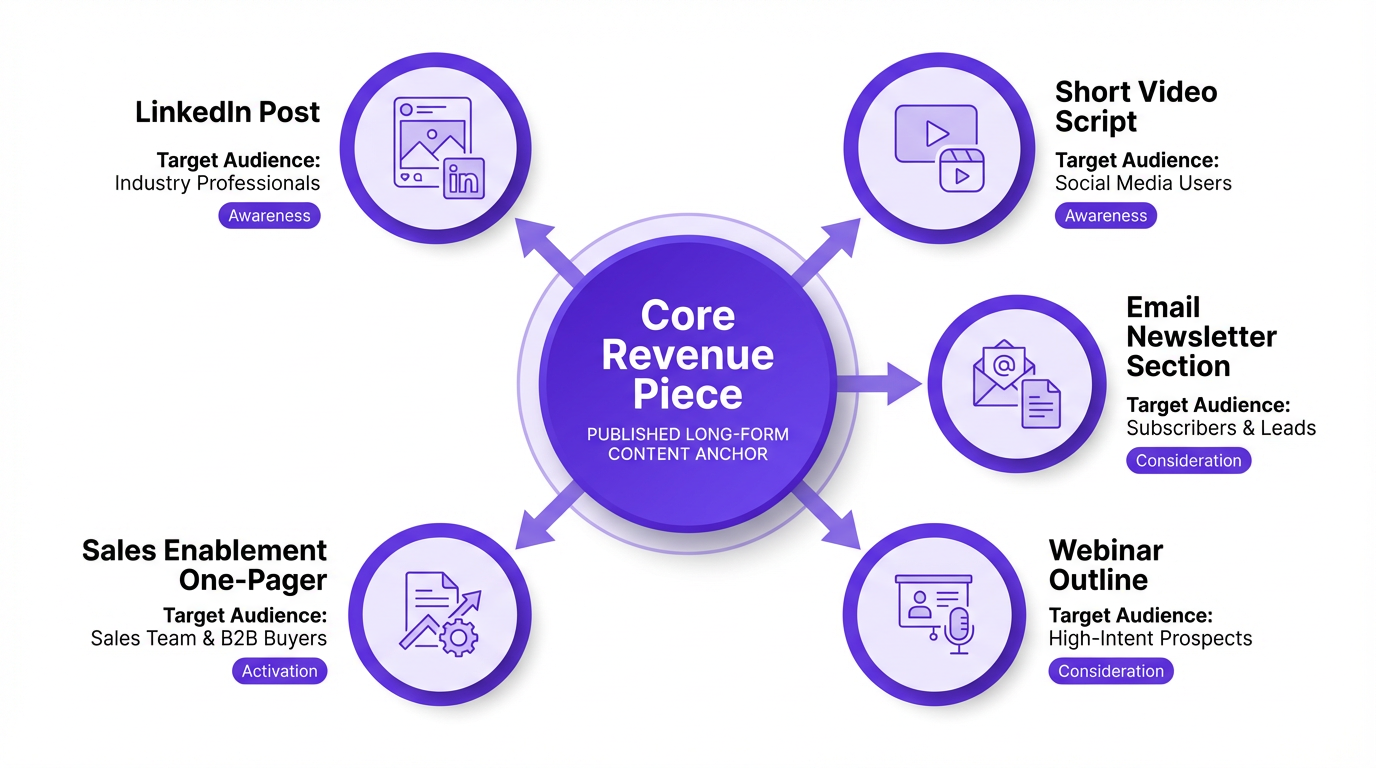
AI distribution is where a lot of teams accidentally torch their brand voice. They take one post, generate 15 variants, schedule them everywhere, and wonder why engagement drops. People can smell automation when it’s lazy.
Use AI to do the annoying parts: extracting angles, drafting hooks, turning a long piece into an email section, creating a sales snippet that doesn’t read like a ransom note.
A workflow I like:
- Publish the core piece.
- Have AI generate 6 to 8 “channel-native” drafts (not 30).
- A human edits for voice and for what’s true.
- Sales gets a one-pager and three talk tracks.
- Customer success gets a version that reduces support load.
The trick isn’t volume. It’s alignment. Organic becomes a revenue engine when the whole company uses the same story.
Step 7: Build the analytics loop that keeps the engine running
If you only look at organic performance once a month, you’re basically driving by staring in the rearview mirror. Organic is slow compared to paid, but it still responds to weekly iteration.
Your loop needs three layers: page-level performance, topic-level performance, and pipeline-level performance.
7.1 Page-level: what’s happening on the page
Look at scroll depth, CTA clicks, internal link clicks, and exit rate. AI can flag anomalies, but you still need to read the page like a buyer. Is the answer buried? Is the CTA mismatched? Did you accidentally write a 2,500-word preamble before saying anything useful?
I’ve seen teams “optimize” titles for CTR and accidentally tank conversions because the new title attracted the wrong audience. Watch downstream behavior, not just clicks.
7.2 Topic-level: are you winning the cluster
This is where AI is genuinely strong. It can track whether your cluster is gaining impressions across related queries, whether you’re cannibalizing yourself, and which supporting pages are missing.
If you’re not building clusters, you’re relying on luck. Luck is not a strategy, and it definitely doesn’t forecast.
7.3 Pipeline-level: what sales cares about
Pull a weekly report of deals influenced by organic touches. Then do the part most teams skip: read 10 deal timelines. Not the aggregate. The actual timelines. You’ll see patterns fast.
Example from a real audit we did: a company had strong rankings for “best analytics tool for startups,” but every deal that touched that page stalled on implementation concerns. The fix wasn’t more content. It was one implementation guide, one migration checklist, and a clearer pricing explanation. Pipeline moved within a month because sales stopped getting blindsided.
If you want to operationalize this without building a custom BI setup, this is the kind of workflow Vizup is designed to support. You can peek at Vizup’s pricing when you’re ready to evaluate whether it fits your team.
A fair comparison: where Vizup fits vs the usual suspects
I’m not going to pretend there’s one tool that does everything. If someone tells you their platform replaces your SEO suite, your analytics, your CRM, and your content team, run.
Here’s the honest positioning from what I’ve seen in the market:
| Tool | Where it shines | Where teams get burned | Best fit |
|---|---|---|---|
| Vizup | AI-powered organic workflows tied to pipeline and revenue outcomes | If you expect it to magically fix broken tracking without setup | Teams serious about organic marketing revenue, not just rankings |
| AirOps | Automation and content operations for AI-assisted production | Great output, weak accountability if strategy is fuzzy | Content-heavy teams that already know what to build |
| Gushwork | Execution support and managed services style workflows | Quality varies by process and oversight | Lean teams that need hands-on help shipping |
| Search Atlas | SEO tooling and competitive features in a suite format | Easy to drown in features and still not ship | SEO teams that want an all-in-one suite |
| SEMRush | Best-in-market breadth for keyword and competitive research | Teams treat it like a strategy, not a tool | Organizations with mature SEO ops and clear priorities |
| This is not an endorsement list. It’s a “buy the tool that matches your bottleneck” list. |
If you’re still shopping around, spend 30 minutes reading a few posts on Vizup’s blog. You’ll get a feel for how we think about organic as a revenue system, not a traffic sport.
Common mistakes (and how to fix them fast)
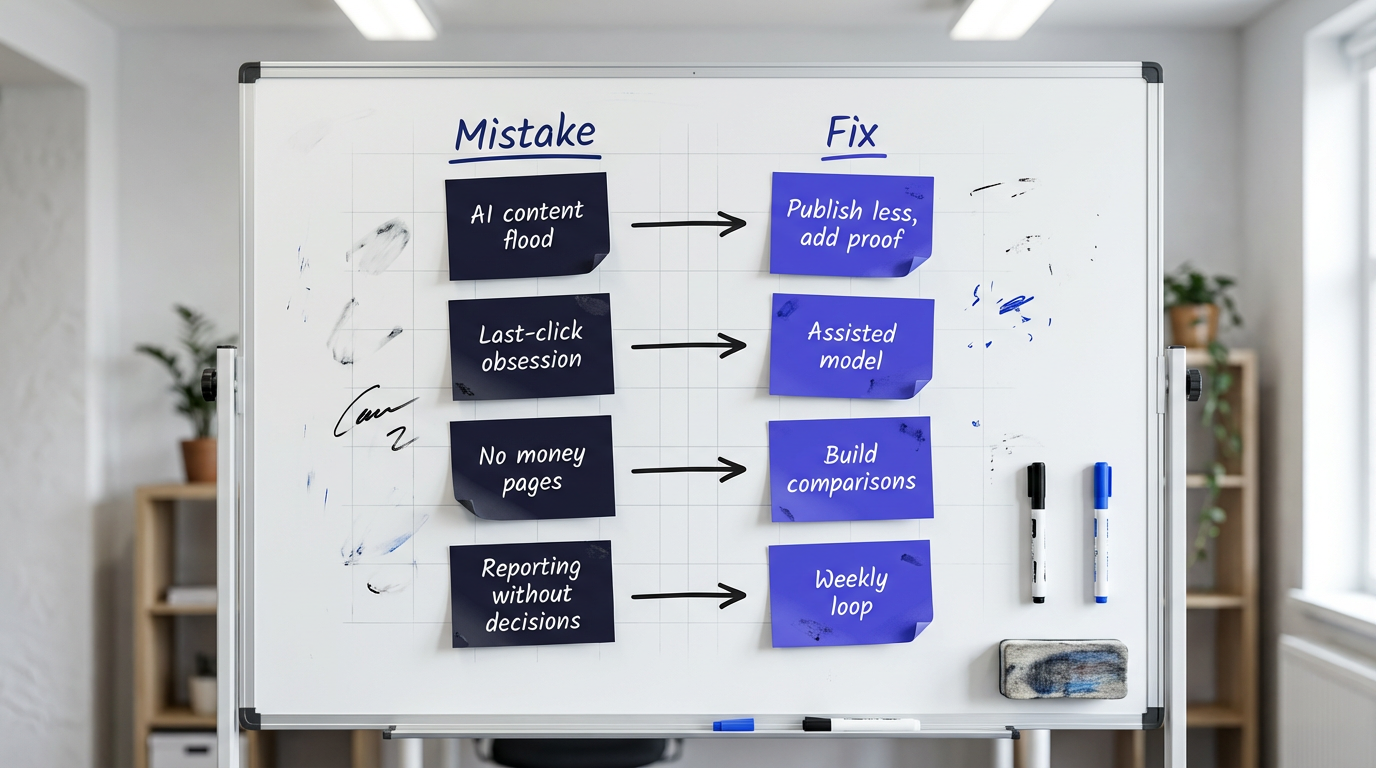
Mistake 1: Treating AI like a content vending machine
If you’ve tried this and gotten garbage results, you’re not alone. The failure mode is predictable: you publish a lot, rankings wobble, brand voice gets weird, and conversions don’t move.
Fix: cut volume in half, double specificity. Add screenshots, workflows, templates, and real objections. AI drafts, humans decide.
Mistake 2: Celebrating traffic while sales complains about lead quality
This is the classic “marketing says it’s working, sales says it’s not” loop. Both are right, which is why it’s so annoying.
Fix: define one qualification signal that sales trusts (company size, job title, use case, activation event). Use AI to score and route, but keep the rule visible so you can argue about it with facts.
Mistake 3: Ignoring the pages that actually close deals
Teams obsess over blog posts and neglect comparison pages, integration pages, and pricing explainers. Then they wonder why organic “doesn’t convert.”
Fix: build 5 to 10 money pages that match real buying queries. Maintain them quarterly. Put an owner on them.
Mistake 4: Reporting without decisions
A dashboard that doesn’t change what you do next week is decoration.
Fix: every report ends with one action. Update a CTA, rewrite a section, add internal links, build the missing support page, or kill the piece if it’s attracting the wrong audience.
A single consolidated caution section (because someone has to say it)
AI will confidently invent facts, misquote sources, and oversimplify anything that smells complex. If you’re in a regulated industry, or you publish anything that touches legal, financial, or health claims, build a review step with someone qualified. Not optional.
Even outside regulated spaces, keep a “claims checklist.” Any number, quote, or competitive statement needs a source or it gets removed. Speed is great until it creates cleanup work for the next six months.
Frequently Asked Questions
How long does it take to see organic marketing revenue impact with AI?
If tracking is already solid, you can usually see leading indicators (better conversion rates, more qualified form fills, improved assisted pipeline) in 4 to 8 weeks. Closed-won revenue takes longer because sales cycles take longer. The teams that win treat it like weekly iteration, not a quarterly reveal.
Do I need to publish more content to compete now that everyone has AI?
No. Publishing more is the easiest way to publish more mediocre. The advantage is in better intent mapping, better “money pages,” and tighter conversion paths. AI makes it cheaper to create drafts, not cheaper to earn trust.
What’s the best attribution model for organic?
Pick the model that matches your cycle and your politics. For longer B2B cycles, position-based plus assisted reporting is a practical combo because it credits early demand creation without pretending you know the exact weighting of every touch.
How do answer engines change organic strategy?
They reward clarity and structure. You need content that can be quoted, summarized, and trusted, plus pages that still convert when the click doesn’t happen. If you’re adapting your playbook, the article on answer engine optimization is a good starting point.
What if my biggest issue is just getting new customers in the door?
You’re not imagining it. A 2025 Squarespace survey found entrepreneurs across stages and ages named attracting new customers as a top business challenge (Squarespace, 2025). Organic can solve that, but only when it’s wired to qualification and conversion, not just awareness.
Summary and next steps (what I’d do this week)
If you do nothing else, do these three things:
- Pick the north-star metric and write it down in plain English.
- Fix attribution enough that organic gets assisted credit.
- Build or refresh one money page that’s designed to convert.
Then run the weekly loop. Read real deal timelines. Update pages based on what buyers actually do, not what you hope they do.
If you want a platform built for this exact “organic to revenue” workflow, take a look at Vizup when it’s convenient. Start with your bottleneck, not with a tool shopping spree.
