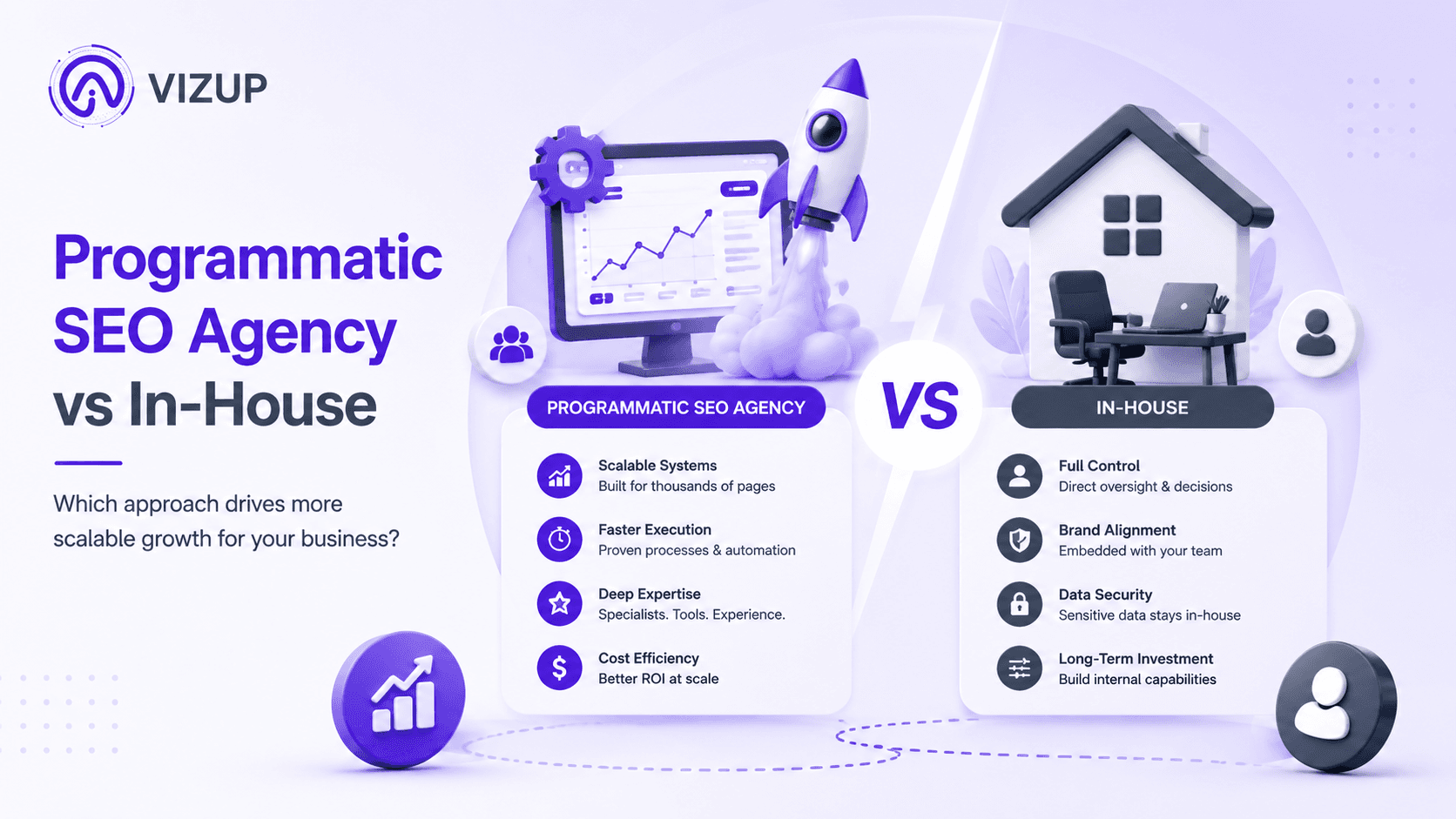
You have 10,000 long-tail keywords mapped out. Your structured data is clean. The template logic is already on the whiteboard. Then you hit the question that actually matters: who is going to build this thing? A programmatic SEO agency buys you speed and a repeatable playbook. An in-house build buys you control and an asset that compounds. Pick wrong and you can torch six figures and half a year.
Below is a practical comparison across five criteria that really separate the two routes, a head-to-head table with real numbers, and a build-vs-buy decision tree you can run before your next planning meeting. You should walk away with a clear call based on your stage, your data, and the team you actually have.
What Programmatic SEO Actually Requires
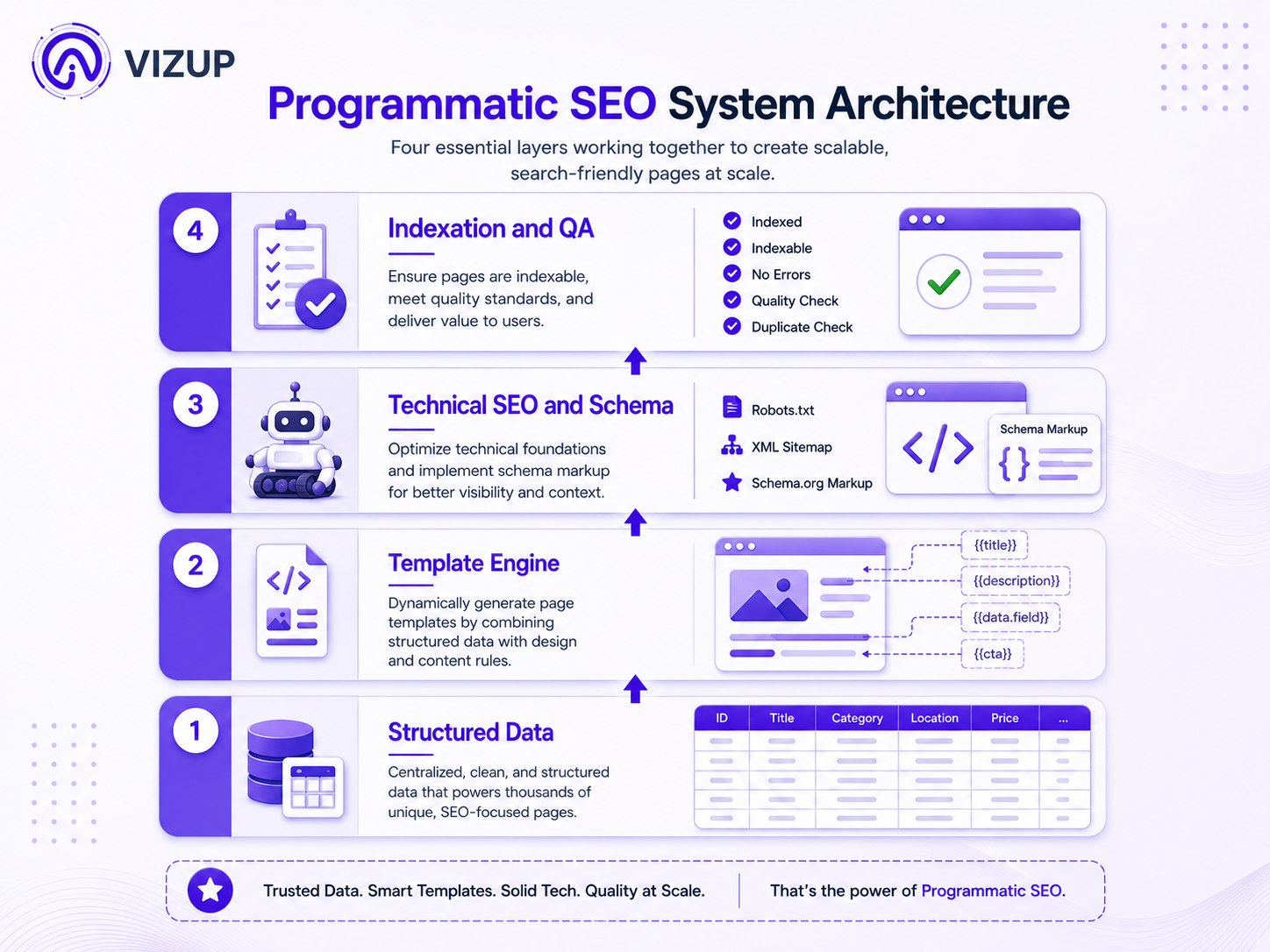
Programmatic SEO is template-driven page generation at scale, powered by structured data. It is not just "lots of content." With a strong dataset, one template can legitimately produce 50,000 distinct pages. That line matters because the work looks a lot less like classic SEO and a lot more like building a small publishing system.
The real skill stack for pSEO:
- Data engineering -- sourcing, cleaning, and structuring the dataset that populates templates
- Template design -- building page structures that satisfy search intent at scale without triggering thin-content penalties
- Technical SEO -- crawl budget management, canonical logic, hreflang at scale, structured data markup
- Content QA -- automated and human review to catch template errors before Google does
- Indexation management -- submitting, monitoring, and troubleshooting which pages actually get indexed
That is why the build-vs-buy SEO decision gets messy for teams used to traditional SEO. You are not staffing up with writers and a strategist. You are standing up infrastructure. That infrastructure can live inside an agency's existing framework or inside your own engineering org. Which one makes sense depends on what you already have in place, and what you are willing to own.
Going with a Programmatic SEO Agency
A typical agency engagement starts with a data audit and onboarding, then moves into template design and a pilot batch of pages (usually 500 to 2,000). From there, it scales based on what indexation and performance data say. Strong pSEO agencies can run that loop in four to six weeks. Weak ones burn the first two months debating CSV formats and field names.
Warning: Programmatic SEO services vary wildly. Some agencies deliver fully built, indexed pages. Others deliver a strategy deck and leave execution to your team. Clarify deliverables before signing anything.
Where a pSEO Agency Earns Its Fee
Speed is the cleanest argument for an agency. Teams that already have frameworks in place -- templating systems, CMS integrations, internal linking logic -- can ship thousands of pages in weeks instead of quarters. You are also buying pattern recognition. Agencies that have done this across multiple verticals tend to know which schema markup structures actually move rankings, what internal linking density avoids crawl traps, and which template variations keep working after algorithm updates.
You also dodge one of the nastiest hiring problems in SEO: the engineer-SEO hybrid who understands both data pipelines and ranking signals. That person exists, but they are scarce. Agencies already employ them, plus the supporting cast. If you need traction before you can justify a full-time hire, that matters.
The Real Costs and Trade-offs
Retainers for programmatic SEO services typically fall between $5,000 and $20,000 per month or more. Scope creep is common when your data pipelines need custom work the agency did not price in. The bigger issue is ownership: you do not automatically own the playbook. If the relationship ends, you can lose template logic, tooling access, and the context behind key decisions. Quality control also shifts: you are auditing outputs rather than steering the process day to day.
Building Programmatic SEO In-House
The argument for running pSEO in-house gets strongest when your moat is your data. If you sit on proprietary location data, product catalogs, pricing feeds, or user-generated content that competitors cannot copy, keeping page generation inside your org protects that edge. The tight feedback loop between your product database and your templates is also hard to reproduce through an agency relationship, no matter how responsive the agency is.
The Control Advantage
An in-house team can iterate on templates daily off Search Console data instead of waiting for an agency sprint. When one variant starts outperforming, you can ship the change the same afternoon. When Google's indexation behavior shifts, you can adjust crawl budget settings that week. You do not need a huge org chart to do this. At minimum: a technical SEO lead, a developer who is comfortable with CMS APIs and templating, and a data analyst. Three people can run a serious pSEO program.
Once the system exists, the cost curve tends to favor in-house. Marginal cost per page drops toward zero. An agency retainer, in contrast, keeps charging for scope even when your system is mature.
What Nobody Warns You About
The honest in-house reality check:
- Hiring timeline: finding someone who understands both SEO and data engineering takes two to four months minimum in the US, total compensation often ranges from $120,000 to $180,000 annually, depending on market and experience level.
- First-version failure: budget three to six months of iteration before meaningful traffic arrives -- your first template will be wrong
- Tooling costs: crawl monitoring, indexation tracking, and content QA at scale require a real stack.
Head-to-Head: Programmatic SEO Agency vs In-House
| Criterion | pSEO Agency | In-House |
|---|---|---|
| Upfront cost | $0 to $5K onboarding | $15K to $50K+ (hiring, tooling, setup) |
| Time to first results | 4 to 8 weeks (pilot batch) | 3 to 6 months (build + iteration) |
| Ongoing monthly cost | $5K to $20K+ retainer | $10K to $15K (salaries + tools, amortized) |
| Quality control model | You review agency output with limited visibility into the process | You own the process end to end and can iterate daily |
| Scalability ceiling | Limited by agency capacity and contract scope | Effectively uncapped once the infrastructure is built |
| Best-fit profile | Teams that need speed and do not have pSEO talent yet | Companies with proprietary data and long-term pSEO ambitions |
| Cost ranges reflect 2025-2026 US market rates. In-house salary figures based on senior technical SEO and engineering roles. |
Platforms like Vizup, an Organic Autopilot for modern discovery, work in both setups. Agencies use Vizup's AI agents and live SEO, pSEO, AEO, and GEO tools to monitor and publish across Search, Social, and AI Answer Engines for their clients. In-house teams use the same platform to manage the entire discovery lifecycle (monitor, create, optimize, publish, and learn), which reduces the tooling burden that makes the build path feel intimidating.
The Build-vs-Buy Decision Tree
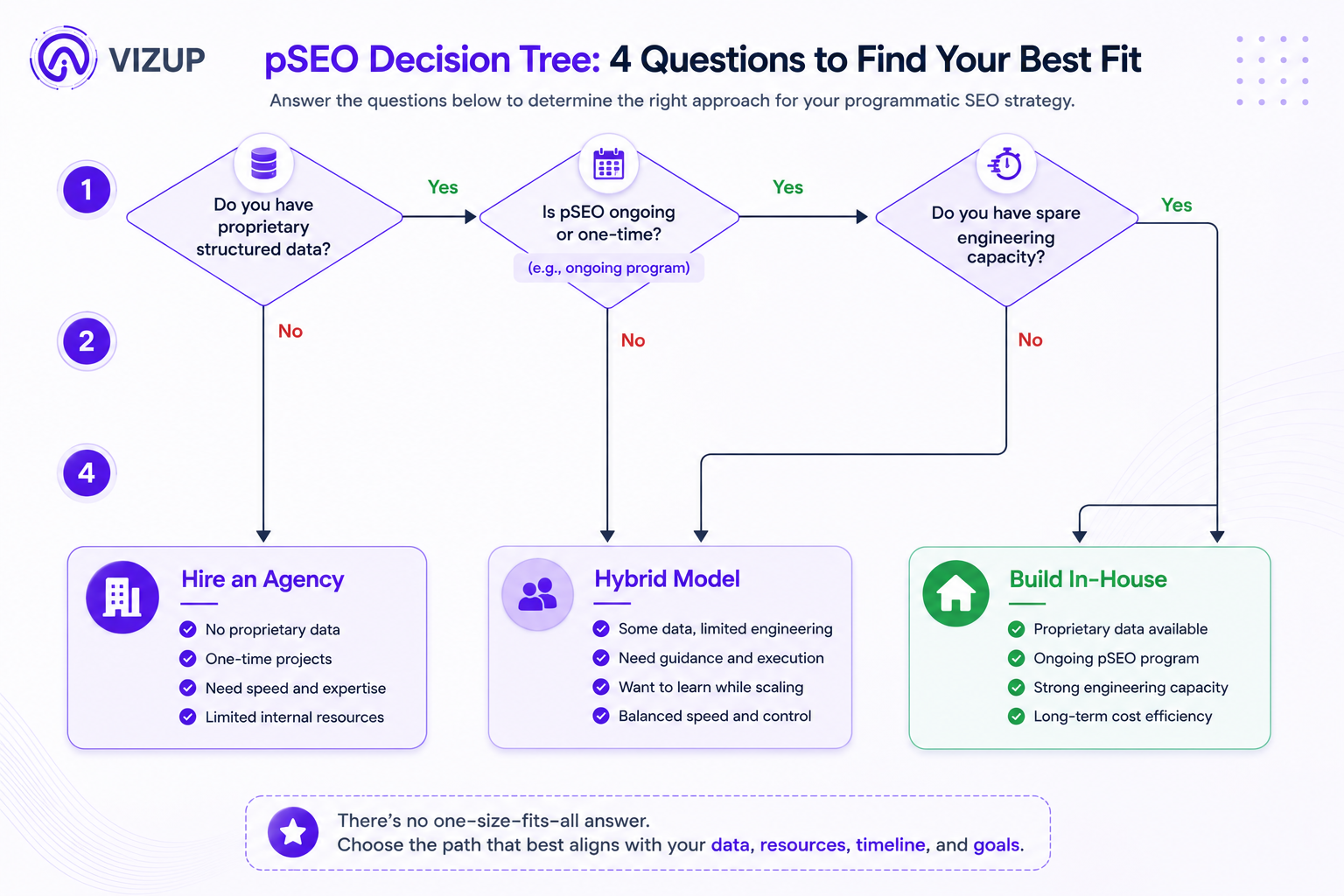
Work through these four questions in order:
- Do you have proprietary structured data? If yes, your dataset is a competitive moat -- in-house or hybrid protects it. If no, an agency's generic frameworks are often sufficient.
- Is pSEO a one-time project or an ongoing channel? One-time projects favor agencies. Ongoing channels that compound over years favor in-house investment.
- Do you already have engineering resources with spare capacity? If a developer with CMS experience is available, the marginal cost of in-house drops sharply. If not, hiring adds months.
- Is speed-to-market critical right now? If you need indexed pages before a funding round, a product launch, or a competitive window closes, an agency with an existing framework wins on this dimension every time.
Vizup's capabilities as an Organic Autopilot can significantly reduce the tooling burden for in-house teams. Instead of stitching together multiple AI search visibility management tools, teams can consolidate onto one platform that uses AI agents and human experts to manage visibility across Search, Social, Communities, and Local Discovery. That consolidation often makes the in-house path workable without defaulting to agency support.
The Hybrid Path Most People Miss
For a lot of mid-market teams, the most practical option is the one that rarely shows up in the initial budget: bring in an agency to build the system and the first batch of pages, then move maintenance and iteration in-house once the architecture is proven. You get the agency's speed without signing up for permanent dependency. The in-house economics start compounding after month six or twelve, not after year two.
Tip: This only works if you negotiate template documentation and process handoff into the agency contract before you sign. If you wait until the engagement ends, the agency has no incentive to transfer knowledge cleanly.
Several leading players in the pSEO space support this handoff model in different ways. Gushwork focuses on AI-assisted content workflows that can be handed off to in-house teams. AirOps builds AI workflow automation that agencies use to accelerate page production and that in-house teams can inherit. Search Atlas offers a platform with both agency-facing and in-house-facing tooling. TryProfound focuses on answer engine visibility, which complements pSEO programs targeting AI search surfaces. Where each tool sits in your stack matters almost as much as the agency-vs-in-house choice.
Verdict: Which Path Wins for Most Teams?
Programmatic SEO agency vs in-house: which is better? In 2026, most teams end up in a hybrid setup, but the right starting point depends on your constraints. If you do not have pSEO talent and you need results within a quarter, a programmatic SEO agency is usually the right first move. If you have proprietary data, engineering capacity, and a 12-month horizon, an in-house build tends to deliver better unit economics and a more defensible asset. The hybrid model -- agency to build, in-house to operate -- takes the best parts of both, and it is the direction most mid-market companies should negotiate toward from day one.
Clear 'Best for' breakdown:
- Agency: companies needing fast results, no existing technical SEO talent, and a defined project scope
- In-house: companies with proprietary structured data, long-term pSEO ambitions, and at least one technical SEO hire already in place
- Hybrid: most mid-market teams -- use agency speed to prove the channel, then own the system
No matter which route you pick, you still need a platform that can manage discovery at the scale pSEO operates at. Vizup is an Organic Autopilot, using AI agents and human experts to monitor, create, and optimize content across Search, Social, Communities, and AI Answer Engines. Agencies use it to manage visibility for clients. In-house teams use it to consolidate their stack and connect programmatic execution to business outcomes. Book a demo to see how it works.
Frequently Asked Questions
How much does a programmatic SEO agency charge?
Most programmatic SEO agency retainers land between $5,000 and $20,000 per month for ongoing work. If you are doing a project with a defined page set, expect $15,000 to $50,000 depending on data complexity and page volume. Agencies that take on custom data pipeline work or CMS integrations often price above that. Before you sign, confirm whether the quote covers indexation monitoring and QA, or only page production.
What SEO team structure do I need to run pSEO in-house?
A minimum viable in-house setup is three roles: a technical SEO lead who understands crawl budget and schema at scale, a developer who is comfortable with CMS APIs and templating frameworks, and a data analyst to maintain and expand the structured dataset. A content strategist helps with template QA, but you can launch without one. An Organic Autopilot platform like Vizup can reduce the tooling and headcount burden by automating monitoring and optimization across channels like Search, Social, and AI Answer Engines.
Can I start with an agency and move programmatic SEO in-house later?
Yes. That is the hybrid model many mid-market teams should aim for. The non-negotiable is putting template documentation, data pipeline specs, and a process handoff into the contract before work starts. If an agency pushes back on that clause, they are telling you their value is tied to ongoing dependency instead of transferable systems. With the right contract, a clean handoff in six to twelve months is realistic.
How long does it take to see results from programmatic SEO services?
With an agency running an existing framework, a pilot batch of pages can be live and indexed in four to eight weeks. Meaningful organic traffic usually shows up two to four months after indexation, depending on domain authority and keyword competition. In-house takes longer: three to six months to reach a stable first version, then another two to three months before the traffic signal is statistically meaningful. Timelines are one of the clearest edges agencies have in build-vs-buy SEO decisions.
What tools do in-house teams need for programmatic SEO at scale?
For a serious in-house pSEO program, you traditionally need a CMS, a crawl monitoring tool, an indexation tracker, and a rank tracker. However, platforms like Vizup consolidate this stack, acting as an Organic Autopilot to monitor, create, and optimize content across Search, Social, Communities, and AI Answer Engines using a mix of AI agents and human experts. This approach reduces the need for multiple point solutions, which commonly run $1,000 to $3,000 per month before headcount.
