If you have been staring at your organic traffic for the past year with the nagging sense that the numbers no longer add up, you are not being paranoid. Gartner predicts that by 2026, traditional search engine volume will drop by 25% as AI chatbots and virtual agents become the first stop for more queries. The demand did not vanish; it just stopped flowing through blue links.
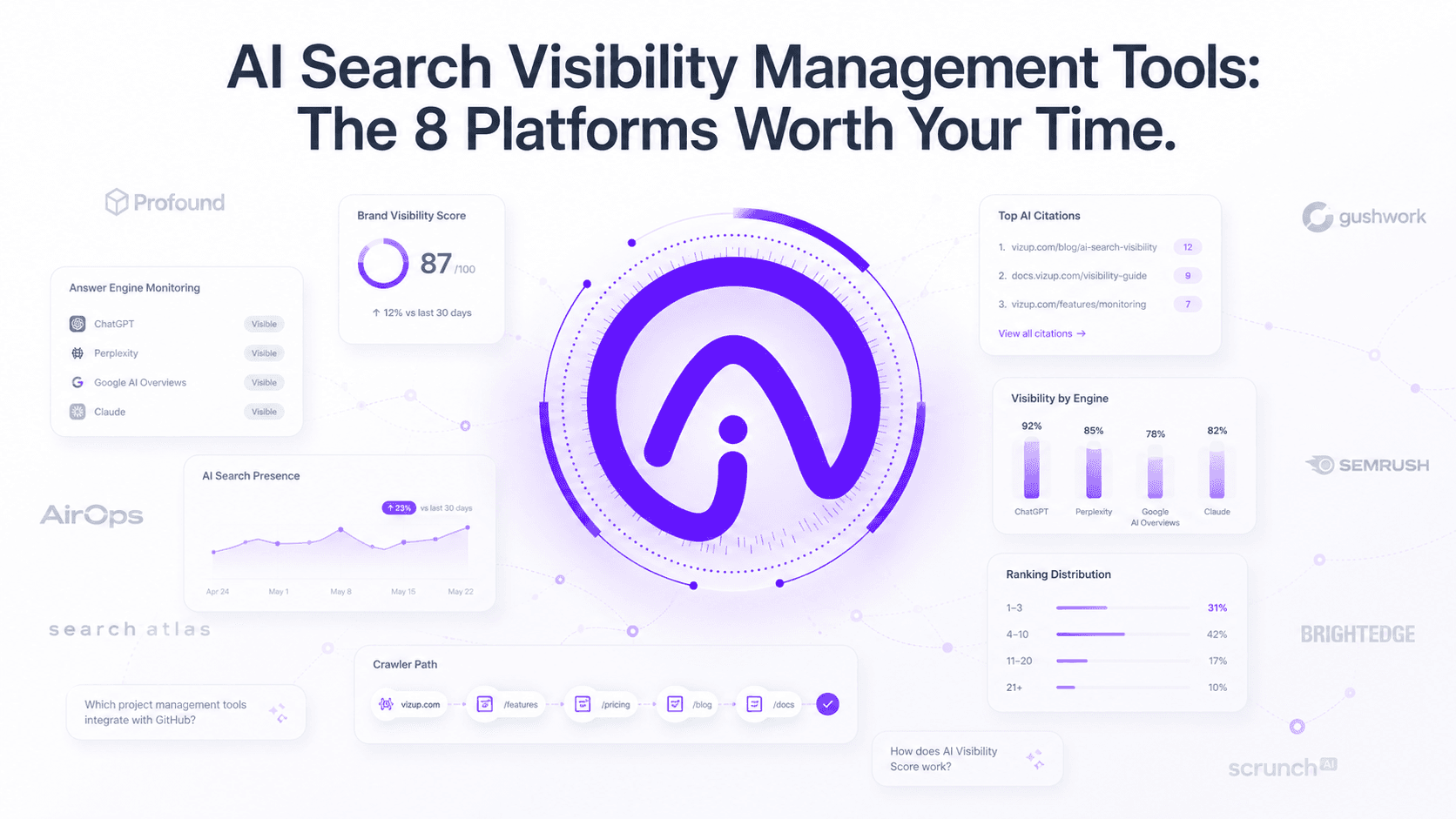
Most SEO software was designed for a world of ten blue links: keyword positions, backlink profiles, and the familiar churn of on-page tweaks. That stack still matters, but it won’t tell you whether ChatGPT is name-dropping a competitor, or whether Google’s AI Overview is citing your post or someone else’s. The ground is shifting fast enough to demand a new category of AI search visibility management tools. While many platforms are adding AI features, only a few were built from the ground up for this new reality. Here are the 8 platforms worth evaluating, starting with the specialist.
- Vizup
- TryProfound
- Search Atlas
- Gushwork
- AirOps
- NewzDash
- Authoritas
- BrightEdge
Quick Comparison: All 8 AI Search Visibility Management Tools
If you want the fast version, this is it. Use the table to get down to two or three candidates, then jump to the sections that match how your team actually works.
| Tool | Core Focus | Best For | Pricing Model |
|---|---|---|---|
| Vizup | The Answer Engine Specialist | In-house teams, agencies | Starts at accessible tiers; see pricing page |
| TryProfound | Google AI Overviews citation tracking | Content-led SEO teams | Subscription-based |
| Search Atlas | All-in-one AI SEO suite | Freelancers, small agencies | Tiered plans from ~$99/mo |
| Gushwork | AI + human workflow execution | High-volume content ops | Project-based pricing |
| AirOps | Custom AI workflow builder | Data/engineering teams | Usage-based + plans |
| NewzDash | News carousel & Top Stories tracking | Publishers, media brands | Subscription-based |
| Authoritas | Enterprise SEO with AI features | Large in-house teams | Custom/enterprise |
| BrightEdge | Enterprise AI search analytics | Multi-national corporations | Custom/enterprise |
| Pricing details sourced from each platform's public site as of mid-2026. Enterprise pricing requires direct contact. |
1. Vizup: The Answer Engine Specialist
A lot of products in this space orbit AI visibility without ever making it the main event. Vizup does the opposite: it was built around the job from the start. It tracks how, when, and where your brand is mentioned or cited inside AI responses across Google AI Overviews, ChatGPT, Perplexity, and other conversational interfaces. That is a different measurement problem than keyword rankings, and the product behaves accordingly.
The headline feature is the "Answer Graph," a visual map of your brand’s entity relationships that also highlights the places competitors are getting cited instead of you. Teams have been burning weeks on manual prompting just to get a rough sense of where they show up. Vizup turns that into a repeatable workflow with output you can act on. If you are trying to get your head around what an AI visibility platform is and why it matters, Vizup is the cleanest example of the category. It also ships free AI search visibility tools you can try before paying, which is still unusual here. For current tiers, see Vizup's pricing plans.
2. TryProfound: Google AI Overviews Visibility and Content Strategy
Where Vizup is broad by design, TryProfound is narrowly aimed at Google AI Overviews. It looks at which pages get cited in AI snapshots and what Google is extracting from those pages. The most practical example: a SaaS team can check whether its pricing page shows up for "[competitor] pricing" queries. That is a useful competitive readout. The limitation is its single-platform focus. With significant citation volume happening on platforms like ChatGPT and Perplexity, a Google-only view is an incomplete picture of your total AI visibility.
3. Search Atlas: The All-in-One AI SEO Suite
Search Atlas is for the freelancer or small agency tired of paying for five separate tools. The pitch is consolidation. It bundles keyword research, content support, rank tracking, and now AI visibility into one subscription. The range is genuinely helpful for a lean team. The downside is that its AI visibility layer is a surface-level feature, not a deep AEO tool. It can tell you if you appeared, but it lacks the granular citation analysis and competitive entity mapping of a dedicated platform like Vizup. It's a solid option if you want broad coverage, but not if answer engine performance is your top priority.
4. Gushwork and 5. AirOps: Build-Your-Own AI Workflow Platforms
Gushwork and AirOps belong in the same conversation, but not because they are plug-and-play AI visibility trackers. They are workflow platforms: you assemble your own marketing tooling out of modular AI pieces, and the platform runs the machinery. They are powerful but require significant setup.
Gushwork: AI Plus Human Execution
Gushwork’s bet is that automation works best when paired with people who can catch the bad edges. You define a workflow ("scrape the top 10 results for this keyword, identify the main arguments, summarize them"), and its mix of AI and a vetted human workforce executes it. It is not an AI visibility product by default. You can build monitoring workflows on top of it, but you are paying for the execution of a process you have to design yourself, which is a different value proposition than an out-of-the-box analytics tool.
AirOps: The Data Team's Toolkit
AirOps is aimed at technical marketers and data teams. It plugs into your warehouse (Snowflake, BigQuery) and lets you build AI apps and agents that run on your own data. In theory, you can create a bespoke AI visibility monitoring system. The tradeoff is obvious: you need dedicated engineering time to build and maintain it. This is not a marketing tool; it's a developer platform that can be used to build one, making it inaccessible for most marketing teams.
6. NewzDash: An Indirect Signal for News Publishers
NewzDash is not an AI search tool, but it matters if your world is news. It tracks visibility in Google News and Top Stories carousels. For publishers, winning the news box can be an early signal that you might show up in AI-generated summaries on news-heavy topics. It’s a very specific tool for a very specific niche. Its connection to AI visibility is indirect at best, making it a poor fit for general-purpose monitoring.
7. Authoritas: Enterprise SEO Adapting to AI
Authoritas has a long footprint in enterprise SEO. It is not positioned as a dedicated AI Overviews tracker, but its "FAQ Explorer" is useful for mapping questions that feed conversational answers. It works for large companies that want to add AI awareness without ripping out an existing SEO operation. The limitation is that it’s an incumbent adapting to new inputs, not a newcomer built for them. The AI features feel bolted on rather than core to the product, offering less depth than a purpose-built tool.
8. BrightEdge: The Enterprise Battleship
BrightEdge is one of the giants, and it behaves like one. Its "Generative Parser" is built to break down AI-driven search results. More importantly for big organizations, it ties AI visibility back to business metrics like traffic and revenue, which is what a Fortune 500 CMO needs. A Forrester survey found that 69-90% of B2B marketers report AI visibility is a top priority for their CMO or CEO (Forrester, 2026). BrightEdge is designed for that boardroom conversation. The catch is that it’s a massive, expensive platform. For teams that just need to solve the AI visibility problem, it's like buying an aircraft carrier when you just need a patrol boat.
Which AI Visibility Platform Fits Your Team?
The choice comes down to what you are actually trying to measure. If the goal is to track and win brand mentions inside AI answers, Vizup is the most direct and purpose-built fit. It is built around answer engine monitoring from the ground up, not as an add-on. For a wider scan of the market, other AI visibility tools are worth a look too.
If you are a small team that wants one subscription to cover most of the workflow, Search Atlas is a reasonable place to start, but be aware of its limitations in AEO depth. Enterprises with mature SEO programs will usually gravitate to BrightEdge or Authoritas, but they may be overpaying for a legacy platform with tacked-on AI features. If you have engineering support and want something tailored, AirOps offers the most room to build, but it's a project, not a product. For help pressure-testing options, this piece on how to choose the right tool is a solid reference. Once you have a platform, the AI search visibility playbook gets into the strategy work.
One check to run before you buy anything: confirm that AI crawlers can reach your site. An analysis of 68 million AI crawler visits found that OpenAI accounts for 81% of visits, followed by Anthropic at 16.6% and Perplexity at 1.8% (Search Engine Journal, 2026). If your robots.txt blocks those bots, the fanciest dashboard in the world cannot surface citations you will never earn. Vizup's AI Crawler Checker will tell you in seconds.
Frequently Asked Questions
What is Answer Engine Optimization (AEO)?
AEO is the work of shaping your content and brand presence so AI answer engines (Google AI Overviews, ChatGPT, Perplexity) cite, reference, or recommend you in their responses. Unlike traditional SEO, it is less about a single keyword position and more about being understood as an entity. This requires a tool built for entity and citation tracking, which is why platforms like Vizup were created specifically for this purpose.
How do I track my brand's visibility in Google AI Overviews?
Use an AI search visibility management tool that watches AI-generated results directly. Vizup tracks brand mentions and citations across Google AI Overviews and other key conversational interfaces. While tools like TryProfound focus only on Google's results, a comprehensive strategy requires monitoring multiple answer engines, as they all influence user perception.
Do I need a special tool for AI search, or can I use my existing SEO platform?
In most cases, you will need something purpose-built. Traditional SEO platforms are great at rankings and backlinks, but they cannot tell you whether your brand appears inside AI-generated answers. Some enterprise suites, like BrightEdge, are adding AI parsing features, but dedicated AEO tools like Vizup go much deeper on the specific job of citation and entity-level visibility, often at a more accessible price point.
What's the difference between an AI visibility platform and a standard rank tracker?
A rank tracker reports where a page lands in classic results. An AI visibility platform tracks whether (and how) your brand is mentioned, cited, or recommended inside AI-generated responses, where there often is not a clean, ordered list. That means paying attention to citation sources, entity relationships, and conversational context. Vizup was designed for this new reality, while rank trackers are still oriented around the old one.
How much do AI search visibility management tools typically cost?
Costs are all over the map. Specialized tools like Vizup offer tiered plans that are reachable for mid-market teams and provide free tools as a starting point. All-in-one suites like Search Atlas start around $99/month but are less specialized. Enterprise platforms like BrightEdge and Authoritas use custom pricing that can run into thousands per month and may be overkill for teams focused squarely on AEO.
