You can hold a page-one Google position with content that's comprehensive, well-linked, and technically clean. Then a buyer asks an AI assistant for a recommendation in your category and your brand simply doesn't show up. No citation. No mention. Nothing. That's not a glitch; it's the consequence of a different retrieval-and-citation stack, with its own logic for what gets pulled in and what survives into the final answer.
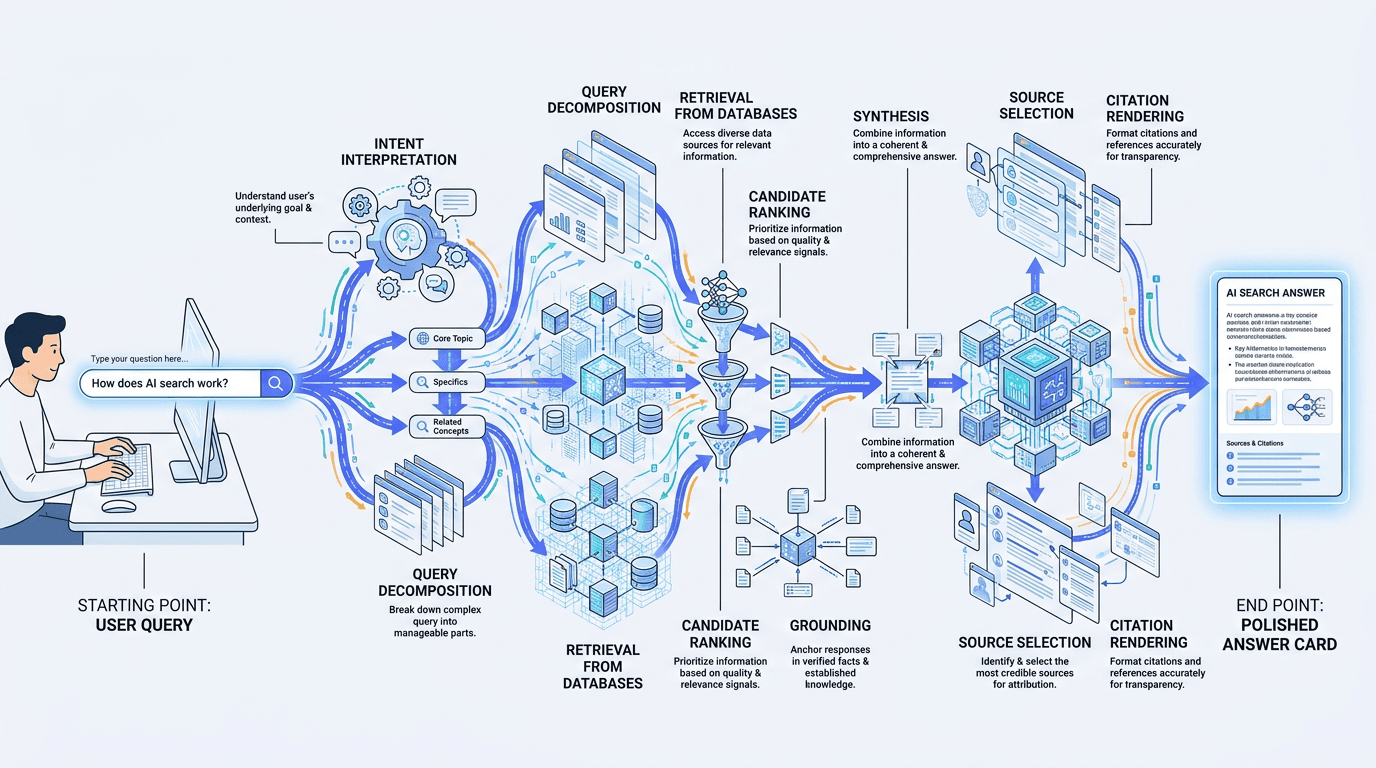
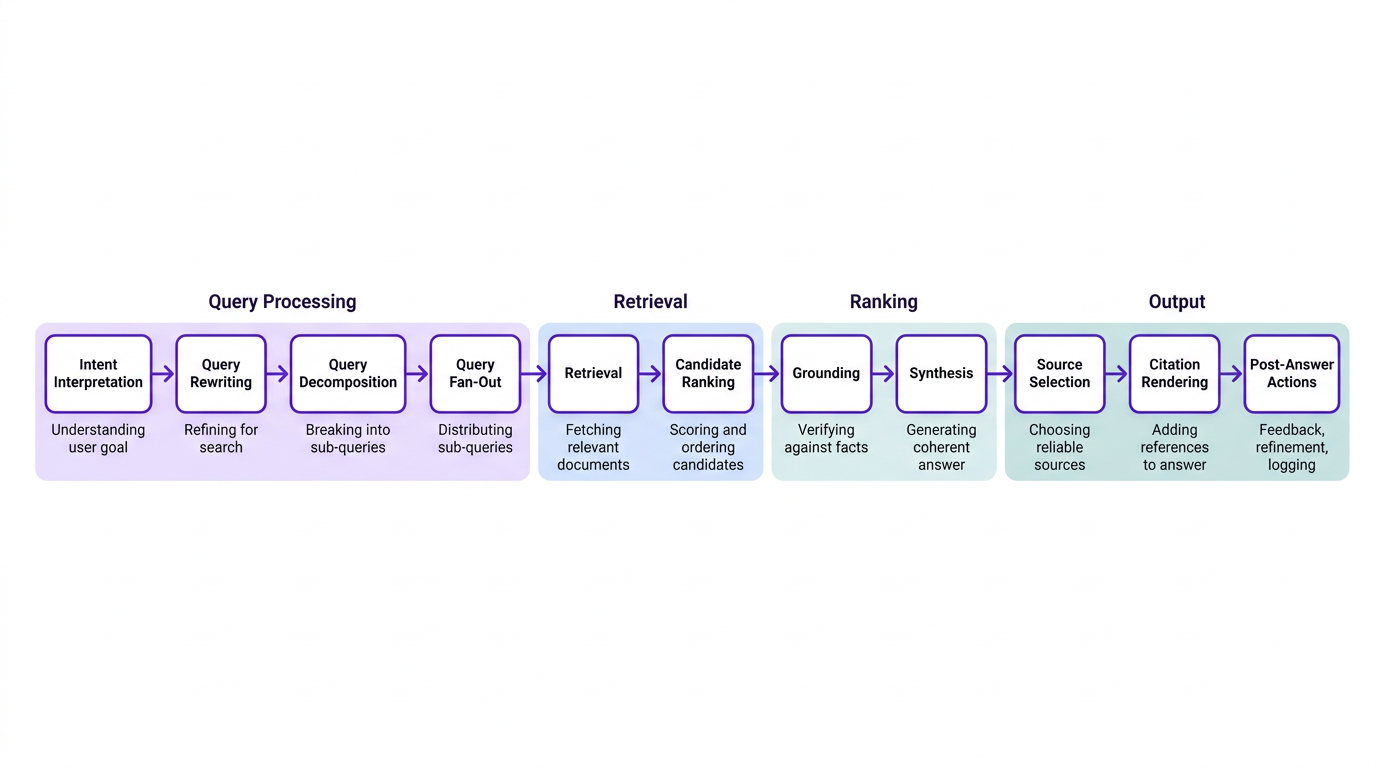
Between the prompt and the response sits a pipeline with multiple gates: intent interpretation, query decomposition, retrieval from external sources, candidate ranking, grounding, synthesis, source selection, and citation rendering. Miss any one of those gates and you can disappear, even if your page would have been the best human-readable result. If you want to move from guessing at AI visibility to earning it on purpose, you have to understand where content gets dropped. The sections below walk stage by stage, separate what research supports from what we can only infer, and tie the mechanics back to operating decisions a team can ship this week.
The Modern Discovery Maze: More Than Just Ten Blue Links
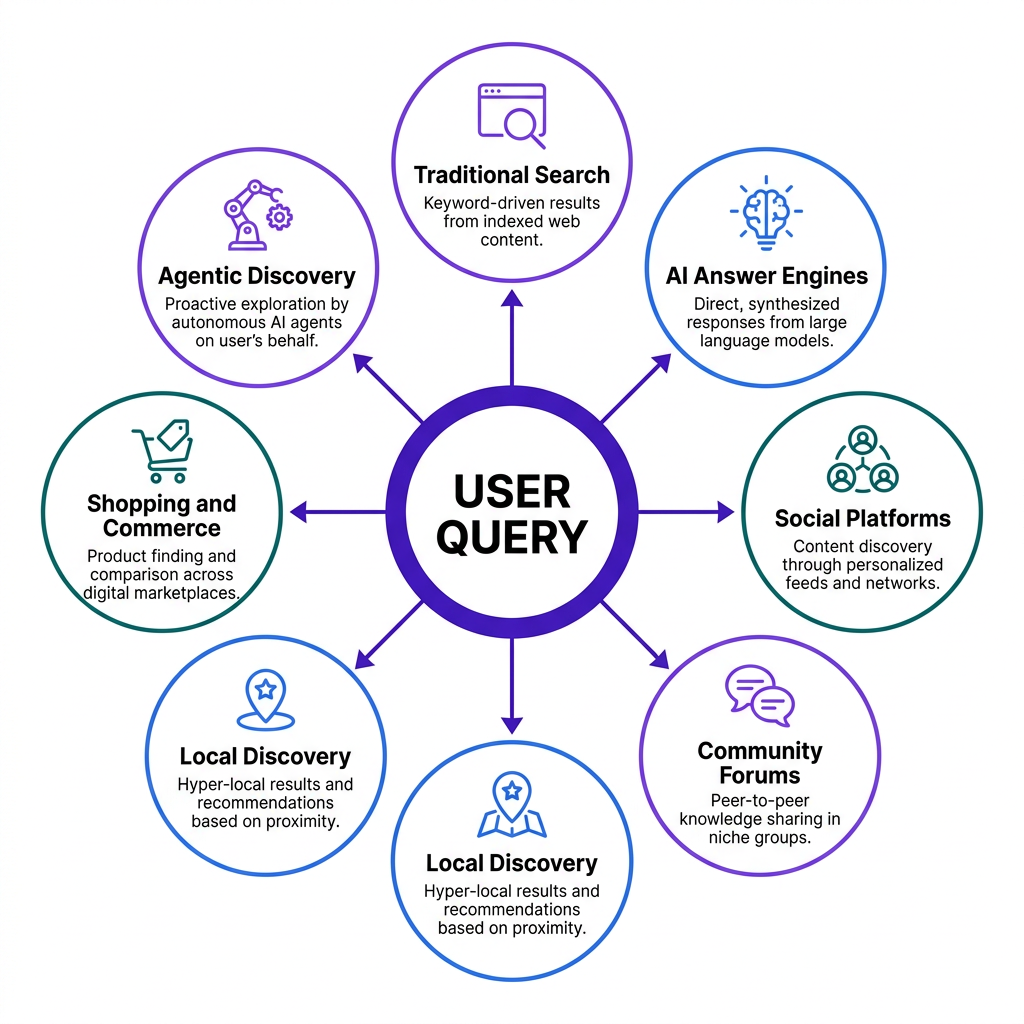
A customer researching project management software in 2026 might start with a voice prompt to an AI assistant, examine a community discussion surfaced by search, watch a social video, compare products in an AI shopping experience, and check a nearby provider through local results. These are all discovery behaviours, but they do not operate through the same systems. Traditional search ranks documents, AI answer engines synthesise information from retrieved sources, social platforms surface content through interest and engagement signals, and local discovery relies heavily on proximity, reviews, listings, and structured business data.
If your strategy ends at traditional rankings, many of these touchpoints remain unmanaged. AI search results can vary significantly across answer engines, even when users submit similar questions. Visibility in one system therefore does not guarantee visibility in another. Vizup treats Search, Social, Communities, AI Answer Engines, and Local Discovery as one connected organic discovery system, helping teams monitor visibility gaps and turn them into prioritised creation, optimisation, publishing, and learning actions.
The Anatomy of an AI Answer: A Step-by-Step Breakdown
It helps to see the whole pipeline before zooming into any single stage. The model below is intentionally generalized. Google AI Mode, Perplexity, ChatGPT, Microsoft Copilot, Gemini, and Claude all run their own proprietary variants with different indexes, retrieval providers, ranking signals, and citation treatments. There's no one diagram that perfectly describes every implementation.
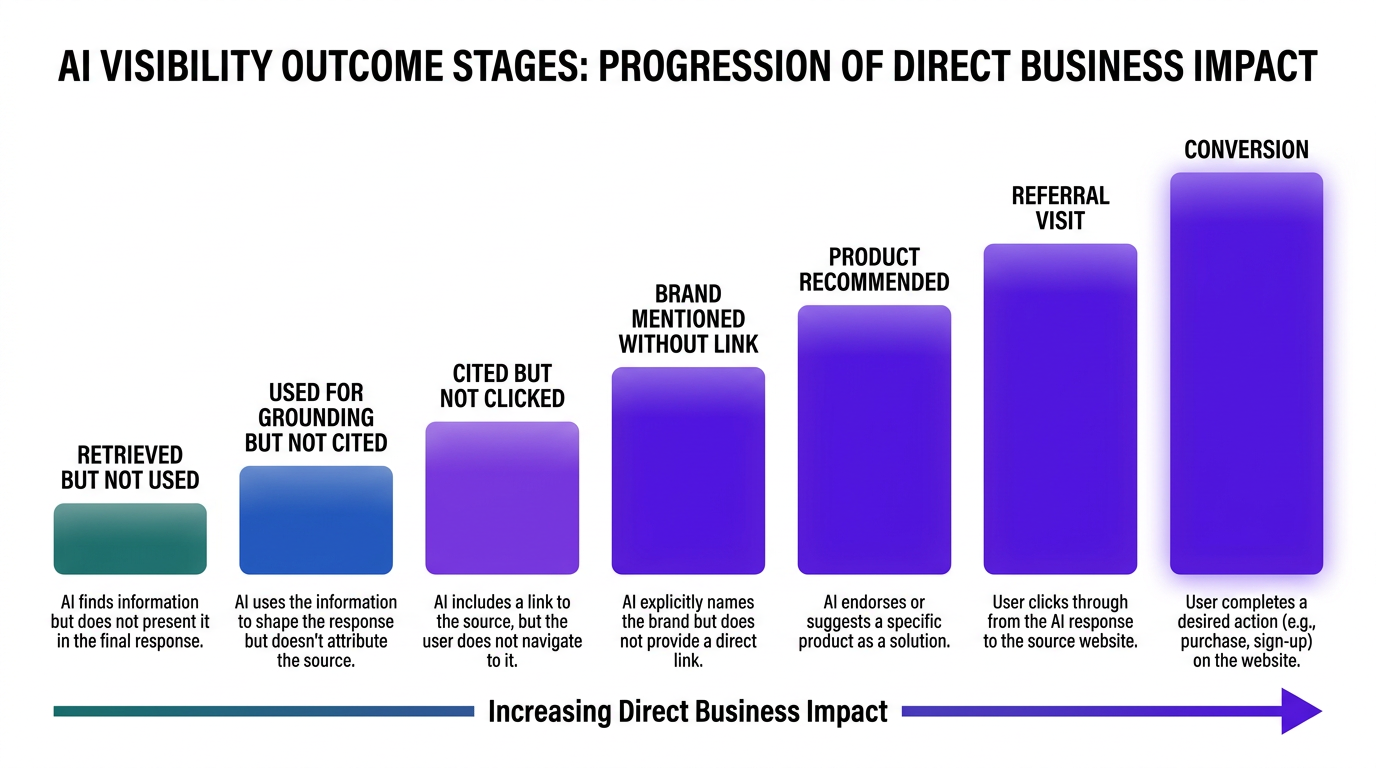
One point that consistently trips teams up: "visibility" isn't one outcome. A page might get retrieved but never influence the synthesized answer. It might be used as grounding evidence yet never receive a visible citation. It can shape a recommendation without sending a click. Treat those as separate events, or you'll end up measuring the wrong thing and optimizing in the wrong direction.
Stage 1: Intent, Interpretation, and the Query Fan-Out
When someone types "best CRM for a 50-person sales team," the system doesn't just run that exact phrase. It tries to resolve intent first: is this a comparison, a straight recommendation request, or a request for implementation guidance? From there it rewrites the query into forms that are more likely to fetch useful results and breaks the prompt into sub-questions: which CRMs fit that team size, which features matter for sales workflows, and how pricing tiers shake out.
That decomposition can trigger what is often called query fan-out: the system generates multiple related searches or retrieval tasks to investigate the entities, comparisons, constraints, and supporting questions required to answer the original request. Users generally do not see these internal queries. However, this does not mean a page should ignore the original question. The page should clearly resolve the primary user need while supporting the most relevant sub-intents. Prompt research for AI search can help teams identify those related needs without forcing every possible variation into one page.
Info: Query fan-out means an AI discovery system may explore several related searches or retrieval tasks before constructing its response. Brands should monitor both the primary user question and its most relevant supporting intents, while keeping each page focused on one clearly defined need.
Stage 2: Retrieval and Candidate Ranking
After the fan-out queries are created, the system retrieves candidate passages from external sources. Retrieval-augmented generation, or RAG, is one common architecture for connecting a language model to current, specialised, or proprietary information. Implementations vary by platform and may rely on web indexes, internal databases, product feeds, local listings, academic sources, community discussions, APIs, or other connected knowledge sources.
What gets queried, though, varies widely by platform. Some systems lean on traditional web indexes (Google's index, Bing's index). Others draw from proprietary databases, academic repositories, product feeds, local business listings, or community forums. If your page is retrievable via Bing but the engine you're targeting relies on a different index or a curated knowledge base, you can be effectively absent by default. That index and source diversity is a big reason AI results diverge so sharply across engines.
Candidate ranking determines which retrieved passages are most useful for the specific information need being investigated. A long, comprehensive guide can lose to a shorter page when the shorter page answers the relevant question more clearly and directly. This is where AI retrieval optimisation becomes an execution problem: pages should use descriptive headings, focused passages, explicit entities, accessible content, and direct answers instead of burying essential information inside an unnecessarily broad document.
Stage 3: Grounding, Synthesis, and Source Selection
Grounding is the stage where an AI system uses retrieved information to support the claims included in its response. Depending on the platform and product, the system may compare multiple sources, prioritise information it can corroborate, and display links to selected supporting pages. Grounding is not identical to traditional search indexing: indexing determines which resources are available to be found, while grounding determines how retrieved information supports the generated response. The distinction is explored further in Vizup's guide to AI grounding versus traditional search indexing.
Synthesis is next: the model composes a coherent answer from multiple sources that may not fully agree. It isn't copy-paste; it's generated text shaped by retrieved evidence. Source selection is its own competitive layer that happens during or after synthesis. Your page can contribute facts that make the answer better and still never show up as a visible citation. Which sources get displayed depends on platform-specific criteria that none of the major providers have documented end-to-end.
What Observational Research Suggests About Citation Selection
Most confident-sounding claims about AI citations are correlations dressed up as rules. No major provider has published a complete specification for citation selection. What we do have are observational studies, and they need to be read with the constraints of their environments in mind.
One large observational study of query fan-out examined how retrieval position, content relevance, page structure, and other characteristics related to citation selection within a specific AI-search environment. The study observed that pages retrieved near the top for relevant sub-queries were more likely to appear as citations. The result is useful evidence that retrieval position matters, but it should not be treated as a universal ranking rule across every AI answer engine, model, interface, query type, or time period.
| Signal | What Recent Studies Observed | Practical Interpretation |
|---|---|---|
| Retrieval position | Pages retrieved nearer the top for relevant sub-queries were more likely to appear as citations. Only 38% of AI Overview citations come from the top 10 organic results. | Retrieval visibility is important, but the relationship should not be treated as a universal ranking rule across all AI engines. |
| Relevance to the query | Pages with stronger alignment to the original user need and relevant supporting sub-queries were cited more often. | Content should answer one clear primary question and support only the most relevant secondary intents. |
| Page structure | Clear headings, focused passages, and machine-readable structure were associated with stronger citation performance. | Structure can improve machine comprehension and extraction, but it does not guarantee citation selection. |
| Content breadth | Pages attempting to cover every related subtopic did not consistently outperform more focused pages. | Avoid turning fan-out research into an oversized "ultimate guide." Focus on usefulness and passage-level relevance. |
| Structured data | Pages containing JSON-LD showed a higher citation rate in some datasets, with some studies showing a lift of 40% or more. Other analyses found no meaningful correlation. | This was an observational correlation and does not prove that schema directly causes citation selection. |
| Domain authority and backlinks | Aggregate authority and backlink metrics did not independently explain which retrieved pages were cited. One analysis found the correlation between DA and AI citation was as low as r=0.18. | Authority may support discovery or retrieval, but it should not be treated as the deciding citation factor. |
| Freshness | The effect of freshness varied, but AI-cited content is on average 25.7% fresher than top-10 organic results. | Keep important content current, but do not assume the newest page will always be selected. |
| Content length | Total word count was not a reliable standalone predictor of citation selection. | Prioritize focused usefulness and passage-level relevance over arbitrary length targets. |
| Observational correlations do not prove causation. These signals were associated with citation but are not guaranteed ranking factors across all engines. |
The takeaway is not that authority, links, freshness, or content depth never matter. Citation behaviour is conditional on the platform, query, retrieval source, ranking process, and type of information required. Brands should therefore avoid chasing one supposed universal citation factor. The stronger approach is to improve retrievability, passage-level relevance, evidence quality, and structural clarity while publishing information that adds something distinctive. Vizup's analysis of what gets cited in AI search explains why original evidence and differentiated insight can outperform interchangeable content.
Beyond the Citation: The Many Ways Your Brand Can Appear
If you only track hyperlinked citations, you're looking at a narrow slice of how AI-driven discovery works. An assistant can recommend your product by name and never link to your site. It can include your business in a local summary pulled from Google Business Profile data. It can surface a Reddit thread where real users praise (or criticize) you. Those are all visibility outcomes, and they can all move pipeline.
Visibility outcomes beyond traditional citations:
- Unlinked brand mentions in generated text (the AI names your product but provides no hyperlink)
- Product recommendations where the AI suggests your solution alongside competitors
- Local business inclusion in map results or location-based summaries
- Community references where AI surfaces forum or social content discussing your brand
- Generated summaries that paraphrase your content without attribution
- Knowledge panel results drawn from structured entity data
- Follow-up queries where the AI's answer prompts the user to search for your brand directly
- Agent actions where an agentic system books, purchases, or initiates contact on the user's behalf
A credible view of organic reach must account for more than clickable citations. Teams should monitor unlinked brand mentions, recommendations, product inclusion, local appearances, community references, generated summaries, referral visits, and downstream conversions. Tracking brand mentions across AI search is only the starting point; the larger opportunity is turning those observations into a prioritised backlog of content, technical, distribution, and publishing improvements.
From Insight to Action: The Organic Autopilot for Modern Discovery
Visibility monitoring only matters if it changes what you ship. The most common failure mode in AI discovery isn't missing data; it's failing to act on it. Teams see a gap, file it away, and move on. Reports accumulate, dashboards show declining mentions, and nothing changes on the site, in the content system, or in the entity data that the engines actually pull from.
Vizup positions itself as an Organic Autopilot for modern discovery: a system to monitor, create, optimise, publish, and learn across Search, Social, Communities, AI Answer Engines, and Local Discovery using AI agents, human experts, and live SEO, pSEO, AEO, and GEO tools. Paid ads are offered as an amplification add-on, but the core operating model is organic.
Here's what that loop looks like in practice: Monitor across discovery surfaces to see where you're present, where you're missing, and where competitors hold ground. Prioritise based on business impact, not vanity metrics. Create assets aimed at specific needs, rather than bloated pages that try to cover every adjacent intent. Optimise for humans and machine retrieval with structured data, passage-level clarity, and consistent entities. Publish via connected workflows so fixes actually land. Learn by measuring citations, mentions, recommendations, referral traffic, and conversions, then feed the results back into monitoring.
AI agents bring speed, scale, automation, and pattern recognition to that loop. Human experts bring strategy, judgment, originality, quality control, and accountability. Live SEO, pSEO, AEO, and GEO tooling is what connects analysis to implementation. The hybrid approach is designed to address the fragmentation problem: SEO, content, social, local, and answer-engine work often lives in separate silos even though the user journey doesn't.
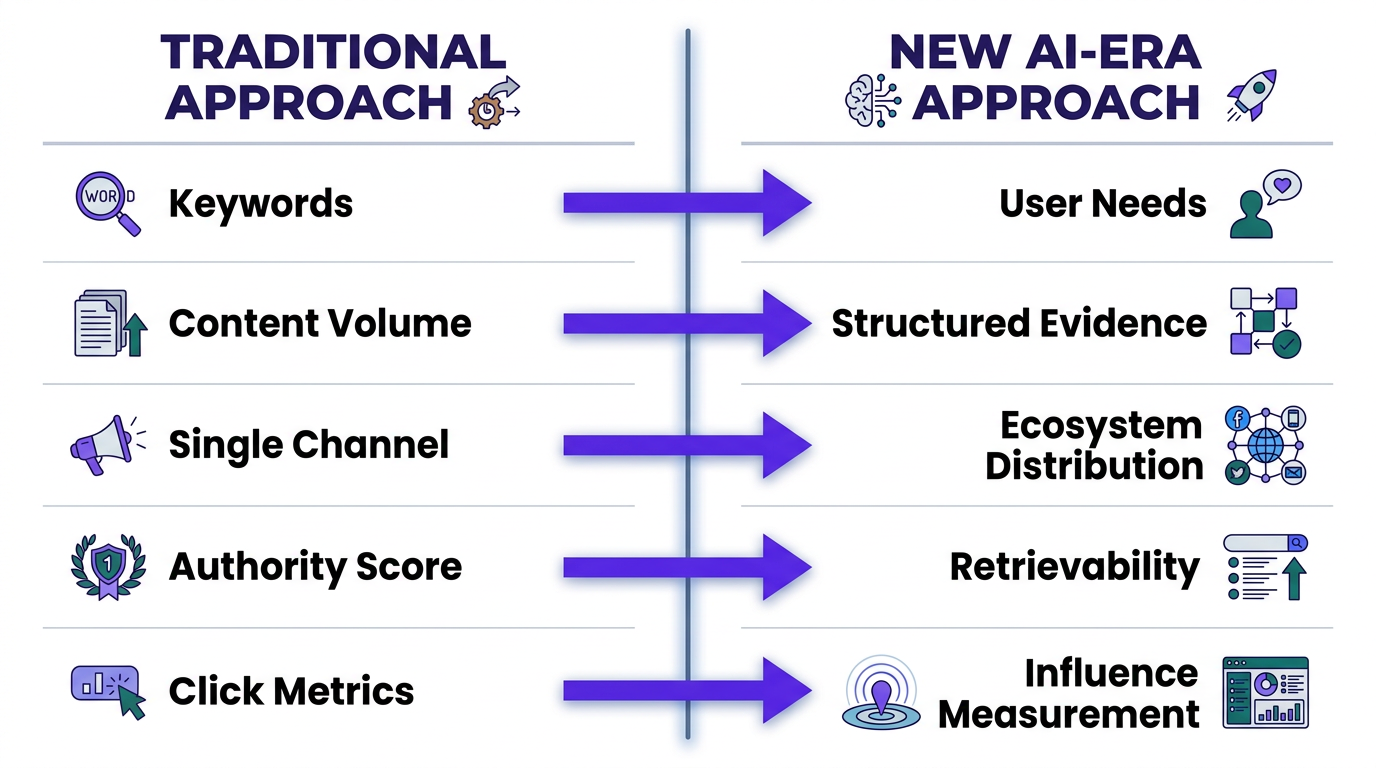
Your Content Strategy for the AI Era: 5 Foundational Shifts
Generative search isn't driven by a single secret ranking formula. The evidence we do have suggests it rewards a different mix of content qualities than traditional search alone. These five shifts stay within what the research supports, without pretending we have provider-level specs.
From Keywords to Specific User Needs
Mapping the demand landscape (fan-out queries and decomposed sub-questions) doesn't mean cramming every related intent into one URL. A page that tries to answer 30 questions often loses to a set of focused pages that each answer a small cluster with real clarity. Build for distinct user needs, then connect the pieces with deliberate internal linking and a clean topical architecture. The win condition isn't length; it's being the most directly useful answer at the passage level.
From Content to Structured Evidence
AI discovery systems often retrieve and evaluate specific passages rather than treating every page as one indivisible document. Descriptive headings, concise answer blocks, useful lists, comparison tables, explicit entities, and accurate structured data can make information easier to interpret and extract. Original research, proprietary data, practitioner experience, and first-party evidence also give systems information that cannot be sourced from hundreds of interchangeable articles. Teams should validate structured data for SEO, AEO, and AI systems while ensuring that every markup claim is supported by visible page content.
From One Channel to an Ecosystem
Traditional crawlability and indexation still matter because many retrieval pipelines start with web indexes. But distribution has expanded: social platforms, community forums, and local listings are also inputs for what models retrieve and repeat. A practical GEO playbook is less about abandoning search and more about extending coverage to the surfaces where generative engines actually look for supporting material.
From Authority to Retrievability
Traditional authority signals may support discovery, but they do not guarantee inclusion in an AI-generated answer. Technical accessibility remains foundational: pages must be crawlable, indexable, correctly rendered, consistently canonicalised, and connected through meaningful internal links. Teams should first check whether AI crawlers are blocked by robots.txt, then ensure important information can be interpreted and extracted without unnecessary friction. These foundations also support efforts to improve referral traffic from AI assistants.
From Clicks to Influence
Treat referral traffic as one signal rather than the complete scoreboard. Brand mentions, product recommendations, local inclusion, follow-up searches, assisted conversions, and agent-driven actions can all represent meaningful organic influence. A user may discover a brand through an AI answer and later visit directly without clicking the original citation. Improving brand visibility across AI search engines therefore requires measurement across the full journey, not only the traffic attributed to visible source links.
Frequently Asked Questions
Is traditional SEO dead because of AI search?
No. Traditional SEO is still foundational because content has to be accessible, indexed, relevant, and retrievable before it can shape AI-generated answers. Crawlability, indexability, structured data, internal linking, heading clarity, and entity consistency remain prerequisites for answer-engine retrieval. What's changed is the sufficiency: traditional SEO by itself no longer covers the surfaces where people now ask and get answers. Brands need strategy across AI answer engines, social platforms, communities, and local discovery, not just classic SERPs.
How can I find the fan-out queries an AI engine is using?
Most platforms do not expose every internal query, retrieval task, or reasoning step used to produce an answer. Teams can still approximate the surrounding demand landscape by testing related prompts, comparing results across engines, studying the sub-questions included in responses, and monitoring which sources appear as the wording changes. Vizup's AI search visibility optimisation playbook explains how to turn that research into a repeatable monitoring and execution process.
Does Domain Authority matter for getting cited by AI?
Domain Authority is not a confirmed universal citation-ranking factor. A strong domain may help content become discovered or retrieved, but authority alone does not guarantee selection in an AI-generated answer. Passage-level relevance, clear responses, evidence quality, freshness, technical accessibility, and alignment with the specific information need may all influence whether a retrieved source contributes to or appears in the final response.
Should I create a separate page for every single question?
Not automatically. Split into a separate page when the question represents a distinct intent that deserves a focused answer. Keep closely related questions together on one page when you can structure them with clear headings and passage-level answers. The target is a set of focused pages connected by intentional internal linking, not hundreds of thin pages and not one monolithic guide that buries the point.
How is AI search visibility different for local businesses and SaaS companies?
Local visibility depends heavily on accurate business information, relevant categories, reviews, proximity, local pages, and consistent listing data. AI systems may surface this information through map results, business recommendations, or location-based summaries rather than conventional article citations. SaaS companies are more likely to compete through comparisons, use-case pages, product information, expert content, and community reputation. Both need to understand how AI-powered answer engines work and how sites can optimise for them, but the relevant sources, assets, and outcomes differ.
Stop Chasing Algorithms, Start Answering Questions
The path from a prompt to an AI-generated answer isn't magic, and it isn't an unknowable black box. It's a pipeline with specific stages and predictable failure points. Intent interpretation, query fan-out, retrieval, candidate ranking, grounding, synthesis, and source selection are all moments where your content can earn a role or get filtered out. Teams that understand how AI search engines retrieve and cite content get an advantage over competitors still optimizing as if one channel defines discovery.
Even when the mechanics are messy, the operating strategy is straightforward: map demand across discovery surfaces, publish focused and structured assets that answer specific questions with original evidence, and keep those assets technically accessible to crawlers and retrieval systems. Then distribute across the places models pull from, not just your own site. Measure beyond clicks: mentions, recommendations, follow-up behavior, and conversions. Keep iterating.
AI discovery behavior changes by platform, model, query type, user context, geography, language, freshness expectations, and the tooling available in the moment. There's no single tactic that guarantees visibility everywhere. What does compound is a continuous system for monitoring, creating, optimizing, publishing, and learning. Brands that build that system will out-execute brands waiting for a checklist.
Stop collecting disconnected reports and start shipping measurable improvements. Explore Vizup's Organic Autopilot to monitor, create, optimise, publish, and learn across Search, Social, Communities, AI Answer Engines, and Local Discovery using AI agents, human experts, and live SEO, pSEO, AEO, and GEO tools. Paid ads are available as an optional amplification add-on.
