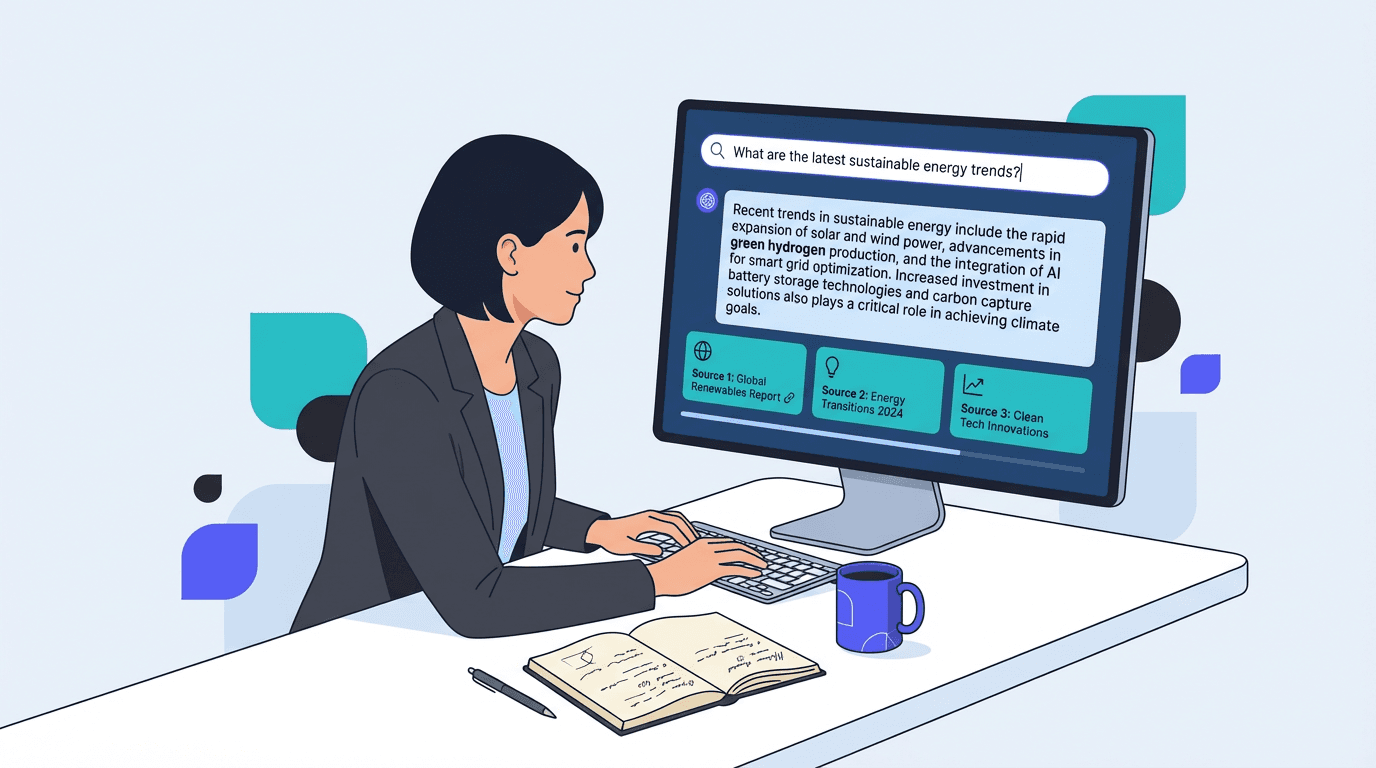
For the past 25 years, traditional search results dominated the web, presenting users with ranked lists of links to click through. That experience is now being replaced. You search for something, and instead of ten blue links, you get a direct answer, a synthesized paragraph with sources cited underneath. Yet most content teams continue to optimize for the outdated model.
An AI-powered answer engine uses natural language processing, large language models, and retrieval systems to figure out what youre actually asking, then it stitches together a single, synthesized response. Tools like Perplexity, Phind, Googles AI Overviews, ChatGPT search, Komo, and Consensus all follow that basic pattern, even if the UX looks different. Search Engine Land reported in 2026 that AI tools now generate 45 billion monthly sessions globally, roughly 56% of traditional search engine volume. Thats not a cute trend line, its a fundamental shift in how people pull information from the web.
If your content isn't structured for these systems, you're invisible to a growing share of your audience. The rest of this guide breaks down how to fix that, from understanding how answer engines select sources to tracking your visibility over time.
Step 1: Understand How AI Answer Engines Choose Sources
Before you optimize anything, you need a clear mental model of what these systems actually reward. Traditional SEO trained us to think about keywords, backlinks, and domain authority. Answer engines care about those signals too, but they filter through a different lens. They're trying to construct a trustworthy, complete answer from multiple sources, and they need content that's easy to extract meaning from.
I've watched brands with strong Domain Authority get completely ignored by Perplexity because their content buried the answer under 400 words of introductory material. Meanwhile, a niche blog with clear, structured responses gets cited repeatedly. The pattern is consistent: answer engines favor content that states the answer early, supports it with specifics, and organizes information in a way that's parseable by AI systems designed to simulate human reasoning.
Answer Engine Optimization (AEO) is the practice of structuring content so platforms like ChatGPT, Perplexity, and Google AI Overviews can discover and cite it. It overlaps with SEO, but the priorities differ. You're not just trying to rank on a results page. You're trying to be the source an AI quotes when a user asks a question.
Step 2: Audit Your Content for AI-Powered Answer Engine Readiness
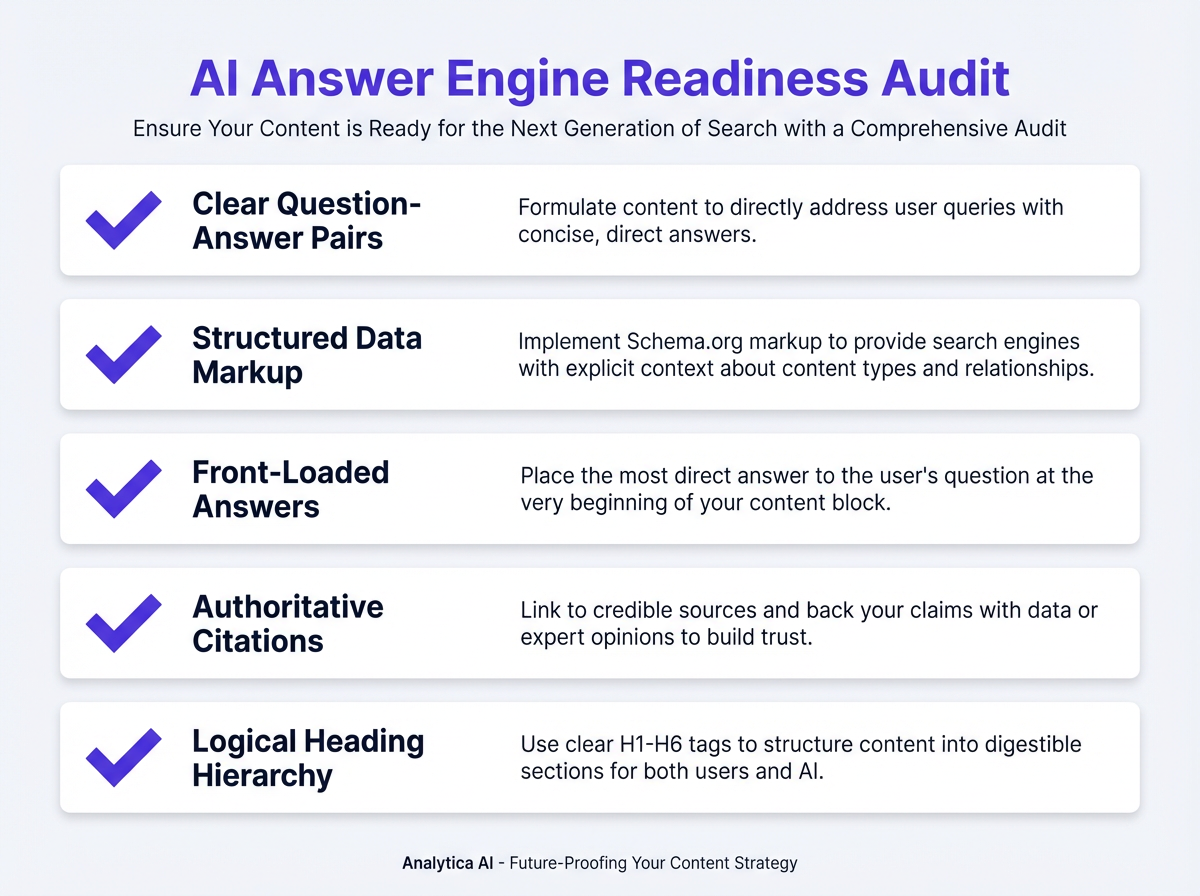
Pull up your top 20 organic pages. For each one, ask yourself: if an AI system read this page, could it extract a clear, direct answer to a specific question within the first 150 words? If the answer is no, that page needs work.
Most content written between 2018 and 2023 was optimized for dwell time, which meant burying the answer to keep people scrolling. That strategy now actively works against you in answer engines.
When auditing, focus on these key areas:
- Schema markup: FAQ schema, HowTo schema, and Article schema give AI crawlers structured signals about your content. Google has recommended structured data for years, but it matters even more now because answer engines use it as a parsing shortcut.
- AI crawler access: Check whether your robots.txt or meta tags are blocking AI-specific bots. Several answer engines use their own crawlers (PerplexityBot, GPTBot), and if you've blocked them, your content won't surface regardless of its quality.
- Front-loaded answers: Each section should deliver its core point within the first two sentences below the heading.
- Heading hierarchy: Ensure your H2s and H3s follow a logical structure that maps to the questions users are asking.
- Content freshness: Outdated dates and stale data points reduce your chances of being cited.
Step 3: Restructure Pages Around Questions and Direct Answers
This is where the real work happens, and it's more straightforward than most people assume.
For each target topic, identify the specific questions users ask. Not broad keywords, but actual questions. "What is an AI-powered answer engine" is a question. "Answer engine optimization tips" is a keyword. Both matter, but the question format is what triggers citations in conversational AI responses.
Use your H2s and H3s as those questions, then answer them directly in the first sentence or two below the heading. Follow with supporting detail, data, or examples.
I've seen teams overthink this, building elaborate content architectures when the fix is straightforward: place the answer where AI systems can easily locate it. Front-load every section. If someone asks "how do answer engines work," your first sentence under that heading should explain how they work. Not why it matters. Not the history. The direct answer.
If you're looking for a broader framework on how to approach this across your entire site, Vizup's guide on building an AI-powered SEO strategy walks through the full planning process.
Step 4: Build the Authority Signals AI Systems Trust
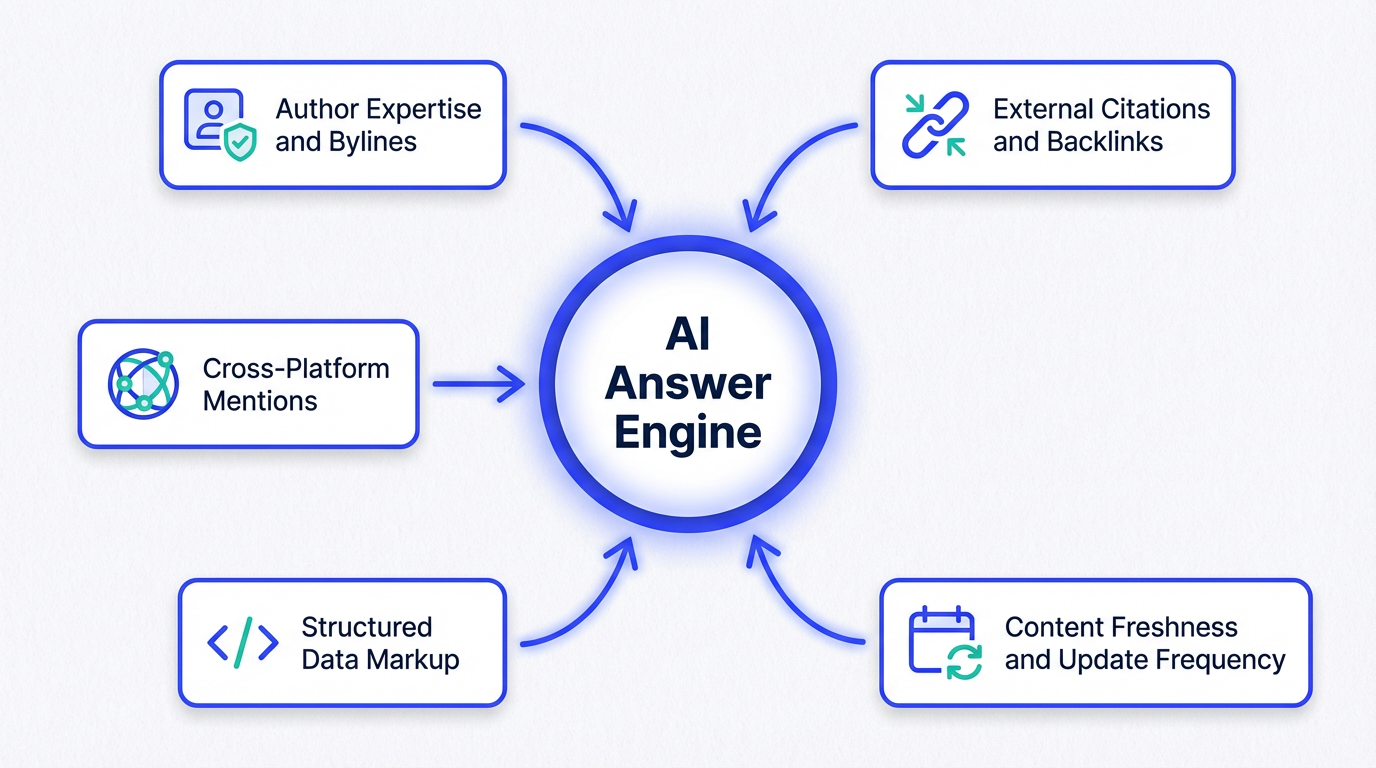
Getting cited once is encouraging. Getting cited consistently requires authority, and the signals AI systems use overlap with, but aren't identical to, traditional SEO authority. Backlinks still matter. But so do author bylines with verifiable expertise, consistent cross-platform mentions of your brand, and content freshness.
In the B2B sector specifically, AI-generated traffic now accounts for 2% to 6% of total organic traffic and is growing at over 40% per month (Forrester, 2025). That growth rate means the brands building authority now will have a compounding advantage. Those waiting for established best practices to solidify will be playing catch-up for years.
One point worth raising: a lot of AEO advice tells you to focus exclusively on content quality. That's incomplete. I've seen well-written, well-structured content get ignored because the brand had zero presence outside its own blog. Answer engines cross-reference sources. If your brand or author shows up on industry publications, podcasts, or forums discussing the same topics, that reinforces the trust signal. Content quality is necessary, but it's not sufficient on its own.
Step 5: Track Your Visibility in Answer Engines
This is the part of the process that no one has fully solved yet. Traditional rank tracking doesn't apply to answer engines because there's no fixed position. Your content either gets cited or it doesn't, and the citation can appear differently depending on how the user phrases their query.
What you can do right now: manually query your target topics in Perplexity, ChatGPT, and Google AI Overviews on a weekly basis. Track which of your pages get cited, which competitors show up, and what format the cited content takes. While this can be tedious, manual tracking is currently the most reliable method until more advanced tools become available.
For teams that want to move beyond manual spot-checks, Vizup's AI Answer Engine Checker is built for exactly this use case. It tracks how AI systems reference your brand and content across multiple answer engines, so you can see which pages are getting cited, where competitors are appearing instead, and how your visibility shifts over time. The category is still young and most tools are evolving, but having structured monitoring in place is far better than operating without any data.
Common Mistakes That Reduce Your Answer Engine Visibility
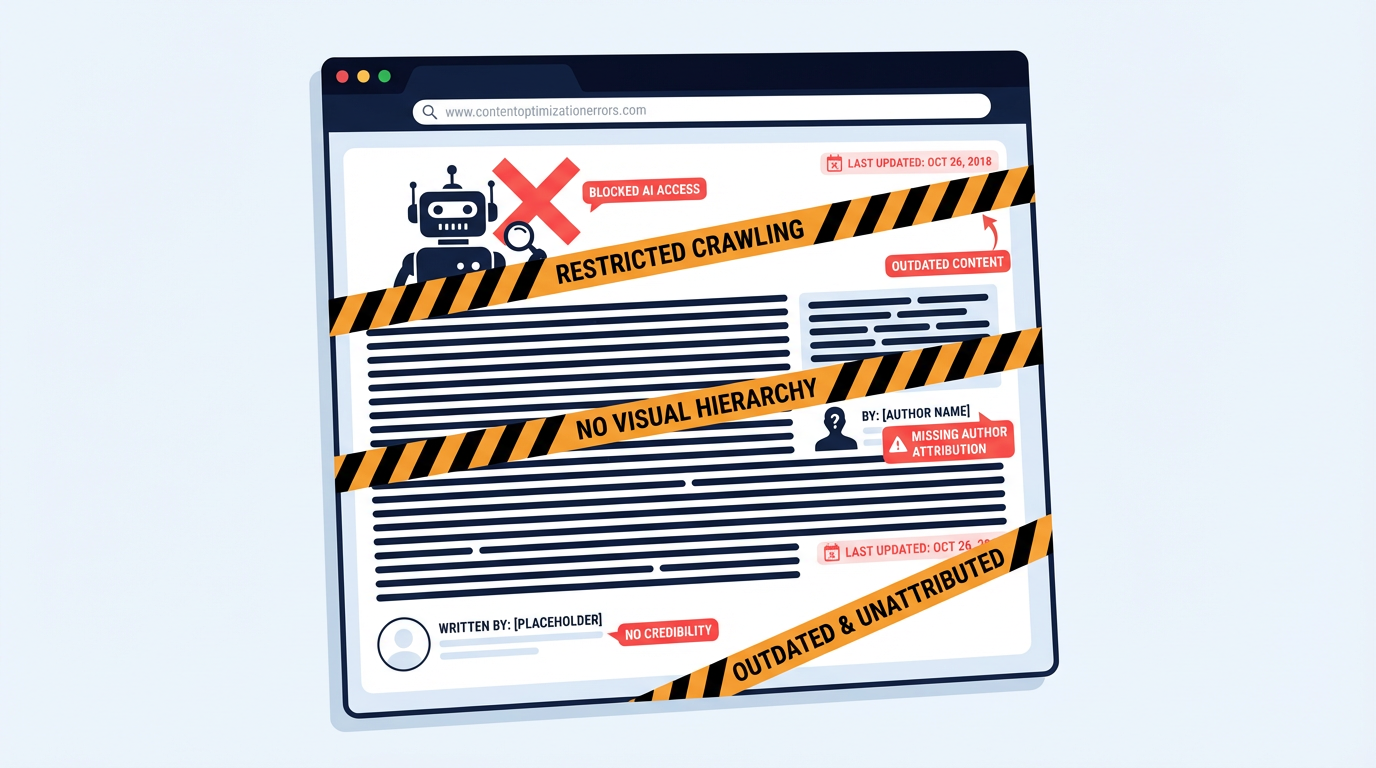
Blocking AI crawlers accidentally is more common than you'd expect, especially on enterprise sites where security teams add blanket bot restrictions. Check your server logs for GPTBot and PerplexityBot requests. If you don't see any, something is likely blocking them.
Writing 3,000-word articles when 800 words would answer the question more effectively is another frequent misstep. Answer engines don't reward length. They reward clarity and completeness. A tightly written 900-word piece that directly addresses the query will outperform a sprawling guide that takes 2,000 words to reach its point.
Ignoring content freshness is a quiet killer. If your article references 2023 and it's now 2026, answer engines notice. They tend to prefer recently updated content, especially for topics where accuracy changes over time. Update your dates, refresh your data points, and make sure your content reflects current conditions.
Skipping author attribution weakens your content's trust signal. Pages with no byline, no author bio, and no verifiable expertise are harder for AI systems to evaluate. Adding real author information takes five minutes and makes a measurable difference.
Where AI-Powered Answer Engines Are Heading
Forrester predicts that in 2025, one in five US and EMEA retailers will launch customer-facing generative AI applications. That number will only grow. The shift from search engines to answer engines isn't speculative. It's already underway, and answer engines are the new front page of the internet for a growing segment of users.
The sites that adapt now, structuring content for direct answers, building cross-platform authority, and tracking AI citations, will own the next era of organic discovery. The playbook isn't complicated. But it does require a willingness to stop optimizing exclusively for a search paradigm that's already being replaced.
To stay ahead in this shifting landscape, begin restructuring your content now and make sure your site is ready for the future of search. If you want more insights on AI-powered SEO strategies, subscribe to the Vizup newsletter for expert guidance on adapting your content for the age of answer engines.
Frequently Asked Questions
What is the difference between a traditional search engine and an AI-powered answer engine?
A traditional search engine returns a ranked list of links for users to browse. An AI-powered answer engine, by contrast, uses large language models and natural language processing to synthesize a direct answer from multiple sources, citing them inline. Instead of receiving a list of pages to click through, the user gets a composed response that addresses their question directly.
Does optimizing for answer engines mean traditional SEO no longer matters?
No. Traditional SEO and answer engine optimization overlap significantly, and strong technical SEO, quality content, and backlinks remain important. The difference is that AI optimization requires additional steps: structuring content so AI systems can extract and cite clear answers, implementing structured data markup (such as FAQ and Article schema), and ensuring AI crawlers have access to your pages.
What tools are available for answer engine optimization?
The category is still maturing, but Vizup's AI Answer Engine Checker is built specifically for monitoring how AI systems cite your content across platforms like Perplexity, ChatGPT, and Google AI Overviews. Combining it with structured data validation tools and traditional SEO platforms gives you the most comprehensive coverage.
How long does it take to see results from answer engine optimization?
It varies, but most teams see initial citations within 4 to 8 weeks of restructuring content and ensuring AI crawlers have access. Building broader authority typically takes longer, around 3 to 6 months of consistent effort across content creation and external mentions.
Can small websites compete with large brands in AI answer engines?
Yes, and in some cases more easily. Answer engines prioritize clarity and direct relevance over domain size. A focused niche site with well-structured, expert content can get cited ahead of a large brand whose pages are bloated or poorly organized.
