On traditional search engines, about 60% of searches now end without the user progressing to another destination, according to a 2025 Bain & Company report. And most brands never make it into AI-generated answers. It usually isn't a content-quality problem; it's a distribution and retrieval problem. If you're trying to figure out how to improve brand visibility in AI search engines, you need a different playbook than traditional SEO.
This is written for marketing leaders, SEO practitioners, and brand strategists who want an operational framework, not a pile of theory. You'll see how AI search engines decide which brands show up, where teams tend to misread the new rules, and how to run a 5-step process that can move results in weeks. Sections cover: how AI retrieval works, common misconceptions, the technical foundation, the 5-step playbook, a tool comparison, advanced tactics, a real-world case study, and an FAQ.
How AI Search Engines Actually Decide Which Brands to Mention
ChatGPT Search, Perplexity, and Google AI Overviews don't "rank" pages the way Google's classic index does. They lean on retrieval-augmented generation (RAG): pull relevant documents from a broad source pool, then synthesize an answer in plain language. That changes the win condition. Your brand doesn't have to sit at #1 to be included; it has to be easy to retrieve and safe to cite across enough trusted sources that the model treats your claims like consensus.
One nuance that matters in practice: citation-based visibility (your URL appears as a source) and brand-mention visibility (your name shows up in the answer text) are related, but not the same. It's common to see a brand mentioned in 40% of category answers without earning a single URL citation. Both are valuable; brand mentions are tougher to measure and often closer to revenue. According to IBM's definition of AI search engines, these systems use NLP and machine learning to interpret intent instead of matching keywords, which pushes entity authority and cross-platform consistency ahead of PageRank-style link signals when deciding what gets surfaced.
What Most Brands Get Wrong About AI Search Visibility
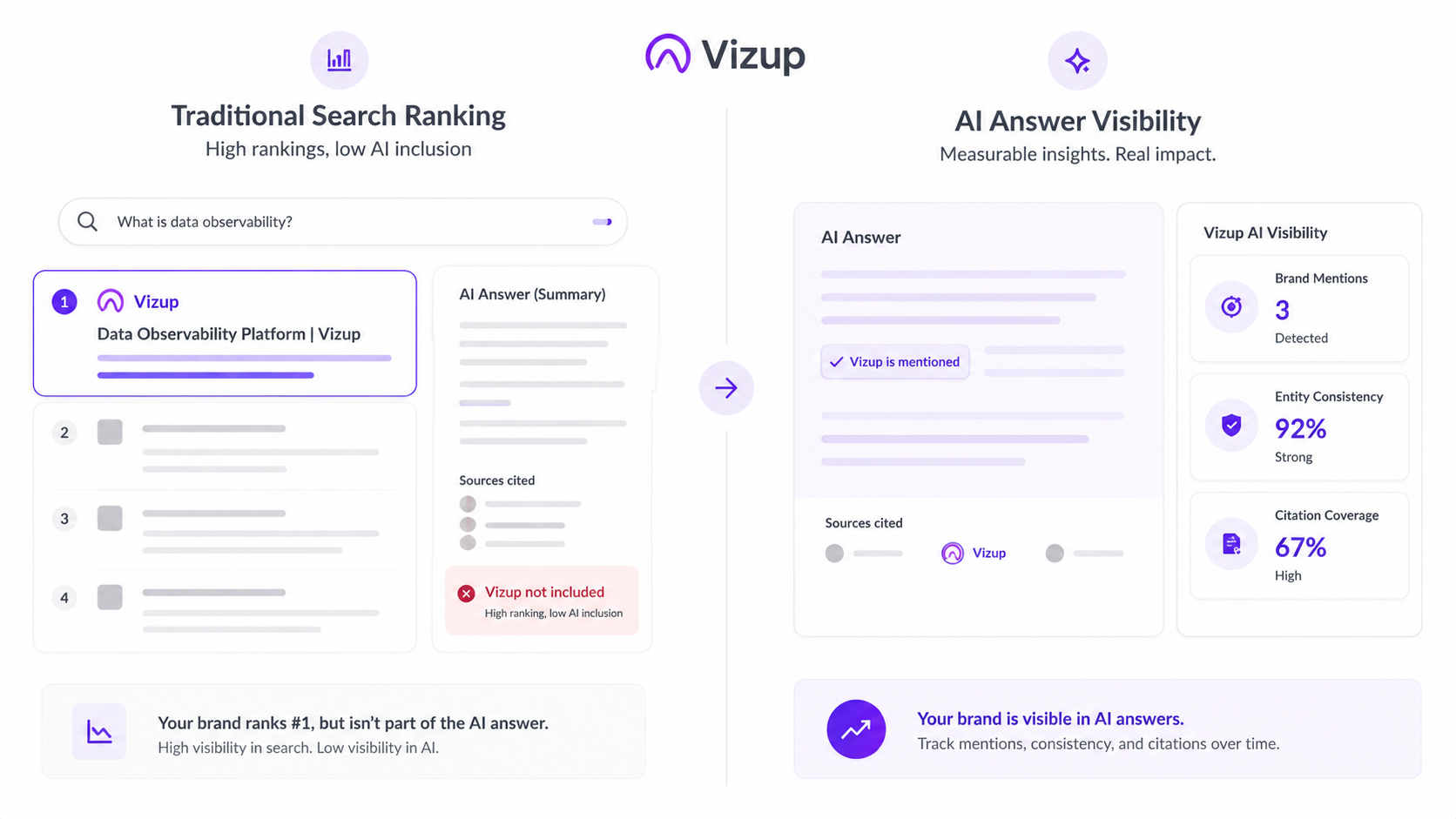
The most common misconception is simple: "If I rank #1 on Google, I'll show up in AI answers." In reality, AI engines pull from a wider, flatter set of sources, and they often reward agreement across multiple domains over a single top-ranking page. Vizup's own research identifies five trust signals AI systems use to surface brands: entity recognition, third-party validation, cross-platform consistency, content relevance, and credibility. A brand that shows up consistently across G2, industry publications, and Reddit threads can outrun a brand with a dominant homepage but a thin off-site footprint.
The next mistake is treating AI search optimization like a one-and-done initiative. AI answers are volatile. You can be present on Monday and gone by Friday as models refresh what they retrieve and how they weight sources. That's why visibility metrics are crucial in 2026, rather than relying on traffic numbers that show up late and blur what's actually changing.
Here's the blunt version: the brands winning in AI search aren't necessarily the ones shipping the most content. They're the ones publishing the clearest claims in the most quotable format. One well-structured FAQ page with original data can beat 50 generic blog posts.
The Foundation: Preparing Your Brand's Digital Presence for AI Crawlers
Note: Skip this section if you've already verified that GPTBot, ClaudeBot, PerplexityBot, and Google-Extended are allowed in your robots.txt, and you have Organization and FAQ schema markup deployed across your key pages.
AI search readiness comes down to three basics: technical accessibility, entity clarity, and content structure. Start with the unsexy part: access. Plenty of sites still block AI crawlers by default, so check robots.txt for GPTBot, ClaudeBot, PerplexityBot, and Google-Extended. Then make your claims legible to machines. Organization, Product, and FAQ schema markup give AI systems structured facts instead of forcing them to interpret a wall of prose. Structured data is essential for AI systems because it turns your content into machine-readable signals that help models judge relevance.
Entity clarity is consistency, enforced everywhere your brand exists. Your name, description, and product claims should match across your site, Wikidata, Crunchbase, LinkedIn, and G2. AI engines triangulate: when independent sources describe you the same way, that language becomes the model's default framing. When those sources disagree, you introduce ambiguity, and ambiguous entities get ignored. If you want the mechanics, optimizing for AI-powered answer engines breaks down how entity reinforcement works in practice.
How to Improve Brand Visibility in AI Search Engines: A 5-Step Playbook
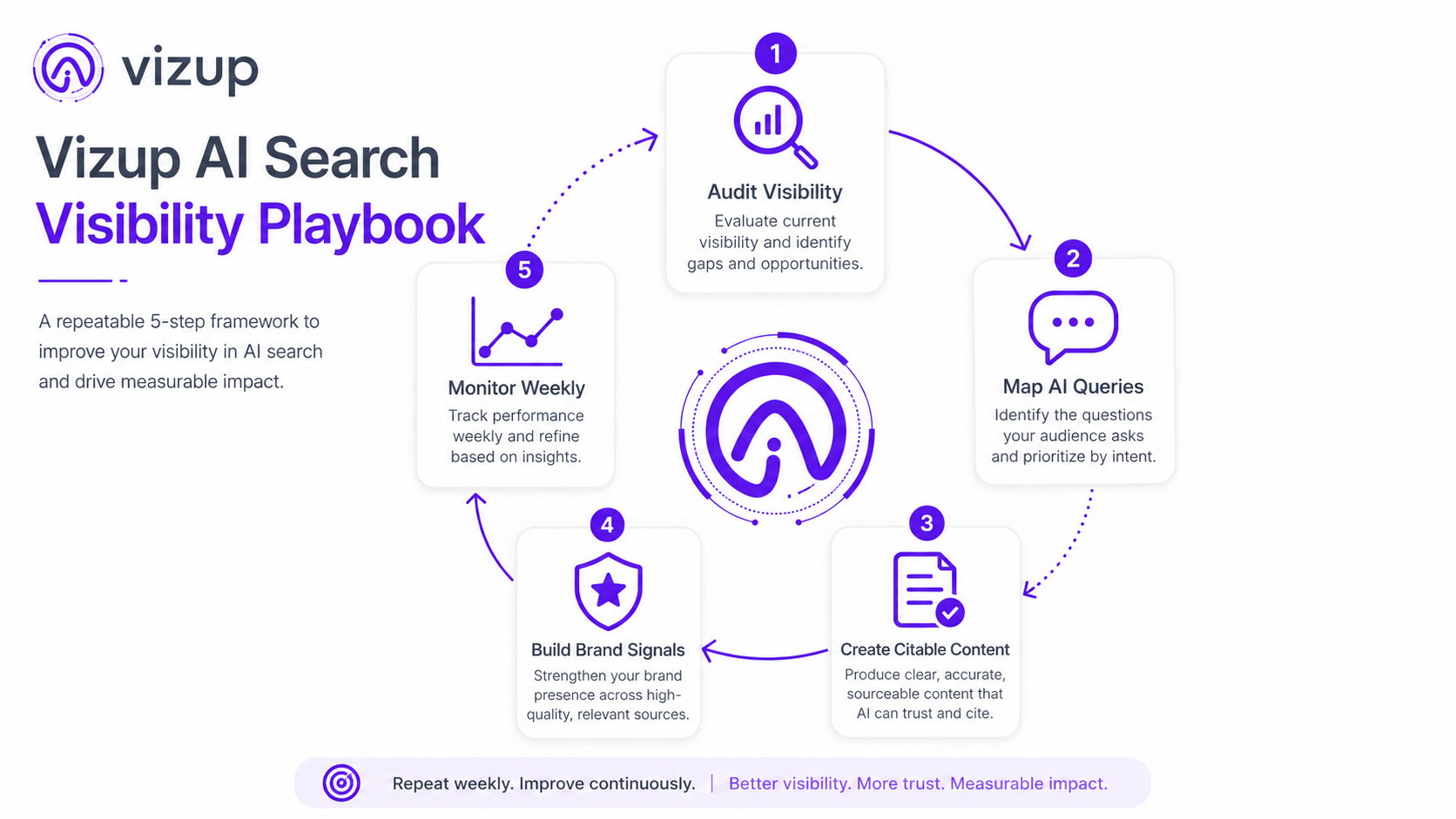
Step 1: Audit Your Current AI Search Visibility
Start with a manual sweep: query your brand name and top product categories across ChatGPT, Perplexity, Gemini, and Copilot. Screenshot and log what comes back. Track whether you're cited, mentioned without a citation, or missing entirely. That baseline shows your real position in the market, not the comforting story your Google rankings tell. If you're managing more than a handful of queries, Vizup's Answer Engine Monitoring can automate tracking across AI platforms at scale, replacing spot-checks with a system you can run weekly.
Step 2: Map the Questions AI Engines Are Answering in Your Category
List 20-30 high-intent, conversational queries in your niche (for example, "best AI SEO tools for agencies" or "how to track brand mentions in ChatGPT"). Run each query across multiple AI platforms and log which competitors show up. That becomes your competitive visibility map: where you appear, where you don't, and who owns the narrative. Bain & Company (2025) found that 80% of consumers rely on AI-powered summaries for answers in at least 40% of their searches, so these queries aren't academic; they're purchase-shaping moments.
Step 3: Create Content That AI Engines Want to Cite
Content that earns AI citations shares three structural traits:
- Concise, claim-rich paragraphs that answer a specific question directly. AI engines extract snippets, they don't reward "thought leadership" fog.
- Original data or proprietary research. Models favor information they can't find in five other places. One strong benchmark can earn recurring citations.
- Clear H2/H3 hierarchies with definition-style formatting, plus structured data where it fits. Pages with structured headings and bullet points are easier for systems to parse and cite, and adding schema markup can help search engines understand your page (Google Search Central, 2026).
If your team is still writing for blue links, you'll miss what AI retrieval actually rewards. This breakdown on how to make your content discoverable in AI engines gets specific about the structural and semantic requirements. Microsoft Advertising (2025) confirms the pattern: winning in AI search comes down to content that's fresh, authoritative, structured, and semantically clear enough to be selected for a generated answer.
Step 4: Amplify Your Brand Signal Off-Site
For AI search, mentions function a lot like backlinks used to. You want your brand referenced in third-party reviews, roundups, podcasts, and industry publications. Feed journalists and analysts expert quotes and original data they can publish. Those pages become retrieval sources when models generate answers. The target is cross-platform consensus: when Perplexity, ChatGPT, and Gemini repeatedly encounter your brand described the same way across independent sources, that phrasing becomes the default answer.
Step 5: Monitor, Measure, and Iterate Weekly
Treat monitoring as a weekly operating cadence, not a quarterly report. Track mention frequency, sentiment, and competitor share of voice across AI platforms, and tie movement back to specific content and distribution pushes. Vizup's Digital Presence Monitoring rolls this into a single dashboard so small teams can stay on top of visibility without living in spreadsheets. This piece on why organic marketing is beyond SEO in 2026 is a useful framing: this is now core marketing work, not an SEO side quest.
Advanced Tactics: The Edge Cases That Separate Leaders from Everyone Else
Programmatic entity reinforcement is the systematic version of "show up everywhere that matters." Seed your brand into knowledge bases, directories, and community forums that AI models pull from during retrieval. Wikidata entries, structured Crunchbase profiles, and consistent participation in niche forums all expand the source pool AI engines draw from. It's not glamorous, but it compounds over time.
Negative visibility defense deserves a spot on the roadmap. AI engines will sometimes output inaccurate or stale brand descriptions, and in 2026 the correction pathways are still limited. Step one is catching the problem early, which is where tools like Vizup's Answer Engine Monitoring help. Fixes usually come from updating the sources the model retrieves from, not from asking the AI provider to change an answer.
Multi-model strategy is where a lot of teams get surprised. Perplexity, Gemini, and ChatGPT don't pull from identical source pools, so visibility gains on one platform don't automatically transfer to the others. You can earn strong citations on Perplexity and still show up as a ghost on Gemini if your brand isn't present in the sources Google's retrieval layer prefers. Cross-platform monitoring is how you find those gaps before competitors do. The AI Search Visibility Optimization: 2026 Playbook goes deeper on multi-model execution.
A Quick Case in Point: From Invisible to Cited in 8 Weeks
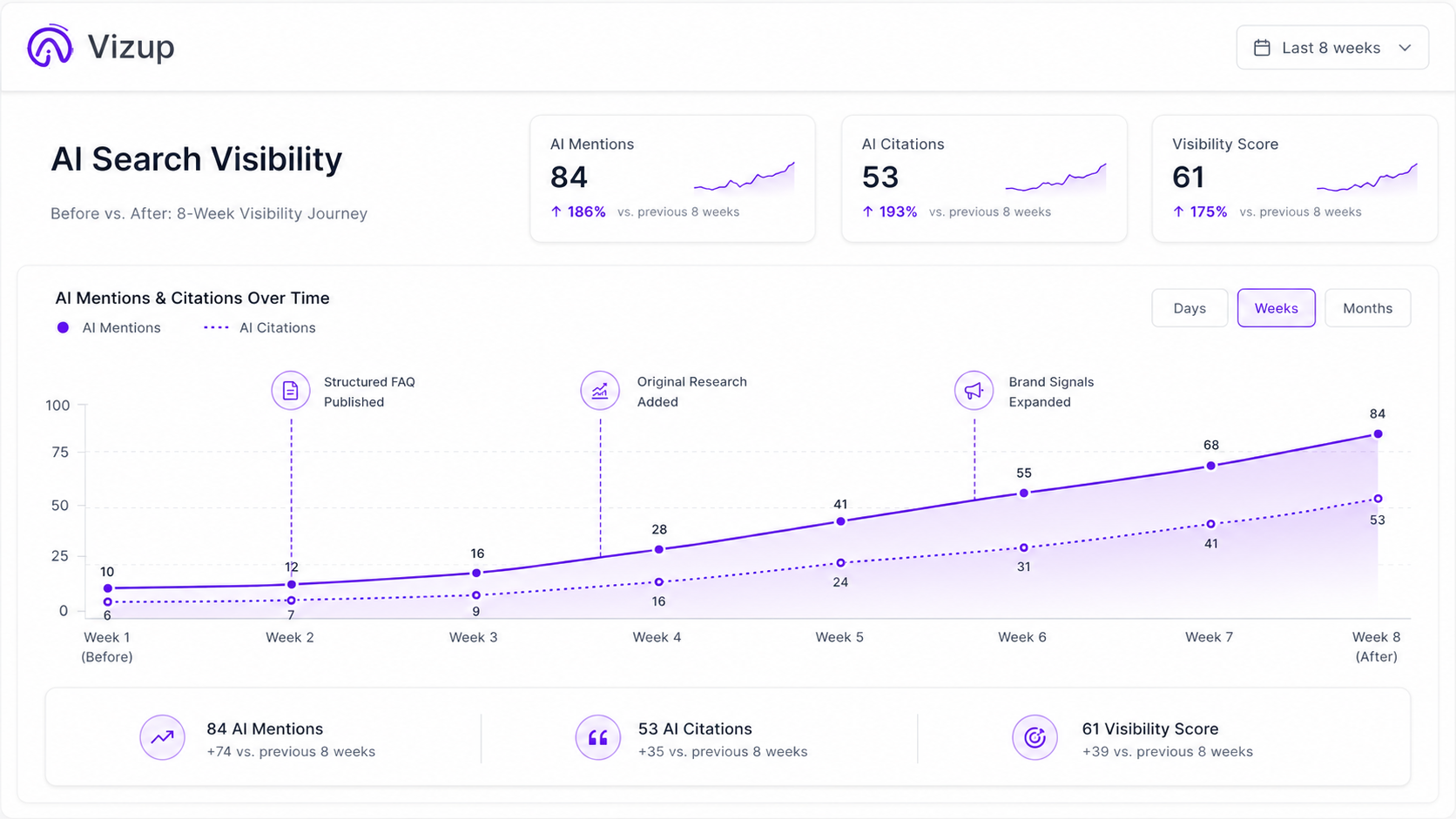
A mid-market SaaS brand in the project management space ran the 5-step playbook and moved from zero AI search mentions to appearing in 40% of category queries within eight weeks. Three levers did the work. First, they shipped a structured FAQ page with original benchmark data that AI engines could lift cleanly. Second, they published an industry report with proprietary survey data that became a retrieval source across platforms. Third, they built third-party review coverage on G2 and Capterra, creating the cross-platform consensus AI engines use to validate brand claims. None of these moves carried the outcome on its own; the combination created the entity authority that led to consistent citation.
Frequently Asked Questions
Is AI search engine optimization (AEO) replacing traditional SEO?
It's not a replacement; it's an expansion. Traditional SEO still matters for click-through traffic. AEO covers the growing share of queries where the AI generates the answer and the user never clicks. ZeroClick Labs (2026) estimates AI summaries intercept roughly 60% of clicks for informational queries. Strong teams run both tracks at once, and Vizup's guide to brand visibility strategies offers a solid reference for how the approaches fit together.
How often do AI search engines update the brands they recommend?
Retrieval pools change continuously, but the impact on brand mentions depends on the platform. Perplexity can refresh sources quickly, sometimes in days. ChatGPT Search and Google AI Overviews move on less predictable cycles. That volatility is exactly why weekly monitoring pays off: you can be present this week and missing next week if a competitor ships more citable content or earns stronger third-party validation.
Can small brands compete with enterprise companies in AI search results?
Yes, and it's one of the real advantages AI search has over traditional SEO. Because these engines weight cross-platform consensus and content clarity more than domain authority, a focused small brand with consistent entity presence and tightly structured, citable content can outrun enterprise competitors with bigger libraries but weaker off-site signals. Authoritas (2024) supports the dynamic: 62% of AI-cited links come from outside the top 10 organic results.
How do I know if my brand is being mentioned inaccurately by AI search engines?
Start with manual spot-checks across ChatGPT, Perplexity, Gemini, and Copilot. Query your brand name alongside category terms, then read the generated descriptions like a skeptical buyer would. Tools like Vizup can automate this by tracking mention sentiment and content at scale and flagging descriptions that drift from your positioning. When inaccuracies show up, the most effective fix is updating the third-party sources the AI is retrieving from, not trying to contact the AI provider.
What's the fastest way to start improving brand visibility in AI search engines today?
Begin with a visibility audit. Query your brand and top category terms across four AI platforms and log what appears; it takes under two hours and gives you a baseline you can actually manage against. Next, ship one structured FAQ page with a handful of original data points that AI engines can extract as discrete facts. With the right formatting and schema markup, that single asset often shows measurable citation improvement in two to four weeks. Then keep the monitoring cadence so you know what's working.
Key Takeaways and Your Next Move
The 5-step playbook, condensed:
- Audit your current AI search visibility across ChatGPT, Perplexity, Gemini, and Copilot before doing anything else.
- Map the 20-30 high-intent queries in your category and identify which competitors are being cited.
- Create concise, claim-rich content with original data and clear H2/H3 structure that AI engines can extract.
- Amplify off-site through third-party reviews, expert quotes, and industry publications to build cross-platform consensus.
- Monitor weekly using automated tools to track mention frequency, sentiment, and competitor share of voice.
This week, run an AI visibility audit using Vizup's free monitoring tools. Two hours of work gets you the baseline that everything else should be measured against. AI search visibility isn't a "someday" initiative; it's a current advantage, and the teams building the monitoring habit now are the ones that will own the category narrative later. The window to establish early entity authority is open, but it won't stay open forever.
