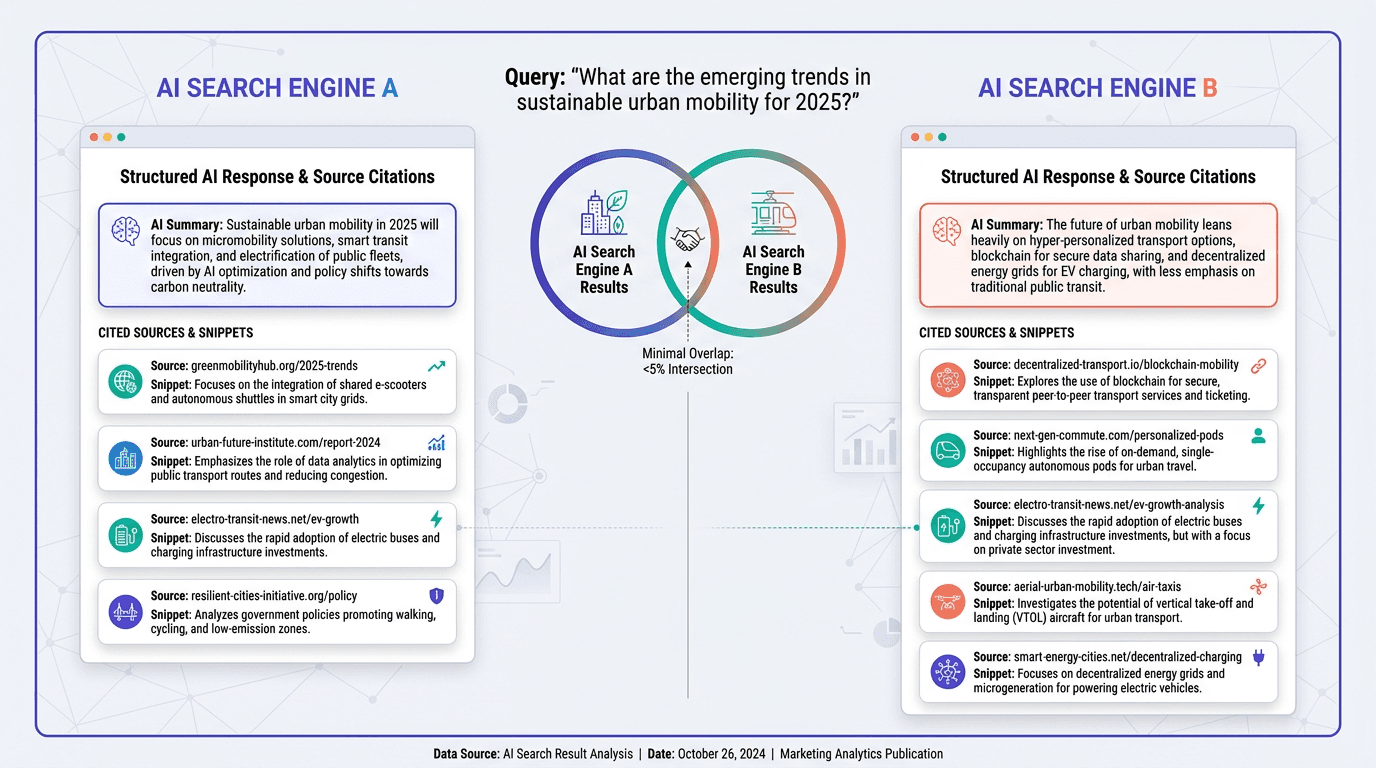
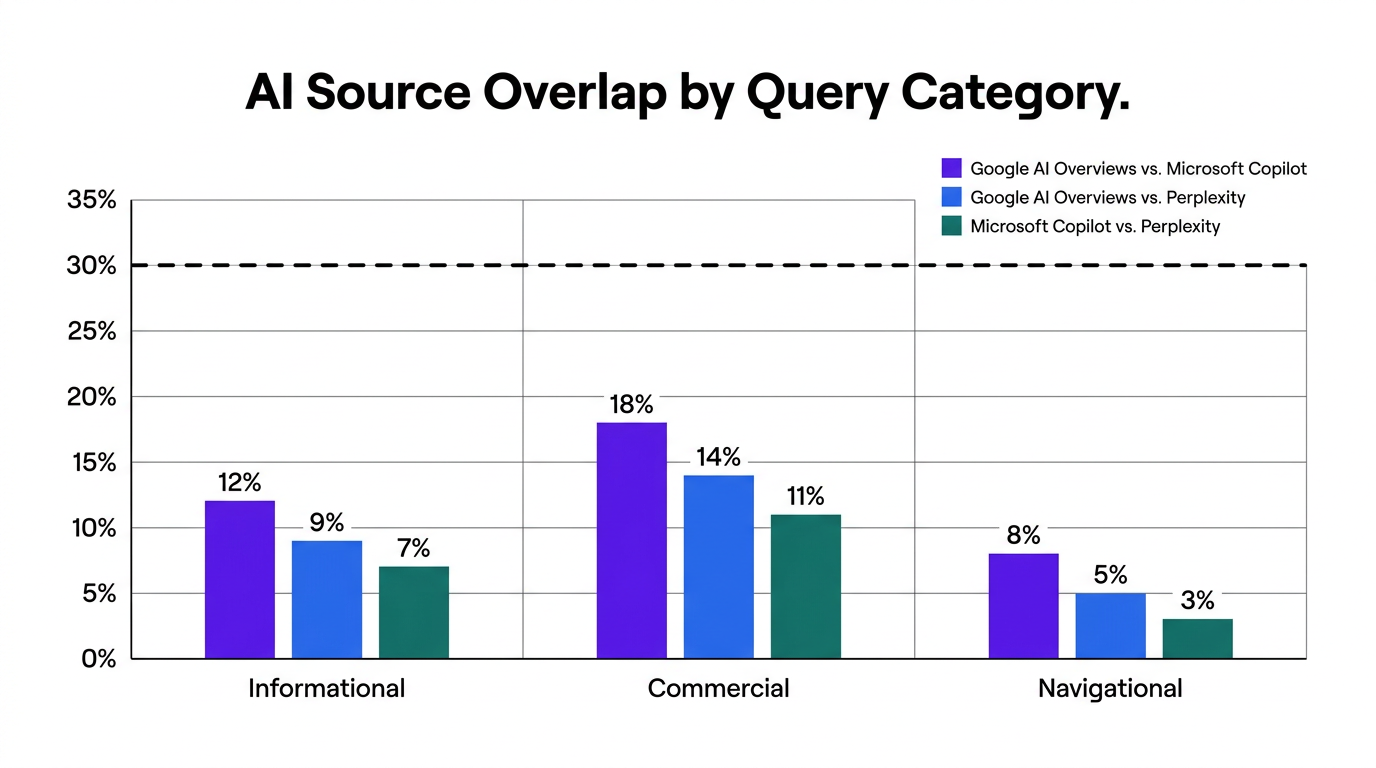
AI search results overlap measures how many source URLs two AI answer engines share when they respond to the same query (think Google's AI Overviews, Perplexity, and Microsoft Copilot). Traditional search could still converge around a familiar set of winners; AI answers rarely do. In practice, referenced-domain overlap ranges from about 9.81% to 25.19% across engine pairs.
For a long time, SEO strategy could treat Google rankings as the main scoreboard and Bing as a small set of tweaks. That playbook does not survive AI answers. The ecosystem is splintered, and rolling everything up into one "AI visibility" number is how teams talk themselves into a false sense of coverage. If you are not measuring performance engine by engine, you are guessing about where your audience is actually seeing you. This piece lays out the data behind the fragmentation, why it happens, and what it changes in how you plan and report.
The Old World vs. the New: How Bing vs Google AI Search Changed the Rules
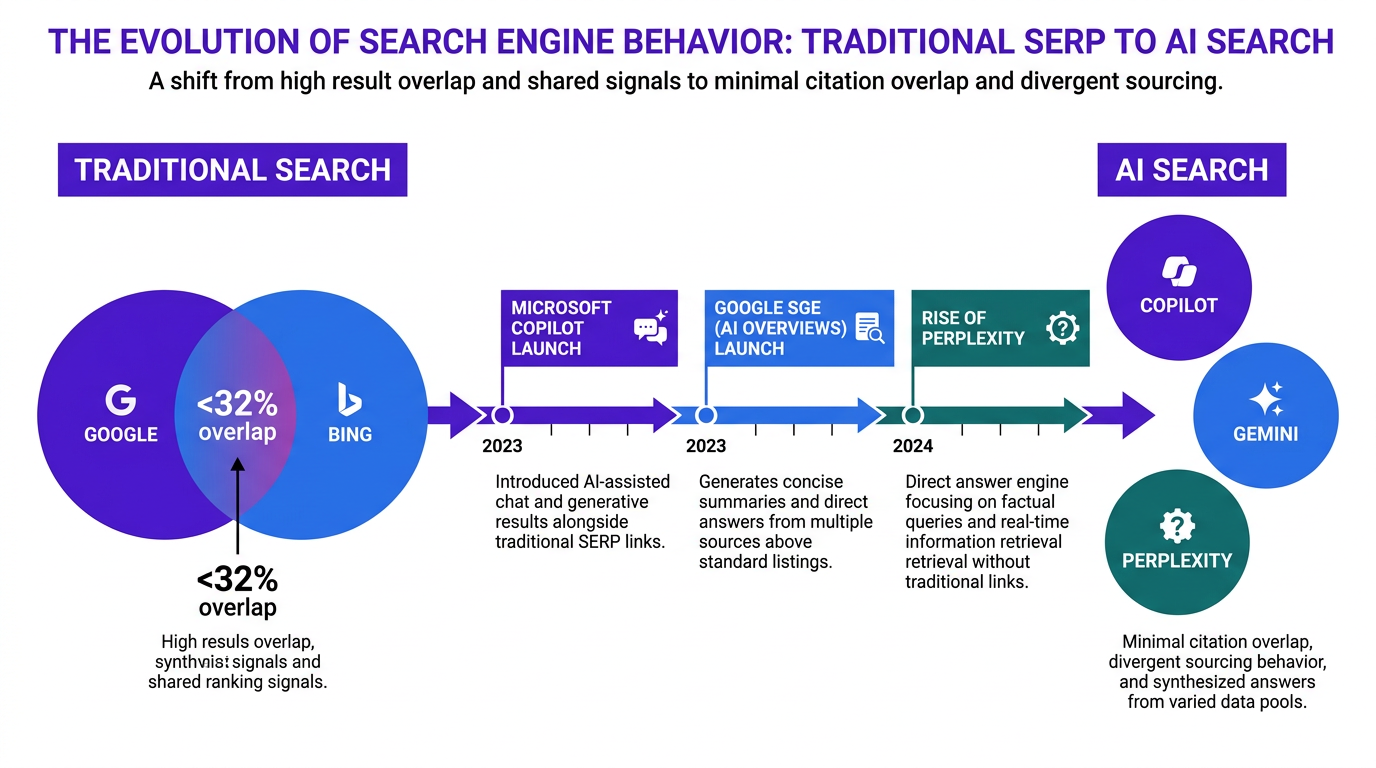
Earlier search-engine studies found Google and Bing search results had limited overlap, consistently under 32% according to a 2022 analysis. Shared ranking signals like backlinks and keyword relevance pulled both engines toward a similar, but not identical, list of pages. The "Win Google first" strategy worked because Bing rarely operated from a totally different universe of content, even if the exact rankings differed.
AI search snaps that logic in half. These products are not just re-ordering links; they are generating answers and attaching citations. Each engine runs a different large language model, taps different real-time data pipelines, and uses its own grounding rules. So the sources cited by Google's AI Overviews for a query can be almost unrecognizable compared to what Perplexity or Microsoft Copilot chooses. The predictable SERP era has given way to a citation layer that behaves differently by default.
Just How Different Are They? A Look at the Data
The numbers are not subtle. Data from 2025–2026 studies shows that, for many queries, AI assistant citations overlap with Google and Bing top-10 results by about 11% on average, with Perplexity closer to 28.6% against Google. Compare AI engines directly and the overlap usually falls further, often landing around 10% to 25% at the referenced-domain level. Put that next to traditional overlap studies, where Google and Bing tended to share roughly 10% to 20% of identical URLs in their respective top 10, and you get the shape of the problem: AI is not just different from classic search, it is different engine to engine.
Info: Verify before publishing: the ranges cited here (AI overlap ~10-28%, traditional overlap ~10-20%) are drawn from cross-engine citation analyses conducted in 2025-2026. Always confirm against the latest available data, as these figures shift as engines update their grounding pipelines.
Traditional SERP Overlap
In the blue-links era, convergence was a feature, not a surprise. Google and Bing both rewarded many of the same things: backlinks, on-page keyword signals, and domain authority. When two systems optimize for similar signals, they tend to surface the same "authoritative" pool. That alignment has weakened inside a single engine. A newer Ahrefs update found that roughly 38% of AI Overview-cited URLs also appeared in the first 10 result blocks, suggesting Google AI citations are less tied to the original SERP than earlier studies implied. High overlap inside one engine is fading; the cliff appears when you cross the engine boundary.
AI Answer Engine Differences
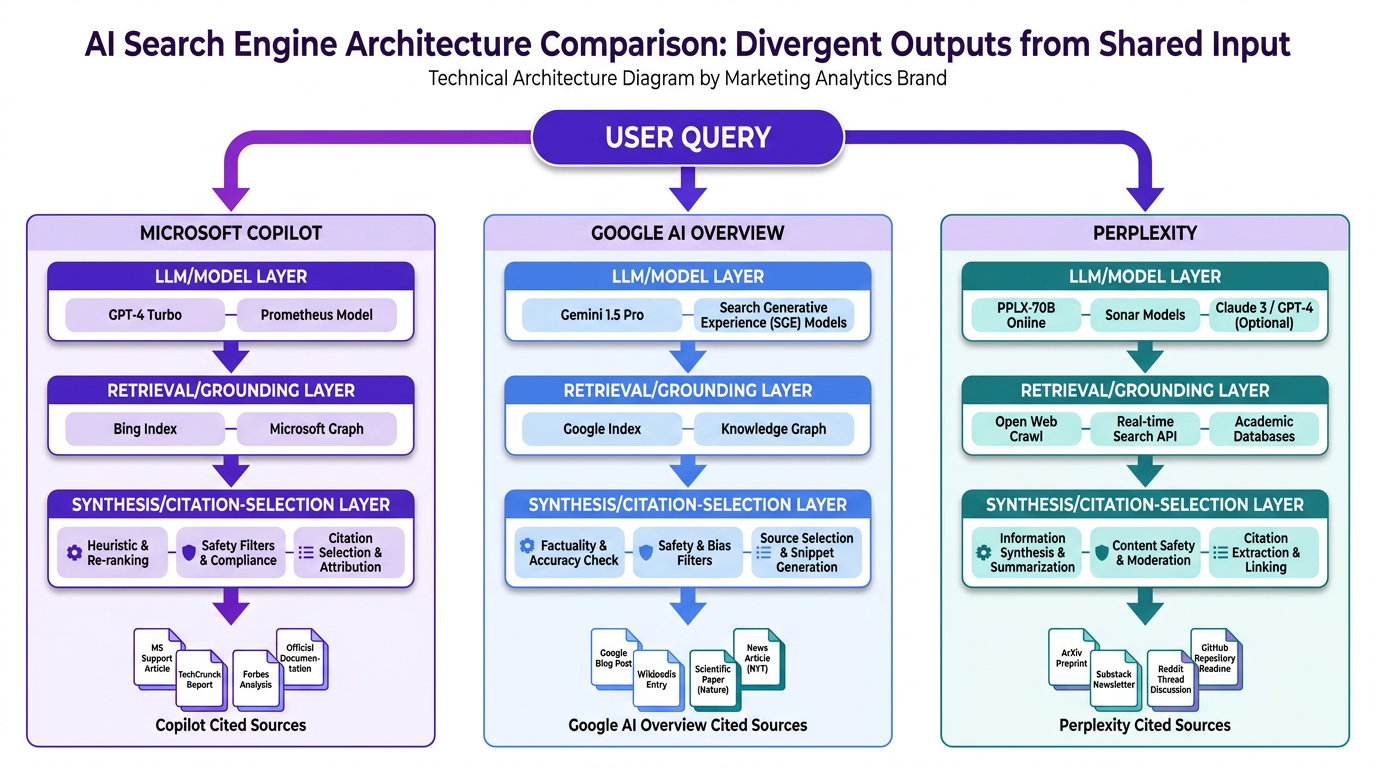
AI engines build answers through different mixes of base LLMs, fine-tuning, and retrieval. Microsoft Copilot can send generated web-search queries to Bing for grounding. Google AI Overviews and AI Mode may use query fan-out across subtopics and data sources. Perplexity may visit web pages to answer user questions and include links in responses. The mechanics in AI grounding vs. traditional search indexing at Bing are a clean example of why ai search vs traditional search produces different citation sets. Give two researchers the same prompt and they will still read different materials, emphasize different points, and cite different sources.
| Metric | Traditional Search: Google vs. Bing | AI Search: Google AI Overviews / AI Mode vs. Perplexity and other answer engines |
|---|---|---|
| Typical source overlap | Usually below 32% in top-10 results, depending on query set and market. | Often around 10–25% across AI engine cited domains; some AI-vs-SERP comparisons reach around 28%. |
| Main ranking / citation drivers | Backlinks, content relevance, query intent, freshness, authority signals | Model architecture, retrieval pipeline, grounding data, citation-selection logic, freshness, and source accessibility |
| Strategic implication | Build a strong SEO base, then refine by search engine | Track and optimise visibility engine by engine across AI answer engines |
| Source overlap is low in both eras, but AI answer engines add a new citation layer that requires engine-by-engine monitoring. |
Why Don't AI Engines Agree? The Mechanics Behind Divergence
Three structural differences drive the spread. Start with the base models: Each answer engine uses a different mix of models, indexes, retrieval systems, grounding rules, and citation-selection logic, and Perplexity runs its own fine-tuned models. Even with the same prompt, models do not weigh evidence the same way. Then there is retrieval. Microsoft Copilot queries the Bing index; Google queries its own; Perplexity crawls the open web independently. If the engines are searching different corpora, they are not even choosing from the same shelf of possible citations.
After retrieval comes synthesis, and that is where engines diverge again. Each one uses its own summarization logic, citation-selection heuristics, and safety filters. A page Microsoft Copilot is willing to cite might never enter Perplexity's candidate set in the first place. Unlike traditional keyword-based indexing, AI search engines analyze context, intent, and semantics to deliver more relevant results. That extra interpretation layer is exactly why two engines can look at the same query and still disagree on what deserves a citation.
The Strategic Response: From Ranking to Cross-Engine Visibility
Low AI search results overlap is not trivia. It forces a change in what "winning" looks like for SEO strategists, GEO specialists, and content leads. The KPI shifts from a single ranking position to cross-engine visibility: getting cited across multiple answer engines, not just sitting at number one on one platform. Gartner projects generative AI tools will reduce traditional search engine volume by 25% by 2026. That matters because the traffic you miss on Perplexity or Microsoft Copilot is not automatically rerouted to Google; a chunk of it simply never encounters your work.
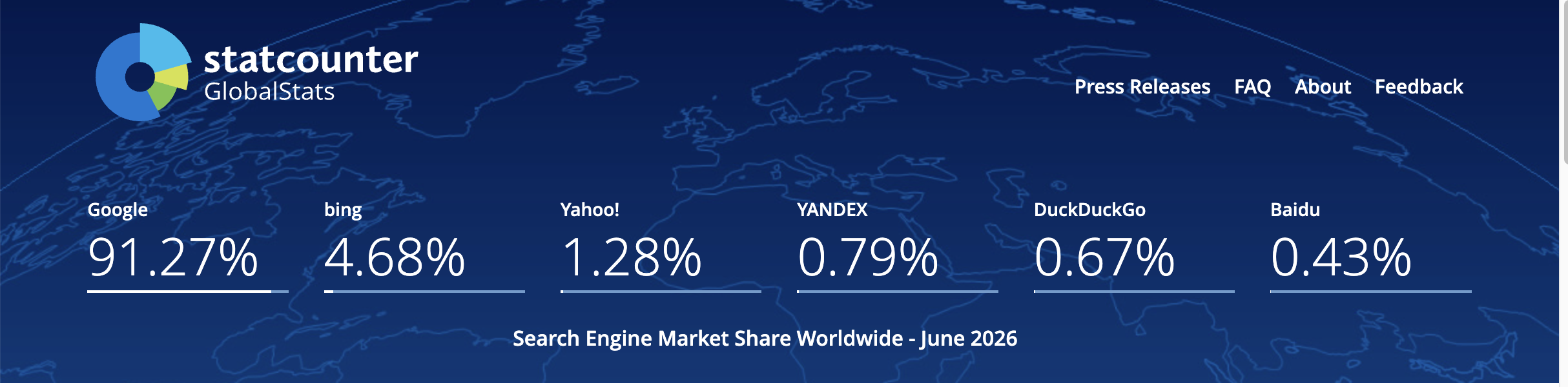
That is why engine-specific monitoring has moved from nice-to-have to table stakes. Vizup's Answer Engine Monitoring tracks which sources are cited by Google's AI Overviews, Perplexity, and Microsoft Copilot for target queries, separately. This is the practical bridge from SEO to AEO and GEO, and it connects to the shift described in AI search visibility in Google's agentic search era. Search market share still varies by device and data source, but the key point is that citation behavior in AI answers cannot be inferred from classic search share alone.
This is where Vizup fits. Vizup is an Organic Autopilot for modern discovery, helping brands monitor, create, optimise, publish, and learn across Search, Social, Communities, AI Answer Engines, and Local Discovery. It combines AI agents, human experts, and live SEO, pSEO, AEO, and GEO tools so teams can move from visibility gaps to shipped improvements without stitching together separate workflows. Paid ads are available as an amplification add-on, but the core system is organic-first.
A clean way to start: take your top 20 target queries, run them through at least three AI engines, and line up the cited sources side by side. If your domain shows up in only one engine (or in none), you have a visibility gap that a single dashboard will happily hide. The Search Engine Journal webinar on tracking AI citations across six engines makes the same point: leading teams are already building engine-by-engine views because the overlap is too low to treat as noise.
For a broader workflow, see Vizup's guide to improving brand visibility in AI search.
Common Misconceptions About AI Search Overlap
"If I rank on Google, AI engines will cite me too." The newer Ahrefs update is about Google AI Overviews citing pages that also appear in Google's own first-page result blocks; it does not prove that visibility carries across other engines. Microsoft Copilot and Perplexity are not downstream consumers of Google's rankings, so "Google authority" does not automatically travel.
"AI search is just a reshuffled version of traditional search." This overlooks how much traditional search has already changed. For years, Google's results have included enhanced features like knowledge panels, video carousels, and "People Also Ask" boxes, meaning classic results are rarely a clean set of ten links. AI search goes further by generating a new answer and choosing citations through different machinery. The gap between AI search and traditional search is baked into how the systems work, not just a simple user interface refresh.
"One AI visibility score covers all engines." This is the trap. When overlap between engines is often under 30%, any single score is an average that erases the differences you actually need to manage. You can look strong on an aggregate metric while being absent on the engine your audience prefers. Google's AI search labels are a reminder that even one engine keeps changing how it presents AI results, which makes engine-specific tracking hard to negotiate away.
Key Takeaways
- AI search results overlap between engines is low (often 10-28%), which makes AI visibility meaningfully more fragmented than traditional SERP overlap studies suggested.
- Different engines run different models and retrieval/grounding pipelines, so they cite different sources even when the query is identical.
- Retire the idea of a single "AI rank." What matters is cross-engine visibility that shows where you are (and are not) getting cited.
- Plan and report engine by engine: Google AI Overviews, Perplexity, Microsoft Copilot, and others do not behave like one blended channel.
- Tools built for engine-by-engine monitoring are now foundational if you want an AI search strategy that reflects reality.
Frequently Asked Questions
What is AI search results overlap?
AI search results overlap is the share of source URLs that two or more AI answer engines (such as Google AI Overviews, Perplexity, and Microsoft Copilot) cite for the same query. Recent data puts overlap around 10-28%, which means most citations change when you switch engines.
Why is AI search result overlap lower than traditional SERP overlap?
Traditional engines lean on many of the same ranking signals (backlinks, keyword relevance, domain authority), so their results tend to converge. AI engines vary in three places that matter: the LLM, the retrieval index, and the synthesis/citation logic. Different candidate pools plus different selection rules produce different citation sets.
How does low overlap affect my SEO strategy?
Low overlap means a win on one engine does not buy you coverage on the others. Track citations and appearances per engine, then adjust content and distribution based on how each engine grounds and retrieves sources. A single-engine view will miss whole pockets of demand.
Which AI search engines should I be tracking for visibility?
At minimum: Google AI Overviews, Microsoft Copilot, and Perplexity. Depending on your audience, ChatGPT's browsing mode and Claude's web search can also matter. The goal is cross-engine visibility, and Vizup's Organic Autopilot for modern discovery helps teams monitor, optimize, and publish across AI Answer Engines, Search, Social, and Communities.
What's the difference between AI search and traditional search?
Traditional search returns a ranked list of links based on indexing and ranking algorithms. AI search generates an answer and cites sources inline. For marketers, the practical difference is competitive structure: traditional search is about position in a list, while AI search is about being selected as a cited source by an engine-specific retrieval and summarization pipeline.
