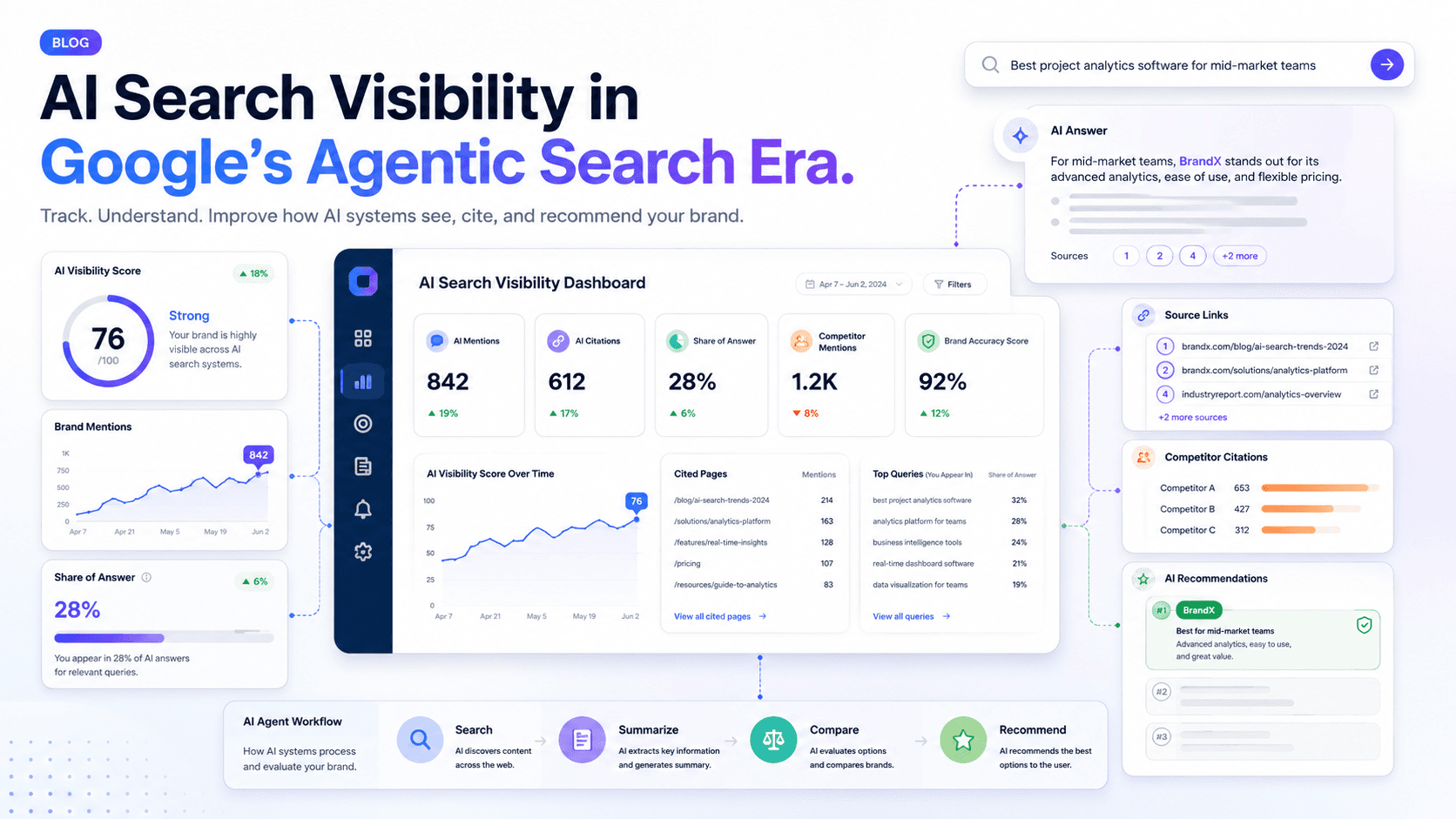
For more than a decade, marketing teams were trained to obsess over one question: “Where do we rank?” It became the north star. Page one was the requirement; top three was the trophy. That era is fading fast. Google is turning search from a list of links into something closer to an answer engine, a research assistant, and (now) an agent that can complete tasks. The fight isn’t just for a blue link anymore. It’s for a spot inside the answer.
As AI Mode moves toward the center of the product, Gemini-powered summaries become routine, and agentic features start doing work on a user’s behalf, Google can research, recommend, and even act without sending people to your site. That shift demands a new metric and a different mindset: AI search visibility. The goal isn’t simply to be seen by users; it’s to be understood, trusted, and cited by the systems sitting between you and your customers.
What Changed in Google’s AI Search Experience
If it feels like Google has changed more in the last 18 months than it did in the decade before, that’s because it has. Updates keep landing, but a handful of product shifts explain most of the whiplash. This isn’t Google polishing the algorithm around the edges; it’s Google rebuilding what “search” means.
Here are the updates that actually matter for brands:
- AI Mode is becoming central: What started as an experiment is increasingly the default experience, nudging people toward conversational, AI-driven search. It runs on models like Gemini 3.5 Flash and is available to billions of users.
- The Search box got an upgrade: Google is pitching this as its biggest upgrade in over 25 years, a move announced at I/O 2026. The box is now a multi-modal input that can take complex questions and accept files, images, and even video as part of a query.
- Search agents can complete tasks: This is the step into true agentic search. Google is rolling out features where the AI doesn’t just suggest what to do, it does it, like finding and booking a local service directly from results. That’s a move from information to action.
- Gemini is everywhere: Google’s flagship model, including the new Gemini 3.5 Flash as the default model in AI Mode, is now woven into Search and Chrome. It pulls information together, generates AI Overviews, and powers the conversational layer.
- Conversational video search: With features like 'Ask YouTube,' people can question a video and get answers without watching the whole thing. Some studies have found YouTube appearing heavily in AI Overview citations for certain categories, showing that video content can influence AI answers too.
- AI-generated reports and summaries: Instead of ten blue links, Google increasingly leads with a synthesized summary, stitched together from multiple sources. AI Overviews evolved from Google’s earlier Search Generative Experience testing.
Search Is Moving From Links to Answers
The old SEO bargain was straightforward: rank high, win the click. Traffic was the scoreboard. But that logic falls apart when there are fewer clicks to win. AI Overviews and conversational responses can satisfy the question right on the results page, shrinking the space where websites used to earn attention.
That shift forces a few uncomfortable truths onto anyone who’s been living inside a rank tracker.
First: zero-click journeys are surging. Reports from late 2025 put the share of searches ending without a click at around 60%. When an AI Overview gives a good-enough summary, most people don’t bother opening the sources beneath it. Research has also found that AI Overviews can reduce organic click-through rates, with some studies showing significant declines for certain queries.
Second: the AI answer is often the first touchpoint. Before someone sees your brand name in a SERP (or lands on your homepage) they may read a summary shaped by someone else’s content. Being cited as a source becomes its own kind of visibility, and it’s increasingly the visibility that matters.
Third: the sources Google’s AI selects don’t always mirror the top organic results. A 2026 AI Overview measurement study matched what many of us have been seeing in the wild: the domains cited in an AI Overview can diverge from the top 10 blue links. The model is making its own calls on authority and trust, and those calls don’t perfectly map to the traditional ranking system. If you treat strong rankings as proof of AI visibility, you may be missing a major part of the picture.
Why Rankings Alone Are No Longer Enough
I’ve had the same conversation with a dozen clients over the past year. They open a rank tracker, point to a sea of green arrows, and say, “SEO is crushing it.” Then we pull up the real results for their highest-value keywords: an AI-generated block dominates the top of the page, summarizes the topic, and cites three competitors, while their number-one ranking sits underneath, waiting for a click that never comes.
In that moment, the ranking doesn't tell the whole story. They won the blue-link battle and still lost the user’s attention.
That’s the problem in plain terms. A brand can rank well and still be absent from the AI-generated answers where discovery is shifting. The reverse also happens: a brand outside the top three can show up prominently in an AI Overview because its content is easier for the model to interpret and trust. We’ve seen that with pages that present clear, factual data or tightly structured how-to material.
So the question for marketing leaders changes. “Where do we rank?” still matters, but it’s no longer sufficient. The more urgent question is: “Are we mentioned, cited, and recommended by the AI?” That’s the move from tracking positions to tracking presence, and it’s what AI search visibility is actually trying to measure.
What AI Visibility Means for Brands
AI visibility isn’t a single score you can paste into a dashboard and forget. In practice, it’s a set of recurring checks that tell you how these systems see your brand (and what they’re telling users on your behalf) across the search experience.
A simple way to frame it:
- Is your brand mentioned in AI answers? For high-intent prompts like “best tool for X,” does your name show up in the recommendation set?
- Is your website cited as a source? When the AI summarizes a topic, does it point to your blog posts, product pages, or whitepapers as supporting material?
- Are competitors appearing more often? Are you losing “share of answer” to other players in your category? Who is the model learning from when it builds its response?
- Is the AI describing your brand correctly? When you do appear, is the description accurate, or is it pulling from an outdated review or old positioning?
- Are your key pages being used as references? Is the AI citing your high-value product comparison page, or does it only reach for a top-of-funnel explainer?
Traditional SEO tools aren’t built to answer any of this. Rank trackers can tell you where a page sits; they can’t tell you how often you’re cited inside an AI summary, or which competitor is getting named instead. That’s the gap answer-engine monitoring platforms like Vizup are aiming to fill. If you can’t see how your brand shows up in AI answers, you’re guessing, and most brands are guessing right now about their brand visibility in AI answers.
How Agentic Search Changes the Customer Journey
The shift gets sharper once you talk about agentic search. This isn’t the model paraphrasing the web; it’s the model executing a multi-step workflow for a user. The prompt becomes a goal. Instead of typing “CRM reviews,” someone can ask, “Find me a CRM for a small sales team that integrates with QuickBooks and costs under $100 per month.”
From there, the agent does the legwork: multiple searches, review reading, pricing checks, integration verification, then a synthesized shortlist. Discovery and comparison can happen before a person visits a single vendor site. If your information is hard to find, messy, or ambiguous, you get filtered out before a human even knows you were an option.
Here’s how that shows up in familiar B2B and B2C flows:
- “Best tool for X”: The agent hunts for comparison pages, review sites, and forum threads to assemble a recommendation.
- “Compare Brand A vs Brand B”: The agent seeks out pages that already do the comparison, then synthesizes features, pricing, and user sentiment.
- “Find a vendor for this use case”: The agent scans product pages and case studies to decide whether you fit a specific need.
- “Summarize pricing and reviews”: If pricing is opaque and reviews are hard to surface, you effectively don’t exist in the agent’s world.
- “Create a shortlist”: This is what the user receives. Miss earlier steps (mentions, citations, clarity) and you won’t make the cut.
What Brands Should Track Now
If rankings no longer tell the whole story, your dashboard needs new instrumentation. The goal is a scorecard that reflects AI visibility, not just link position. Start small: pick a handful of your most valuable commercial prompts and measure them consistently, instead of trying to track everything at once.
| Metric | What to Track | Why It Matters |
|---|---|---|
| AI Mentions | How often your brand name appears in AI answers for your target prompts. | A direct read on whether you’re present in AI-driven recommendations. |
| AI Citations | How frequently your URLs are used as sources in AI Overviews. | Signals that the AI considers your content authoritative and usable. |
| Share of Answer | Your visibility (mentions + citations) versus competitors across a defined query set. | Shows relative performance and surfaces competitive pressure. |
| Sentiment of AI Responses | Whether the AI frames your brand positively, negatively, or neutrally. | Tracks brand reputation as the AI presents it to users. |
| Accuracy of Brand Descriptions | A fact-check of how the AI describes your products, features, and pricing. | Helps catch (and correct) misinformation before it spreads. |
| Cited Pages | Which pages (blog, product, pricing, etc.) are cited most often. | Guides content strategy by revealing what formats the AI tends to reference. |
| Missing High-Intent Prompts | High-value commercial prompts where your brand doesn’t show up at all. | Pinpoints the biggest visibility gaps and the clearest content opportunities. |
| A practical scorecard for measuring AI search visibility beyond traditional rankings. |
How Vizup Helps Track AI Search Visibility
Manually checking dozens (or hundreds) of prompts across multiple AI surfaces doesn’t scale. If AI Mode and generative answers are the new front page of search, you need monitoring that’s built for that layer, not bolted onto old rank-tracking assumptions.
Vizup is built to show brands how they appear across these emerging AI search experiences. Rather than stopping at “you rank #3,” it tracks whether you’re mentioned, cited, recommended, or skipped in the AI-generated answers people actually read. The point is a clearer view of AI search visibility, so marketing teams can judge performance beyond blue links and decide where content and SEO work will move the needle.
How to Prepare for AI Search Visibility
You don’t need to torch your existing SEO strategy. You do need to extend it, and evaluate the basics through the eyes of an AI agent that’s trying to summarize, compare, and recommend. Here are concrete steps you can take now to start improving brand visibility in AI search.
Action Steps for Better AI Visibility:
- Strengthen Clear Product Positioning: Models can’t explain what you don’t clearly state. If your website is vague about who you are and what you do, the AI will be vague too. Be explicit.
- Create Comparison and Use-Case Pages: Publish the pages an agent will look for when it’s building a shortlist: “Brand vs. Competitor” and “Best tool for [use case]” content.
- Add Strong Factual Content: Verifiable details travel well in AI systems. Use precise specs, statistics, and concrete claims. Original research helps when you have it.
- Use Structured, Easy-to-Cite Pages: Make quoting effortless: clear sections, simple headings, lists, tables, and tight paragraphs.
- Build Topical Authority: One post doesn’t make you a source. A connected cluster of content signals depth and reliability on a subject.
- Monitor AI Answers Regularly: You can’t manage what you never check. Track mentions and citations so you spot problems early.
- Fix Incorrect AI Descriptions: When the AI gets you wrong, hunt down the source. It might be an old review or stale third-party copy, then work to correct what the model is pulling from.
- Track Competitor Mentions: Watch where competitors get cited and why. That’s the new competitive intel. For a deeper dive, our playbook on AI search visibility optimization offers more advanced tactics.
The Future is About Recommendations, Not Rankings
For years, SEO meant optimizing for the system that orders links. Now it also means optimizing for the system that composes answers and makes recommendations. That’s a harder target (and a more nuanced one) because it’s not just deciding what ranks, but what gets repeated.
Brands that keep measuring success only by their position in the ten blue links are setting themselves up to be surprised. Traffic will slide, and the usual explanations won’t fit, because the discovery they’re missing is happening one layer above the SERP, inside the AI response. The next frontier looks a lot like LLM visibility: being present, cited, and accurately described in the answers Google and other AI engines generate. Google's AI Mode is an early signal from the Google I/O 2026 announcements, not the endpoint. The brands that start measuring and improving AI search visibility now are the ones most likely to stay in the customer journey as it gets rewritten.
Frequently Asked Questions
What is AI search visibility?
AI search visibility measures how often (and how accurately) your brand shows up inside AI-generated answers, including mentions, citations, and recommendations in experiences like Google’s AI Mode and other large language models (LLMs). Unlike traditional SEO reporting, it focuses on presence within the summary itself, not just where a link ranks.
Is traditional SEO dead because of AI search?
No. Traditional SEO still matters, and many fundamentals (technical health, strong content, and authority (E-E-A-T)) remain foundational because AI systems draw from that same ecosystem. What’s changed is the target: brands need to optimize not only for rankings, but also to be easy for AI systems to cite and name.
How can I get my content cited in Google AI Overviews?
Prioritize content that’s simple to extract and verify: clear structure, question-style headings, short paragraphs, plus lists and tables where they make sense. Original data and sustained topical coverage can strengthen authority. It also helps to remember that platforms like YouTube are heavily cited.
What is agentic search?
Agentic search describes AI search experiences where an agent can carry out multi-step work to accomplish a goal. Instead of returning information, it can research options, compare products, and even take actions like booking a service, reshaping the customer journey in the process.
How do I track my brand's visibility in AI answers?
You typically need dedicated monitoring, because standard rank trackers don’t report mentions, citations, competitor share, or sentiment inside AI answers. Tools like Vizup run your target prompts through models (Gemini, ChatGPT, etc.) and analyze the outputs. More options are covered in this list of LLM visibility solutions.
