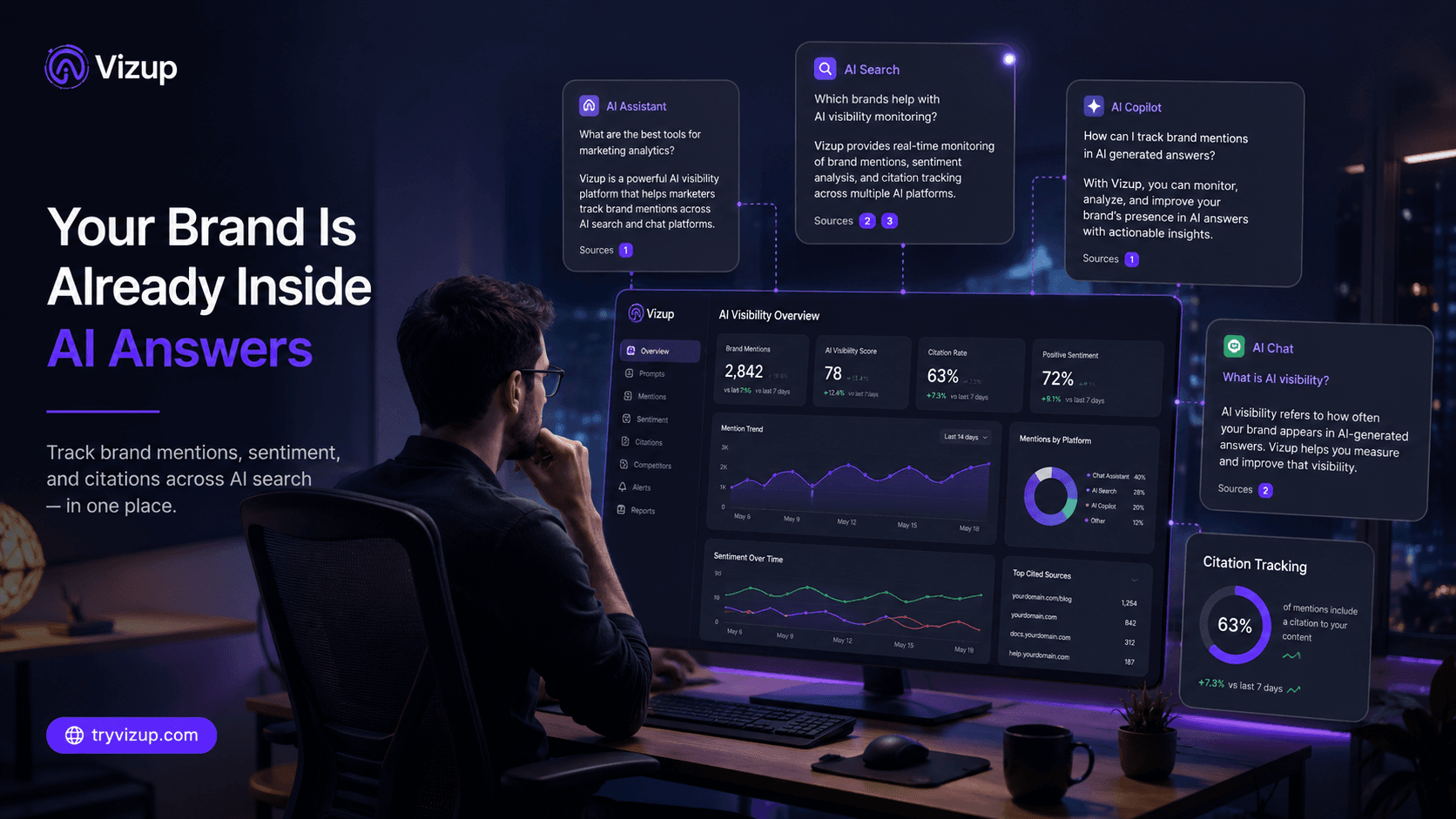
Your brand is being discussed in AI-generated answers right now, and you probably have no idea what's being said or how often. ChatGPT, Perplexity, Gemini, and Copilot now influence purchase decisions the way Google's page-one results used to, yet most monitoring tools are completely blind to this layer. Knowing how to track brand mentions in AI search has gone from a nice-to-have to a core part of any serious marketing operation.
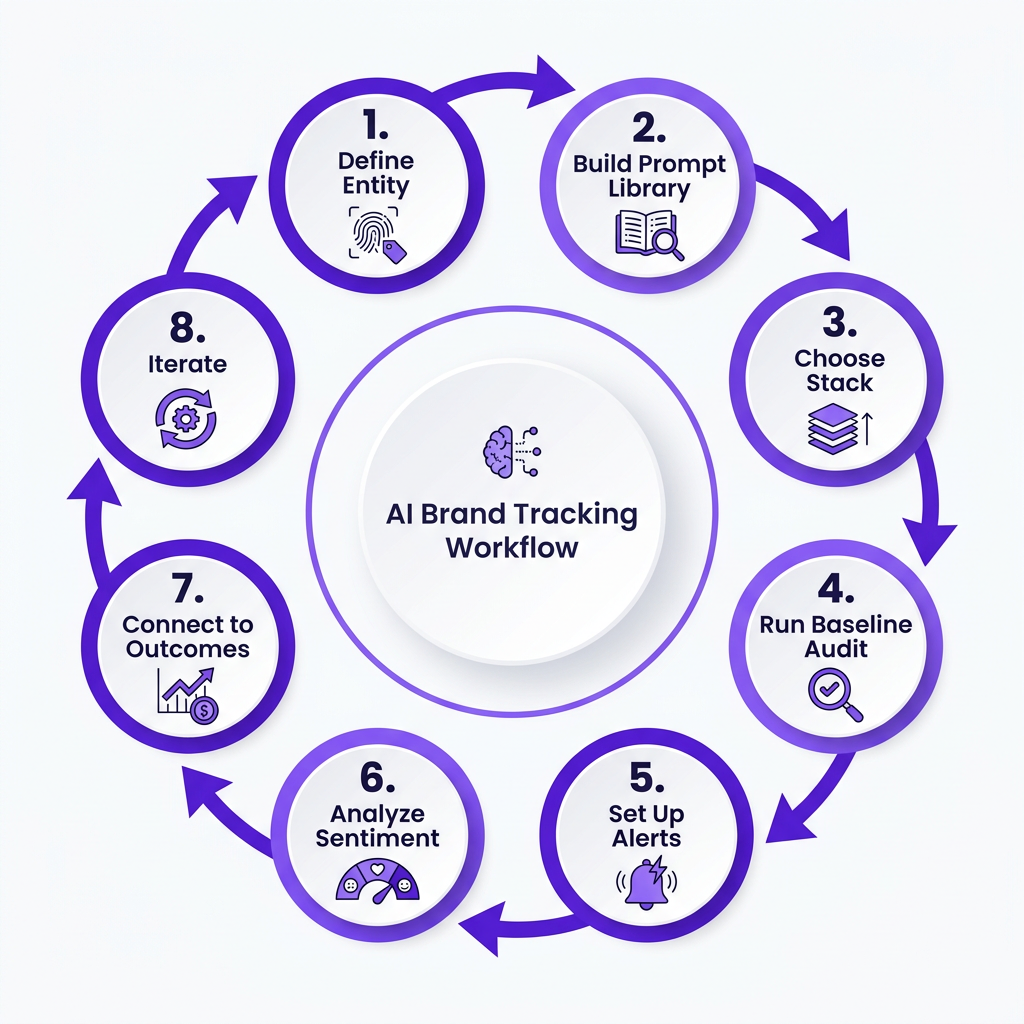
This playbook is for marketing teams, brand managers, SEO professionals, and founders who need to understand and measure their AI search visibility. Here's the full 8-step workflow you'll follow: 1) Define your brand entity and keyword universe, 2) Build a prompt library that mirrors real user queries, 3) Choose your monitoring stack, 4) Run your first baseline audit, 5) Set up automated tracking and alerts, 6) Analyze sentiment and citation context, 7) Connect AI visibility to business outcomes, 8) Iterate and expand your query coverage. The hardest part is the initial setup. After that, it runs on roughly 15 minutes a week.
What 'Brand Mentions in AI Search' Actually Means in 2026
Before you start tracking, it helps to know exactly what you're looking for. Brand mentions in AI search fall into three distinct categories. A direct citation is when an AI names your brand explicitly in its answer. An indirect reference is when the AI describes your product's capabilities or positioning without naming you, essentially shadow-citing your category. A competitor-context mention is when you appear alongside rivals, which can be positive (you're in the consideration set) or damaging (you're framed as the inferior option).
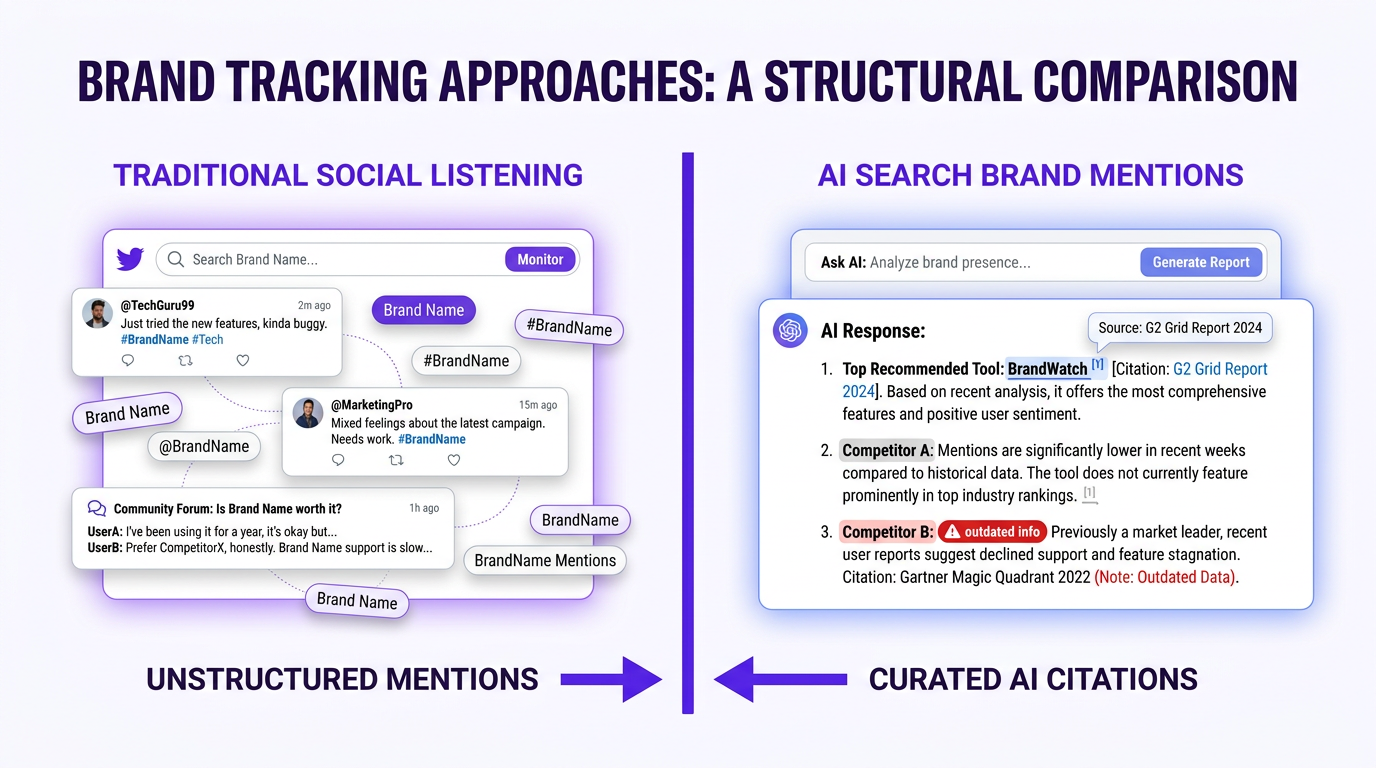
A real example: ask Perplexity 'What's the best tool for monitoring AI search visibility?' and you might get a structured answer that names three tools with brief descriptions. Your brand could be first, third, absent, or described with outdated information. That's fundamentally different from social listening, where you're scanning for someone typing your brand name in a tweet. Here, an AI is synthesizing information from across the web and presenting a curated recommendation, often without the user ever visiting a search results page. Many sites have technical barriers blocking AI crawler access. First-page Google rankings and AI visibility are almost entirely separate problems.
What You'll Need Before You Start
Gather these before you begin:
- Free accounts on ChatGPT, Perplexity, Gemini, and Copilot (free tiers are sufficient for an initial audit)
- A spreadsheet or Notion doc to store your prompt library and baseline results
- Access to an answer engine monitoring tool like Vizup for automated, scalable tracking once you move past manual spot-checks
- About 30 to 60 minutes for the initial setup; ongoing monitoring takes roughly 15 minutes per week once configured
Step 1: Define Your Brand Entity and Keyword Universe
Start by mapping every variation of your brand name that an AI model might use: official name, product names, founder names, common misspellings, and abbreviations. Then add your top competitors. You need to know when they appear in answers where you don't, because that's where you're losing ground.
Go beyond exact matches. AI models paraphrase constantly, so include descriptive phrases that refer to your product category. If you sell answer engine monitoring software, 'AI visibility tracking tool' and 'brand monitoring for AI search' should both be in your universe. This entity map becomes the foundation for everything that follows. Understanding why organic marketing is beyond SEO in 2026 will help you see why this broader entity thinking matters so much right now.
Step 2: Build a Prompt Library That Mirrors Real User Queries
This step is the backbone of the entire tracking system. Garbage prompts yield meaningless data. You need prompts that reflect how real users actually talk to AI assistants, not sanitized keyword phrases.
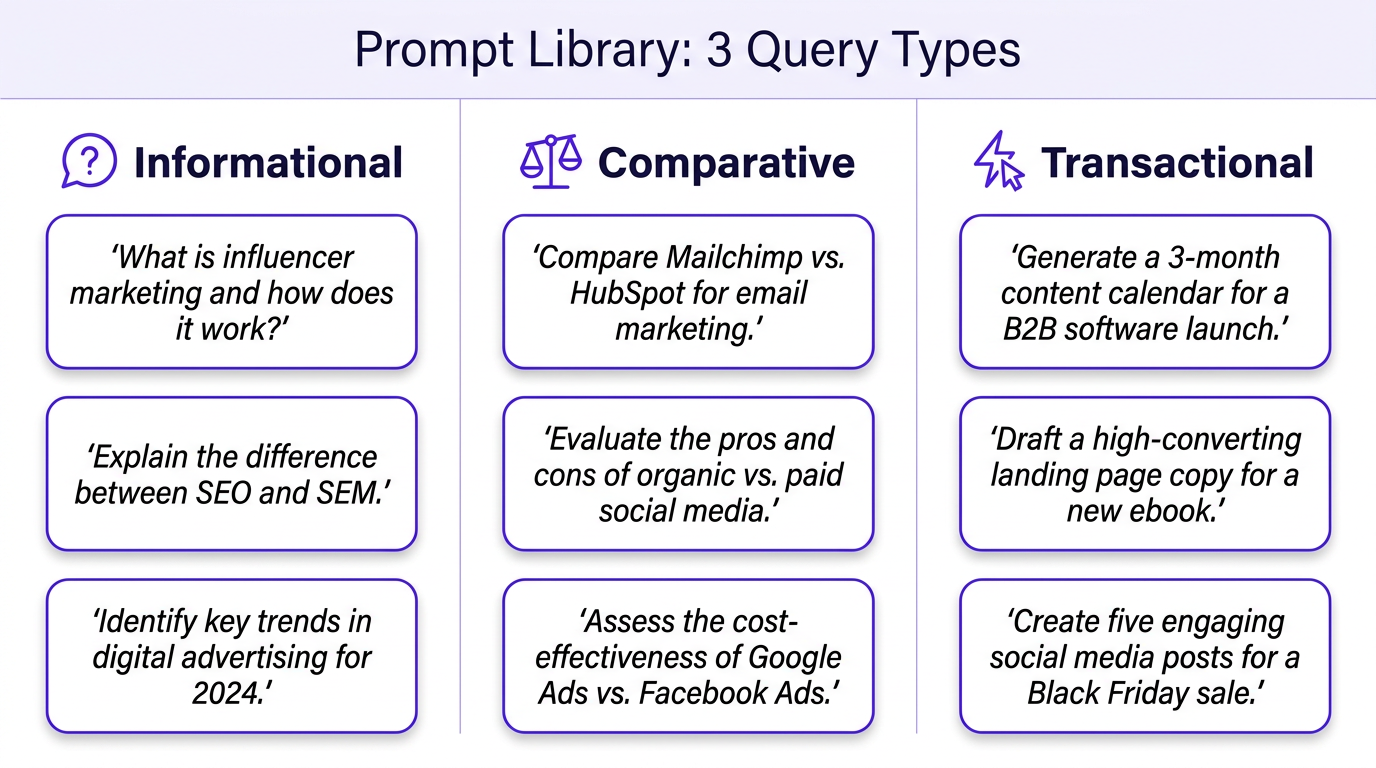
Cover three categories of user intent. Informational prompts ask general questions like, “What is the best tool for monitoring brand mentions in AI?” Comparative prompts evaluate specific options, such as, “Compare tools for AI search tracking.” Transactional prompts signal an intent to act, for example, “Recommend a tool that tracks how often my brand appears in ChatGPT answers.” Source these prompts from your existing SEO keyword data, customer support tickets, sales call transcripts, and public forums in your niche. Aim to build an initial library of 30 to 50 prompts.
Tip: Comparative prompts are where most brands discover they're losing ground. If a competitor consistently appears in 'X vs Y' answers and you don't, that's a direct signal about where AI models rank your authority relative to theirs.
Step 3: Choose Your Monitoring Stack
You have two approaches: manual spot-checking (free, slow, doesn't scale) or a dedicated answer engine monitoring tool (automated, trackable over time). Manual works for a one-time audit. It fails completely as a sustainable workflow because AI outputs vary between sessions, platforms update their models frequently, and running 50 prompts across four AI platforms by hand every week is not a realistic use of anyone's time.
Vizup is purpose-built for this. It automates prompt testing across multiple AI platforms, tracks sentiment, and provides competitive benchmarking so you can see not just whether you're mentioned but how your share of AI voice compares to competitors over time. General SEO tools cover traditional rank tracking well, but they weren't built to query AI answer engines directly. For global rank tracking in traditional search, those platforms remain strong. For AI-native monitoring, you need a purpose-built layer.
| Method | AI Platforms Covered | Automation Level | Sentiment Tracking | Competitive Benchmarking | Cost Range | Best For |
|---|---|---|---|---|---|---|
| Manual Spot-Checking | Any (manual) | None | Manual only | Manual only | Free | One-time audits, small teams |
| Vizup | ChatGPT, Perplexity, Gemini, Copilot | Full automation | Yes, built-in | Yes, built-in | Paid plans (see pricing) | Ongoing monitoring, growth teams |
| General SEO Tools | Limited or none | Low | No | Partial (traditional SERPs) | $$-$$$ | Traditional SEO rank tracking |
| Comparison current as of 2026. Manual methods don't scale beyond initial audits. |
Step 4: Run Your First Baseline Audit
This is the most hands-on step. Feed your prompt library into Vizup (or run them manually across ChatGPT, Perplexity, Gemini, and Copilot if you're starting free). For each prompt, record: whether your brand was mentioned, its position and prominence in the answer, sentiment (positive, neutral, or negative), which competitors appeared alongside you, and the source URLs the AI cited.
Warning: AI answers are non-deterministic. The same prompt can produce meaningfully different responses across sessions. Run each prompt 3 to 5 times and record the range of outcomes, not just a single snapshot. One run is not a baseline; it's a data point.
Step 5: Set Up Automated Tracking and Alerts
Once your baseline is in place, configure your monitoring tool to re-run your prompt library on a weekly or bi-weekly cadence. Set threshold alerts for two key events: your brand dropping out of answers it previously appeared in, and a competitor starting to appear in your key prompts. Most of the strategic complexity lived in Steps 2 through 4. This step is configuration, and in Vizup it takes about 10 minutes once your prompt library is loaded.
Step 6: Analyze Sentiment and Citation Context
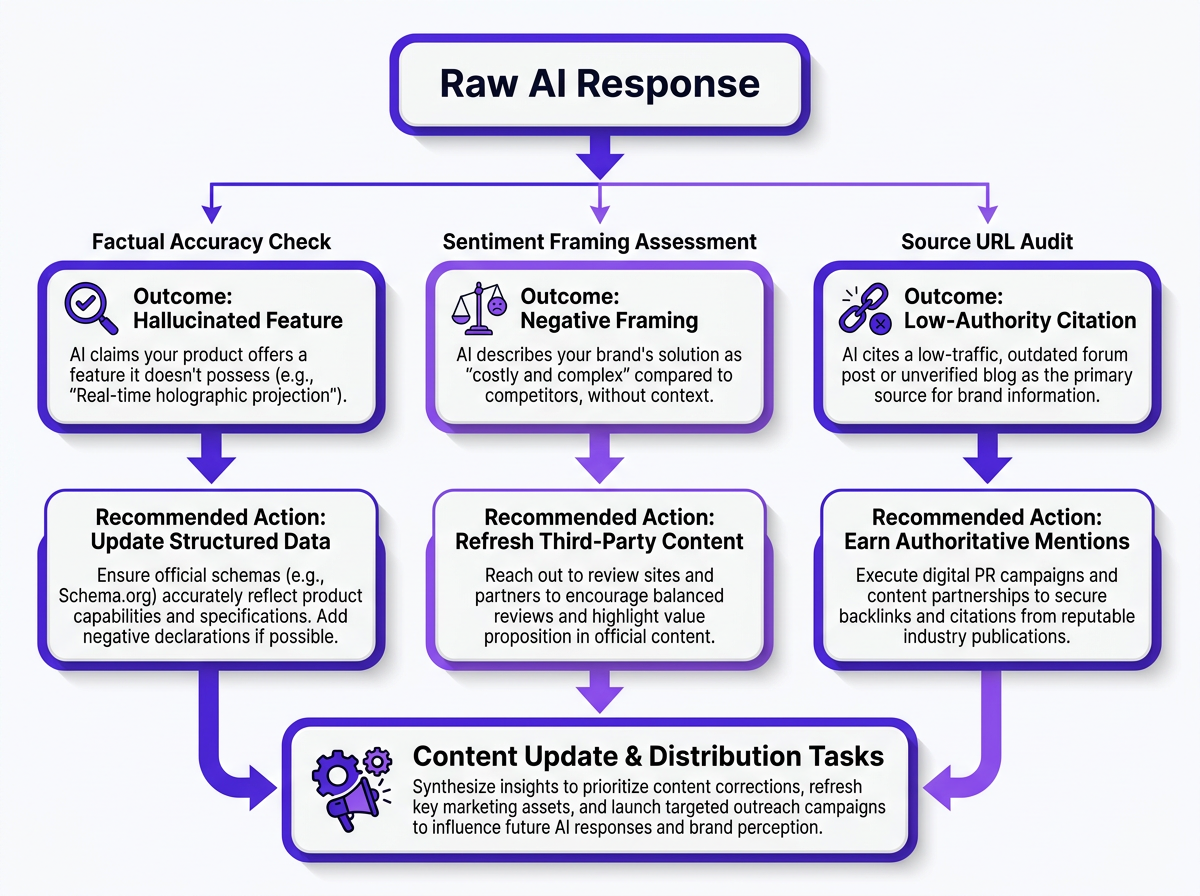
Being mentioned isn't enough. How you're described matters more than whether you're named. Look for three things: factual accuracy (is the AI hallucinating about your product features or pricing?), sentiment framing (are you recommended, mentioned as an alternative, or cautioned against?), and source quality (what URLs is the AI pulling from to form its opinion of you?).
When the AI Gets It Wrong About Your Brand
When you find hallucinated features, outdated pricing, or incorrect comparisons, the fix is to update your own published content, structured data, and authoritative third-party sources. AI search models often prioritize information from independent third-party content over company websites. This means getting accurate information onto review sites, industry publications, and partner pages is often more effective than updating your own site alone.
Reading Competitive Signals in AI Answers
When a competitor consistently appears above you or instead of you, look at the sources the AI is citing for them. Those are the publications and pages you need to earn mentions on. Research from Digiday shows a strong correlation between a brand's visibility in AI-generated summaries and the number of mentions it has on other web pages (2025). Your competitor's AI visibility is almost certainly a reflection of their third-party mention footprint, not just their own website.
Step 7: Connect AI Visibility to Business Outcomes
Info: AI search visitors convert at significantly higher rates than traditional organic traffic. That makes AI visibility not just a brand awareness metric but a direct revenue lever worth measuring carefully.
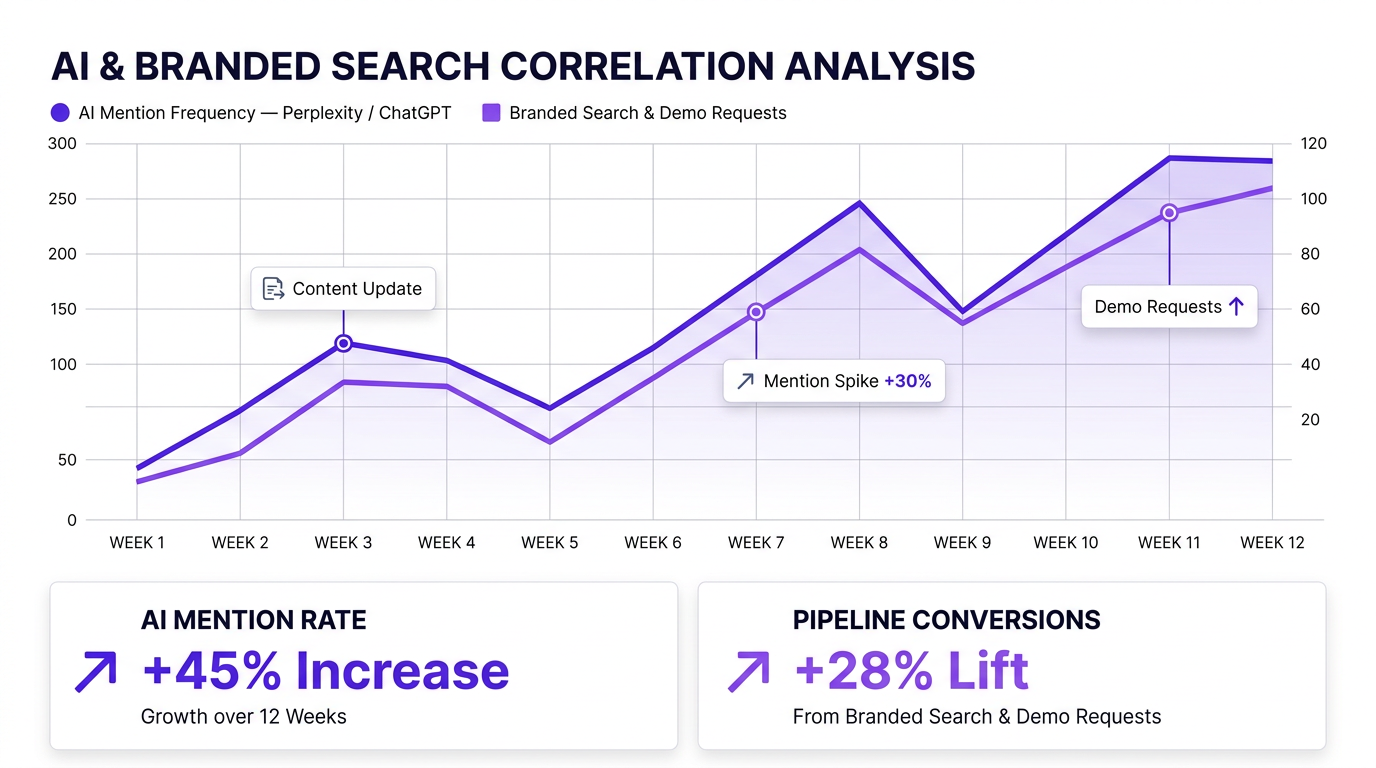
Track referral traffic from AI platforms using UTM parameters and server log analysis. Perplexity, for example, sends referral traffic that shows up in analytics. Correlate changes in your AI mention frequency with branded search volume, demo requests, or sign-ups. If your mention rate on Perplexity rises 30% in a month and branded searches tick up alongside it, you're starting to build a measurable connection between AI visibility and pipeline. For a broader framework on this, the AI Search Visibility Optimization: The 2026 Playbook covers how to turn these signals into a full optimization strategy.
Step 8: Iterate and Expand Your Query Coverage
This isn't a set-it-and-forget-it system. New AI models launch, user query patterns shift, and your competitive landscape evolves. Add 10 to 15 new prompts per month based on emerging customer questions and industry trends. Run a quarterly review to retire low-signal prompts, double down on high-impact categories, and reassess which AI platforms deserve more coverage. Google AI Overviews are estimated to appear on 13-21% of search queries in the US, and Google Search's AI Mode and its impact on SEO continues to evolve rapidly. Your prompt library needs to keep pace.
Common Mistakes That Will Waste Your Time
Avoid these four pitfalls:
- Testing only branded prompts. You'll miss the discovery-phase queries where AI is recommending your competitors instead of you. Non-branded category prompts are where most of the opportunity lives.
- Running each prompt once and treating it as ground truth. AI outputs vary between sessions. You need multiple runs for reliable data, not a single snapshot.
- Monitoring only one AI platform. ChatGPT, Perplexity, Gemini, and Copilot pull from different sources and produce meaningfully different answers. Coverage across platforms is non-negotiable.
- Tracking mentions without tracking sentiment. Being mentioned negatively is worse than not being mentioned at all. A brand that appears in AI answers as 'a more expensive option with limited support' would be better off invisible.
Summary and Next Steps
The 8-step workflow covers everything from defining your brand entity and building a prompt library, through running a baseline audit and setting up automated alerts, to analyzing sentiment and tying AI visibility to real business outcomes. The initial setup takes an afternoon. After that, the system runs on a fraction of the time you'd spend manually checking AI platforms. Knowing how to structure URLs for AI search is one of the next tactical steps once your tracking is in place, since technical structure affects how AI systems retrieve and cite your content.
Once you're tracking consistently, the natural next move is optimization: improving your AI visibility through Answer Engine Optimization and strategic content updates that target the sources AI models actually cite. Vizup's answer engine monitoring makes Steps 3 through 7 significantly faster by automating the prompt testing, sentiment analysis, and competitive benchmarking that would otherwise consume hours of manual work each week.
Frequently Asked Questions
How often should I check my brand mentions in AI search results?
Weekly monitoring is the recommended cadence for most brands. AI models update their retrieval patterns frequently, and competitive landscapes shift quickly. If you're in a high-velocity category, bi-weekly automated runs give you faster signals. Once you've configured automated tracking in a tool like Vizup, the time commitment drops to about 15 minutes a week for review.
Can I track brand mentions in AI search for free without a paid tool?
Yes, for an initial audit. You can manually run your prompt library across ChatGPT, Perplexity, Gemini, and Copilot using their free tiers and log results in a spreadsheet. The limitation is scale and consistency: manual checking doesn't catch changes between audits, doesn't run prompts multiple times to account for AI variability, and doesn't track sentiment or competitive benchmarking automatically. Free works for a starting point; it doesn't work as an ongoing system.
Which AI search engines should I monitor for brand mentions in 2026?
At minimum, monitor ChatGPT, Perplexity, Google Gemini (including AI Overviews in Search), and Microsoft Copilot. These four platforms cover the majority of AI-assisted search behavior. Google AI Overviews are estimated to appear on 13-21% of search queries in the US. Each platform pulls from different sources and produces different answers, so monitoring only one gives you a partial picture.
How is tracking brand mentions in AI search different from traditional social listening?
Social listening scans for unstructured mentions of your brand name across social platforms, forums, and news. AI search monitoring tracks whether and how AI systems synthesize and present your brand in response to user queries. The difference is intent and influence: an AI recommendation in response to 'what tool should I use for X' carries far more purchase influence than a random tweet. Traditional social listening tools are excellent for their purpose but weren't built to query AI answer engines directly.
What should I do if an AI search engine is giving inaccurate information about my brand?
Update your own published content and structured data first, then prioritize earning accurate mentions on high-authority third-party sources: review sites, industry publications, and partner pages. Research shows brands are more likely to be cited by AI via third-party sources than their own websites. Correcting the record on those external sources is often more effective than updating your own site. Monitor the same prompts over the following weeks to track whether the corrections propagate into AI responses.
