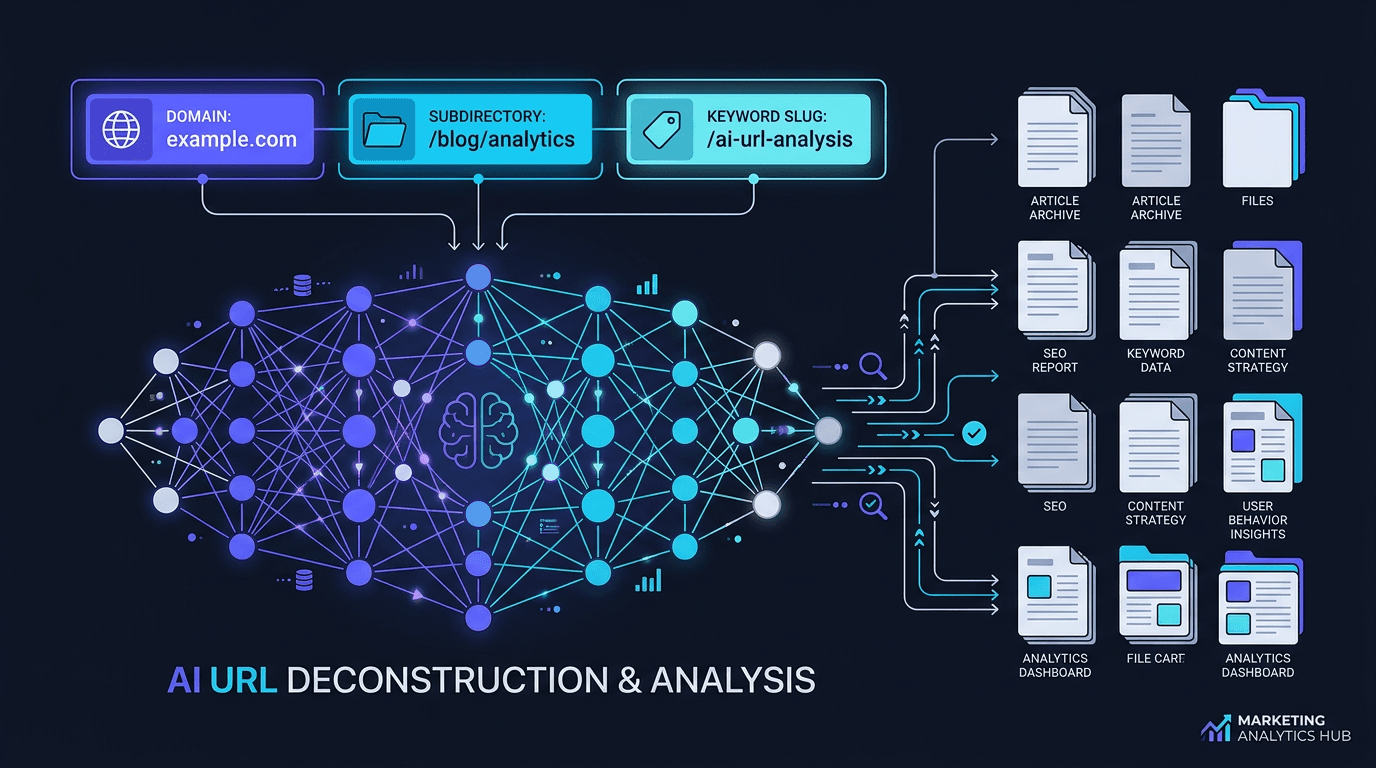
For years, the standard URL advice was simple: keep it short, readable, and sprinkled with keywords for SEO. That advice still holds. It’s just not the whole job anymore. Search is drifting from link lists to answer engines, and the mechanics of how they find, interpret, and cite your pages aren’t the same as they were.
I’ve watched teams spend months shaving a few points off bounce rates by polishing meta descriptions, only to see a new AI model blow past those snippets entirely. The new choke points are retrieval-augmented generation (RAG) pipelines and large language models. For them, your URL isn’t just an address; it’s metadata they can use early and often. Getting the URL structure for AI search right isn’t a fussy technical detail anymore. It’s part of the foundation for being found at all.
Why AI Cares So Much About Your Messy URLs
Start with the basic mismatch: AI search engines don’t “read” your site the way a person does. They ingest it. If classic keyword engines were librarians flipping through a card catalog, AI search looks more like a researcher absorbing whole shelves and then synthesizing an answer. In many RAG setups, the URL gets used as an early relevance check before the system spends compute on the page itself. When your URL is descriptive, it signals context and legitimacy up front.
Now look at how these systems show their work. They don’t hand you ten blue links; they give you an answer with citations. Perplexity AI, for instance, drops clickable source numbers directly into the text. Google’s AI Overviews follow the same pattern. Those citations are your URLs, sitting in plain sight. A URL like tryvizup.com/blog/12948 tells the reader nothing and reads like a database leak. tryvizup.com/blog/ai-seo/url-structure-guide does the opposite: it explains itself, and it earns a little trust before anyone clicks.
The Anatomy of an AI-Friendly URL
So what qualifies as a good URL in 2026? The checklist looks familiar, but the motivation has changed. You’re not just chasing keyword matches; you’re making the page easier to classify and retrieve. Here’s the framework I use with clients.
The core components:
- Logical Folder Structure: Use subdirectories to express hierarchy.
/services/monitoring/beats/page-id-7/every time. It mirrors how the site is organized and gives the AI a stronger sense of how pages relate to each other. - Human-Readable Slugs: The slug (everything after the final
/) should say what the page is about in plain language. If the headline is “How to Bake Sourdough Bread,” the slug should be/how-to-bake-sourdough-bread. No cleverness required. - Hyphens as Separators: Google’s guidance here is clear. Use hyphens (
-) between words. Skip underscores (_), spaces (%20), or running words together. Hyphens are the web’s default word boundary. - Lowercase Only: Sure, you can configure servers to treat
URLandurlas the same thing. You can also spend a weekend untangling duplicates and broken links when something goes sideways. Use lowercase and move on. - No Extraneous Parameters:
?source=email&utm_campaign=spring-promois for tracking, not indexing. Parameters can create duplicate URLs, split signals, and muddy what the “real” page is. Use canonical tags to point crawlers to the clean version, and be deliberate about which parameters bots are allowed to see.
Standards bodies like the IETF and W3C have always permitted complex URLs, but the web’s lived best practice has been the opposite: keep them simple. The difference now is that retrieval systems can make that complexity hurt in ways that are hard to diagnose later. If you’re building beyond URLs, this broader playbook on AI search visibility optimization is a useful next step.
Common Mistakes I Still See Every Week
After a decade doing this work, the patterns repeat. URL problems are especially maddening because the fixes are usually straightforward, while the downside is quiet: not a screaming 404, just a slow bleed of trust and clarity. Over time, that adds up.
Dates in Slugs: The Silent Killer
Unless you publish news, stop baking dates into URLs. /blog/2021/05/awesome-post instantly feels stale. People hesitate to click “a 2021 guide,” even if you refreshed it yesterday. AI systems pick up on that, too. And once the date is in the URL, you’re boxed in: updating the content without changing the URL keeps the stale signal; changing the URL forces redirects and invites a temporary dip. Leave dates out. They rarely earn their keep.
Overstuffed, Spammy Slugs
The opposite failure is treating the slug like a keyword landfill. /seo-services-best-seo-company-affordable-seo-new-york is unusable and reads like panic. Users see it; AI sees it; neither comes away impressed. A slug should be a tight description of the topic, not a meta keywords tag resurrected from 1998. It’s also where old habits from traditional keyword research and execution can actively work against you.
Ignoring the Hierarchy
I audited a large e-commerce site where every product lived at the root: domain.com/blue-widget, domain.com/red-sprocket, all flattened into one pile. Nothing in the URL hinted that two items belonged to the same category. Moving to something like /widgets/blue/ and /sprockets/red/ would have given AI crawlers (and Googlebot) immediate structure to latch onto. This is basic information architecture, yet it still gets missed, especially in CMS setups that default to a flat URL scheme.
Putting It All Together: A Practical Workflow
Enough abstraction. The work here is mostly process: set a standard, apply it consistently, and revisit it as the site grows.
For new pages, keep it disciplined. When your CMS generates a slug from the headline, treat that as a draft, not a decision. Cut it down to the actual topic. how-to-structure-urls-for-ai-search is clean. how-to-structure-urls-for-ai-search-ai-citations-and-better-retrieval is trying to do three jobs at once.
For existing pages, you need a steadier hand. Changing a URL means shipping a 301 redirect from the old address to the new one. Skip that, and you throw away the authority the page has already earned. Start by crawling the site, exporting the full URL list, and circling the worst offenders. Tackle pages that already pull meaningful organic traffic but have URLs that look untrustworthy or unreadable. Updating a high-performing URL is uncomfortable, but if the current structure is undermining user confidence or confusing retrieval systems, it’s worth fixing. Do it in batches and watch analytics closely for any drop-off.
This sits next to your broader technical hygiene. A clean URL doesn’t matter much if the page itself is hard for systems to parse. That’s where testing your structured data fits: the URL gets the crawler to the right place; schema and clean HTML make the content legible once it arrives. As features like Google's AI search mode spread, that end-to-end clarity is harder to treat as optional.
Frequently Asked Questions
Is it worth changing old URLs even if they rank well?
Sometimes, but treat it like surgery. If a URL is sitting at #1 for a high-value query, be conservative. If it’s a messy, parameter-heavy URL that still ranks on page one, cleaning it up and shipping a proper 301 redirect can improve trust and make the page more resilient for AI search without adding much long-term risk.
What's the ideal length for a URL slug?
Prefer short slugs, but don’t trade away clarity. Three to five descriptive words is a solid target. tryvizup.com/blog/url-structure-ai-search is strong. The living URL standard doesn’t impose a practical limit, but humans do.
Do I need to include the category in the URL for a blog post?
Yes, if you can do it consistently. /blog/category/post-name/ adds instant context, helps users understand where they are, and gives AI systems a clearer map of how your content is organized. That extra semantic signal is hard to replace later.
How do file extensions like.html or.php affect AI search?
In most cases, they’re just noise. Extensions add length and a bit of technical baggage without improving meaning. Modern servers and frameworks can serve pages cleanly without them, which keeps URLs simpler and less dated. If you already have extensions, it’s not urgent to rip them out, but avoid them on new builds.
Will my URL structure impact how my content is cited by AI?
Yes. Citation formats vary, but many systems display the source URL. A clean, descriptive path like /research/2026-market-study reads like a credible reference. /p?id=8734 reads like a random database row, even if the content is great.
