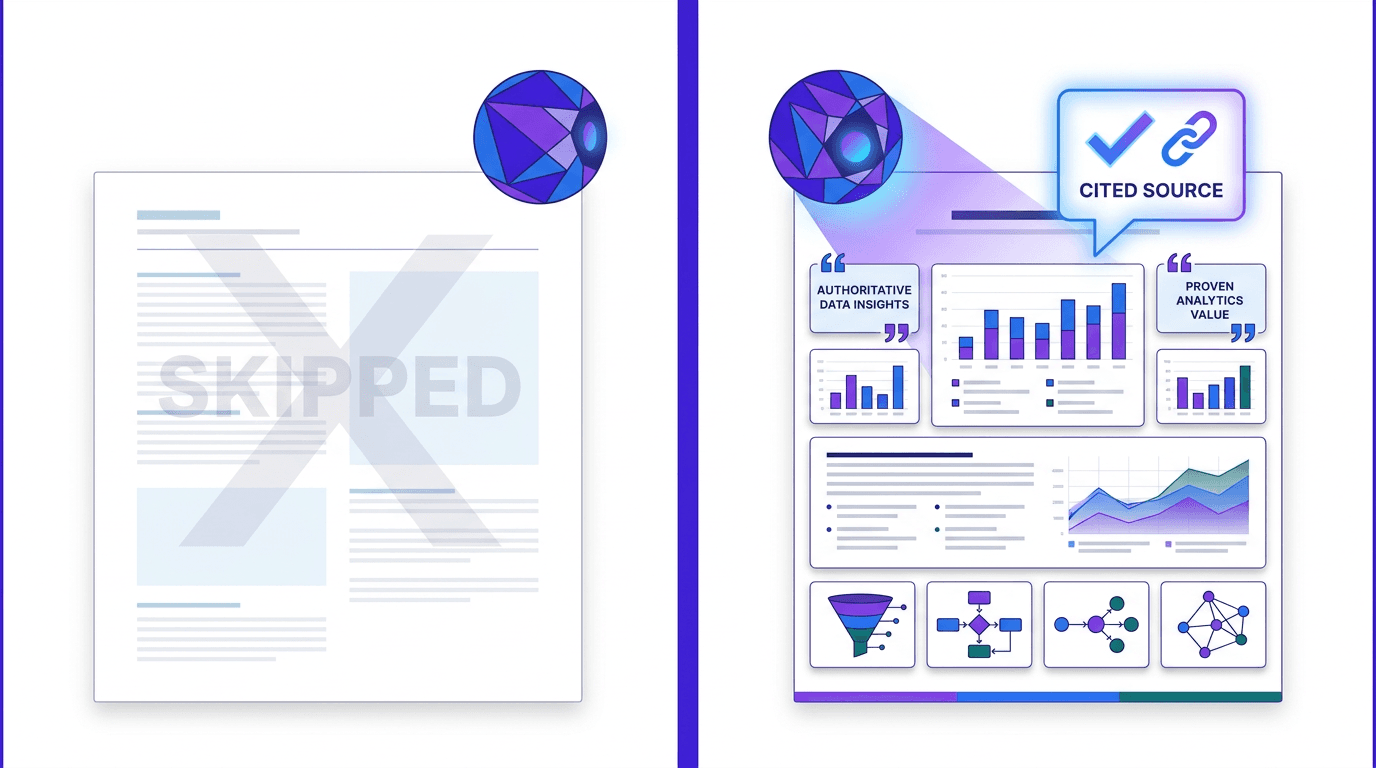
You have spent years building a library of helpful, keyword-targeted pages. Hundreds of URLs, each built to answer a question your audience reliably asks. Then the ground shifted, mostly without ceremony, and a lot of that work stopped showing up where it used to matter. AI search engines are not just matching queries to the best-looking page; they are assembling answers from sources they consider dependable. The pages they ignore are sending a blunt message: commodity content in AI search is a liability, not an asset.
Emerging AI search research points to the same pattern: pages cited by AI engines tend to contain more original data, expert perspective, and specific analysis than pages that merely perform well in classic organic results. The implication is uncomfortable but clear: the playbook that built traffic over the last decade is now the playbook that gets your work condensed into an answer and left behind without a link. This guide breaks down what separates commodity from non-commodity content, offers a scoring method to audit your library, and outlines upgrade moves that can turn thin pages into citable assets.
The Great Divide: What Is Commodity Content?
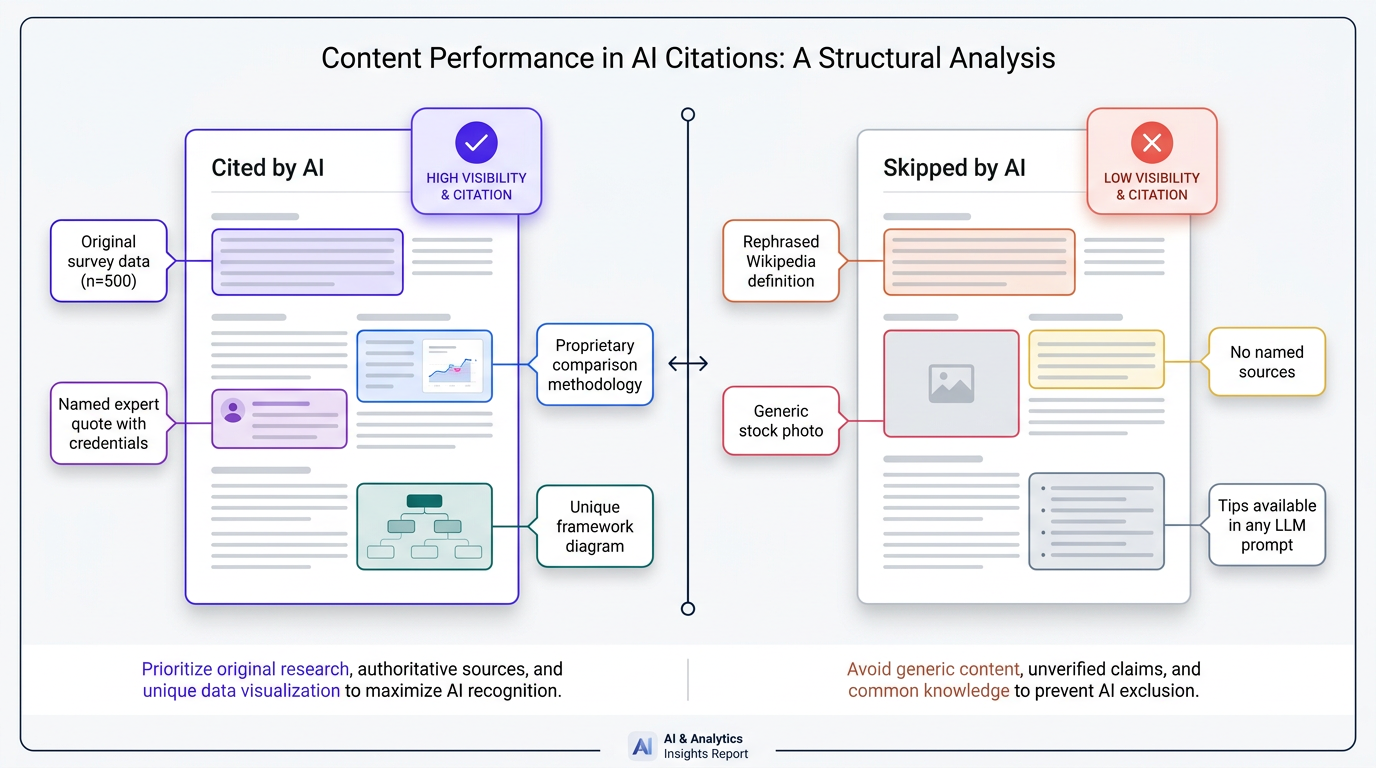
Commodity content is not synonymous with low quality. It can be accurate, cleanly structured, and perfectly capable of ranking in traditional search. The issue is that it is replaceable. Any competent writer, or any large language model, can reproduce it without access to proprietary knowledge, lived experience, or unique data. It shows up as the "what is X" explainer, the generic "10 tips for Y" listicle, the definition-style glossary entry. In practice, commodity content is generic, interchangeable advice that does not depend on real-world experience, proprietary data, or a distinct point of view.
Non-commodity content earns its keep by adding something an LLM cannot conjure from training data alone. That might be a proprietary dataset, a named expert's view on an emerging shift, a framework built from years of consulting work, or a synthesis that connects two ideas that rarely get discussed together. This is not a debate about polish or length. It is about whether a page contributes new material to the information supply chain, or simply forwards what is already circulating.
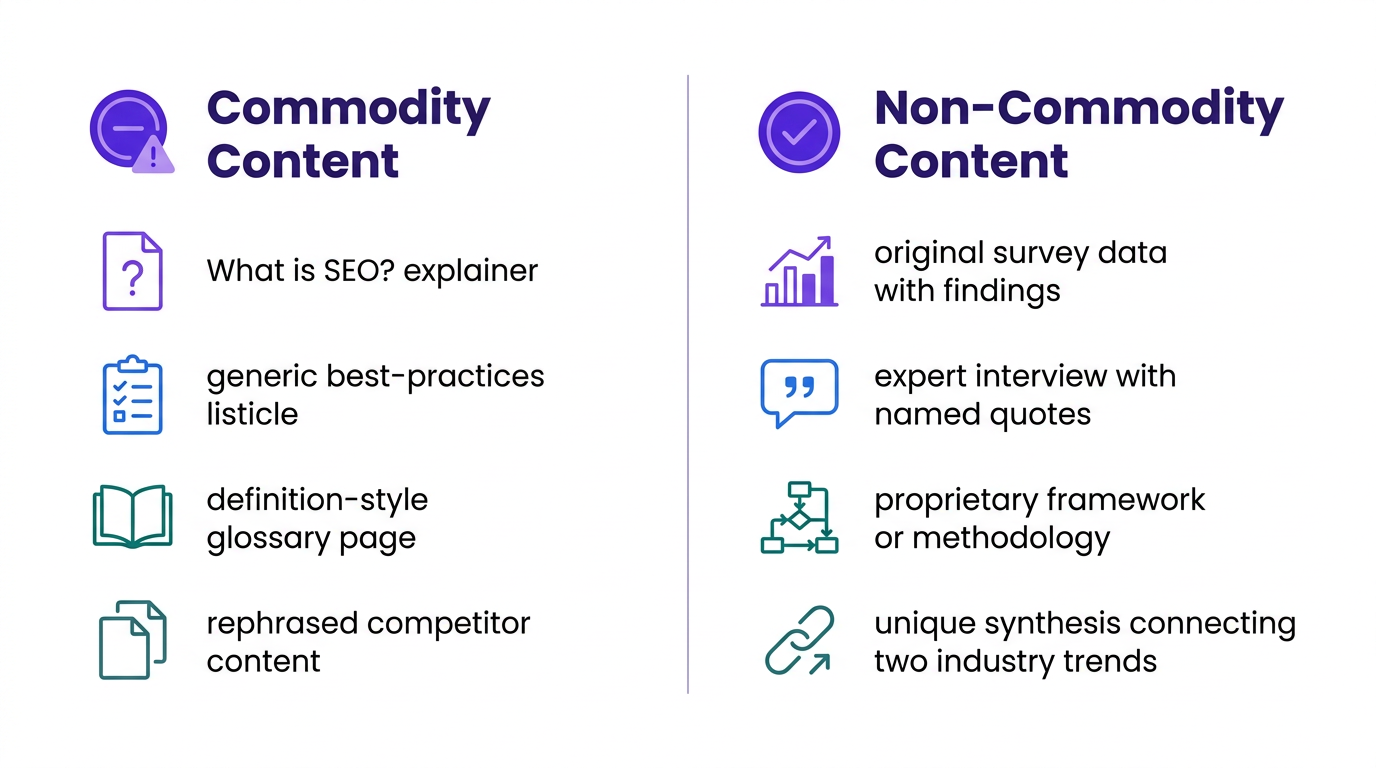
The editorial reset is straightforward: AI-cited pages consistently score lower on commodity metrics than pages that simply rank. When an AI overview needs to cite a source, it reaches for material it cannot reliably recreate inside the model. A 2025 study tracking 768,000 AI search citations found that product-related content (specs, comparisons, detailed "best of" analyses) accounts for 46% to 70% of all sources referenced by AI search engines, while generic blog content captured only 3 to 6 percent. The pattern holds across categories: AI search cites specificity, data, and a point of view.
How to Audit Your Site for Commodity Content Exposure
Before you upgrade anything, get a clear read on where your library actually sits. This is not a purge exercise. It is triage: put editorial time where it has a realistic shot at earning AI citations, and stop funding pages that AI engines will happily summarize without attribution.
Step 1: The Five-Second Test
Open ChatGPT, Gemini, or any general-purpose LLM and paste in the core question your page is meant to answer. If you get a complete, accurate response from a single prompt with no extra context, your page is high-commodity. The model already contains the substance of what you published. Run this against a handful of your own URLs and the contrast shows up quickly: a page titled "What Is Content Marketing?" will almost certainly fail. A page titled "How We Increased Organic Leads 340% by Restructuring Our Content Hub" will not, because the model has not seen your internal numbers.
Warning: Run this test on your top 20 pages by traffic. If more than half fail the five-second test, you have meaningful commodity exposure and your AI search visibility is probably sliding.
Step 2: The Originality Scorecard
The five-second test gives you a quick gut check. To audit at scale, score each page across four originality dimensions. The result is a simple commodity-risk number you can use to rank upgrade opportunities across the whole library.
| Originality Factor | 0 Points | 1 Point | 2 Points | 3 Points |
|---|---|---|---|---|
| Contains original data or survey results | No data included | Cites others' data | Reworks public data with a distinct angle | Uses proprietary, first-party data |
| Features named expert quotes or perspectives | No expert input | Only a generic author bio | One named expert quote | Multiple credentialed experts cited |
| Includes proprietary framework or process | Standard advice only | Light tweaks to a common framework | Adapted framework with distinct steps | Fully original methodology |
| Has custom diagrams, visuals, or models | Stock images or nothing | Basic charts built from common data | Custom visuals explaining unique concepts | Interactive or data-driven original visuals |
| Score each page out of 12. Pages scoring 0-3 are high commodity risk. Pages scoring 8-12 are strong candidates for AI citation. |
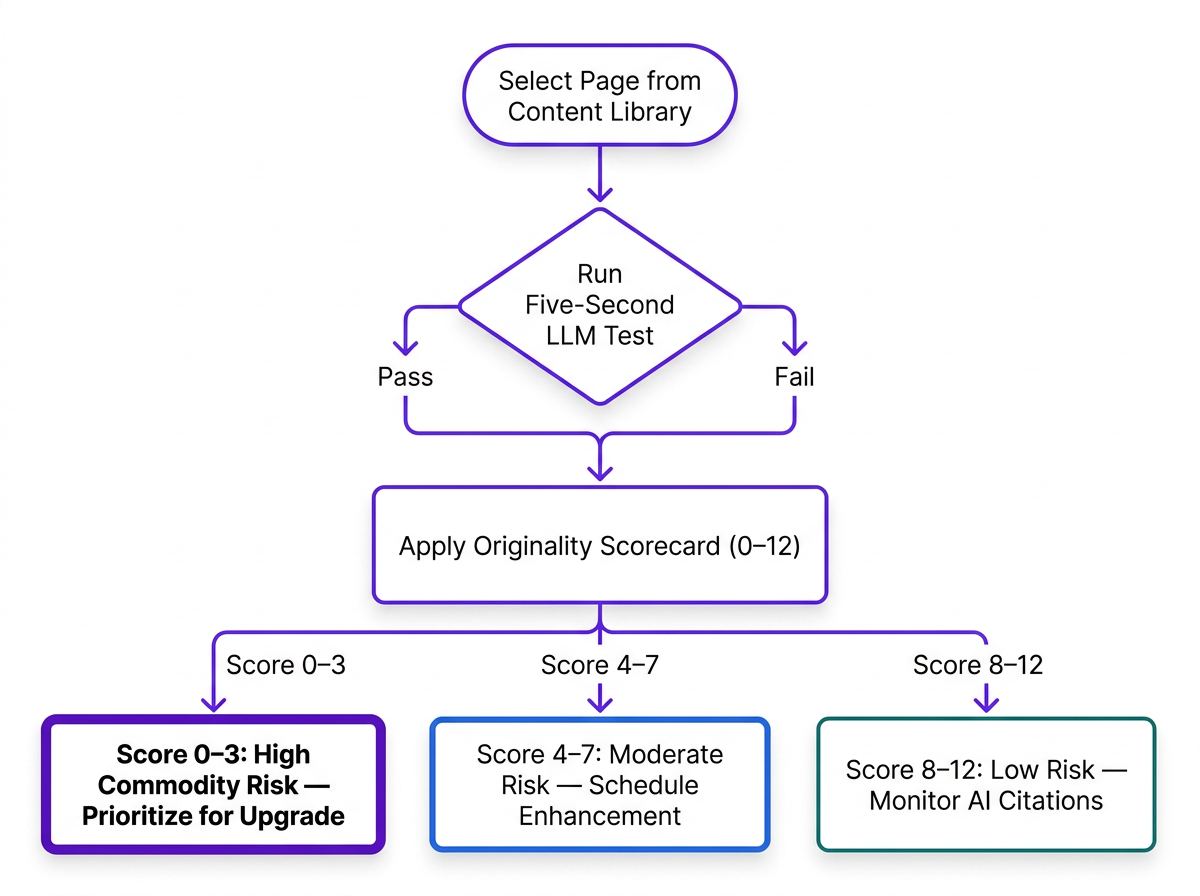
Step 3: Mapping to AI Citations
The scorecard tells you what should be cite-worthy; now check what is getting cited. Use an Answer Engine Monitoring tool to identify which URLs appear in AI overviews, Gemini responses, and other AI-generated answers, then cross-reference that list with your originality scores. The relationship usually shows up fast: pages scoring 8+ appear in AI citations far more often than pages scoring under 4. That is the operational proof that depth in AI overviews is table stakes, not a nice-to-have. To watch the trend over time, use AI search visibility management tools and track how specific upgrades translate into citation gains.
The Upgrade Playbook: Turning Commodity Content into Citable Assets
You do not need to torch your library and start over. The efficient move is to upgrade pages that already carry topical authority and backlinks, but are missing the originality signals AI engines reward. The tactics below are designed to break the commodity pattern, and they build on the broader shift outlined in our content marketing in the AI search era guide.
Inject Original Data and Research
Original data is the most reliable way to stop a page from being treated as interchangeable. AI models cannot cite numbers they have never encountered. A small survey of 200 respondents, an analysis of your own product usage, or a distinctive synthesis of public datasets gives the page something the model cannot manufacture. Original statistics are one of the clearest ways to make a page harder for AI systems to ignore. For teams managing this at scale, Vizup helps identify which pages need original data, monitor whether those upgrades earn citations, and feed those learnings back into future content.
Practical ways to generate original data without a research budget:
- Run a 5-question survey through your email list or LinkedIn audience. Even 150 responses can produce citable findings.
- Analyze anonymized product or platform data to publish benchmarks (e.g., "We analyzed 10,000 campaigns and found...").
- Cross-reference two public datasets that are rarely combined. The pairing is the original contribution.
- Document A/B tests, experiments, or process changes with specific before-and-after metrics.
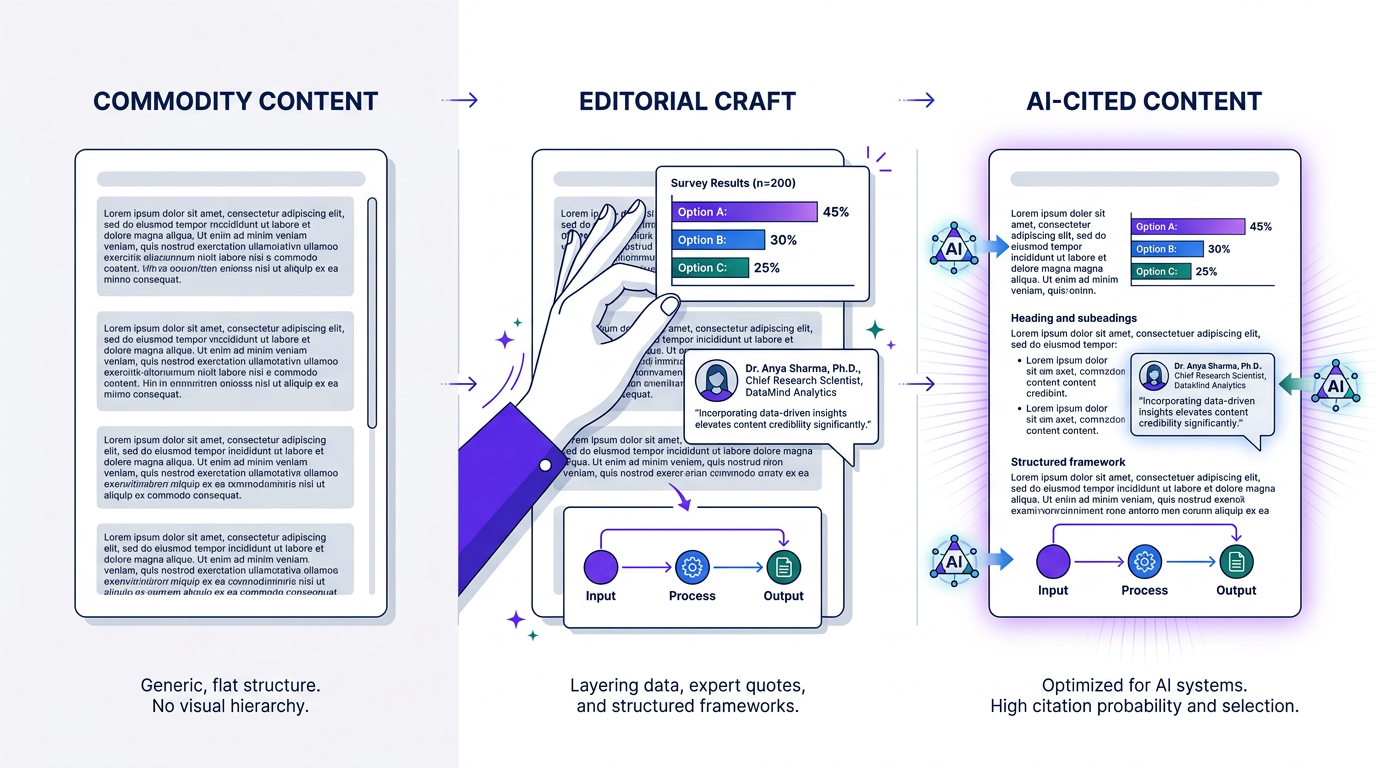
Layer in Verifiable Expertise
A generic author bio tacked onto the bottom of a page rarely moves citation behavior. What matters is expertise that shows up inside the argument: named, credentialed professionals offering concrete perspectives, not vague encouragement. Google's guidance on E-E-A-T and people-first content is a better fit here: it encourages creators to demonstrate experience, expertise, authoritativeness, and trustworthiness through helpful, reliable content.
This maps cleanly to expertise content GEO principles. Place expert quotes where they do the work, not in a quarantined "expert roundup" section. Attribute each quote with full name, title, and organization. If you are positioning the author as the expert, make credentials explicit and connect claims to specific experience ("In 14 years of running content audits for SaaS companies, I have seen..."). For a detailed execution framework, see our playbook on how to make your content GEO.
Increase Content Depth with Unique Synthesis
Depth is not a word-count contest. A 5,000-word page that paraphrases the same points as everyone else is still commodity content, just longer. Real depth comes from synthesis: connecting variables other pages leave isolated. Move from "what is X" to "how X interacts with Y, and what that means for Z." CXL's 100-page AI Overview citation study found that AI Overviews tend to cite material that appears early on a source page, with 55% of citations coming from the first 30% of the content. Put your unique synthesis up front, not after 2,000 words of warm-up.
Tip: A practical depth check: after drafting a section, ask, "Could someone who has never worked in this field write this paragraph?" If the answer is yes, it is commodity. Rework it with a specific example, a defensible contrarian take, or a connection to adjacent data that requires domain knowledge.
What AI Search Cites: A Look at the Winners
Theory helps, but patterns land harder when you can see them. Two examples show what tends to get cited, and why, across different content types.
B2B example: Product comparison pages with proprietary testing. Ahrefs' March 2026 AI Overview citation study found that only 38% of pages cited in Google's AI Overviews also rank in the top 10 organic results for the same query, down from 76% previously. The pages that do get cited skew toward original benchmark data, hands-on product testing, and specific use-case analysis. A B2B software review site that runs its own performance tests and publishes the raw numbers gets cited repeatedly, while a competitor that rewrites feature lists from vendor websites does not. The difference is not domain rating or brand authority; it is whether the page contains information the AI model cannot generate from training data.
Publisher example: data journalism and original reporting. News and research articles capture 5% to 16% of AI citations, according to Search Engine Journal's AI citation study. The pieces that earn those citations tend to share the same ingredients: original reporting, named sources, specific findings, or distinctive data visualization. A publisher that surveys 500 marketers about AI adoption and publishes the findings gives AI systems something specific to cite. A publisher that simply summarizes someone else's survey is easier to skip. The same lesson applies to B2B brands: AI search is more likely to cite content that contributes original evidence, not just content that repeats what already exists.
Stop Feeding the Commodity Machine
The era of filling content gaps with generic explainers is ending. Every "what is" page that ships without original insight is another asset AI engines can ingest, summarize, and move past without sending a click back to you. The editorial mandate is simple: become a source of primary insight, not a relay for information already everywhere.
That does not require producing less; it requires allocating effort differently. The 80/20 rule hits especially hard here: spend 80% of editorial energy on the 20% of pages that can become genuinely citable. Those are the pages with original data, named expertise, and synthesis you cannot get from a generic prompt. The rest can still support site architecture and internal linking, but they should not be where the team burns its best hours.
Once the organic system is working, paid ads can be layered on as amplification rather than used as a substitute for citable, expert-led content.
If you need a starting point, run the originality scorecard across your top 50 pages by organic traffic. Flag the ones scoring under 4 that still bring in meaningful traffic; those are your highest-leverage upgrade candidates. For the wider strategy of earning visibility across AI engines, our guide to improving brand visibility in AI search lays out the full picture. To benchmark where your pages show up inside AI-generated answers right now, Vizup's AI Content Checker is a practical place to begin.
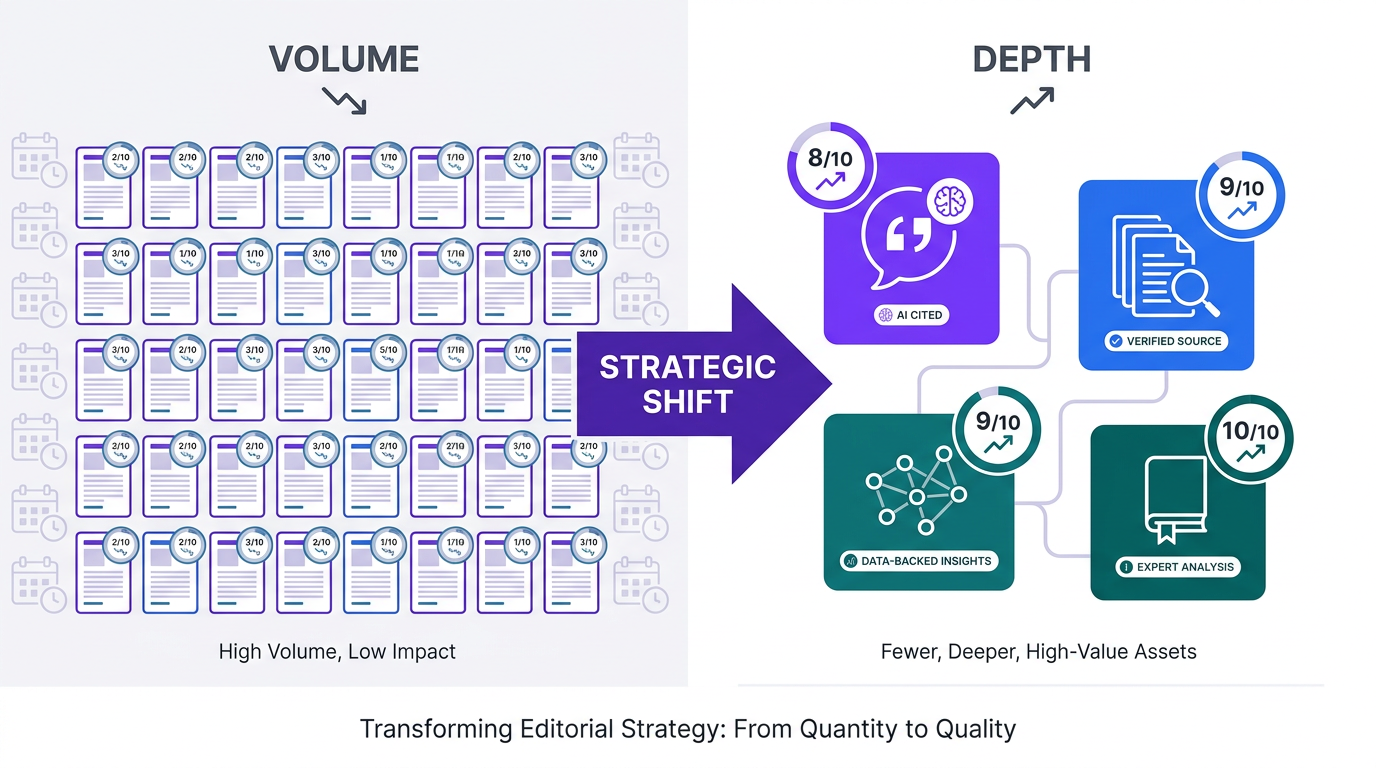
The content teams that win in AI search will not be the ones publishing the most. They will be the ones publishing pages an AI system cannot credibly recreate. Commodity content in AI search is not merely underperforming; it is feeding models the material they need to answer your audience without ever visiting your site. The durable response is to produce work worth citing.
Frequently Asked Questions
Should I delete my old commodity content?
Not by default. Pages with existing backlinks and topical authority can still support your site's broader signals. Upgrading is usually the better move: add original data, weave in expert perspectives, and restructure the page so the unique material appears in the first 30% of the content. If a page has zero traffic, zero backlinks, and scores 0-2 on the originality scorecard, consolidating it into a stronger page is a reasonable call.
How is this different from Google's E-E-A-T guidelines?
E-E-A-T (Experience, Expertise, Authoritativeness, Trustworthiness) is Google's quality framework for traditional rankings. Commodity scoring is about AI citation behavior specifically. There is overlap because both reward expertise and real experience. The difference is outcome: E-E-A-T influences whether you rank; commodity scoring predicts whether an AI engine will cite you or simply incorporate your information without attribution. A page can still rank with moderately commodity content. It is much less likely to get cited with it.
Can I use AI to help create non-commodity content?
Yes, with an important constraint. AI tools are useful for outlines, draft structure, and spotting obvious gaps. They do not generate original data, lived experience, or genuine expert perspective. Use AI for the commodity scaffolding (definitions, background, formatting), then invest human effort in the non-commodity layers: first-party analysis, expert interviews, and synthesis that reflects domain knowledge. The finished page needs elements no LLM could produce from training data alone.
How long does it take to see results from upgrading my content?
AI citations often shift faster than traditional rankings because AI engines re-crawl and re-evaluate sources frequently. Citation timelines vary, so track changes after each substantial update instead of assuming a fixed ranking window. Use an answer engine monitoring tool to track which URLs are cited and for which queries. Traditional ranking lifts from the same work often follow on a 2 to 4 month timeline.
Does this mean traditional SEO is dead?
No. Traditional SEO still drives most web traffic, and fundamentals like technical health, site architecture, and keyword targeting still matter. What is changing is the content layer. Pages optimized mainly for keyword matching, without original depth, are losing ground in AI citations and increasingly in traditional rankings as Google's algorithms evolve. The smartest B2B content marketing strategy for AI search treats classic SEO and AI citation optimization as complementary priorities.
