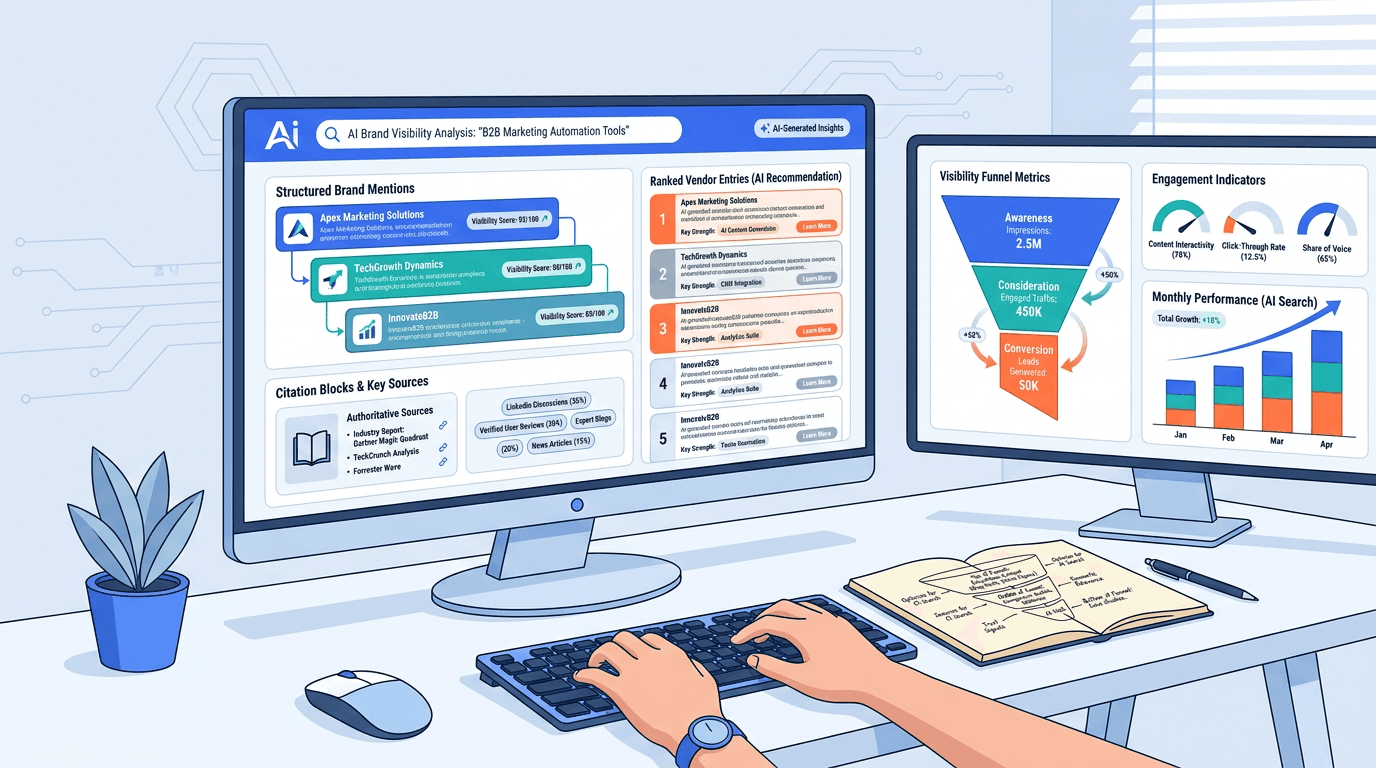
How B2B buying committees research vendors is changing. Buyers increasingly use Large Language Models to synthesize information and organize their purchase research. A B2B content marketing strategy cannot stop at ranking on Google; it has to show up inside the AI-generated answers where committees form preferences. Many deals are won by the vendor the buyer favored before ever contacting sales, making early visibility critical.
What follows is a narrative framework for building content that can win in both traditional search and AI answers. The flow is deliberate: audience mapping first, then creation, distribution, measurement, and the tooling to keep it all running. If you run demand gen or you are building a plan for the CMO, anchor on a simple rule: build around buying committees, not standalone keywords.
Map Your Buying Committee Before You Write a Word
Most B2B purchases do not hinge on one person. A typical committee spans an executive sponsor, a technical evaluator, procurement, and the end users who will live with the decision. They ask different questions, in different language, at different moments in the funnel. If your account-based content only speaks to one slice of that group, you can get screened out before the shortlist even exists. Forrester's B2B content strategy framework pushes the same point: content works when it is built on a real understanding of audience, journey, and messaging needs.
Start with a buying committee map for your top 20 target accounts. For each persona, capture the primary pain point, the questions they are likely to paste into AI tools, and the formats they actually consume (whitepapers for executives, technical docs for engineers, ROI calculators for procurement). Treat that map as your operating document; it should drive every content decision that comes next.
Build a Content-to-Funnel Map That Serves Every Stage
A content-to-funnel map forces every asset to earn its place: a specific stage, a specific role on the committee, a specific job to do. Without it, teams tend to overproduce top-of-funnel material while the mid- and bottom-funnel gaps quietly drain pipeline. The table below is a practical way to structure the mapping for both B2B AI search and traditional channels.
| Funnel Stage | Buying Committee Role | Content Type | AI Search Goal |
|---|---|---|---|
| Awareness | Executive Sponsor | Thought leadership articles, industry reports | Brand mention in AI overviews |
| Consideration | Technical Evaluator | Comparison guides, architecture docs | Cited as authoritative source |
| Decision | Procurement Lead | ROI calculators, case studies | Named in vendor recommendation |
| Retention | End Users | Onboarding guides, best-practice playbooks | Referenced in how-to answers |
| Each row targets a distinct persona and AI search outcome. |
This mapping also makes the overlap between demand gen and ABM obvious. A comparison guide aimed at technical evaluators in your target accounts can also perform as an organic asset when models respond to prompts like "best tools for X." Teams with a documented strategy tied to revenue goals consistently outperform ad hoc publishing.
Structure Content for AI Citability and B2B SEO
Classic B2B SEO rewarded keyword targeting and backlinks. AI search behaves less like a list of blue links and more like an answer engine that stitches together sources. LLMs tend to prefer content that is easy to parse, grounded in verifiable facts, and clearly attributed to a credible publisher. If you want citations in AI-generated answers, you need to design for it.
Structural principles for AI-citable B2B content:
- Lead with a direct answer. Put the clear, factual takeaway in the first 100 words. LLMs often pull from the top of the page.
- Use schema markup. FAQ, HowTo, and Organization schema make it easier for models to interpret intent and authority.
- Include named data points. Use specific numbers with a source (e.g., "45% of B2B marketers plan to increase AI tool investment in 2026, per the Content Marketing Institute"). Verifiable claims travel further in AI answers.
- Write modular sections. Make each H2 a self-contained answer so models can extract it without relying on surrounding context.
- Maintain entity consistency. Keep your brand name, product names, and category terms consistent so models reliably connect you to the right topics.
Thought leadership SEO is where this gets real for CMOs. Executive bylines and original research tend to carry more weight in AI search because they read as first-party perspective, not rewritten consensus. A CMO point of view on market shifts, backed by proprietary data, is simply more citeable than a generic listicle. For a deeper look at these mechanics, read this complete guide to improving brand visibility in AI search.
Layer ABM Targeting onto Your Content Distribution
Writing the right asset is only half the work; getting it in front of the right account is the other half. An ABM-first distribution model treats content like targeted outreach, not a broadcast schedule. McKinsey (2023) reports that companies that excel at personalization generate 40% more revenue than average performers, and that edge stacks up when the same content also shows up in AI search results.
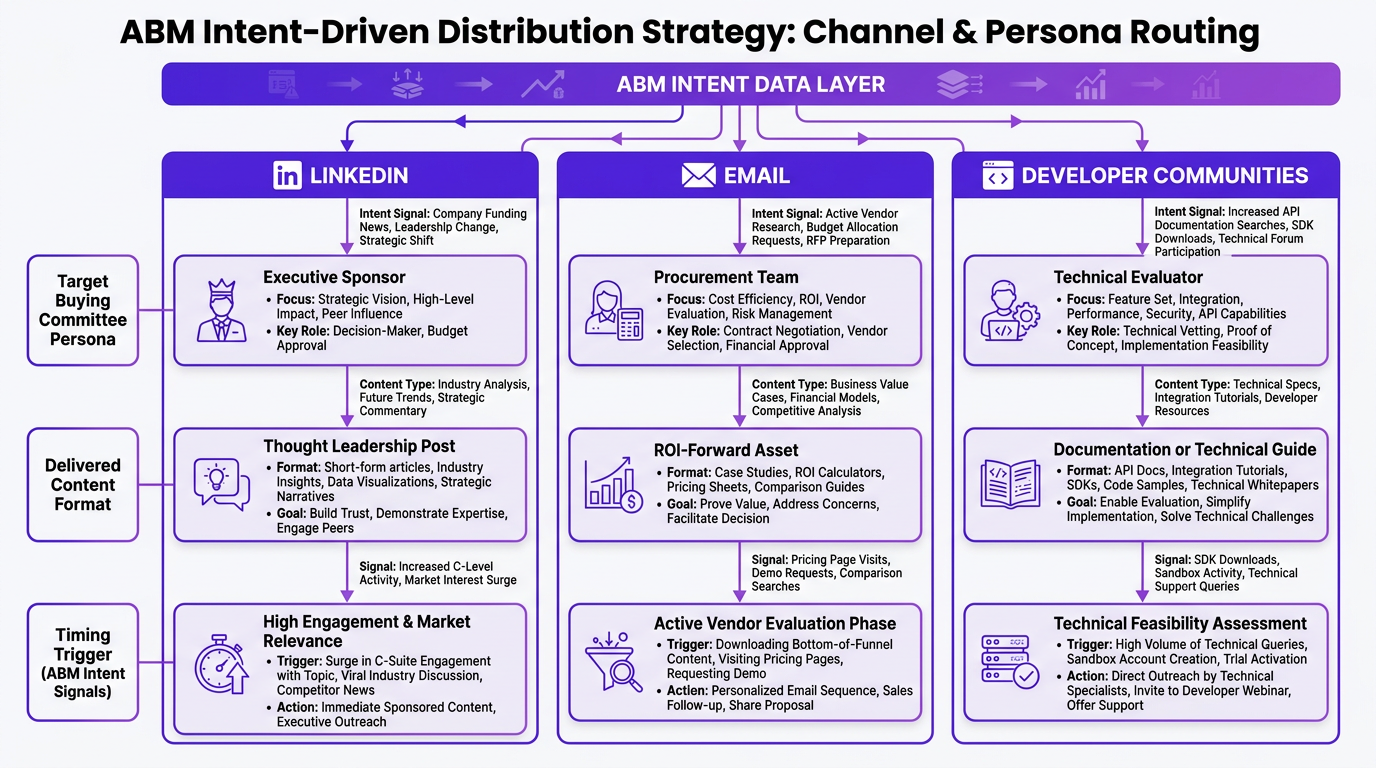
Match channels to how each persona actually consumes information. Technical evaluators show up in developer communities and documentation portals. Executive sponsors are more likely to engage with LinkedIn thought leadership and curated email digests. Procurement teams want direct outreach with ROI-forward assets that make the business case cleanly. Understanding why organic marketing is beyond SEO helps teams resist the temptation to bet everything on one channel.
Measure Visibility, Not Just Traffic
In 2024, 58% of B2B marketers said content marketing helped generate sales and revenue, up from 42% the year before (MarketingProfs and CMI, 2023). But traffic alone is a blunt instrument when AI search can answer questions without sending a click. The metric that earns its keep now is visibility: how often your brand appears in AI-generated responses, which queries trigger those appearances, and whether the right buying committee personas are the ones seeing them.
Tools like Vizup include AI Content Checker capabilities to audit whether your content is structured for AI citability. Monitoring platforms built for answer engine optimization track brand mentions across ChatGPT, Perplexity, Google AI Overviews, and other LLM-powered interfaces. For a practical measurement framework, the AI search visibility optimization playbook lays out a step-by-step approach. And if you are reporting up to a CMO, why visibility metrics matter more than traffic is the argument you will end up making anyway.
Content Marketing Institute (2025) found that 45% of B2B marketers plan to increase investment in AI-powered marketing tools in 2026. The teams that put measurement infrastructure in place now will compound that investment over time, because they will know what is getting cited and why. Explore AI content strategy frameworks to see how leading teams are operationalizing the shift.
Putting Your B2B Content Marketing Strategy Into Action
Treat AI search visibility as an operating model, not a one-off project. Start with the buying committee map, then build a content-to-funnel map that covers every persona and stage. From there, structure each asset so it is easy to cite, distribute it through ABM-aligned channels, and report on visibility instead of vanity metrics. The teams that treat AI search as a first-class channel (not an afterthought) are the ones that will win the research phase where deals are often decided before sales ever gets a shot.
Frequently Asked Questions
How does B2B AI search differ from traditional organic search?
Traditional organic search returns a ranked list of links. B2B AI search composes a direct answer from multiple sources and often includes citations to the most authoritative, well-structured content. That shifts the job from pure keyword ranking to earning citations and consistent entity recognition.
What role does account-based content play in AI search visibility?
Account-based content is built for specific personas on the buying committee. When it is also structured for AI citability (clear answers, named data, schema markup), it can do two jobs at once: support ABM outreach to target accounts and surface in AI-generated answers to the exact questions those personas ask.
How should demand gen teams measure AI search performance?
Track how often your brand is mentioned in AI-generated responses, which queries drive those mentions, and which buying committee personas are most likely to encounter them. Platforms focused on answer engine optimization techniques can automate that monitoring and make it easier to report consistently.
Is thought leadership still valuable for B2B SEO in 2026?
Yes, and the bar is higher. LLMs tend to prioritize original, expert perspective over commodity content. Executive bylines backed by proprietary data earn citations more often than generic posts, which makes thought leadership SEO a practical investment, not a brand-only nice-to-have.
How often should we update our content-to-funnel map?
Revisit it quarterly. Buying committee structures change as organizations evolve, and AI search models update regularly. A quarterly review keeps coverage aligned to emerging questions and to the way LLMs are surfacing (or skipping) your brand.
Track your AI search visibility across major LLM platforms with Vizup.
