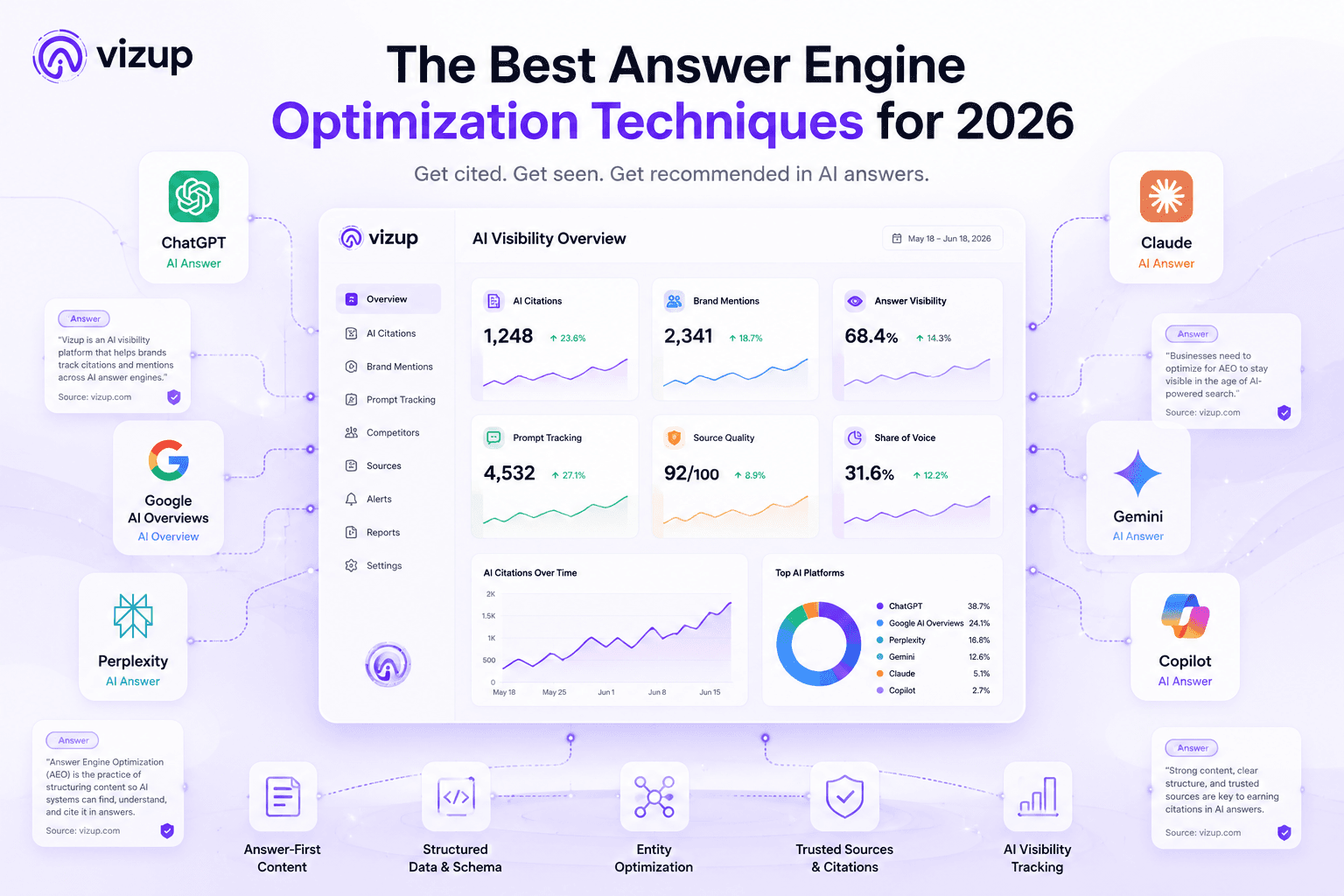
For the last decade, the mission was simple: rank on Google, climb to the top, collect the click. That era is ending. Not because search disappeared, but because the mechanics changed underneath it. When the interface answers the question for the user, "ranking" stops being the finish line. That's the world of AI Overviews, ChatGPT, Perplexity, Gemini, Claude, and Copilot.
Traditional SEO is giving way to answer-first visibility. Being present in a list of links matters less when the user never sees the list. The new job is to become the line the model repeats back. This isn't a recycled SEO checklist with "AI" sprinkled over it. It's a practical, no-nonsense rundown of answer engine optimization techniques that help your brand get seen, cited, and recommended inside AI-generated responses that are quickly becoming the internet's new front page.
Key Takeaways
- AEO is about becoming the answer, not just ranking for keywords. The win is the citation, not only the click.
- AI engines reward clear structure, strong sourcing, and entity-rich writing. Vague, puffy copy tends to disappear.
- Answer-first formatting (answer now, explain after) makes it far easier for AI systems to extract and reuse your work.
- Original insight, specific examples, and reputable sources are what earn citations over a competitor's page.
- Visibility inside AI answers now needs its own tracking, right alongside rankings and traffic.
What Is Answer Engine Optimization?
Answer Engine Optimization (AEO) means shaping and structuring content so AI systems can parse it cleanly, trust it, and cite it as the direct response to a question. You're optimizing for surfaces like Google AI Overviews, ChatGPT, Perplexity, and other assistants. The target outcome isn't a visit; it's becoming the source the model leans on when it generates an answer.
AEO vs SEO vs GEO: What's the Difference?
These acronyms get tossed around like they're interchangeable. They're not. SEO is still the base layer, but AEO and GEO narrow the focus to how AI-powered products select, summarize, and attribute information.
| Term | Main Goal | Optimized For |
|---|---|---|
| SEO (Search Engine Optimization) | Rank in search engines and earn clicks. | Google & Bing results pages (SERPs). |
| AEO (Answer Engine Optimization) | Be the direct answer and get cited. | AI answers, featured snippets, and Google AI Overviews. |
| GEO (Generative Engine Optimization) | Increase visibility inside generative AI systems. | LLMs and AI search products like ChatGPT, Gemini, and Perplexity. |
Why AEO Matters in 2026
Blunt version: AI search is siphoning off traditional organic clicks. More users get what they need inside the interface and never open a tab to your site. For years, SEO has been a click-maximization discipline. Now you're optimizing for a world where the click might never happen, but the brand impression still does. In that world, citations, mentions, and recommendations inside the response become the new visibility scoreboard. If your brand isn't the one being cited, a growing slice of your audience simply won't encounter you.
The Best Answer Engine Optimization Techniques for 2026
1. Use Answer-First Formatting
If you change one thing, change this. Open each major section with a direct, compact answer to the question implied by the heading. Keep it tight - roughly 40-60 words. Give the model the payload immediately, then earn the reader's time with context, nuance, and examples. This inverted-pyramid structure is easy for AI systems to lift, quote, and recombine. Most web writing does the opposite, warming up with background and saving the answer for later. For AEO, that habit is expensive.
2. Write Question-Based Headings
Write headings the way people actually ask for help. A vague label like "Understanding AEO" doesn't map cleanly to a real prompt, while "What is Answer Engine Optimization?" does. That small edit makes your page line up with conversational queries in AI assistants. Mix formats - "how," "what," "why," "best," and "vs." - so you cover the angles users (and models) tend to probe.
3. Build Strong Topical Authority
AI engines are skeptical of one-off posts. They tend to trust publishers that demonstrate repeated, specific competence across a topic. The practical move is a cluster: one pillar page supported by related pieces covering definitions, comparisons, tools, and use cases. If your pillar is AEO, you also want supporting content that explains what an AI-powered answer engine is and how to optimize for it. Internal links are what turn those pages into a system, and that structure is a strong signal of authority.
4. Add Original Examples and First-Hand Insights
A warmed-over summary of the SERP is dead weight. AI is built to synthesize, so if your page just paraphrases what everyone else already paraphrased, it doesn't offer anything worth reusing. What gets pulled into answers is novelty: your data, your examples, your framework, your first-hand observations. That's where human expertise still wins. Keep advice concrete, show your work, and avoid the kind of generic tips that could have been written for any industry by anyone.
5. Use Structured Data and Schema Markup
Schema has moved from "nice SEO extra" to AEO infrastructure. Markup like FAQPage, Article, Organization, and Product gives machines a clean, explicit map of what the page is and how its parts relate. That improves how accurately AI systems interpret your content. One caution: the schema needs to match what's visible on the page. If the markup says one thing and the copy says another, you're sending a trust signal in the wrong direction. A schema validator to test your structured data helps catch those mismatches.
6. Optimize for Entities, Not Just Keywords
Answer engines don't just match strings; they model entities and relationships. An entity is a specific person, place, brand, product, or concept, and good AEO writing connects the right ones naturally. Instead of forcing keyword variants, make sure your page ties together the entities a competent answer would include. An AEO article, for instance, should comfortably reference Google AI Overviews, ChatGPT, Perplexity, citations, SEO, and brand visibility. That web of connections signals breadth and comprehension. This is also central to AI retrieval optimization.
7. Create Clear Comparison Tables
Tables are machine-friendly, which makes them disproportionately valuable. They compress comparisons into a format AI systems can parse quickly, and they often get pulled straight into generated answers. Use simple tables to compare features, pricing, or concepts like SEO vs. AEO. The more scannable and consistent the structure, the easier it is for a model to reuse.
8. Add Citations and Trusted Sources
Citations do the same job here as they do in academic writing: they give your claims weight. Back up important points with links to reliable sources such as official documentation, industry research, or credible publications. Skip the unsupported assertions. Strong sourcing is one of the clearest signals that your content is researched and worth trusting.
9. Include FAQs for Conversational Queries
A good FAQ section is an AEO cheat code, because it mirrors the way users actually talk to assistants. Collect 6-8 common questions and answer each one directly in about 40-80 words. That format targets long-tail, conversational prompts common in voice search and AI chat. It's also a straightforward way to make your content discoverable in AI engines.
10. Optimize for AI Citations
Write in modules, not monologues. A definition, a short explanation, or a data point should still make sense if it gets pulled out of the page and dropped into an answer. That's what "citable" looks like. Use crisp definitions, specific numbers where you have them, and short summaries that can stand on their own. Avoid vague filler that only works when the reader has three paragraphs of context.
11. Improve Brand Mentions Across the Web
AEO isn't confined to your CMS. AI systems learn from the broader web, not just your domain. Mentions on review sites, directories, social platforms, and trusted publications all feed your entity's perceived authority. A consistent, credible footprint across high-authority sources is a long-term AEO bet, and it's one many teams ignore because it doesn't look like "on-page" work.
12. Track AEO Performance
If you can't see it, you can't manage it. Rankings and organic traffic still matter, but they no longer tell the whole story. You also need to measure how often your brand is mentioned or cited inside AI answers across ChatGPT, Perplexity, and Google AI Overviews. That means monitoring AI share of voice, competitor presence, and performance at the prompt level.
AEO Techniques by Platform
AEO isn't plug-and-play across every product. Each platform has its own incentives and quirks, so your emphasis should shift accordingly.
Google AI Overviews
- Prioritize clear, factual writing that signals expertise and trust (E-E-A-T).
- Reinforce topical authority with well-linked content clusters.
- Use schema and cite credible sources to support key claims.
ChatGPT
- Make your brand and entity details unambiguous so the model can identify you correctly.
- Publish educational content that demonstrates expertise, not just opinion.
- Earn third-party mentions on review sites and in community spaces like Reddit, which often function as trust signals.
Perplexity
- Build pages that are easy to cite: current, specific, and well-sourced.
- Lead with direct answers and include original data Perplexity can extract cleanly.
- Don't abandon classic SEO: Strong organic visibility can support discoverability across AI search systems, especially when those systems retrieve from live web sources.
Gemini
- Stay aligned with Google's quality guidance: helpful, people-first content with real substance.
- Use structured, trustworthy writing that reads like an expert wrote it for humans, not for bots.
AEO Checklist for 2026
| AEO Element | Done? |
|---|---|
| Direct answer after every major H2 | ✅ |
| Question-style headings | ✅ |
| FAQ section added | ✅ |
| Schema added | ✅ |
| Internal links added to cluster | ✅ |
| Sources cited for key claims | ✅ |
| Relevant entity mentions included | ✅ |
| AI visibility tracking setup | ✅ |
Common AEO Mistakes to Avoid
These are the errors that show up again and again. Skip them and you're already ahead of a lot of the field.
- Burying the answer under a long intro. Lead with the point, then expand. The model will extract the first clean answer it finds.
- Forcing keywords into awkward sentences. Answer engines care about meaning and relationships, not keyword density.
- Publishing generic AI-written copy. If it doesn't add anything new, it won't be the thing that gets cited.
- Skipping citations and sources. Unbacked claims read as low-quality, to humans and machines alike.
- Measuring only rankings and traffic. Without AI visibility tracking, you're missing where the interaction is shifting.
- Treating AEO as "just add FAQs." It's broader than that: structure, authority, and off-site signals all matter.
- Ignoring off-site brand mentions. The web's opinion of you increasingly shapes whether you show up in answers.
How to Measure AEO Success
AEO success looks more like influence than raw traffic. That means adding a new set of metrics to your dashboard:
- AI Citations & Brand Mentions: How often do AI answers cite your brand, product, or content? This is the core KPI.
- AI Share of Voice: For your priority topics, what share of AI answers include you versus competitors?
- Prompt Visibility: Do you show up for the specific high-intent prompts your customers actually use?
- Source Inclusion: Is your URL listed as a source even when your brand name isn't repeated in the text?
- Sentiment in AI Answers: When you appear, is the mention positive, neutral, or negative?
- Assisted Conversions: Even if direct clicks fall, you can still track how AEO contributes to awareness that converts later.
Where Vizup Fits In
After you ship an AEO strategy, the obvious question is whether any of it is showing up in the places that now matter: are AI platforms mentioning you, citing you, or recommending you at all? It's the question showing up in more CMO conversations. Vizup helps teams track AI visibility, brand mentions, citations, and share of voice across answer engines. It's the measurement layer for this new version of search, turning a fuzzy idea like "AI visibility" into numbers you can actually use. There's also a 2026 AI search visibility playbook if you want a tighter starting point.
Final Thoughts
AEO isn't here to kill SEO; it's what you add when rankings alone stop guaranteeing attention. The brands that do well in 2026 and after will be the ones optimizing for multiple outcomes at once: rankings, citations, mentions, and AI recommendations. Search is turning into a conversation, and AEO is how you make sure your brand is part of it.
FAQs
What is Answer Engine Optimization?
Answer Engine Optimization (AEO) is the work of structuring content so AI products like Google AI Overviews and ChatGPT can understand it, trust it, and cite it directly when responding to a query. The goal is to be the referenced answer inside the AI interface, not just another link in a results list.
Is AEO different from SEO?
Yes. They're related, but they aim at different outcomes. SEO is built around ranking in a list of links and winning the click. AEO is built around getting selected as the direct answer inside an AI-generated response, where the user may never visit your site.
Why is AEO important in 2026?
Because AI answer experiences are taking over more queries and keeping more users inside the interface. That reduces clicks to websites. If your content isn't structured to be cited in those answers, your brand can disappear from a large - and growing - share of customer research.
How do I optimize content for AI answers?
Lead with answer-first formatting: after a question-style heading, give a direct 40-60 word response. Then support it with schema, topical clusters and internal links, credible citations, and original insights that make your page more useful than a generic summary.
How do I track AEO performance?
Go past traditional SEO metrics and measure visibility inside AI answers: citation and mention rate, share of voice for your key topics, and the sentiment of those mentions. Tools such as Vizup can automate monitoring across platforms so you can track changes over time.
