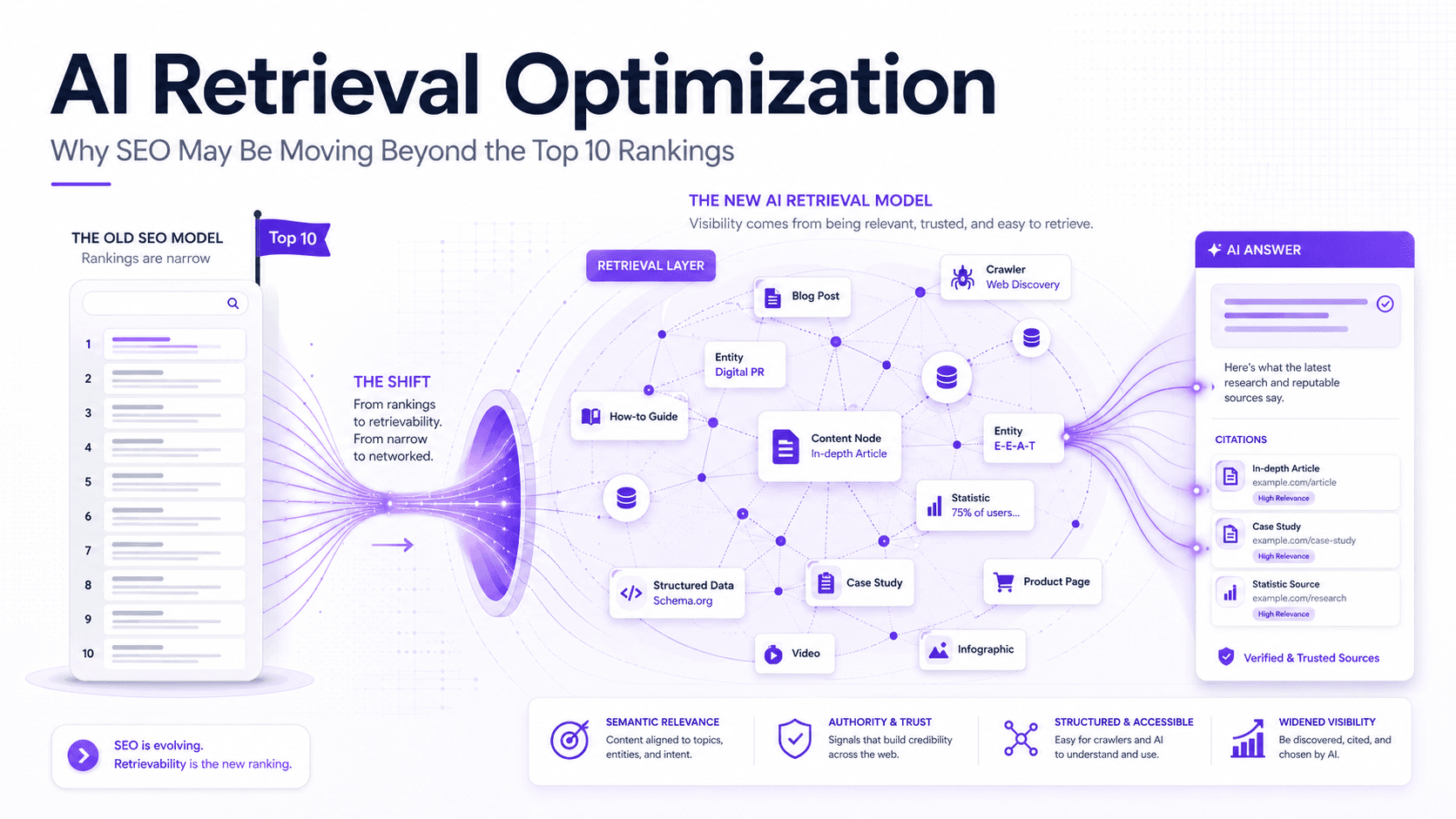
For years, SEO had a blunt, easy-to-grade objective: land in the top 10. Teams chased positions, piled on links, and tweaked pages to outrun the handful of rivals visible on page one. The whole thing was measurable, competitive, and overwhelmingly about rank.
That framing is starting to crack. Between recent court testimony and fresh Google research papers, a different center of gravity is coming into view: retrieval. The question shifts from "Can my page rank?" to "Will an AI system find this, understand it, and trust it enough to use it?" That’s the bet behind AI retrieval optimization.
What Is AI Retrieval Optimization?
AI retrieval optimization is the work of making your site easier for search engines, AI systems, and answer engines to discover, parse, understand, and reuse when they generate responses. It’s less about winning a single SERP slot and more about making your material the most eligible, citable input when a model assembles an answer.
Traditional SEO is a ranking question: does this page rise? AI retrieval optimization is a comprehension and trust question: can a machine confidently interpret it and cite it? That matters because AI-driven search, including what powers Google’s AI Overviews, isn’t just sorting links anymore; it’s synthesizing. To do that, it has to pull definitions, facts, and data from multiple sources and stitch them into one coherent output. Your page isn’t only a destination now; it’s also raw material for a larger, conversational result.
Why This Is Happening Now: The Economics of Search
This shift isn’t just philosophy. It’s tied to the messy reality of compute budgets inside Google. A recent Search Engine Land article connected two dots that matter.
- The "Ranking Window": Court testimony from a Google VP confirmed that RankBrain, a key AI ranking system, historically only analyzed the top 20-30 results for a query. The reason was mundane: running it across more pages cost too much. That created a hard cutoff. Miss the initial candidate set and the most sophisticated parts of the system never even evaluated your page.
- The Cost of Retrieval: Around the same time, Google Research published a paper on a technique called TurboQuant. Put simply, TurboQuant is designed to make vector search (the tech behind semantic, meaning-based retrieval) cheaper and more efficient. It reduces the memory and compute required to compare huge numbers of documents based on what they mean, not just which keywords they include.
To be clear, Google hasn’t said TurboQuant is live in Search, and it hasn’t announced that the ranking window has expanded. This isn’t about pinning everything on one update. It’s about incentives. If the main reason the window stayed narrow was cost, and a new technique meaningfully lowers that cost, the pressure to widen the window only grows. In that world, being "retrievable" starts to matter as much as being "rankable."
The New SEO: From Ranking-First to Retrieval-First
The old SEO playbook was mostly reactive. You’d search a keyword, scan what ranked, then publish a slightly "better" version of what was already there: more words, more sections, more backlinks. That approach assumes the top 10 is the arena, and everything outside it is irrelevant.
A retrieval-first mindset flips that assumption. Your content can get pulled into an AI system’s output before anyone cares where it sits in a classic list of links. A page sitting at position 25 might still show up in an AI Overview because it offers a clean, citable definition the top results never bothered to write down. Once you accept that, you start thinking in layers instead of a single leaderboard.
What "Beyond the Top 10" Actually Means
Moving beyond the top 10 doesn’t mean rankings stop mattering. It means rankings are no longer the only visibility layer you’re playing for.
In AI search, a page becomes valuable for reasons that don’t map neatly to a single "position". A model might pull one tight definition from your glossary, a single stat from a report, or a well-structured explanation from a page that never cracks page one. If you’ve ever watched an AI Overview cite a weirdly specific source you’ve never heard of, you’ve already seen this in the wild.
So the SEO goal expands. You’re not only trying to rank for one keyword. You’re trying to become a reliable source across many retrieval moments, the little times an AI system goes looking for something quotable, checkable, and easy to stitch into an answer.
What Makes Content Retrieval-Friendly?
Retrieval-friendly content isn’t synonymous with long or "comprehensive." It’s content a machine can break apart into reliable, reusable, citable pieces. That means writing for understanding, not just for keyword coverage. If you’ve ever gone hunting for a straight answer and found it buried halfway through a 3,000-word post, you’ve already felt the pain point AI systems are trying to eliminate. Here’s what tends to hold up.
1. Clear Entity Coverage
A machine has to be confident about what your page is actually about. Don’t gesture at "SEO" in the abstract; name the related concepts, systems, tools, and people explicitly. That’s entity-first SEO in practice. Dropping in concrete entities like Google Search, RankBrain, vector search, AI Overviews, and semantic retrieval gives an AI the context it needs to classify the page correctly. Done well, this isn’t keyword stuffing; it’s specificity.
2. Direct, Answer-First Sections
Lead with the answer, not the runway. If you change only one thing about how you structure content, make it this. AI systems want the point quickly, and so do readers. Write headings that ask a real question, then make the first sentence underneath it an actual answer.
Bad: A long, winding paragraph that eventually defines a term. Good: What is semantic retrieval SEO? Semantic retrieval SEO is the practice of optimizing content to be understood and surfaced by search systems that prioritize meaning and user intent over exact keyword matches.
3. Citable, Specific Paragraphs
AI systems don’t like quoting fog. If a paragraph reads like marketing copy, it’s harder to lift as a clean citation. Write so each paragraph could stand on its own as a blockquote. Skip filler like "The digital landscape is always changing." Swap it for claims that are specific and checkable: "A 2026 study by Digitaloft found that the presence of AI Overviews lowered the click-through rate of the #1 organic result by 34.5%." That’s the kind of sentence an AI can repeat without blushing.
4. Technically Accessible Content
None of the above matters if crawlers can’t reach the content in the first place. Key material should be rendered on the server, not tucked behind complicated JavaScript flows that require user interaction. Check that your robots.txt isn’t blocking important AI bots like ChatGPT-User or ClaudeBot. And don’t stash critical information inside images or videos without text alternatives or transcripts.
See which AI bots are crawling your site with Vizup
How to Start Optimizing for AI Retrieval
Moving from ranking-first to retrieval-first doesn’t require you to toss out SEO fundamentals. It’s a layer on top of what already works, with a different set of failure modes. Start here.
Build Topic Pages Around Entities, Not Just Keywords
Instead of publishing a dozen thin posts to cover every long-tail variation, build one strong page around the core entity. A serious page on "AI retrieval optimization" should naturally cover adjacent concepts like semantic search, answer engine optimization, and AI crawler visibility. That kind of density creates topical depth that reads as authority to humans and machines alike, and it maps to the idea that organic marketing is beyond SEO.
Add Original Viewpoints and Data
If your page is just a cleaner rewrite of the top five results, an AI has little reason to cite it, it can generate that summary on demand. Originality is what makes you worth retrieving. Bring a framework, a checklist, proprietary platform data, expert commentary, or a small case study. The goal is to become a source, not just another document in the pile. That matters even more when you’re optimizing for LLM referral traffic: you need to offer something the model can’t conjure from everyone else’s work.
Use Structured Data Carefully
Schema markup helps machines understand what kind of page they’re looking at. It won’t magically lift rankings, but Article, BreadcrumbList, and Organization schema can make your structure and provenance clearer. Don’t build a strategy around rich results Google has deprecated, like leaning on FAQPage schema alone. Use structured data for clarity, not as a bet on a particular SERP treatment.
See How AI Systems Actually Read Your Site
You can’t optimize what you can’t observe. Plenty of AI and search bots don’t execute JavaScript, and many won’t show up cleanly in tools like GA4. Your most dependable record is still server logs. That’s where you’ll see whether Googlebot, ChatGPT-User, and PerplexityBot are crawling the pages you care about.
For a lot of marketing teams, this is the hidden failure point. A pillar page can look "done" in a CMS, but if AI crawlers aren’t fetching it, it may as well not exist. Vizup is aimed squarely at that gap. Instead of guessing, you can see which pages AI systems are retrieving, what they’re spending time on, and where your visibility drops off. It turns AI search optimization from a theory project into something you can measure. If you’re serious about staying visible, AI crawler traffic isn’t trivia; it’s table stakes.
Measure AI search visibility with Vizup
The Takeaway: Prepare for a Wider Field
SEO’s footing is shifting. A strategy built purely around winning a top-10 slot is starting to look incomplete. If semantic retrieval keeps getting cheaper, the set of pages that can be evaluated (and then pulled into AI-generated answers) gets bigger. The winners will be the brands that plan for retrieval, not just rank.
Make your content accessible to crawlers. Write it for clarity. Put answers where they’re easy to lift. Add original, citable value. And verify that the systems you’re trying to influence are actually seeing your work. The next phase of SEO won’t be about beating 10 blue links; it’ll be about being the most credible, useful, retrievable source among thousands.
Frequently Asked Questions
How does AI retrieval optimization differ from traditional SEO?
Traditional SEO is centered on earning a high position (like the top 10) in organic results. AI retrieval optimization is centered on making content easy for AI systems to locate, interpret, and cite, even if that citation happens independently of where the page sits in classic rankings.
Has Google confirmed that the "ranking window" is expanding?
No. Google hasn’t officially announced an expansion of the deep-learning ranking window. What we do have is court testimony confirming the window existed and was constrained by cost, plus research like TurboQuant that points toward cheaper retrieval, making a wider window a logical outcome.
What is semantic retrieval in SEO?
Semantic retrieval is how search engines locate relevant content based on the meaning and intent behind a query, rather than exact keyword matching. It depends on techniques such as vector search to understand relationships between concepts.
How do I verify whether AI bots are crawling my site?
Check your server logs. Many AI crawlers won’t reliably appear in standard analytics platforms, so logs are the closest thing to a source of truth. Tools like Vizup focus specifically on tracking and analyzing this AI bot traffic.
Does this mean keywords and backlinks don’t matter anymore?
No. Keywords still signal relevance, and backlinks remain a strong authority signal. AI retrieval optimization adds another layer on top of solid SEO fundamentals rather than replacing them. You still need to focus on improving search rankings.
