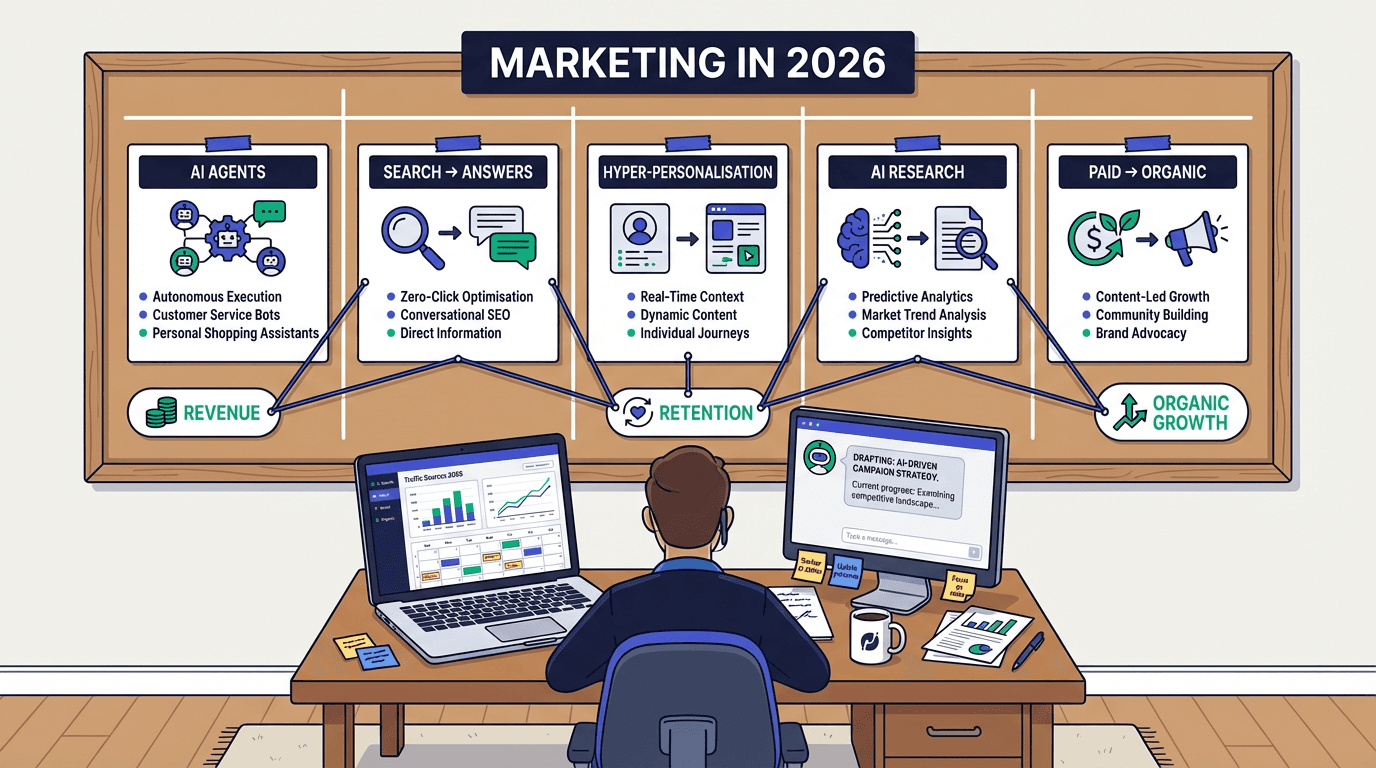
Most “AI marketing trends” lists read like vendor brochures. I’m going to do the opposite: five trends I actually believe in for 2026, because I’ve watched them change how real teams plan, publish, and measure growth. If you’re tracking AI marketing trends 2026 because you need results, not jargon, this is the short list that matters.
Why this matters right now (and why I’m picky about “trends”)
2026 is the year marketing teams stop asking “Should we use AI?” and start asking “What should AI do, and what should humans own?” That shift is happening because the easy wins are gone. Everyone can generate a blog post. Everyone can spin up ads. Everyone can summarize customer calls. The differentiator is operational: who can turn insight into shipping, consistently.
So my bar for a “trend” is simple. It has to change one of these: how you decide what to make, how fast you can ship it, how you earn attention, or how you prove it worked. If it only changes your prompts, it’s not a trend. It’s a party trick.
A quick comparison: the 5 trends, what they replace, and what to measure
| Trend (2026) | What it replaces | What to measure weekly | Common failure mode |
|---|---|---|---|
| 1) AI agents as marketing operators | One-off automations and “prompt libraries” | Cycle time from idea to publish, backlog burn-down, QA defect rate | Agents ship content that is fast but off-brand or unverified |
| 2) Search shifts from rankings to answers | SEO as a keyword-to-blog factory | Share of citations/mentions, branded search lift, assisted conversions | Chasing SERP positions while losing visibility in AI answers |
| 3) Hyper-personalization that starts with prediction | Segment blasts and static nurture tracks | Offer acceptance rate, time-to-first-value, churn by cohort | Personalization that feels creepy or breaks trust |
| 4) Synthetic research becomes the first draft of strategy | Weeks of manual competitive scans | Time to insight, win/loss themes, content gaps closed | Treating synthetic output as truth instead of a hypothesis |
| 5) Measurement moves to incrementality and causal proof | Last-click attribution and vanity dashboards | Incremental lift tests, holdouts, LTV by channel | Optimizing what is easy to track, not what drives growth |
| Use this table as a planning artifact. If you cannot name the metric, the trend will not survive budgeting season. |
1) AI agents become marketing operators, not assistants
In 2024 and 2025, most teams used AI like a better intern: write this, summarize that, generate some variants. In 2026, the teams pulling ahead are using agents as operators. That means the system does multi-step work across tools with a goal, constraints, and a definition of done.
Here’s the part people miss: an agent is only valuable if it reduces coordination cost. The biggest drag on marketing is not writing, it’s the handoffs. Briefs, revisions, approvals, analytics checks, repurposing, internal linking, publishing, then reporting. Agents compress that chain.
What I’ve seen work in practice (and what I’d implement first):
- A “content operator” agent that turns a topic into a publish-ready package: outline, draft, internal links, meta title/description, and a measurement checklist.
- A “refresh operator” agent that scans existing posts monthly, flags decaying pages, proposes updates, and drafts the change set.
- A “distribution operator” agent that repurposes a single asset into channel-specific formats, then schedules them with tracking parameters.
The hard line I draw: agents should not be autonomous publishers for most brands. They should be autonomous doers with human sign-off. If you skip that, you will eventually publish something untrue, off-tone, or legally risky, and you will deserve the consequences.
This is where platforms matter. Tools that only generate text are becoming commodities. The value is in systems that connect planning, creation, optimization, and measurement into one workflow. If you want the organic angle on this shift, our take on organic marketing beyond SEO in 2026 explains why distribution and brand signals are now part of “organic,” whether we like it or not.
2) Search stops being a rankings game and becomes an answers game
I still care about SEO. I just don’t worship rankings anymore. AI-driven discovery is changing what it means to “win” a query. You can be position three and still be invisible if the answer engine summarizes the category without citing you. You can also be position nine and get the only citation that matters.
My opinionated take: the new SEO is “search presence.” It includes classic on-page work, but it also includes being the source that answer engines want to quote. That pushes you toward original data, clear definitions, strong entity signals, and content that resolves the query without fluff.
What I would measure instead of obsessing over rank trackers:
- Citation share across AI answers for your core topics (manual sampling is fine if you are consistent).
- Branded search volume and direct traffic trend, because brand is the hedge against channel volatility.
- Assisted conversions from organic content, not just last-click signups.
This trend is uncomfortable because it removes the illusion of control. You can “do SEO” perfectly and still lose distribution if you are not a trusted source. That is not a reason to quit. It is a reason to stop publishing filler and start publishing assets that deserve to be referenced.
3) Hyper-personalization shifts from segmentation to prediction
Personalization used to mean “Hi {first_name}.” Then it became segmentation. In 2026, the real shift is predictive: using behavior signals to surface the right offer before the customer goes looking for it.
Prediction is powerful, but it can also feel invasive. The brands that win will be the ones that personalize based on intent signals, not personal secrets. If someone reads three pages about “AI content briefs,” it is fair to show them a template. If you infer something sensitive and act on it, you are playing with fire.
A practical implementation order that avoids the creepiness trap:
- Start with on-site personalization tied to explicit behavior (pages viewed, features clicked, trial milestones).
- Add predictive scoring for next-best content, not next-best discount.
- Only then connect it to offers, and keep a clear opt-out and preference center.
Also, personalization is not a substitute for positioning. If your message is vague, personalizing it just makes the vagueness arrive faster.
4) Synthetic research becomes the first draft of strategy (not the final answer)
I believe synthetic research is one of the most underrated AI marketing trends 2026 because it saves the scarcest resource: senior thinking time. The trick is using it as a starting point, then validating with reality.
Here’s a real pattern I’ve watched: a team spends two weeks compiling competitor notes, then the doc dies in a folder. Synthetic research flips that. You can generate a structured competitive snapshot in hours, then spend your human time on the only parts that matter: customer truth and strategic choices.
The failure mode is obvious: treating the synthetic output as fact. Models are good at plausible synthesis. They are not inherently good at truth. The fix is process. Require citations to specific pages, quotes, or internal data. Require a “what would change my mind” section. Require a quick validation loop with sales calls or support logs.
5) Measurement shifts from attribution theater to incrementality
AI makes content cheaper. It also makes bad measurement more expensive, because you can now produce a lot of “performance” that is just noise. If you are not careful, you will scale activity, not outcomes.
This is the trend I’m most stubborn about. Last-click attribution is not “wrong,” it’s incomplete, and it gets worse as journeys fragment across answer engines, communities, and private sharing. Incrementality testing, holdouts, and causal approaches are how you keep your budget honest.
What I’d put in a 2026 measurement minimum standard:
- Run at least one holdout test per quarter for a major channel or campaign.
- Track cohort retention and LTV, not just signups, especially for product-led funnels.
- Separate leading indicators (engaged sessions, qualified clicks) from lagging indicators (revenue, expansion) so you do not panic mid-cycle.
This is also where “AI dashboards” can mislead. If your model optimizes to what you measure, it will find shortcuts. If you measure the wrong thing, the AI will get very good at being wrong faster than a human ever could.
The strongest counterargument: “This is just hype, and humans will keep doing marketing”
I get the skepticism. A lot of AI marketing output is generic, and a lot of teams are quietly embarrassed by what they published in 2024. The counterargument goes like this: great marketing is taste, empathy, and narrative, and machines do not have those. Therefore, the “AI trend” is mostly hype.
My response: humans will absolutely keep doing marketing, but the job description is changing. The human advantage is still taste and judgment. The human disadvantage is throughput and consistency. Agents, predictive systems, and synthetic research are not replacing taste. They are clearing the operational sludge so taste can show up more often.
What this means for your 2026 plan (a founder’s checklist)
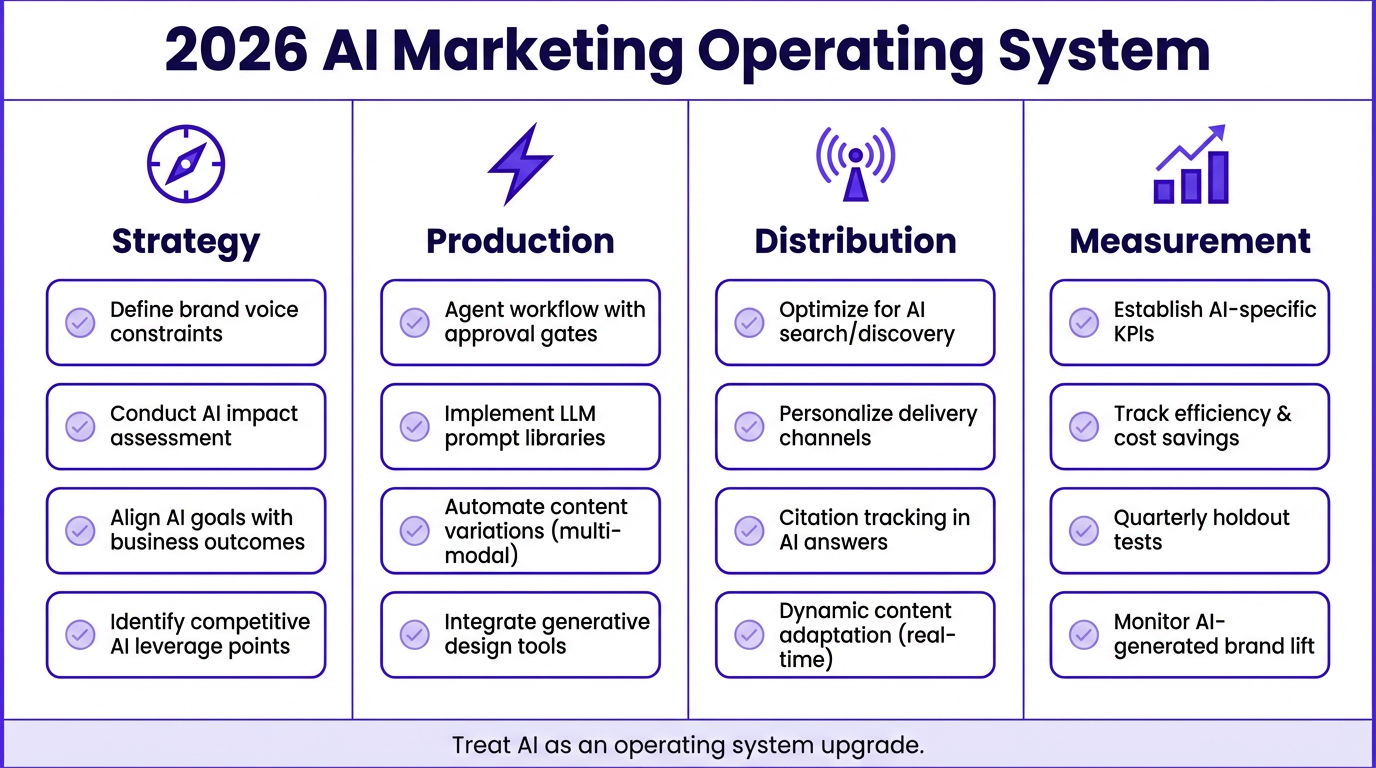
If I were advising a team in the US or India with a real pipeline target and a small team, I’d focus on sequencing. Doing all five trends at once is how you end up with five half-built systems and zero confidence.
A practical sequence that works in many B2B and prosumer cases:
- Weeks 1 to 2: Build your measurement minimum standard (incrementality, cohorts, leading vs lagging indicators).
- Weeks 3 to 6: Implement one agent workflow end-to-end (content operator or refresh operator) with human approval gates.
- Weeks 7 to 10: Update your search presence strategy around answers and citations, then refresh your top 10 money pages accordingly.
- Weeks 11 to 14: Add predictive personalization for content and onboarding, then expand to offers only after trust and opt-outs are solid.
- Ongoing: Use synthetic research monthly to keep strategy current, then validate with customer conversations.
One blunt aside: if your team cannot say no, AI will not save you. It will amplify your chaos. Pick a narrow workflow, make it reliable, then expand.
FAQ
What is the single biggest AI marketing trend for 2026?
Agents that act as operators, not assistants. They reduce cycle time across planning, drafting, QA, publishing, and reporting, as long as you keep human approval gates.
How should I adapt SEO to AI-driven search in 2026?
Stop treating SEO as a keyword factory. Build “search presence” by publishing cite-worthy assets, tracking citations in AI answers, and strengthening brand demand so you are not dependent on one channel.
Is hyper-personalization worth it for smaller teams?
Yes, if you start with intent-based signals and keep it simple. Begin with on-site and in-product personalization tied to behavior, then add prediction, then connect to offers.
How do I keep synthetic research from misleading my strategy?
Make it a hypothesis generator. Require source citations, add a validation checklist, and confirm key claims with customer calls, support logs, and analytics before you act.
Where does Vizup fit into these trends?
Vizup is built for AI-powered organic marketing operations, especially turning strategy into consistent shipping and measurable outcomes. If you want the bigger picture on how organic is changing, start with our perspective on organic marketing beyond SEO in 2026.
Closing: my bet for 2026
My bet is that 2026 rewards teams that treat AI as operations, not decoration. The five AI marketing trends 2026 I believe in are not shiny features. They are shifts in how work gets done: agents that run workflows, search optimized for answers and citations, predictive personalization, synthetic research with validation, and measurement that proves incrementality.
These trends show that AI is becoming the infrastructure for modern marketing teams. The goal isn't just to automate tasks, but to build a system that connects strategy to real business outcomes. If your team is ready to move beyond isolated tools and build a true visibility operating system, you can explore how Vizup turns these AI marketing trends for 2026 into a reality.
If you do this well, you will ship more, learn faster, and waste less. If you do it poorly, you will publish more noise, annoy more customers, and build dashboards that congratulate you while growth stalls. The gap between those outcomes is not the model. It’s your operating system.
