Content marketing in the AI search era means creating, structuring, and distributing content so it earns citations in AI-generated answers, large language model outputs, and traditional search results simultaneously. The goal shifts from winning a page of blue links to becoming the source an AI response trusts enough to cite. A content marketing AI search strategy now sits at the center of every serious organic growth plan, and the teams that understand this shift are pulling ahead.
The stakes are straightforward: most search experiences now include an AI layer, and content that is not built for LLMs can vanish from view even if your domain authority is strong. What used to be an SEO-first motion is now dual optimization for both crawlers and generative systems. Teams that adjusted early are already capturing a disproportionate share of AI citations, while those still running a traditional-only playbook are watching their visibility erode in AI Overviews, Bing Copilot, Perplexity, and ChatGPT. Monitoring where your brand appears (or does not appear) across these AI answer surfaces is no longer optional. It is the feedback loop that separates informed strategy from guesswork.
Content Marketing AI Search in 2026
Key data points shaping content marketing in 2026:
- AI tools are now integral to content marketing workflows, with many teams using them for research, ideation, drafting, and optimization.
- A significant portion of search queries now end without a click to an external website, as users get answers directly from AI Overviews and other SERP features.
- High-performing content teams are creating dedicated roles for AI content strategy and prompt engineering to adapt to new search behaviors.
- Content optimized for answer engines and AI citations gains more visibility in generative responses than content focused only on traditional SEO.
- Google's own guidance emphasizes that structured data and clear, citable content are foundational for visibility across both traditional and AI-powered search results.
These numbers are already reshaping workflows and outcomes. The sections that follow break down what changed, how the new discipline operates, and why some teams rack up citations while others get left out of the answer layer entirely.
Why Content Marketing Had to Change
From roughly 2015 to 2023, content marketing was tuned for PageRank-era signals: backlinks, keyword density, SERP features, and click-through rates. The playbook assumed a person would scan a results page and click through to a site. For more than a decade, that model worked.
Generative search snapped that loop. Google AI Overviews, Bing Copilot, Perplexity, and ChatGPT with browsing now assemble answers from multiple sources and often satisfy the query without a click. In that world, AI visibility depends on being the source the model trusts and cites, not merely the page sitting in position one. The old cycle (publish, rank, earn traffic, measure conversions) misses a growing share of impact because more people consume your content secondhand, filtered through an LLM summary. Understanding how AI grounding differs from traditional indexing helps explain why yesterday's signals are no longer enough on their own.
Answer Engine Optimization (AEO) showed up to close that gap. Google Search Central's documentation on structured data frames structured markup and clear, citable content as essential for appearing in search experiences that synthesize answers from multiple sources, including AI Overviews. While Google does not use the terms "AEO" or "GEO" in its own documentation, the practices these labels describe (structured data, passage-level clarity, entity consistency) align directly with what Google recommends for surfacing content in generative results. These disciplines are not substitutes for SEO; they are additions you now need if you want to show up inside synthesized answers.
How Content Marketing for AI Search Actually Works
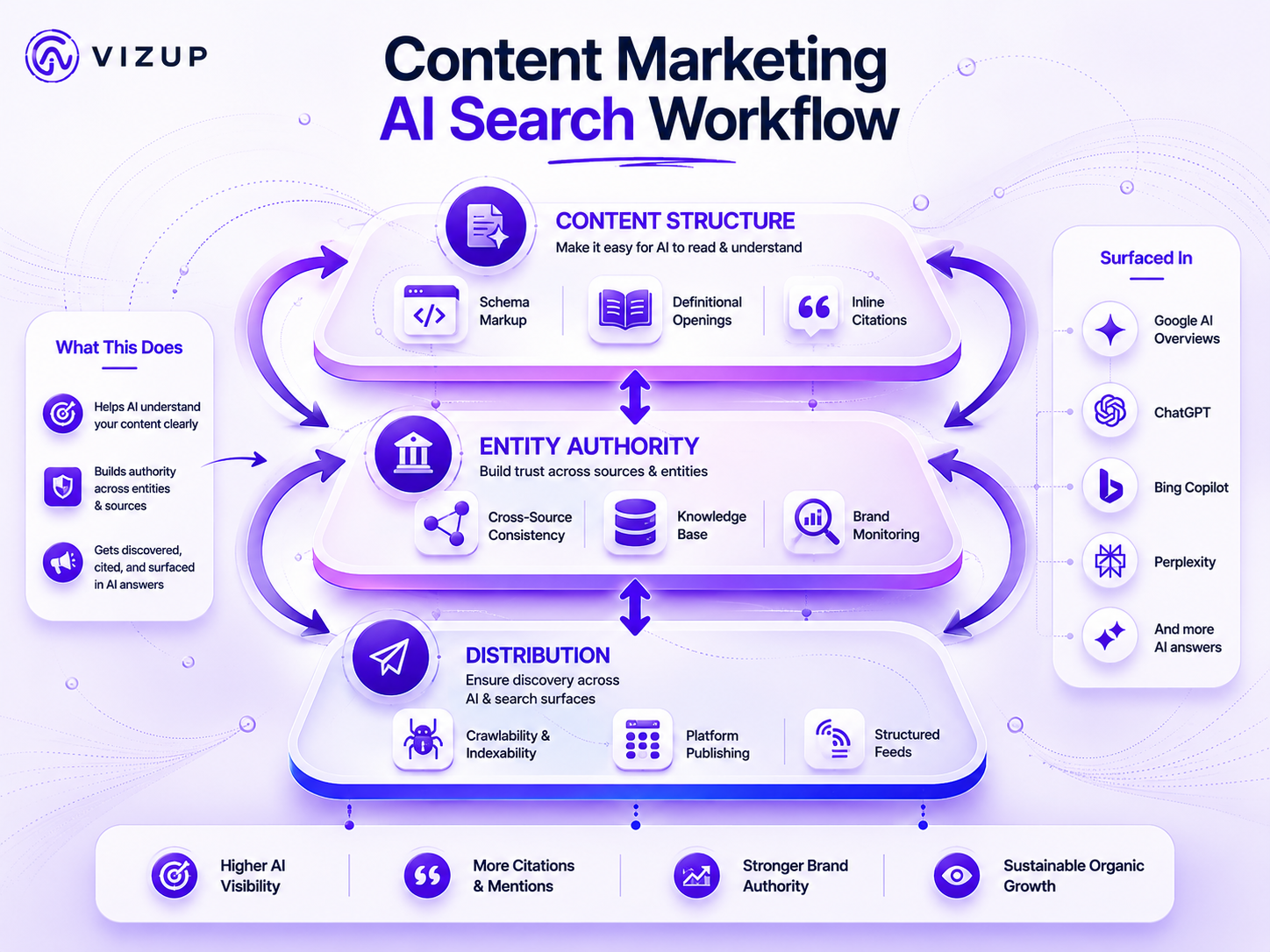
There is no single trick here. This is a workflow that runs through how you write, how you describe entities, and where you publish. Three connected disciplines make the whole thing work.
Structuring Content for LLM Consumption
LLM-based systems do not read pages the way classic crawlers do. They reward clearly attributed claims, consistent entity naming, and passages that stand on their own, rather than broad keyword coverage spread across an entire page. You can rank well in traditional search and still get skipped by a generative engine if your claims are hard to verify or your structure forces the model to guess what matters.
In practice, that looks like tightening each section around a crisp definition, adding structured data (FAQ, HowTo, speakable markup), cutting filler in favor of factual density, and placing citations inline so provenance is obvious. The original GEO research paper shows that GEO methods can increase visibility in generative engine responses. The arXiv paper says GEO can boost visibility by up to 40%. If you want a quick read on whether a page meets the bar, Vizup's AI Content Checker scores content from an AI-readability angle, flagging gaps in structure and citation density that directly affect whether answer engines pick up your content.
Building Entity Authority Across AI Surfaces
Models form their understanding of brands and topics by reconciling signals across sources. When your brand shows up with consistent claims, credentials, and context across your site, third-party coverage, and structured data, you become easier to represent and more likely to be cited. When those details drift (say, one description on your site and a different one on a review platform), the model's picture of you gets fuzzier, and citation probability drops.
Operationally, that means keeping a living knowledge base, pursuing co-citation with authoritative entities in your category, and checking how models currently describe your brand. Vizup's Answer Engine Monitoring is built for exactly that purpose, surfacing where and how your brand is cited (or missing) across AI answer surfaces so you can act on gaps in real time. The platform tracks citation frequency, mention accuracy, and inclusion rates across Google AI Overviews, Bing Copilot, Perplexity, and ChatGPT, giving content teams the data they need to strengthen entity authority systematically. For the broader playbook on entity authority, improving brand visibility in AI search walks through the process end to end.
Distribution That Feeds the Model Layer
Social, email, and syndication still do the job of reaching people. AI-era distribution adds another requirement: your content has to be reachable by the retrieval pipelines that feed LLMs. That pushes you toward crawlable pages (not aggressive paywalls or JavaScript-only rendering), publishing on platforms models tend to ingest, and using structured feeds where possible. If your content sits behind a login or only renders client-side, topical authority will not save you from being ignored by answer engines. For the concrete checklist, see how to make content discoverable in AI engines.
A Real Example: HubSpot vs. NerdWallet in AI Answers
Run a query like "best CRM for small business" in an AI Overview and you will usually see two citation styles emerge. HubSpot's structured product pages, with clear entity markup and consistent feature descriptions, tend to get pulled in for product facts: pricing tiers, feature lists, integration counts. NerdWallet's editorial comparison pages, built around cross-linking and evaluative depth, more often show up for context: which CRM fits which use case, trade-offs between platforms, and buyer considerations.
Same query, different jobs, different winners. HubSpot owns the "what does this product do" lane. NerdWallet owns the "which option should I choose" lane. That is the point: a content marketing AI search strategy is not one-size-fits-all. Your content type shapes your citation pathway, and why organic marketing is beyond SEO helps clarify which lane to prioritize. Tracking where your brand lands across these citation pathways is one of the core use cases for AI search visibility management tools. Without that tracking layer, you are optimizing blind.
What Content Marketing in the AI Search Era Is Not
Misconception 1: "It's just SEO with a new name." Traditional SEO is largely about ranking position. Content marketing for AI search is about citation probability inside a generated answer. That changes what you measure (citation frequency and mention share vs. rank position), how you interpret movement (model representation vs. SERP shifts), and what formats win (passage-level clarity vs. page-level keyword targeting).
Misconception 2: "AI will just scrape my content, so why bother?" Models do not pull from sources at random. They weigh authority, recency, and structural clarity. Research on Generative Engine Optimization (GEO) found that optimizing content with statistics, citations, and a more authoritative tone can boost visibility in AI answers by up to 40% (Aggarwal et al., 2023). Sloppy or unsubstantiated content does not get stolen; it gets skipped.
Info: Misconception 3: "You need to create AI-specific content." The content that performs best still works for human readers and AI retrieval at the same time. The difference is structure and metadata, not writing for robots. AI-readiness is a layer you add to content that already earns trust with people.
Monitoring What You Cannot See on a SERP
The frustrating part of content marketing in 2026 is that you cannot just check a ranking and call it a day. AI-generated answers do not have a stable position. You are either cited, paraphrased, or missing, and traditional rank trackers do not tell you which bucket you are in. AI citation tracking has become a distinct discipline, separate from rank monitoring, and it requires purpose-built tooling.
That is why presence monitoring has moved from "nice to have" to required. Vizup tracks brand mentions, citation frequency, and answer inclusion across AI answer surfaces, including Google AI Overviews, Bing Copilot, Perplexity, and ChatGPT. This restores the visibility feedback loop that disappeared when the SERP turned into a synthesis layer. Competitors like TryProfound and Search Atlas cover adjacent ground in the broader SEO and visibility space, but Vizup's monitoring-first approach (tracking AI citations, mention share, and entity accuracy rather than only traditional rankings) is what separates content marketing AI search measurement from legacy analytics. For a full comparison of platforms, see this roundup of AI search visibility management tools.
Traditional vs. AI-Era Content Marketing Metrics
The shift from traditional SEO to content marketing for AI search changes what you measure and how you interpret performance. The table below maps each legacy metric to its AI-era counterpart, along with the reason the shift matters.
| Traditional Metric | AI-Era Metric | Why It Changed |
|---|---|---|
| Keyword Rankings (position on SERP) | Answer Inclusion (cited inside AI-generated responses) | A page can rank #1 and still be absent from the AI Overview. Inclusion in the synthesized answer is the new visibility benchmark. |
| Organic Traffic (sessions from search) | AI Visibility (brand presence across AI answer surfaces) | Zero-click answers mean users consume your content without visiting your site. Measuring traffic alone misses this growing share of reach. |
| Click-Through Rate (CTR from SERP) | Mention Share (% of relevant AI answers that cite your brand) | When the answer appears directly in the search interface, clicks drop. Mention share captures influence even when no click occurs. |
| Keyword Positions (tracked across SERPs) | Citation Frequency (how often your content is cited by LLMs) | Positions fluctuate by device and location. Citation frequency reflects how reliably models trust and surface your content. |
| Backlinks (links from other domains) | Entity Authority (cross-source consistency and co-citation signals) | LLMs weigh entity coherence across the web, not just inbound link counts. Consistent entity data strengthens citation probability. |
Traditional metrics still matter for the portion of traffic that flows through classic search. The point is not to abandon them but to layer AI-era metrics on top. Vizup's Answer Engine Monitoring provides the citation frequency, mention share, and answer inclusion data that traditional rank trackers cannot, giving content teams a complete picture of performance across both search paradigms.
Key Takeaways
- Content marketing in the AI search era means optimizing for citation inside AI-generated answers, not just traditional rankings.
- Generative engine optimization (GEO) and AEO are the tactical disciplines that make this work. The practices they describe align with what Google Search Central recommends for surfacing content in generative results.
- Structure, entity consistency, and source authority matter more than keyword volume for earning LLM search citations.
- You need dedicated monitoring for AI search visibility. Traditional rank trackers do not cover the synthesis layer, and tools like Vizup fill that gap by tracking citations, mention share, and answer inclusion across AI surfaces.
- The best content still serves human readers first; AI-readiness is a structural layer, not a content compromise.
Frequently Asked Questions
How does content marketing for AI search differ from traditional SEO content marketing?
Traditional SEO content marketing is built around ranking on a results page and measuring outcomes through CTR and organic traffic. Content marketing for AI search is built around earning citations inside synthesized answers from systems like Google AI Overviews, Bing Copilot, Perplexity, and ChatGPT. The measurement shifts from rank position to citation frequency and mention share, and the writing shifts from page-level keyword targeting to passage-level factual clarity. Both disciplines coexist, but AI search optimization adds a layer that traditional SEO alone does not address. Tools like Vizup make this measurable by tracking where and how often your brand is cited across AI answer surfaces.
What is generative engine optimization (GEO) and how does it relate to AEO?
Generative engine optimization focuses on structuring content so AI systems can reliably include and cite it in generated responses. AEO (Answer Engine Optimization) is a closely related term that emerged earlier and emphasizes winning placement on answer surfaces like featured snippets, answer boxes, and AI summaries. Google Search Central documentation treats structured data and clear, citable content as foundational for appearing in search experiences that synthesize answers, which aligns with the core practices of both GEO and AEO. While Google does not use these specific terms, the underlying recommendations (structured markup, entity clarity, passage-level precision) map directly to what GEO and AEO practitioners do. In practice they overlap significantly, with GEO leaning more toward structural optimization for LLMs and AEO leaning more toward the answer surface itself.
Can existing blog content be optimized for LLM search without rewriting it entirely?
In many cases, yes. A lot of pages only need structural fixes: add concise definitions at the start of sections, embed structured data markup (FAQ, HowTo, speakable), include inline citations with named sources, and keep entity naming consistent throughout. A full rewrite is typically only needed when the original piece is light on verifiable facts or padded with filler. Vizup's AI Content Checker flags the specific gaps between your current content and what answer engines look for, so you can prioritize fixes rather than starting from scratch.
How do you measure AI search visibility if there are no traditional rankings to track?
You measure it with tools that monitor citations and mentions inside AI-generated answers across platforms like Google AI Overviews, Bing Copilot, Perplexity, and ChatGPT. Vizup's Answer Engine Monitoring reports citation frequency, entity mention accuracy, mention share, and answer inclusion rates across these surfaces. This gives content marketers a feedback loop that traditional rank trackers cannot provide, showing exactly where your brand appears (or is absent) in the AI answer layer. Without this data, you are making optimization decisions without knowing whether they are working.
Will AI search make organic content marketing obsolete by 2026?
No. AI search changes distribution, not the underlying value of authoritative content. Models still rely on high-quality sources to produce accurate answers, which makes well-structured, trustworthy content more important than ever. What changes is the operating model: content needs to be structured for retrieval, optimized for citation, and monitored in the answer layer, not just published and tracked through rankings. The teams that treat AI-readiness as an added layer (rather than a replacement for quality) are the ones gaining ground. Vizup helps close the loop by showing you how AI systems actually represent your brand, so you can refine both content and strategy based on real citation data.
