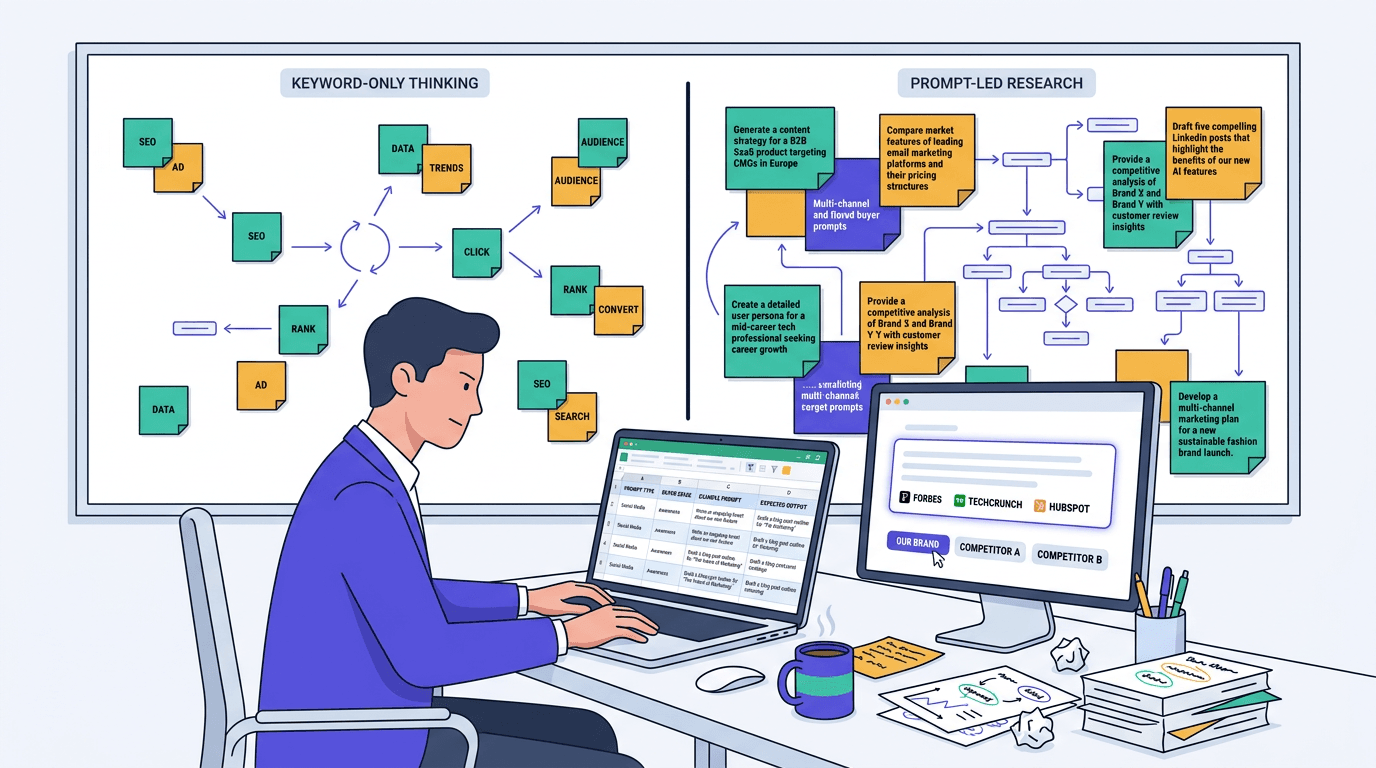
Buyers are already asking ChatGPT, Gemini, Claude, Perplexity, and AI Overviews which product to buy, how to compare vendors, and what to watch out for. Traditional SEO tools were built for search boxes and short phrases, so they miss the longer, context-heavy prompts that drive modern product discovery.
That gap is why prompt research for AI search has become a core marketing skill. You are not just collecting phrases -- you are mapping real decision-making language across the AI buyer journey, then monitoring whether your brand actually gets mentioned when those questions get answered.
Six steps to replace keyword-only research with prompt-led research:
- Map buyer personas to AI search scenarios (who is asking, and why).
- Reverse-engineer real buyer-intent prompts from communities and customer conversations.
- Use LLMs to expand variations and capture prompt fan-out.
- Categorize prompts by stage (awareness, comparison, evaluation, purchase).
- Validate and prioritize with AI visibility monitoring across real prompts.
- Build a living prompt library, then track changes over time.
Why Prompt Research for AI Search Is Not Just Keyword Research with Extra Steps
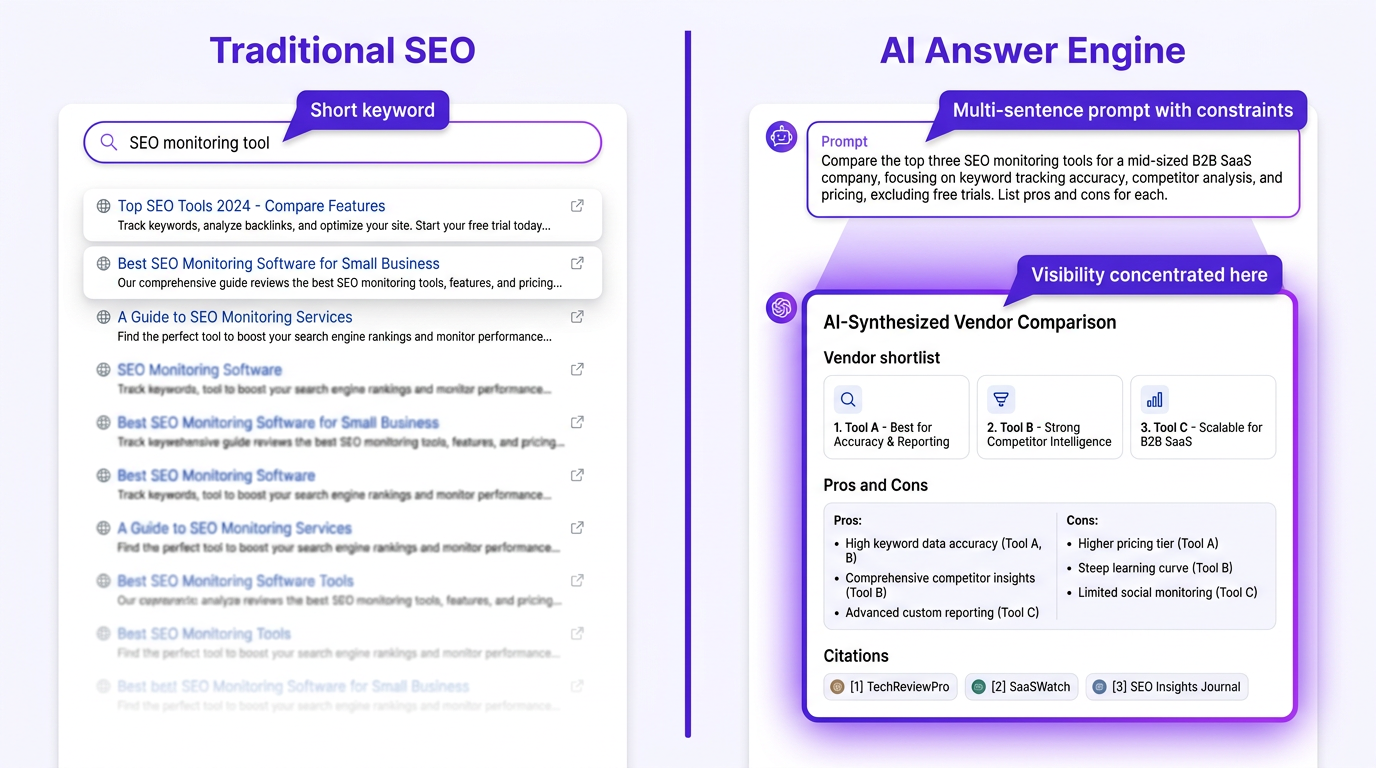
AI search prompts differ from SEO keywords in three practical ways that change how you do research and how you measure success.
How AI search prompts differ from keywords:
- Prompts carry constraints and context. A buyer does not type "SEO monitoring tool". They ask: "What is the best SEO monitoring tool for a 50-person B2B SaaS team that needs AI Overviews tracking and weekly reporting?" That context changes the answer.
- Answer engines return synthesis, not a menu of links. LLMs often provide one consolidated recommendation set, which concentrates attention. If you are not in the answer, you are invisible for that prompt.
- Prompt fan-out is real. One intent becomes dozens of natural variations (budget, stack, geography, compliance, team size). Classic AI search keyword research that tracks one phrasing undercounts the market.
Research backs up the behavior shift. Microsoft Research (2025) found that users assigned to LLM-based search completed tasks faster using fewer, more complex queries than traditional search users -- which matches what marketers see in the wild: longer prompts, fewer sessions, and faster decisions. See the study: Effects of LLM-based Search on Decision Making: Speed, Accuracy, and Overreliance.
For a broader market signal, Forrester reported that 89% of B2B buyers used genAI in at least one area of the purchasing process. That is why prompt-led research belongs in the core workflow now, not on a future roadmap. That is why prompt-led research belongs in the core workflow now, not on a future roadmap.
What You Need Before You Start
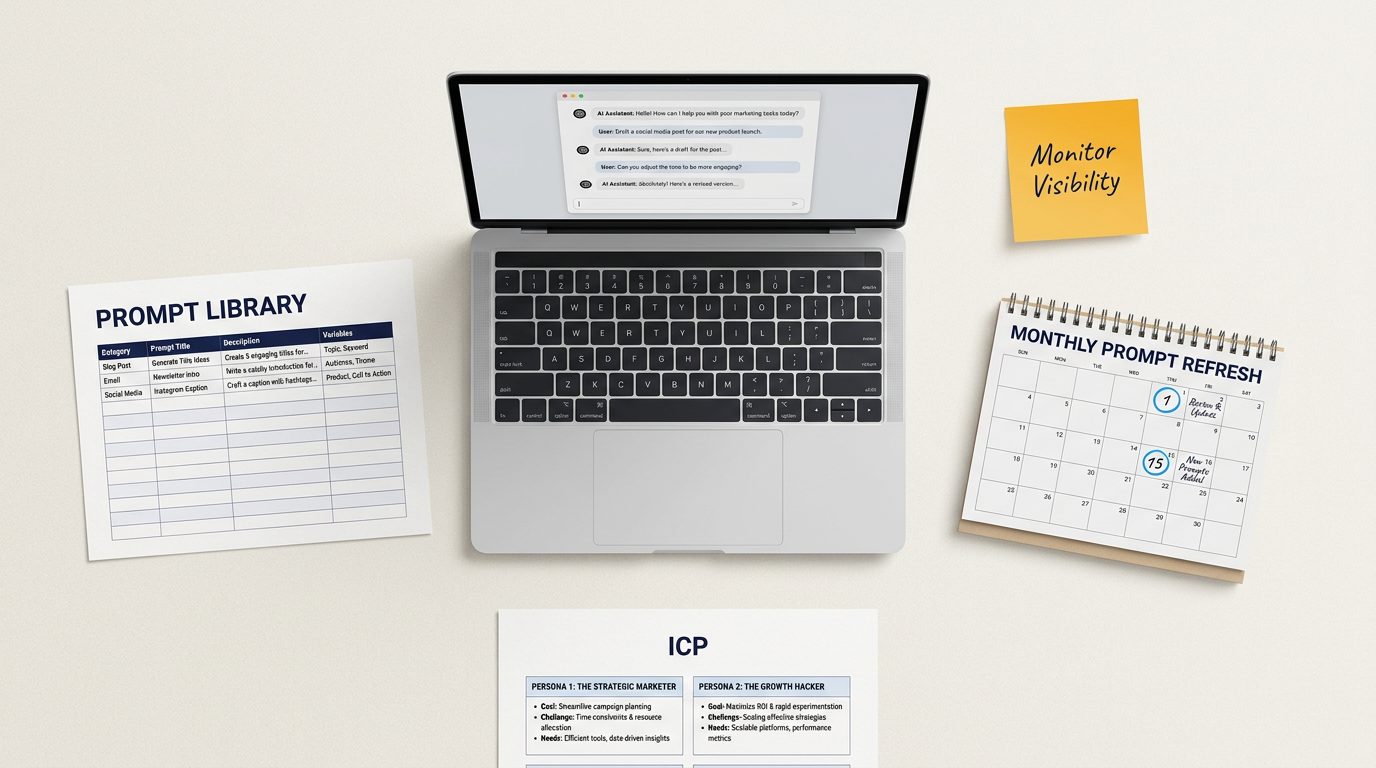
Keep the setup lightweight so you can iterate. A first pass takes a day; refinement happens monthly.
Minimum requirements:
- Access to ChatGPT (free works). Optionally add Gemini, Claude, or Perplexity for cross-model checks.
- A spreadsheet or Notion database to store AI search queries, tags, and notes.
- Your ICP and persona documentation, plus a shortlist of competitors and alternatives buyers mention in sales calls.
- An AI visibility monitoring tool to validate which prompts actually mention your brand. Vizup is designed for digital presence monitoring and answer engine monitoring, so you can track brand visibility across real buyer prompts and find prompt gaps.
Note: If your team is still aligning on why prompts matter, share how AI chatbots could replace keyword search internally. It helps stakeholders understand why old keyword-only dashboards miss new discovery paths.
Step 1: Map Buyer Personas to AI Search Scenarios
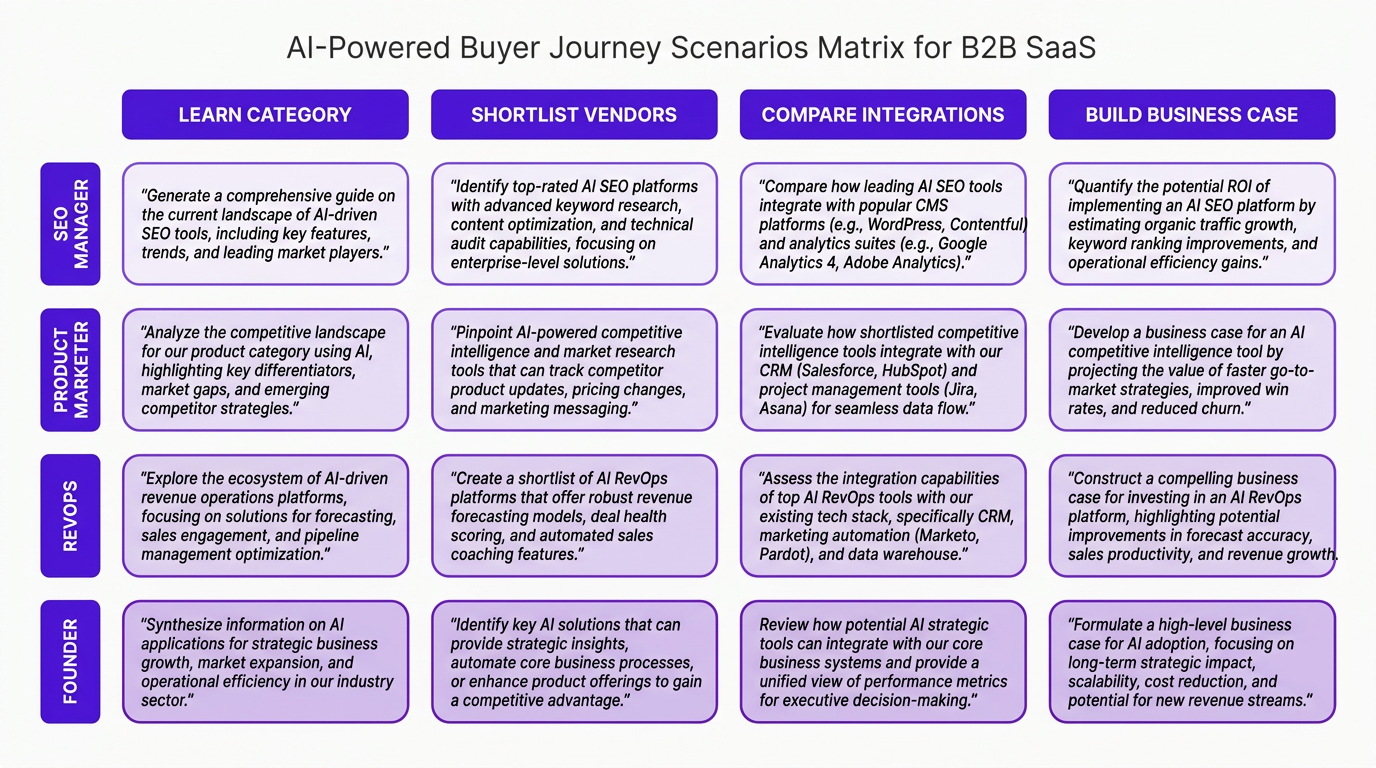
Prompt-led research starts with the buyer, not the query. Pick the 2 to 3 personas most likely to use LLMs for product research in your category, then write down the situations where they reach for an answer engine instead of a search engine.
Use this structure for each persona: role, job-to-be-done, constraints, and proof needed. Proof matters because many B2B prompts are really about internal justification, not curiosity.
Common B2B AI search scenarios to capture:
- "I am new to this category, explain it like I am onboarding."
- "Give me a shortlist that fits my stack and team size."
- "Compare vendors and call out tradeoffs."
- "Tell me what questions to ask in a demo."
- "Help me write a business case and ROI narrative for leadership."
Tip: A fast way to uncover scenarios is to ask Sales and CS one question: "What did the prospect say they already asked ChatGPT before booking this call?" Those answers become your highest-signal ChatGPT product research prompts.
Step 2: Reverse-Engineer Real Buyer-Intent Prompts from the Wild
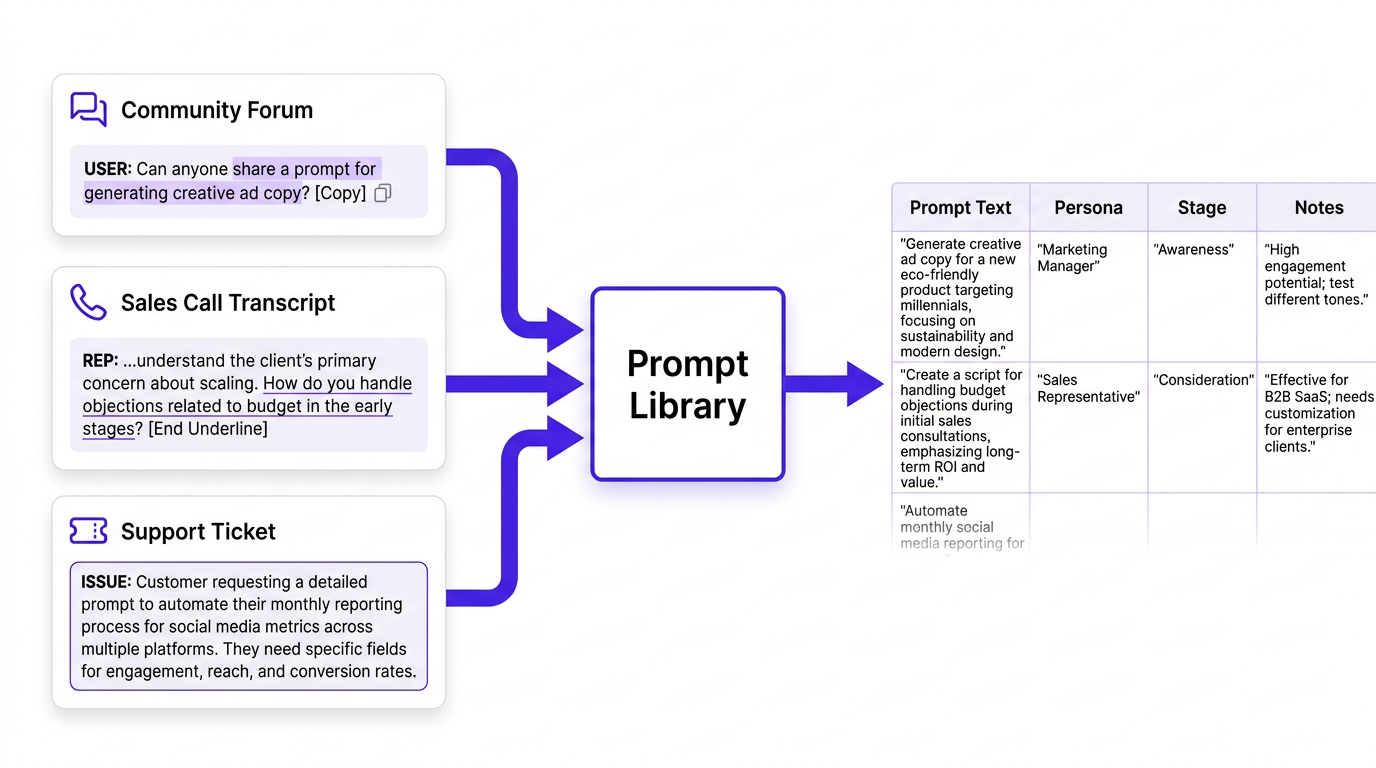
This step is where AI prompt research gets grounded. Instead of inventing prompts, you collect the exact phrasing buyers use -- including the weird constraints they add (budget caps, compliance requirements, team size, existing tools).
Mine community posts where people share their exact prompts
Look for posts that literally include the prompt text. Reddit, Quora, and niche Slack communities are full of "I asked ChatGPT..." threads where users paste what they typed and the answer they got. Save the prompt, the context, and what the user was trying to decide.
Pull prompts from your own customer conversations
Your best answer engine prompts are already in your systems. Demo request forms, call transcripts, and support tickets are full of long-form questions. People write to support the same way they prompt LLMs -- especially when they are stuck or comparing options.
What to capture for each prompt (so it is usable later):
- The full prompt text (do not shorten it).
- Persona and company context (industry, team size, maturity).
- Stage tag (awareness, comparison, evaluation, purchase).
- What the buyer is optimizing for (cost, speed, compliance, integrations, reporting).
- Any named tools or platforms they mention (their stack is part of the prompt).
For context on why full-funnel coverage matters, Verve (reported via EMARKETER, 2026) found that roughly 40% of LLM prompts are transactional and 60% informational. Tracking only purchase-stage prompts means you are invisible during the majority of the research process. You can also review Verve's analysis of LLM interactions for more context on how these conversations map to intent.
Step 3: Use LLMs to Expand Your AI Search Prompts List
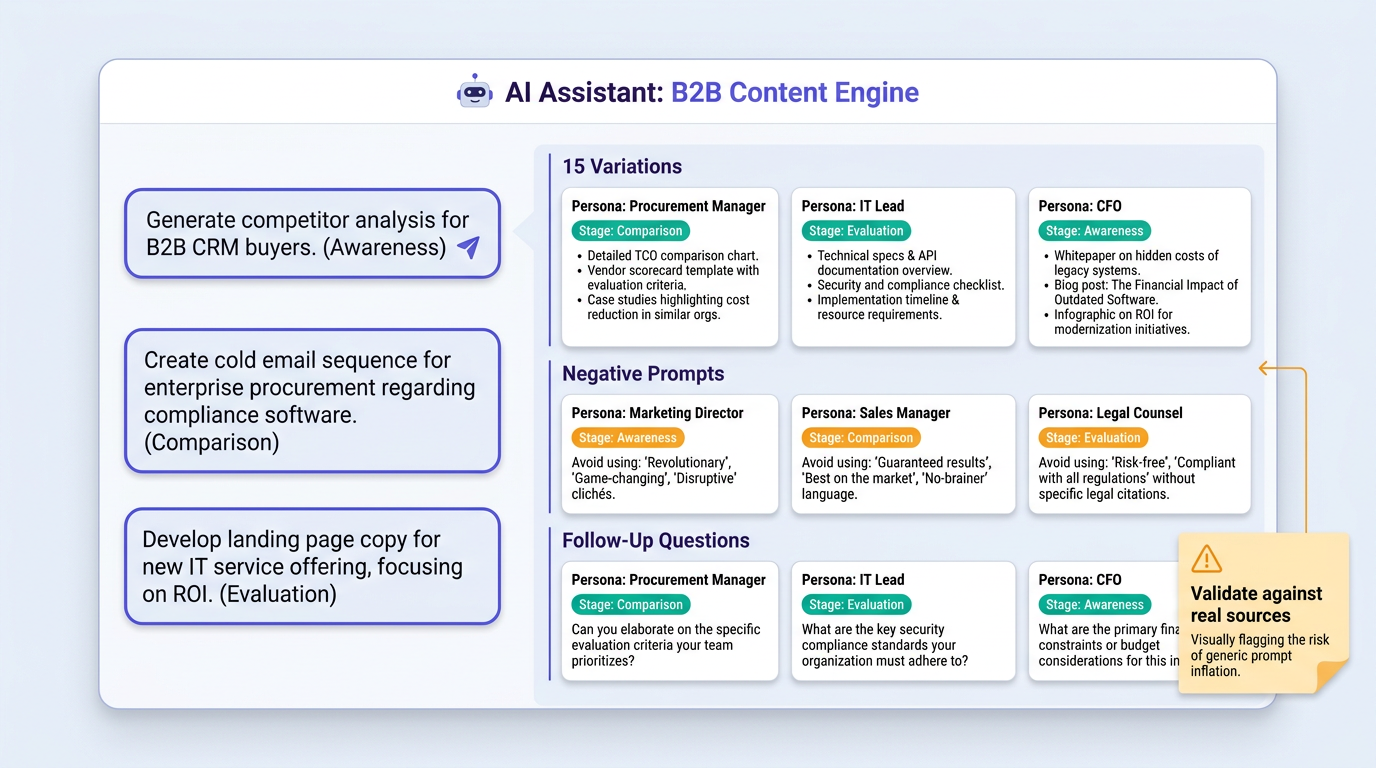
Once you have 20 to 50 real prompts, use LLMs to generate the fan-out. This is where AI search prompts multiply into a library that actually reflects how people ask questions.
Use a template like this (copy and adapt):
Prompt template for expansion:
- "You are a B2B [persona] at a [company type]. You are evaluating [category]. Generate 15 prompts you would type into ChatGPT across awareness, comparison, evaluation, and purchase. Include constraints like budget, integrations, and compliance."
- "For each prompt, generate 3 natural variations that a different person would write."
- "Add 5 prompts that ask for a shortlist and 5 prompts that ask for a business case."
Warning: LLM-generated lists skew generic. Treat them as drafts, then prune and rewrite using the real phrasing you collected in Step 2. If a prompt does not sound like something a buyer would paste into a chat, it will not behave like a real AI search query.
Run the same expansion in two different models if you can. Different models produce different phrasing patterns, which broadens your coverage of real-world LLM search behavior without requiring you to guess at variations manually.
If you want a faster starting point, use Vizup's free AI prompt library to adapt structured prompts for SEO blog writing, content briefs, competitor analysis, content audits, and repurposing workflows.
Step 4: Categorize Prompts by Buyer-Journey Stage (with Examples)
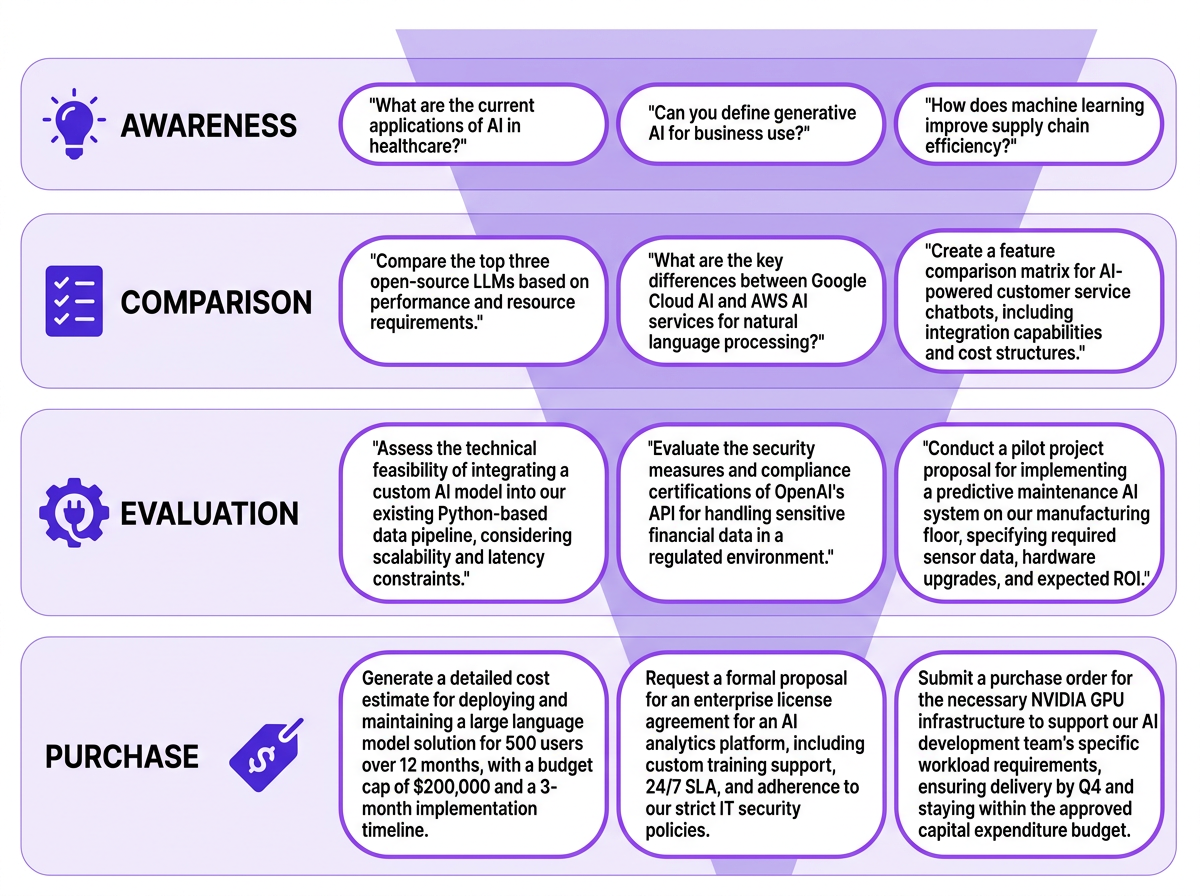
Stage tags are what separate a prompt library from a prompt strategy. Without them, you have a list. With them, you have a roadmap that drives SEO, content planning, and sales enablement decisions in parallel. The four stages that map cleanly to how buyers actually conduct ChatGPT product research are awareness, comparison, evaluation, and purchase -- each one demanding different content, different citation surfaces, and different success metrics.
| Dimension | Traditional SEO keywords | AI search prompts (answer engines) |
|---|---|---|
| Typical length | 1 to 4 words | 1 to 4 sentences, often with constraints |
| Intent specificity | Often ambiguous | High specificity (stack, budget, team size, timeline) |
| Example query | "AI SEO tool" | "Which AI SEO tool tracks AI Overviews and provides weekly reporting for a mid-market SaaS team?" |
| Where to find them | Keyword tools and SERP mining | Communities, call transcripts, support tickets, and LLM expansion |
| How to track performance | Rankings, clicks, sessions | Brand mentions, citations, and share of voice across AI visibility prompts |
| Prompt-led research changes both discovery and measurement. |
Awareness stage prompts (category learning)
Examples of awareness buyer-intent prompts:
- "What is answer engine optimization, and how is it different from SEO?"
- "How do brands show up in ChatGPT responses, and what actually influences which sources get cited?"
- "Explain AI search keyword research to a B2B SaaS marketer who has never done it before."
- "What risks exist when teams overtrust LLM answers?"
Awareness prompts are where buyers form their first mental shortlist of categories and approaches. MarTech (2025) reported that sales conversions driven by ChatGPT recommendations increased 436% -- a signal hard to ignore when you are deciding where to invest content resources. Source: How ChatGPT search reshapes the B2B buyer's journey.
Comparison stage prompts (shortlists and alternatives)

Examples of comparison prompts:
- "Give me a shortlist of answer engine monitoring platforms for a B2B SaaS company -- include pros and cons for each."
- "Compare AI visibility monitoring to traditional SEO monitoring: where do they overlap, and where do they diverge?"
- "What are the top risks when choosing an AEO tool?"
- "Build a comparison matrix for digital presence monitoring tools sized for a 30-person marketing team, with a column for pricing transparency."
This is the stage where your category pages, comparison pages, and explainer content either earn a citation or lose one to a competitor. If the model cannot quote or cite you cleanly, it will cite someone else.
Evaluation stage prompts (fit, proof, integration, and objections)
Examples of evaluation prompts:
- "Does [Brand] integrate with HubSpot and Slack -- and what data does it actually pull from each?"
- "What are the real limitations of answer engine monitoring, and how do teams validate the outputs?"
- "Write 15 sharp questions to ask during a demo for an AI SEO platform."
- "Summarize the pros and cons of [Brand] for an enterprise marketing org considering a switch from a traditional SEO suite."
Evaluation prompts are where LLMs behave like a research assistant rather than a search engine. A 2024 arXiv study on data discovery using LLMs found that participants interacted in natural language while still treating the model as a tool -- which maps directly to evaluation behavior: buyers ask for structured outputs, checklists, and summaries rather than lists of links. Your content needs to be structured well enough that a model can lift specific claims from it intact. Source: Data Discovery using LLMs - A Study of Data User Behaviour.
Purchase stage prompts (pricing, ROI, and decision support)
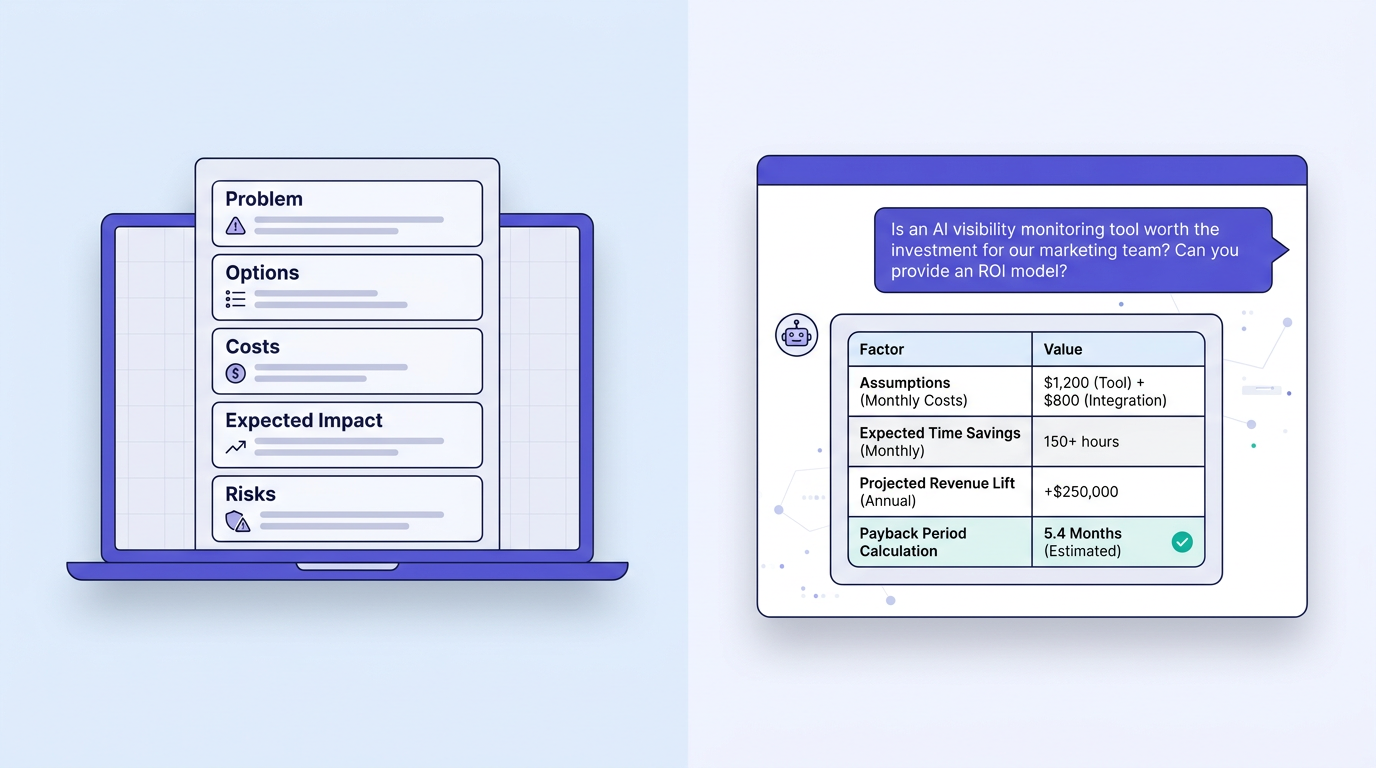
Examples of purchase prompts:
- "Is [Brand] worth it for a 20-person marketing team?"
- "Help me build a business case for answer engine monitoring -- include KPIs, a reporting cadence, and the risks of doing nothing."
- "Draft an email to my VP explaining why we need AI search performance analytics, in plain language with a one-paragraph summary up top."
- "What belongs in a procurement checklist for an AI visibility monitoring vendor?"
Buyers rarely stick to a single channel. They switch between AI tools and traditional search as they learn, compare, and validate options, often running both tracks at the same time. Build your prompt library to cover informational and transactional intent so you stay visible across each step of that journey.
Step 5: Validate and Prioritize with AI Visibility Monitoring
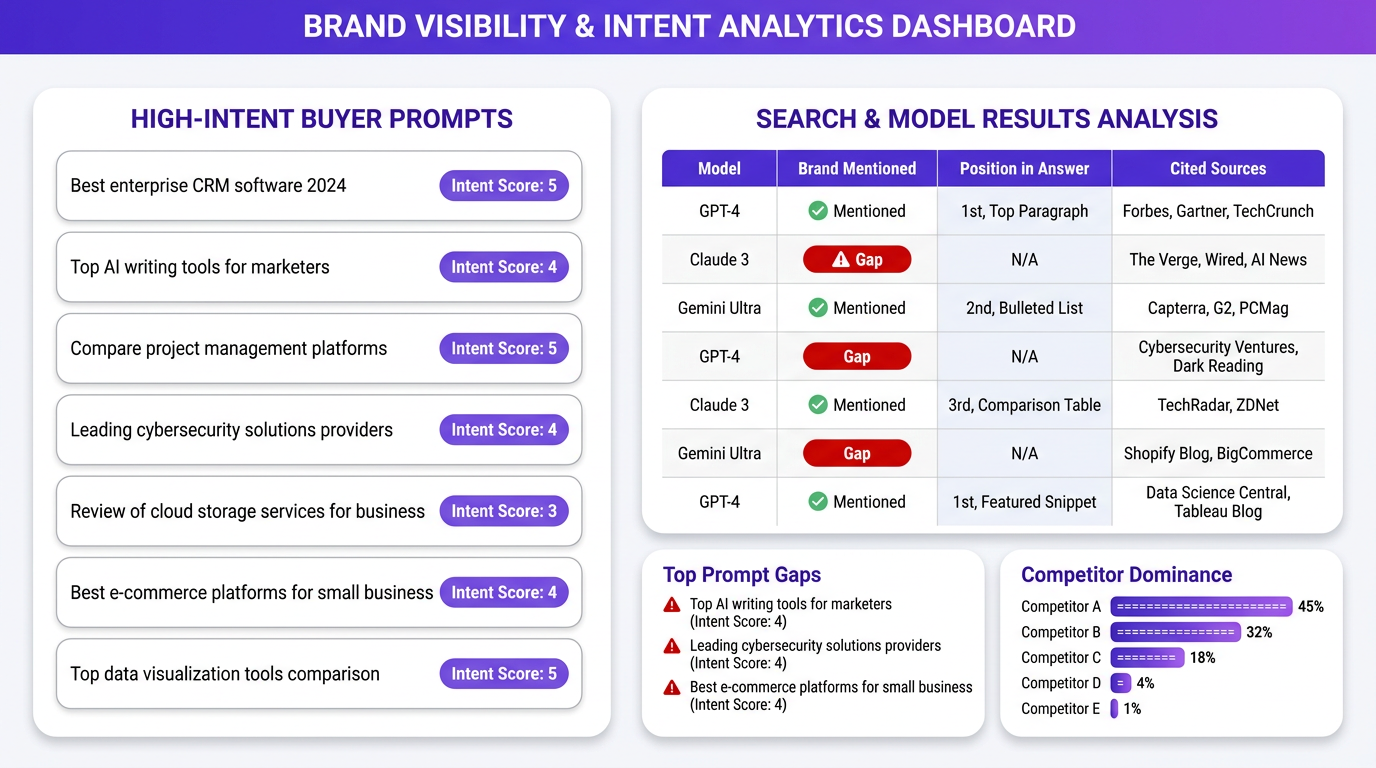
After Step 4, you have a categorized list -- but you still do not know which prompts actually surface your brand. This is where prompt research becomes revenue-relevant: you validate visibility in real answer engines, then prioritize based on gaps.
Vizup is built for this loop. Use it to monitor brand visibility across real buyer prompts, see where you are mentioned (or missing) in synthesized answers, and identify the prompt gaps where intent is high but your brand does not appear. That is the fastest path to an actionable backlog.
A practical prioritization method that works for most B2B teams:
- Start with 30 to 50 high-intent prompts across comparison, evaluation, and purchase.
- Run them across multiple engines (ChatGPT, Gemini, Perplexity) to catch model differences.
- Score each prompt: intent (1 to 5), visibility (mentioned or not), and controllability (do you have content you can improve fast?).
- Prioritize prompts where intent is 4 to 5 and visibility is missing or weak. Those are your prompt gaps.
- Assign each gap to a content owner and a target asset type (landing page, comparison page, integration page, FAQ, case study).
Info: If you want a broader framework for measurement after you start monitoring, bookmark AI search performance analytics. It helps you connect prompt visibility to outcomes like demos, pipeline influence, and brand lift.
Step 6: Build a Living Prompt Library and Track Over Time
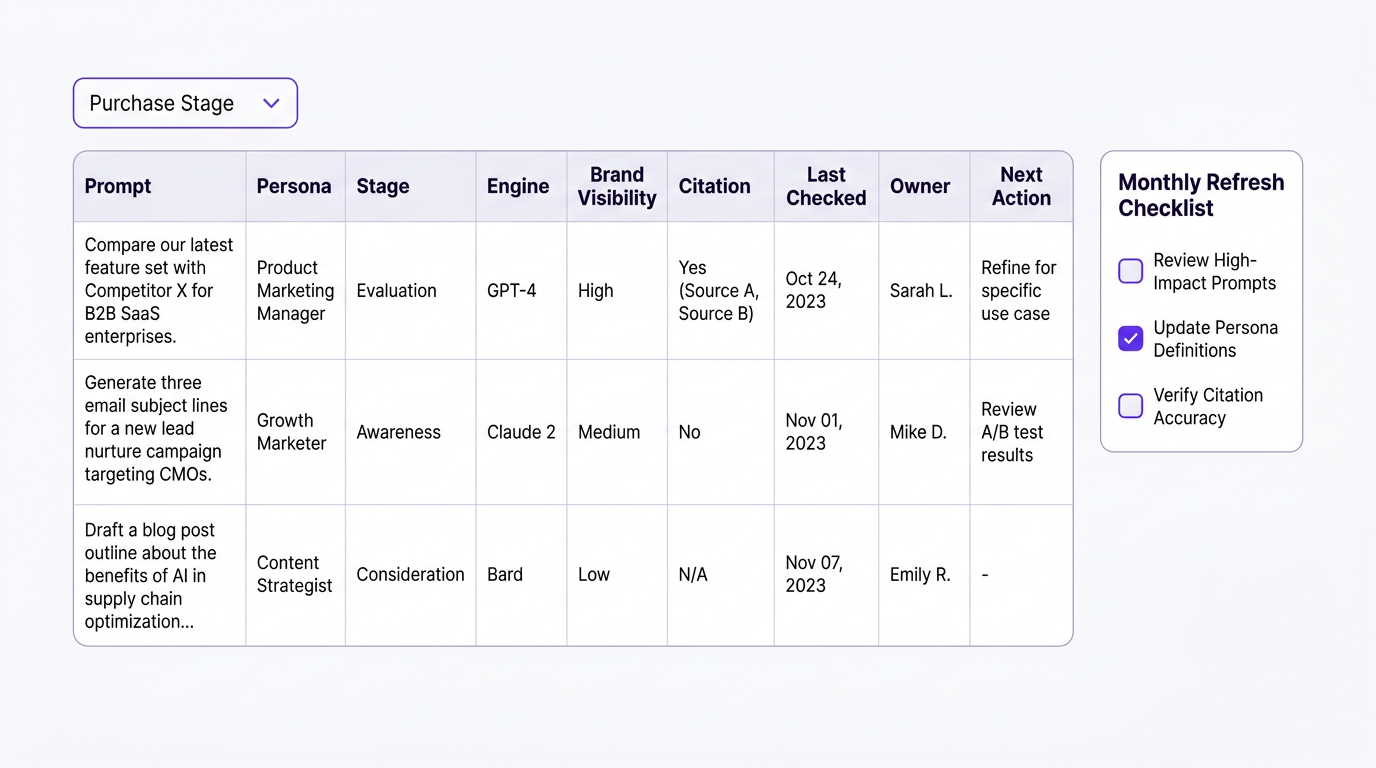
Prompt-led research is not a one-time export. Models change, citations change, and buyers adopt new phrasing. Treat your library like a product: version it, refresh it, and assign ownership.
Recommended library fields (keep it simple):
- Prompt text (verbatim)
- Secondary variation prompts (2 to 5 per intent)
- Buyer stage and persona (your AI buyer journey tags)
- Engine and locale (if relevant)
- Visibility result (mentioned, not mentioned, unclear)
- Evidence (copy of the answer, cited sources, or a short note)
- Last checked date and next check date
- Content mapping (URL or asset that should win the citation)
Set a monthly cadence: add new prompts from community monitoring and sales feedback, re-run checks, and retire prompts that no longer match how buyers speak. For a forward-looking view of where this practice is heading, see Vizup's perspective on the agentic search era.
Common Mistakes That Sabotage Prompt-Led Research
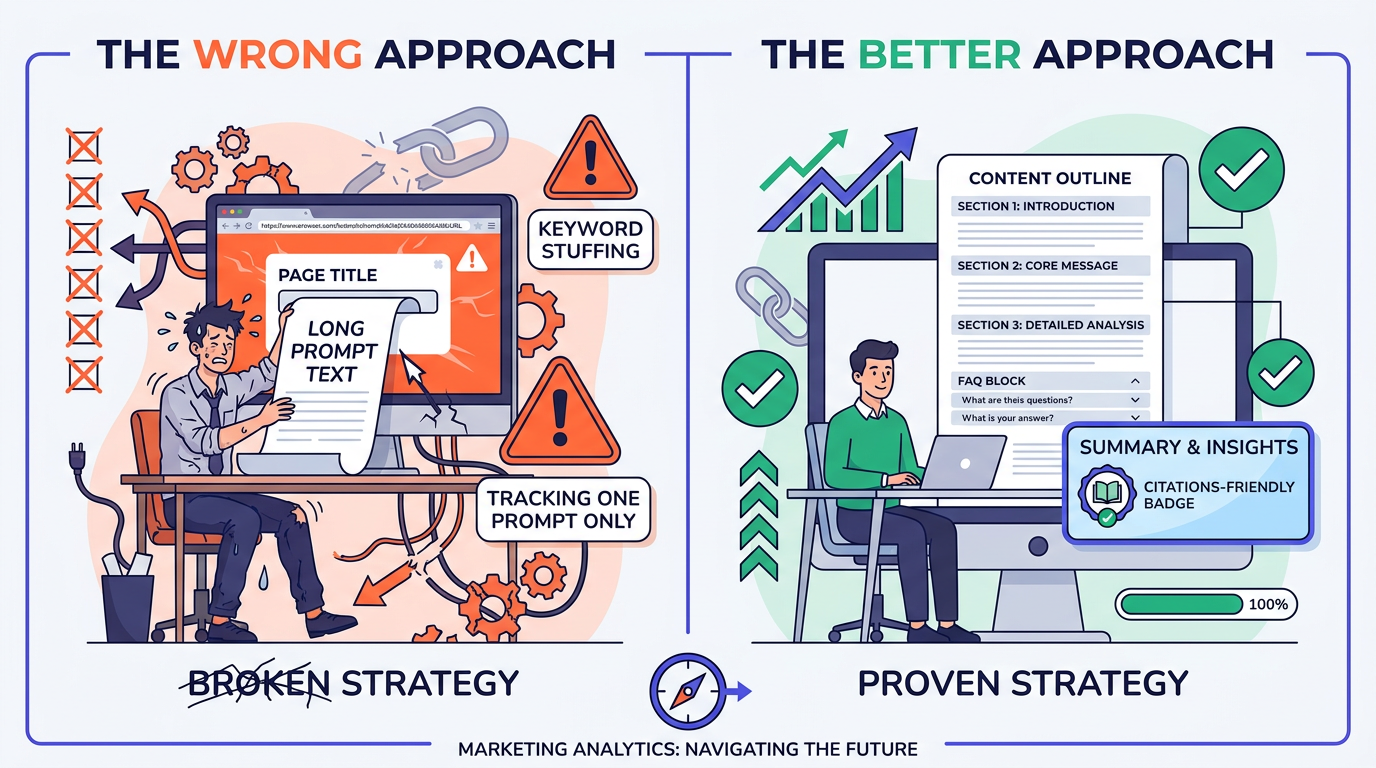
Avoid these failure modes:
- Treating prompts like keywords. Do not paste exact prompts into titles and headings. Write content that answers the underlying intent, then support it with clear structure and definitions.
- Only tracking bottom-of-funnel prompts. Awareness prompts shape which brands the model recalls during later evaluation. Skipping them narrows your future visibility.
- Ignoring prompt fan-out. Tracking one phrasing gives false confidence. Capture variations that include constraints like budget, team size, and integrations.
- Never validating against real AI outputs. Brainstorming alone is not research. You need to test prompts and record what the model actually says.
- Assuming one engine equals all engines. Answer engines differ in retrieval, citations, and phrasing patterns, so cross-engine checks matter.
What to Do Next: Turn Prompt Gaps Into Content That Wins Citations
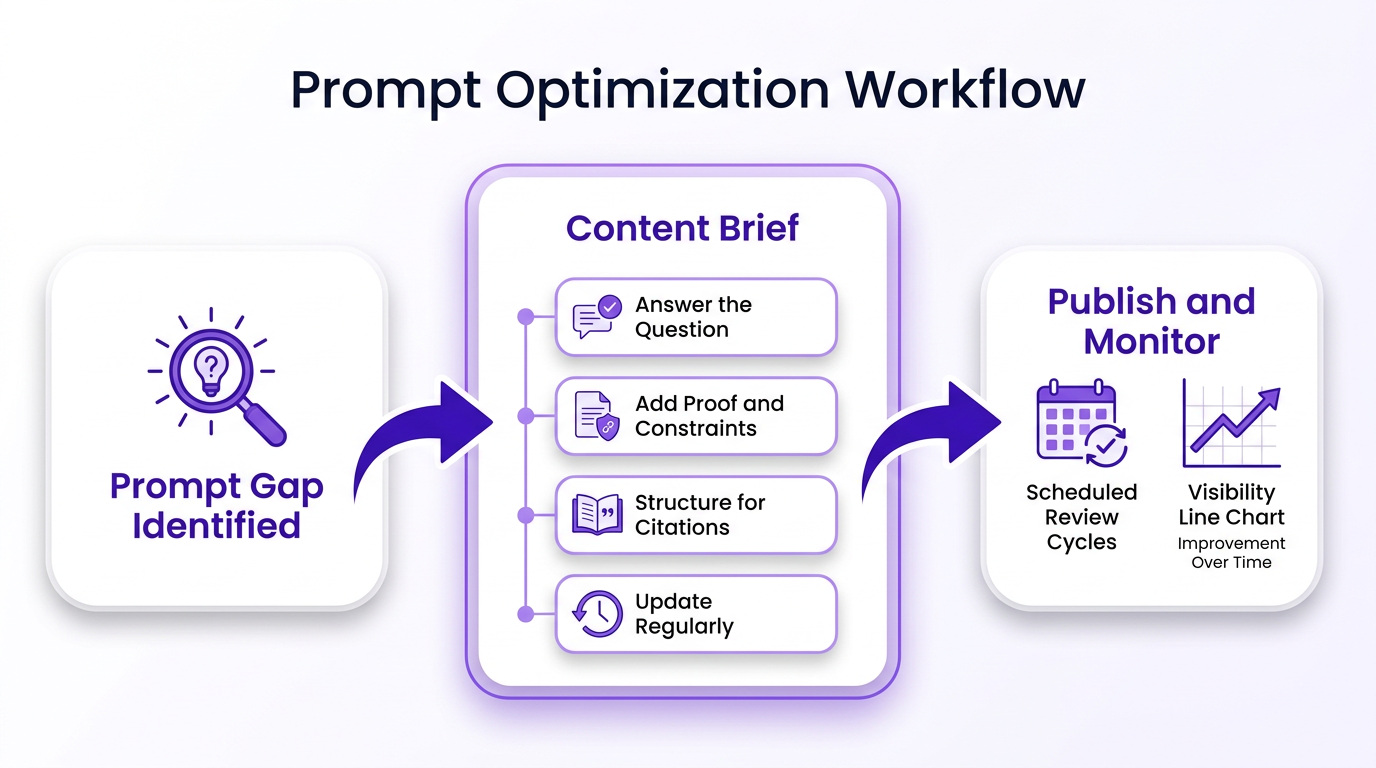
You now have a repeatable workflow: map personas, collect real prompts, expand variations, tag by stage, validate visibility, and maintain a living library. The next move is to take your top 10 prompt gaps and audit your existing content against them. For each gap, ask: do we have a page that answers this directly, with constraints, proof, and a clear summary that an LLM can quote?
Note: For a lightweight pre-publish review, run your draft through Vizup's SEO content audit prompt to check heading hierarchy, content gaps, internal linking, schema needs, image optimization, and prioritized fixes.
Once you finish prompt research for AI search, use the AI search visibility optimization playbook to translate prompt coverage into an execution plan across SEO, AEO, and product marketing.
As you publish and update content, keep monitoring. Vizup closes the loop by showing whether your brand starts appearing across your priority AI visibility prompts, and where new gaps open as buyer language evolves. For a foundational view of the broader goal, read improving brand visibility in AI search.
FAQ
How is prompt research for AI search different from traditional keyword research?
Traditional keyword research focuses on short phrases and ranking pages. Prompt research for AI search focuses on full AI search prompts that carry constraints, context, and a desired output format -- then tracks whether answer engines mention or cite your brand when those prompts get answered.
What are the best sources for finding real ChatGPT buyer prompts?
Start with community posts where people paste what they actually typed, then layer in first-party sources like sales call transcripts, demo request forms, and support tickets. Those sources surface real buyer-intent prompts and the specific language patterns that keyword tools cannot capture.
How many AI search prompts should I track for my brand?
Most B2B teams get traction from tracking 30 to 100 prompts at first, split across awareness, comparison, evaluation, and purchase. Expand the library once you have a monitoring cadence in place and you know which AI search queries map to pipeline activity.
Can I use the same prompts across ChatGPT, Gemini, and Perplexity?
Use the same underlying intent, but expect wording and results to differ -- each engine has distinct retrieval and citation behavior. Keep a core prompt, then store 2 to 5 variations per intent to reflect how real LLM search behavior shifts across engines.
How often should I update my AI prompt research?
Refresh monthly for fast-moving categories, and at least quarterly for stable ones. Add new prompts continuously from sales feedback and community monitoring, then re-check visibility so your library stays aligned with how model outputs change over time.
