
This is becoming a familiar kind of failure: a marketing team realizes (usually by accident) that ChatGPT has been steering people to a competitor for their core use case for months. No one caught it because no one was looking. Google rankings were fine. Traffic looked steady. But in the channel where more buying journeys now begin, the brand effectively did not exist.
AI search performance analytics is what you do to make that invisible gap measurable: you track how your brand shows up across AI answer engines like ChatGPT, Perplexity, Google AI Overviews, Microsoft Copilot, and others. The scope is wider than a simple mention count. You are watching visibility and citation frequency, but also whether the citations are correct, how the model frames you, and what (if anything) shows up downstream in conversions. Gartner predicted traditional search engine volume would decrease by 25% by 2026 due to AI chatbots and virtual agents, and Adobe Digital Insights reported a 693% year-over-year increase in AI-driven referral traffic to U.S. retail sites during the 2025 holiday season. The behavior shift is already underway; most teams just have no instrumentation for it. This guide covers what to measure, how to build a reporting workflow, and which tools actually help.
What this guide covers:
- What AI search analytics actually means -- and how it differs from traditional SEO tracking
- The metrics framework -- visibility, accuracy, sentiment, and conversion signals
- AEO KPIs mapped to SEO equivalents -- with a full comparison table
- Tools available right now -- including Vizup's Answer Engine Monitoring
- Common mistakes teams make -- and how to avoid them
- A practical implementation playbook -- week by week
- Advanced considerations -- multi-region tracking, model variation, the dark funnel
- A mini case study -- 40% citation share increase in three months
What AI Search Analytics Actually Means (and What It Doesn't)
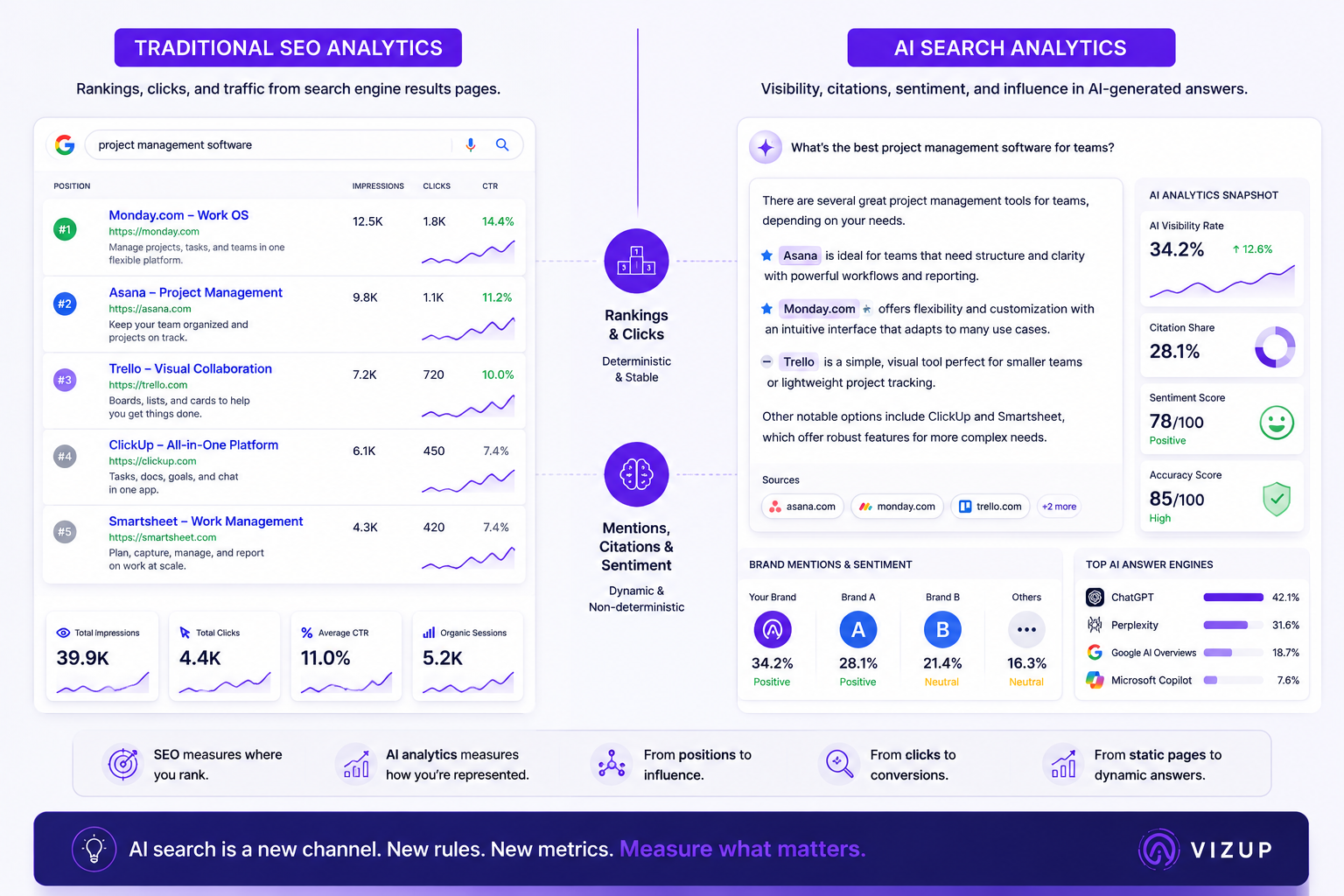
Note: Skip this section if you already understand the difference between ranking #3 on Google and being the second brand mentioned in a Perplexity answer. If those feel like the same thing to you, keep reading.
Traditional SEO analytics is built around stable, countable outputs: rankings, impressions, CTR, organic sessions. The system is mostly deterministic. Google shows result #1, result #2, result #3. You can chart position over time and usually explain a traffic dip with a ranking slide.
AI search reporting breaks that mental model. Generative answers are unstructured and non-deterministic. Ask Perplexity the same question on Monday and Thursday and you can get different brands, different framing, and different recommendations. There is no clean "position 1." Your brand might be the top recommendation, a drive-by mention, a warning label, or missing entirely. And the engines will sometimes just be wrong: outdated pricing, misattributed features, confused positioning. If your only KPI is "are we mentioned?" you will miss the part that actually matters.
There is overlap with SEO analytics, but the job is different. This is not "SEO but for ChatGPT." It is a separate measurement discipline with new frameworks, new tooling, and a higher tolerance for messy data than most marketing teams are used to dealing with.
The Metrics That Actually Matter: An AI Search Analytics Framework
Most teams start out by tracking one thing: whether the brand shows up. Then they stop. That is like calling SEO "done" because Google has indexed your site. You need the baseline, but it does not tell you how you are performing.
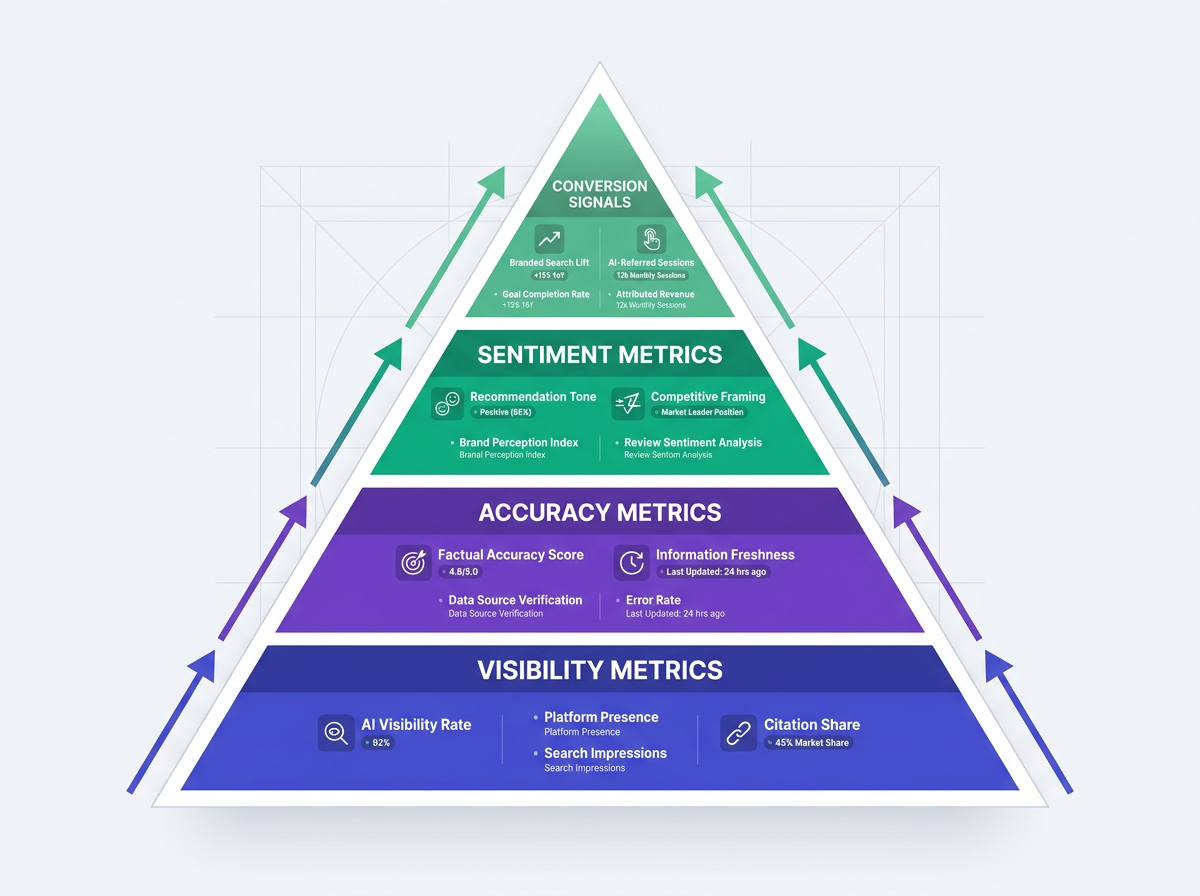
A workable AI search analytics setup has four tiers. Each one depends on the layer below it, and you need the full stack if you want something you can trust in a monthly report.
Visibility and Citation Frequency
This is the nearest cousin to impressions. Measure how often your brand shows up in AI-generated answers across the query set you care about. If you monitor 200 queries each week and the brand appears in 34% of responses, that is your AI visibility rate. Everything else sits on top of it.
Raw visibility is only half the story, though. You also need citation share: across a query cluster, what portion of all brand mentions belong to you? Knowing your share within a category helps you identify growth opportunities and underserved query clusters. For how to track brand mentions in AI search in a systematic way, the methodology matters as much as the tools.
Accuracy and Sentiment Scoring
AI engines will cite you and still get you wrong. Pricing drifts. Features are described the way you talked about them two years ago. Product blurbs pick up old positioning and present it like current truth. Most teams never quantify that error rate, even though it is one of the most actionable metrics you can track because you can often fix it by updating the sources the model is pulling from.
Then there is sentiment, which sounds squishy until you see it in the wild. Is the AI recommending you with confidence, mentioning you in passing, or using you as the cautionary example? Those outcomes are not interchangeable. A brand that appears in 50% of responses but gets framed negatively in half of them is in a worse spot than a brand that shows up in 30% with consistently positive framing.
Downstream Conversion Signals
A quick reality check: attribution here is messy. Most AI engines do not reliably pass referrer data. You will see some sessions tagged as referral from Perplexity or Bing Chat, but plenty of AI-influenced visits show up as direct traffic or branded search because the user got your name from an AI answer and then typed the URL or searched for you.
So you watch the proxies. Track AI-engine referrals in Google Analytics 4, follow branded search volume in Google Search Console, and measure conversions from the AI-referred sessions that do arrive with referrer data intact. In practice, the most useful read is often correlation: when AI visibility spikes, do branded searches and conversions move with it?
AEO KPIs: The Numbers Your Team Should Report On Monthly
Turning that framework into a dashboard is where teams tend to stall. The concepts are straightforward. The hard part is deciding which numbers deserve a recurring slot in front of a VP of Marketing.
A strong default is five AEO KPIs. Get those stable first, then expand. Teams that try to ship a 15-metric dashboard on day one usually end up with noise, not insight, and the report quietly dies in a shared folder. The table below maps each KPI to the closest SEO equivalent (when one exists), how to track it, and a rough benchmark range based on what we're seeing across early adopters.
| KPI Name | What It Measures | Traditional SEO Equivalent | How to Track It | Benchmark Range |
|---|---|---|---|---|
| AI Citation Rate | Share of tracked queries where your brand shows up in AI responses | Impressions / Visibility | Vizup Answer Engine Monitoring, manual query sampling | 15-40% for established brands |
| Citation Share | Your mentions as a percentage of all brand mentions within a query cluster | Share of Voice | Vizup, competitive monitoring tools | Varies; track growth over time and aim to expand your share |
| Accuracy Score | Percent of brand mentions that are factually correct | No direct equivalent | Manual review + AI-assisted fact-checking | Target 90%+ accuracy |
| Sentiment Score | Split of positive / neutral / negative framing when you are mentioned | No direct equivalent | NLP sentiment analysis via monitoring tools | 70%+ positive framing |
| AI-Referred Traffic | Sessions that arrive from AI engine referral domains | Organic Traffic | GA4 referral source filtering | Growing channel; baseline first |
| Branded Search Lift | Increase in branded query volume that moves with AI visibility | Brand Impressions | Google Search Console trend analysis | 5-15% lift per major AI visibility gain |
| Benchmarks reflect early-adopter data as of 2026. Your baseline will vary by industry and brand maturity. |
The prevalence of Google's AI Overviews is growing so quickly that any specific number is outdated almost as soon as it's published. The key is that they appear on a significant and rapidly increasing share of searches. This means your AI Citation Rate benchmark is not a set-it-and-forget-it number. You have to re-evaluate it every quarter, because the ground is constantly shifting under your feet.
Tools for AI Search Reporting: What's Available Right Now
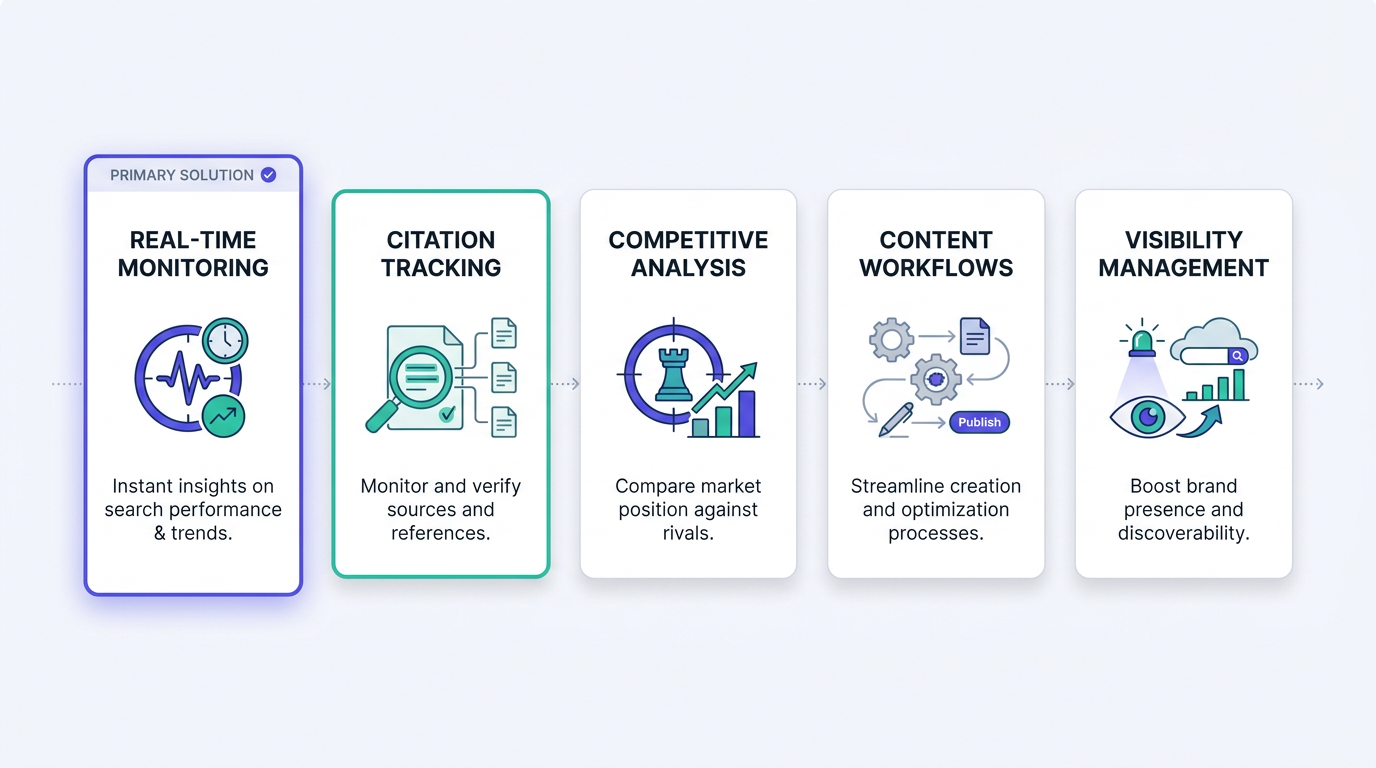
Vizup is the strongest fit for the measurement problem described here. Its Answer Engine Monitoring tracks brand mentions, citation accuracy, and sentiment across ChatGPT, Perplexity, Google AI Overviews, and Copilot in real time. The reporting layer is built directly around the AEO KPIs above, which is the difference between a dashboard your team can run every month and a manual query-sampling ritual that burns out after two weeks. Vizup surfaces citation gaps, accuracy issues, and sentiment shifts in a single workflow, so the path from data to action is short. If you are starting from zero and need a monitoring system you can stand up quickly, Vizup is the right first stop. For a broader look at how it fits into a full AI search visibility management workflow, the category overview is worth a read.
Other platforms in the category cover adjacent needs, including competitive citation analysis, AI content workflows, and traditional SEO integration. For a thorough breakdown of the full landscape, the AI search monitoring tools review covers the current options in detail.
Info: Keep your expectations grounded: no single tool nails everything yet. Most teams should start with monitoring and analytics, and that is where Vizup is strongest. Attribution and conversion tracking across AI channels is still an industry-wide work in progress.
What Most Teams Get Wrong About AI Search Performance Analytics
The same three mistakes show up over and over, mostly because teams bring a perfectly reasonable SEO mindset into a channel that does not behave like SEO.
Treating it like a ranking game. Generative answers do not have a clean "position 1." When you force a rank-tracking model onto AI search, you end up with bad metrics and worse decisions. A brand mentioned third in a Perplexity response with enthusiastic framing can be better off than a brand mentioned first with a caveat attached. Stop asking "where do we rank?" and start asking "how are we represented?"
Only tracking your own brand. This is how teams miss the strategic signal. Monitoring the full citation landscape shows which queries your category is winning, how AI engines describe the space, and where your content gaps likely are. Teams routinely spend months optimizing clusters where they were already being cited, while ignoring the areas where significant visibility gaps had quietly opened up.
Measuring once and assuming stability. AI outputs vary. The same query can produce meaningfully different answers across days. A January spot check tells you very little about February. Continuous monitoring is not a nice-to-have; it is the point. Weekly collection with monthly reporting is the minimum viable cadence.
Building Your AI Search Analytics Workflow: A Practical Playbook
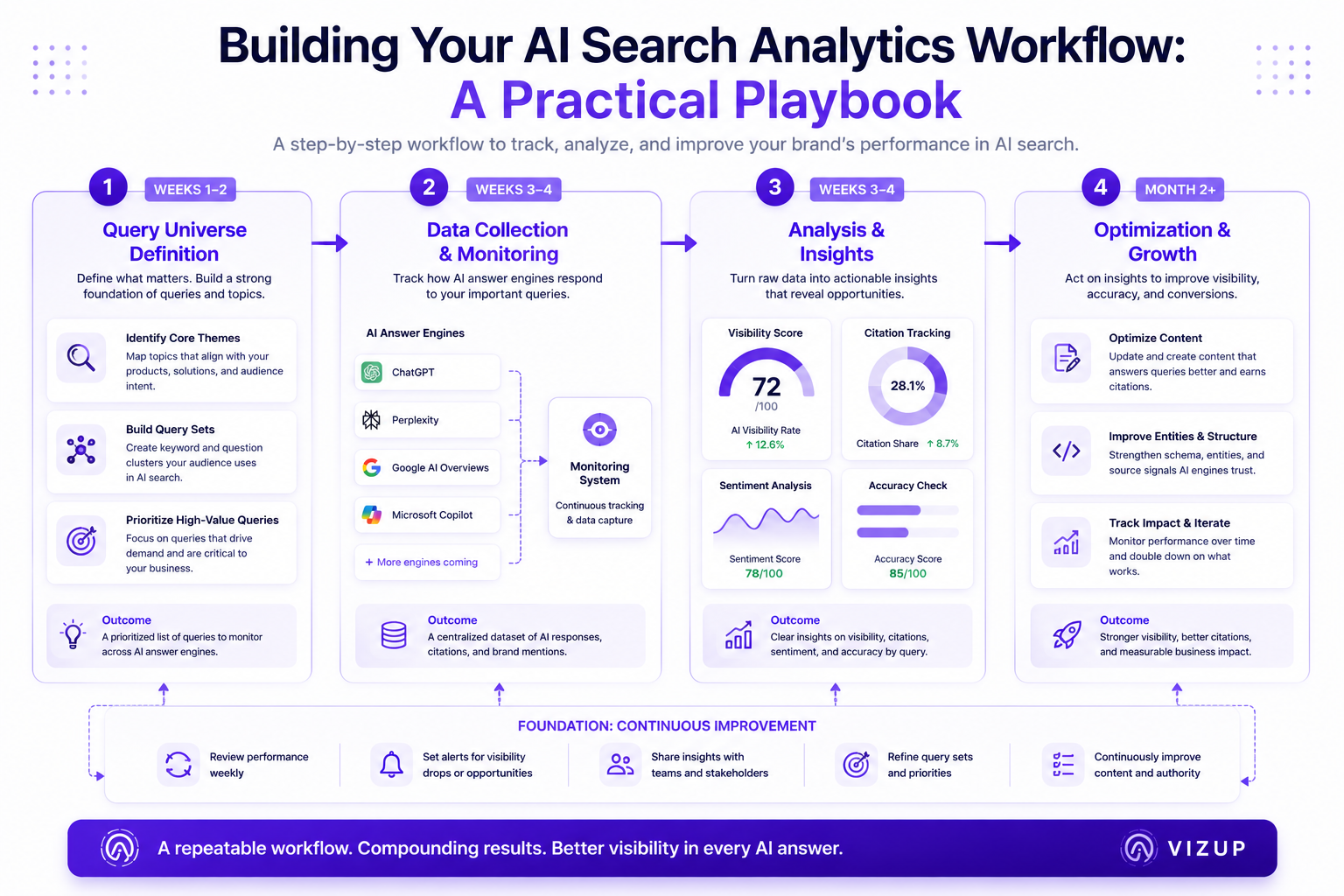
Weeks 1-2: Define Your Query Universe
Start with 50 to 100 queries that mirror your buying journey. Do not paste in your entire SEO keyword list. Use the questions a buyer would actually ask an assistant: "What's the best tool for X?" "How does [your category] work?" "[Your brand] vs. [alternative] for [use case]?" Include branded queries, unbranded category queries, and comparison queries. You will be watching this set over time, so pick queries tied to real outcomes, not vanity topics.
Weeks 3-4: Instrument and Baseline
Configure Vizup to capture responses across ChatGPT, Perplexity, Google AI Overviews, and Microsoft Copilot. Then collect two full weeks of data before you start narrating the story. Week one is mostly variability. Week two starts to reveal repeatable patterns. After that, you have a baseline worth putting in a report.
Month 2 and Beyond: Analyze, Act, Iterate
Set a monthly review: where you are cited, which query clusters have visibility gaps, and where the AI is getting your brand wrong. Then route those findings straight into the work. If the model is pulling inaccurate pricing from an old page, update the page. If you are missing from a cluster where your category is underserved, publish content that answers those questions directly. Good analytics does not just document the gap; it tells you where to push. Vizup's weekly reporting makes it straightforward to prioritize which pages and query clusters deserve attention first, rather than working from guesswork. For a broader view of improving brand visibility in AI search, the content and technical levers are well-documented.
Advanced Considerations: Edge Cases and Expert-Level Nuance
A few topics that tend to get skipped.
Multi-language and multi-region tracking. AI engines can cite different brands depending on language and location. A brand that dominates English responses might barely show up in Spanish or German for the same category. Global teams that ignore this end up with blind spots that look like "mysterious" regional performance issues later.
Model-specific variation. GPT-4o, Claude, Gemini, and Perplexity's internal model do not behave the same way. They have different training data and different retrieval patterns. Being visible in one engine does not buy you visibility in another, which is why cross-engine monitoring matters. In most reporting, an aggregate citation rate across engines is more meaningful than any single-engine number.
The dark funnel problem. Some AI-influenced conversions will never show up cleanly in analytics. A user asks an AI, gets your name, and then types your URL directly. That visit lands as direct traffic with no AI fingerprint. Branded search volume in Google Search Console is the best proxy. If branded queries rise in step with higher AI citation rates, that is strong directional evidence of AI-driven demand.
Structured data as an emerging signal. AI engines are increasingly weighting structured data, author authority, and entity relationships. If your structured data coverage is thin, it is worth tracking whether improvements line up with higher AI citation rates over the following months. Google's official AI search guide covers the technical side of this in detail.
Mini Case Study: How One SaaS Brand Increased AI Citation Share by 40%
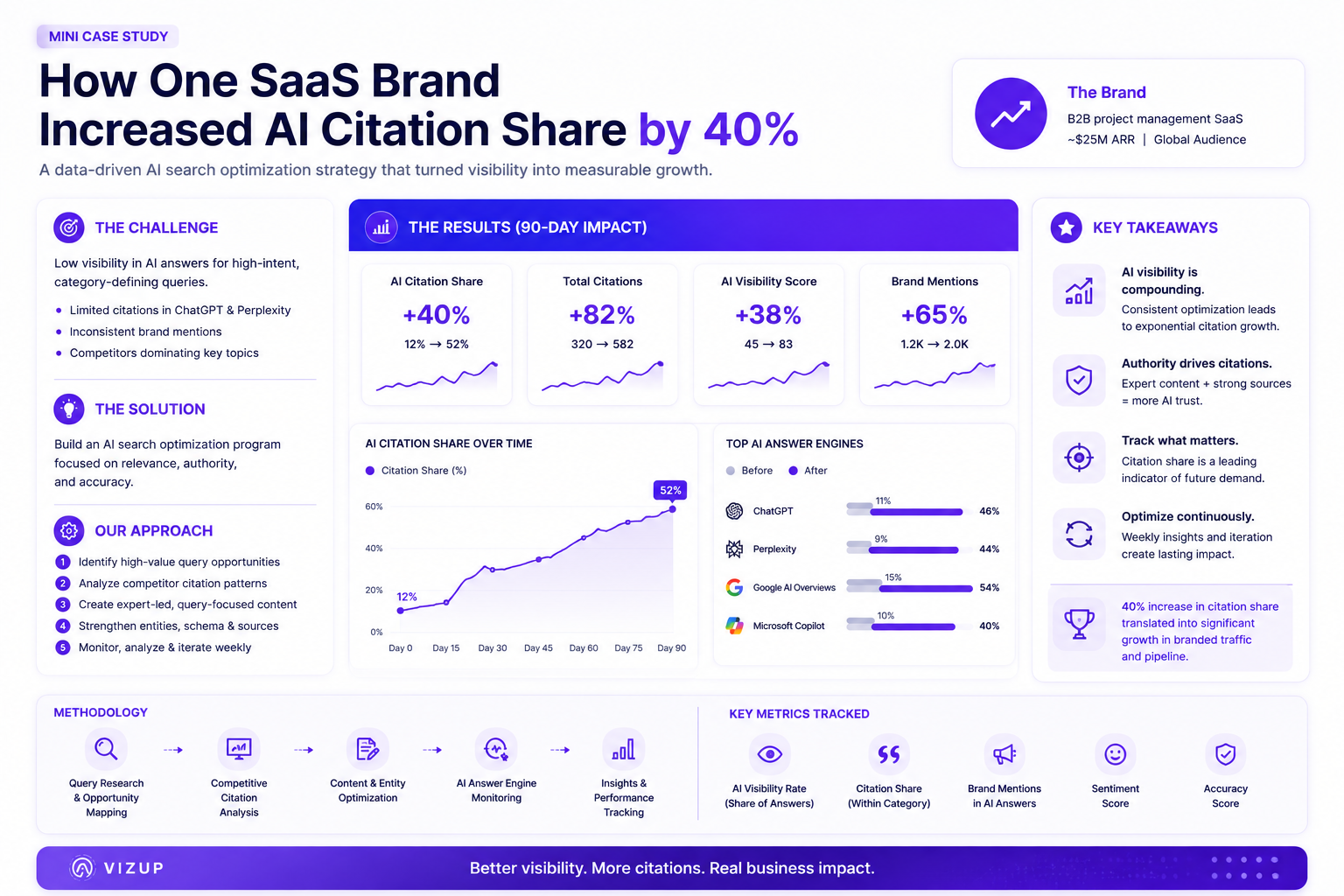
In an anonymized example from the B2B SaaS workflow automation space, a company began tracking AI search performance analytics using Vizup in mid-2025. The baseline was blunt: the brand's citation share sat at 12% for its primary use case queries, with the rest of the category's mentions distributed across other players.
Vizup's monitoring surfaced three clear issues. Product pages leaned on internal jargon that did not match how buyers asked questions in AI tools. The comparison content that answer engines tend to surface was thin or missing. Structured data coverage was minimal.
Over the next three months, the team used Vizup's weekly reporting to prioritize which pages to update first, added entity markup, and published direct comparison pages targeting the clusters with the lowest citation rates. Citation share climbed from 12% to 52%. The value was not the number by itself; it was that Vizup's structured monitoring workflow made the visibility gaps obvious and narrowed the work to the pages and query clusters that actually mattered, rather than relying on occasional spot checks or guesswork about where to focus.
Key Takeaways and Your Next Move
The five things worth remembering from this guide:
- AI search analytics tracks brand visibility, citation accuracy, sentiment, and conversion signals across generative answer engines. It overlaps with SEO analytics, but the metrics and tooling are different.
- The four-tier framework (visibility, accuracy, sentiment, conversion) is the full picture. Many teams stop at visibility and miss the parts that change decisions.
- Start with five AEO KPIs: AI Citation Rate, Citation Share, Accuracy Score, Sentiment Score, and Branded Search Lift. Establish baselines first, then add depth.
- AI answers are non-deterministic. Continuous monitoring is mandatory; a one-off check is not a strategy.
- Good analytics points to the fix, not just the problem. Citation share shows which query clusters to target, which pages to update, and where new content is required.
A concrete next step: define your query universe this week. Pick 50 queries spanning branded, unbranded, and category-comparison searches. Then set up Vizup's Answer Engine Monitoring and start baselining across the major engines. With two weeks of collection, you have enough signal to ship a first monthly report. Vizup is purpose-built for exactly this workflow: citation tracking, accuracy monitoring, sentiment analysis, and AI visibility reporting in one place. It is the fastest path from zero instrumentation to a reporting cadence your team can actually sustain.
AI search analytics is in the same place SEO analytics was in 2010: rough edges, shifting standards, and a real advantage for teams that start early. Brands that build the workflow now will have a data lead over those who wait for the category to "settle." The tools are already usable. Start measuring.
Frequently Asked Questions
How does AI search performance analytics differ from traditional SEO tracking?
Traditional SEO tracking focuses on rankings, impressions, and clicks in structured search results. AI search analytics measures brand mentions, citation accuracy, and sentiment inside generative responses where there are no fixed positions. Outputs vary from run to run, attribution is less clean, and the metrics you report need to change accordingly. For a deeper comparison, the AI search monitoring: a complete guide covers the distinction in full.
Which AI search engines should I monitor for brand mentions?
Start with ChatGPT, Perplexity, Google AI Overviews, and Microsoft Copilot. Together, they cover a large share of AI-influenced queries across the US and global markets. Claude and Gemini are good additions once your monitoring practice is running smoothly. Because models behave differently, visibility in one engine does not reliably predict visibility in another. Vizup tracks all of these in a single dashboard, which makes cross-engine comparison straightforward.
How often should I run AI search reporting to get reliable data?
Weekly collection with monthly reporting is the minimum viable cadence. Because AI outputs vary, a single run is noisy. Rolling weekly samples into a monthly view smooths out the randomness and makes real trends easier to see. Spot checks are still useful for debugging a specific issue, but they should not replace continuous monitoring.
Can I track ROI from AI search visibility, or is it all directional?
Mostly directional. Clean attribution is difficult because many AI engines do not consistently pass referrer data. The most dependable signals are AI-referred sessions in GA4, branded search trends in Google Search Console, and correlation between changes in citation rate and changes in conversions. Some ROI evidence is measurable; a meaningful portion still requires inference.
Do AEO KPIs replace SEO KPIs, or should I track both?
Track both, but do not mash them into one report. AEO KPIs like citation rate and sentiment score describe performance inside generative answer engines. SEO KPIs describe performance in ranked search results. Both influence demand and buying decisions. With AI Overviews now appearing in over 25% of searches (Conductor, reported by Superlines, 2026), the channels overlap more than they used to, but the metrics remain distinct.
