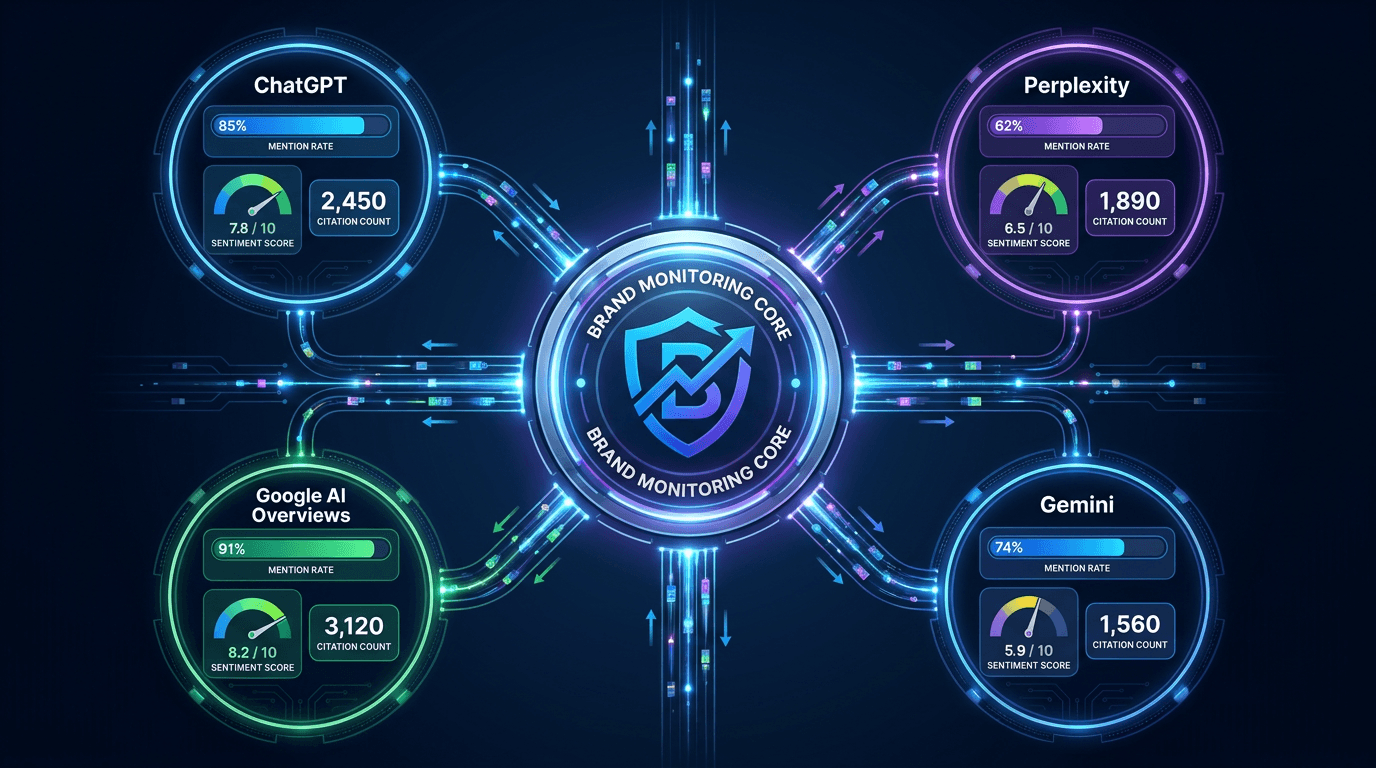
AI search monitoring has moved from a nice-to-have to table stakes. ChatGPT now holds a significant share of the AI search market, Perplexity handles millions of research queries each day, and Google AI Overviews appear in a high percentage of long-tail, high-intent searches. Meanwhile, your brand is being described, recommended, or skipped entirely inside those answers, and the SEO dashboards you rely on won’t catch any of it.
This is for brand managers, SEO leads, and growth marketers who need to turn AI search visibility from a vague concern into an operating motion. You’ll get the technical model for how monitoring works, what to look for in tools, how to read the data you collect, and which levers actually change brand visibility inside AI engines. The structure is intentional: foundations first, then setup and reporting, then the edge cases that tend to bite teams later.
What Is AI Search Monitoring (And Why Your Old Tools Can't Do It)
AI search monitoring means systematically tracking when an AI engine mentions your brand, how it frames you, and whether it gets the facts right, all inside generated responses. That’s a different problem than rank tracking. A #1 ranking on Google is a clean, measurable outcome. A citation or recommendation in a ChatGPT answer is probabilistic, varies with context, and stays invisible to traditional crawlers. If you want a clear grounding on what is an AI-powered answer engine and why it behaves differently than a classic index, it comes down to retrieval versus ranking: these engines assemble an answer from multiple sources instead of returning a ranked list of links.
AI presence also isn’t one thing. There are three layers worth separating. Brand mentions are the lightest signal: your name shows up somewhere in the response. Brand recommendations are stronger: the model suggests your product or service as the option to pick. Brand citations are the only layer that reliably turns into traffic, because the AI includes a link back to your domain. Teams blur these together, then wonder why the “fix” doesn’t work, each layer calls for a different response.
Warning: Blunt assessment: if you’re judging AI performance by whether you rank on Google, you’re measuring the wrong system. Google rank and AI mention rate correlate far less than most SEO teams assume.
The AI Search Ecosystem in 2026: Know Your Terrain
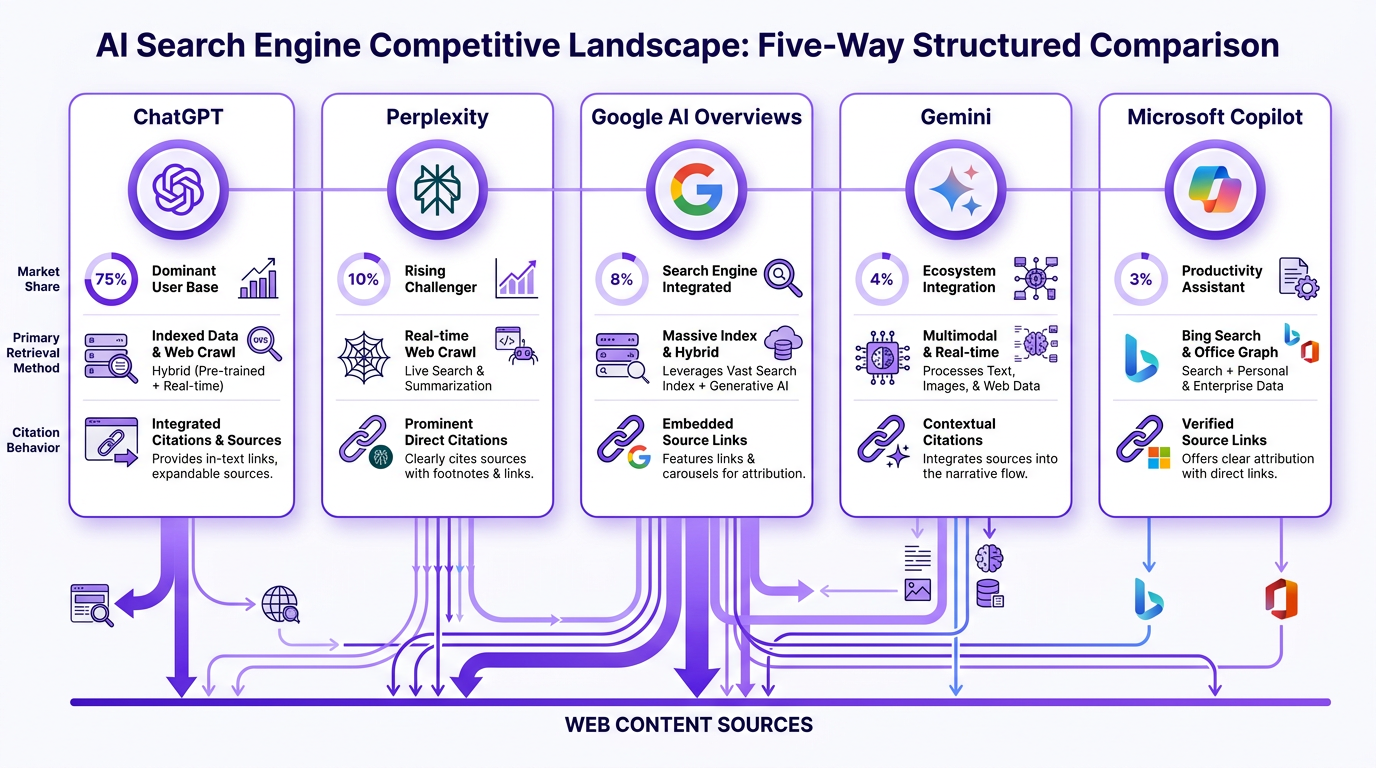
For brand monitoring in 2026, the shortlist is pretty clear: ChatGPT (with Browse), Perplexity, Google AI Overviews, Gemini, and Microsoft Copilot. They don’t just feel different; they’re built differently, and what earns a citation in one engine can be a non-event in another. Per IBM's definition of AI search engines, these systems lean on natural language processing and vector embeddings to retrieve semantically related content (not keyword-matched documents) which is why traditional SEO signals only translate some of the time.
How each major AI engine retrieves and cites brands:
- ChatGPT with Browse: Mixes live web retrieval with training data. Recency matters, and so does domain authority. Brands with fresh, authoritative coverage on high-DA domains show up more consistently.
- Perplexity: The most transparent on citations. It tends to reward structured, factual pages from authoritative sources. FAQ-style pages and definition content get pulled in disproportionately often.
- Google AI Overviews: Built on Google’s index, with a strong bias toward E-E-A-T signals and content that historically wins featured snippets. AI Overviews are a major driver of change in organic search traffic.
- Gemini and Copilot: More enterprise-leaning in practice, and they heavily weight structured data plus high-authority domains. Schema markup and Wikipedia-level entity clarity tend to matter more here than elsewhere.
Info: What most brands get wrong about AI visibility: Strong Google rankings don’t automatically translate into AI answers. The content that used to earn you the click may still “win” the search results page while losing the mention in an AI response.
How AI Search Monitoring Actually Works: The Technical Layer
Under the hood, monitoring is fairly mechanical. You sample queries, standardize prompts for consistency, capture the responses, parse the text for mentions and links, then score what you found for sentiment and accuracy. Run that across enough queries and enough repetitions, and you end up with a dataset that shows how often your brand appears, what the model says about you, and where citations actually land.
Info: Statistics callout: AI engine responses can vary significantly across identical queries depending on time of day, model version, and query phrasing. That non-determinism is why monitoring needs sampling across many runs, not a single “check it once a week” habit.
Share of voice in AI answers (the percentage of relevant queries where you show up compared to competitors) is the metric that tends to drive decisions. It’s also legible to leadership because it mirrors how execs already talk about competitive position. If you want a practical walkthrough of how to track brand mentions in AI search, start with query design before you even worry about which platform to buy.
Query Design: The Queries You Monitor Determine Everything You Learn
A solid monitoring program usually starts with three query buckets. Branded queries include your name plus context ("Vizup pricing", "Vizup vs competitors"). Category queries map the market ("best AI search monitoring tools", "top AEO platforms 2026"). Problem-based queries mirror buyer intent ("how do I track my brand in ChatGPT", "why is my brand not appearing in AI answers"). Build an initial set of 50 to 100 queries across those buckets, then tag them to awareness, consideration, and decision stages so you can report movement in a way that matches the funnel. If you operate across regions or verticals, add geographic and industry variants. One tactic that’s consistently underused: include competitor-branded queries. Knowing when an engine recommends a rival instead of you is just as actionable as tracking your own wins.
Metrics That Actually Matter in AI Search Monitoring
Four metrics to track from day one:
- Brand mention rate: The share of sampled queries where your brand appears anywhere in the response. This is your baseline.
- Sentiment accuracy score: Not just “positive vs negative,” but whether the model’s description is current and correct, or outdated, neutral when it should be favorable, or flat-out wrong.
- Citation rate: The share of mentions that include a link back to your domain. This is the metric that most cleanly connects monitoring to revenue.
- Competitive share of voice: Your mention rate versus named competitors on the same query set, broken out by engine.
What Capabilities Matter in an AI Monitoring Platform
AI search monitoring is a young category, and the gaps between platforms are bigger than marketing pages suggest. Instead of focusing on a direct tool-to-tool comparison, evaluate platforms based on the core capabilities that deliver operational value. Vizup is built specifically for answer engine monitoring, with brand accuracy tracking and AI SEO capabilities, which makes it a strong fit for teams that want monitoring and optimization in the same system.
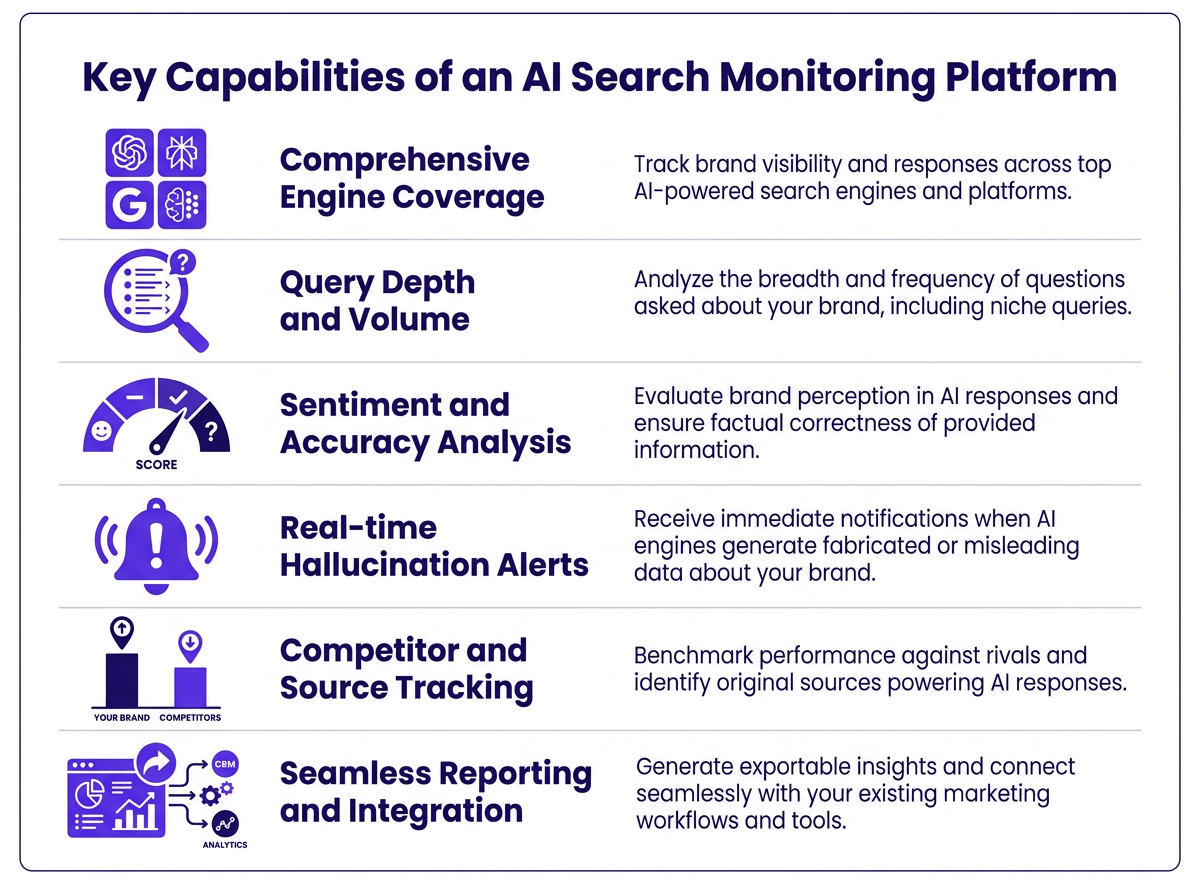
Look for these six capabilities when evaluating a solution:
- Engine Coverage: The platform must monitor the engines your audience actually uses, including ChatGPT, Perplexity, and Google AI Overviews. Broader coverage prevents blind spots.
- Query Depth and Volume: A tool should support a high volume of queries and allow for deep segmentation by brand, category, and problem-based intent. This is the foundation of meaningful analysis.
- Sentiment and Accuracy Analysis: Basic sentiment (positive/negative) is not enough. A strong platform scores the factual accuracy of the AI's description of your brand, flagging outdated or incorrect information.
- Hallucination Alerts: The ability to automatically detect and alert on hallucinations (factually incorrect statements) is a critical feature. This moves a team from reactive cleanup to proactive brand safety.
- Competitor and Source Tracking: You need to see not only your own mention rate but also which competitors are being cited and from what third-party sources. This intelligence directs both content and PR strategy.
- Reporting and Workflow Integration: The platform should produce clear, stakeholder-ready reports and offer API access to integrate monitoring data into other workflows. This makes the data actionable across the organization.
Setting Up Your AI Search Monitoring Program: A Practical Playbook
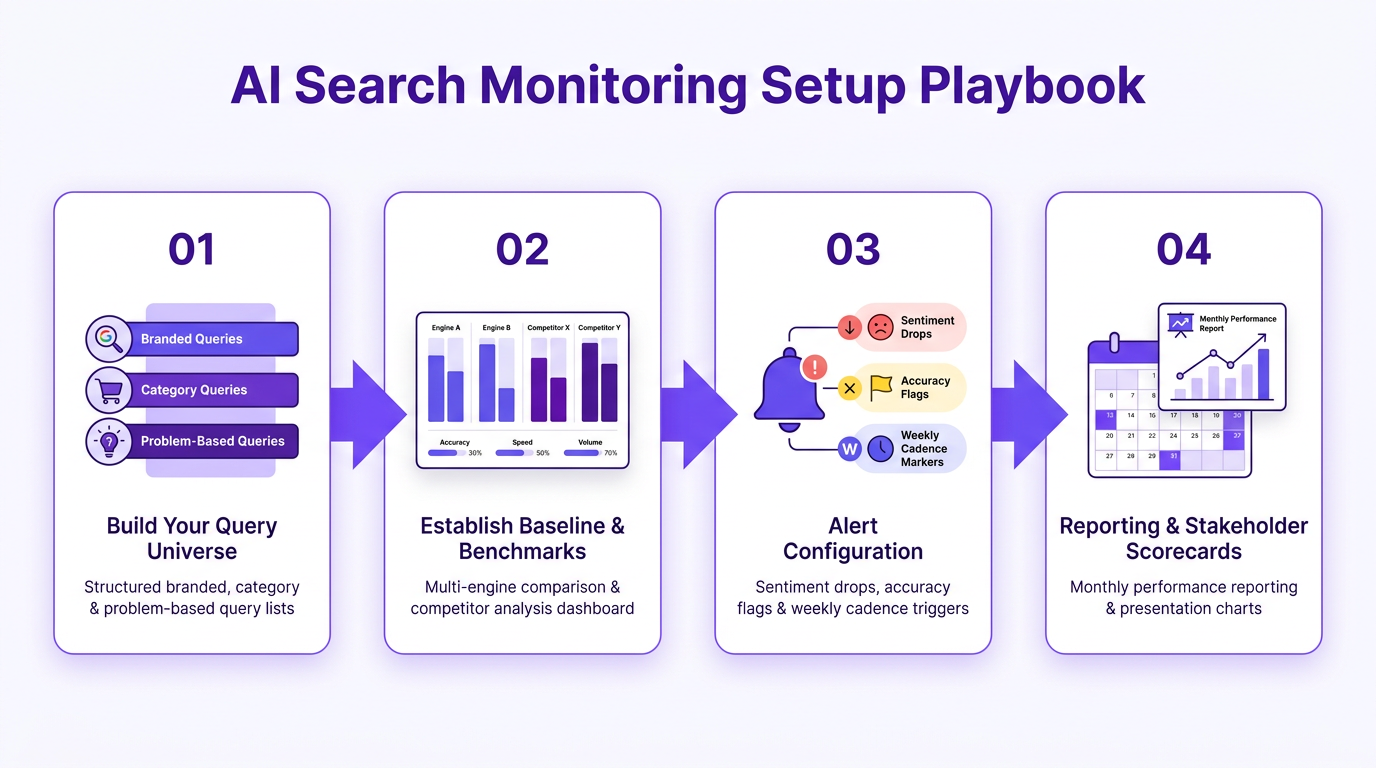
Phase 1: Build Your Query Universe
Start with 50 to 100 queries split across branded, category, and problem-based types. Assign each query to a buyer-journey stage so reporting maps to how your pipeline actually works: awareness queries introduce you to people who don’t know you yet, consideration queries show up when buyers compare options, and decision queries appear when someone is close to purchasing. If you sell across markets, add geographic variants ("best AI monitoring tool for UK brands") and industry phrasing for each vertical. This query set becomes your monitoring spine, so it’s worth getting right before you touch tooling.
Phase 2: Establish Your Baseline and Set Benchmarks
Run an initial sweep across your target engines and capture mention rate, sentiment accuracy, and citation rate for each one. Then run the same query set against two or three direct competitors. That’s the step that turns “interesting data” into an actual strategy, because you can see where you’re losing, and to whom. Vizup’s dashboard automates baseline reporting, which matters when you’re running the same set across five engines. If you want broader context, the AI search visibility optimization playbook is a good starting point, as this baseline phase is usually where the biggest gaps show up.
Phase 3: Alert Configuration and Accuracy Monitoring
Set alerts around three triggers: a week-over-week brand mention drop of more than 10%, emerging negative sentiment patterns, and factual inaccuracies in how the engine describes your brand. Accuracy alerts (hallucinations) are the feature teams most often ignore, and the one that can save you the most pain. A workable cadence looks like this: daily alerts for accuracy issues, weekly reporting for share-of-voice movement, and monthly scorecards for stakeholders. For the first 30 days, treat accuracy as the priority; you can’t correct what you don’t catch.
How to Actually Improve Your Brand's Visibility in AI Search
Monitoring alone just tells you what’s happening. To change the outcome, the strategies that reliably move AI mention rates are structured authority content, third-party citation building, and schema markup that makes your entity unambiguous. Many teams wonder how answer engine optimization works in 2026, and it's because the engines are pulling from different signals, so the levers change too.
Note: "AI engines don’t rank pages. They synthesize sources. Your job is to become the source they trust."
In retrieval, structured and factual tends to beat sprawling opinion. FAQ pages and definition-style content get cited disproportionately by Perplexity and Google AI Overviews, per CXL's comprehensive AEO guide. Schema markup (Article, FAQPage, Organization) also helps engines attribute content to the right entity, instead of treating it like another generic source. If you want a full framework on how to improve brand visibility in AI search, start with entity clarity; it’s the highest-leverage fix most teams can make quickly.
Off-Site Authority: Why Third-Party Mentions Are the New Backlinks
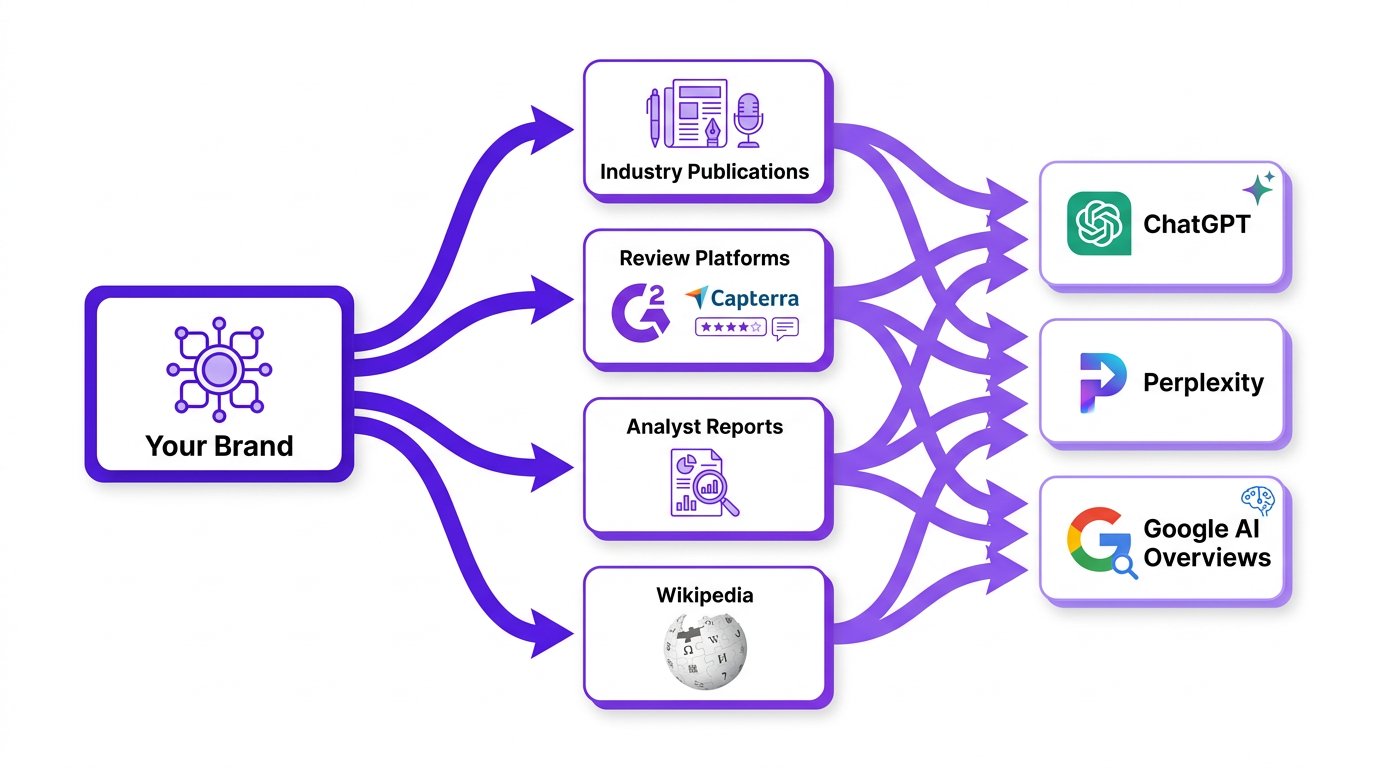
AI engines tend to trust what trusted sources say about you. That means mentions on high-authority third parties, industry publications, review platforms like G2 and Capterra, analyst reports, and Wikipedia, carry outsized weight. A practical way to prioritize: look at which sources your competitors are being cited from inside AI responses, then go after the same sources. The idea isn’t new, but the execution is: you’re chasing editorial mentions and clean, structured profiles, not just inbound links. Vizup’s competitive monitoring surfaces this directly by showing which third-party sources are driving competitor citations so you can focus outreach where it’s most likely to change the model’s answer. These tactics are covered in detail in various AI content strategy frameworks.
Advanced: Edge Cases, Hallucinations, and What Happens When AI Gets You Wrong
Hallucinations are real, and they’re still treated like a novelty. Engines will describe brands inaccurately, swap your features with a competitor’s, or repeat outdated pricing and discontinued plans. One pattern that shows up often in monitoring data: a SaaS company finds that ChatGPT routinely recommends a competitor for a use case where the company actually leads. That’s fixable, but only if you’re measuring it.
Once you spot a hallucination, the correction playbook is straightforward but not instant. First, update the sources the engine is most likely pulling from: your site, Wikipedia (if applicable), and major review profiles. Next, tighten entity disambiguation with structured data so attributes attach to the right brand. Then use PR to generate corrective coverage in high-authority publications that states the facts clearly. Model-version shifts are the other advanced variable teams miss. A GPT model update can move your visibility overnight, so track the serving model version when you can, it helps you separate “we broke something” from “the model changed.”
Warning: Edge case for multi-brand companies: AI engines often blur parent brands and sub-brands, mixing features or pricing across entities. The fix is entity-level monitoring with separate query sets per brand, not a single keyword list for the whole company.
Reporting AI Search Performance to Stakeholders
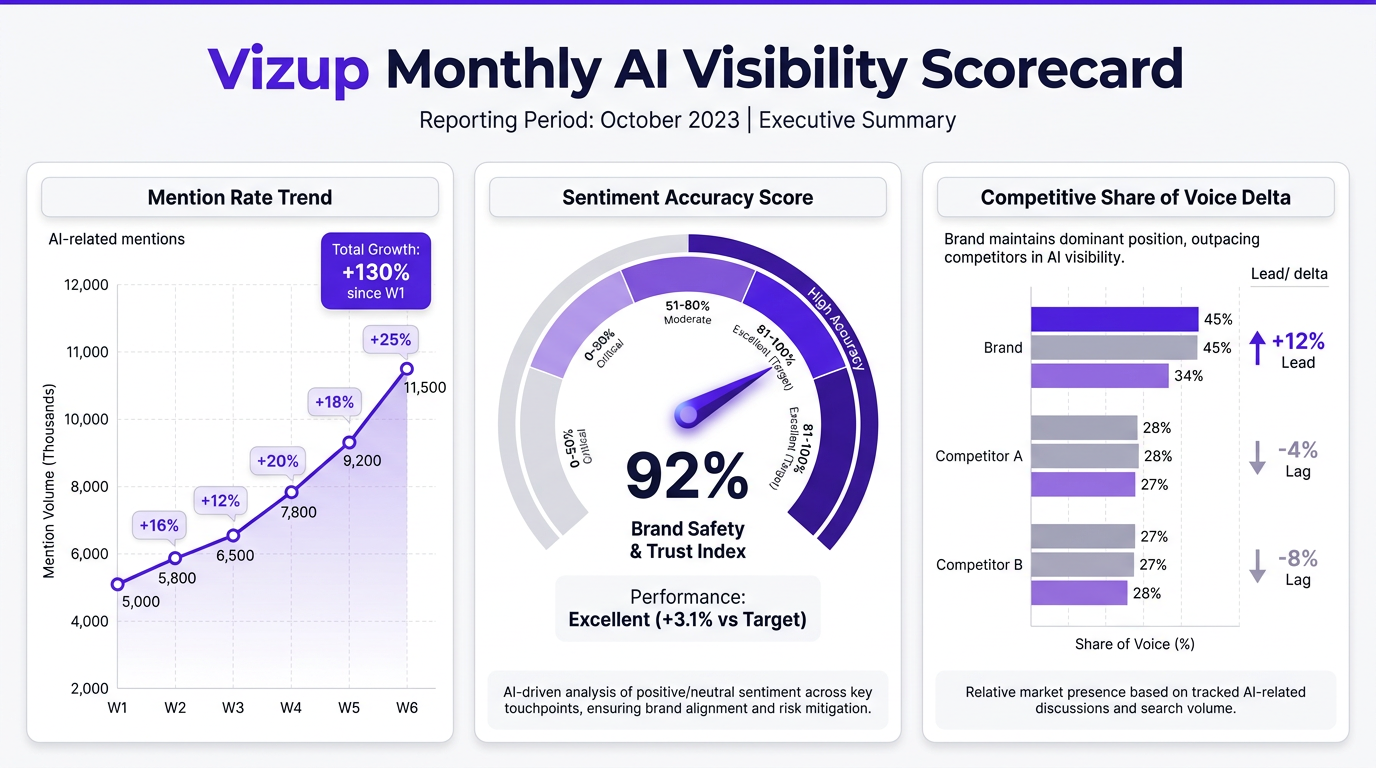
Most executives don’t have a mental model for “AI mention rate” yet, so don’t lead with jargon. Translate the story into concepts they already track: share of voice, brand safety, and pipeline influence. A clean monthly scorecard can stick to three metrics: mention rate trend (are we showing up more or less than last month?), sentiment accuracy score (is the model describing us correctly and favorably?), and competitive share-of-voice delta (are we gaining or losing against named competitors?). Vizup’s exports are built to be stakeholder-ready, which cuts out the manual formatting that usually slows reporting down. If you’re also managing paid channels, the 2026 migration guide for AI ads is a useful companion for connecting organic AI visibility to paid search strategy.
Your Next Steps in AI Search Monitoring
Five core principles to guide your strategy:
- AI search monitoring is a distinct discipline. It tracks brand presence inside AI answers, a layer invisible to traditional SEO tools.
- Different engines require different strategies. ChatGPT, Perplexity, and Google AI Overviews each have unique retrieval behaviors and trust signals.
- Monitoring requires sampling. The probabilistic nature of AI responses means you must test queries multiple times to get a reliable baseline.
- Accuracy is as important as presence. Detecting and correcting AI hallucinations about your brand is a critical brand safety function.
- Third-party authority is a key signal. Mentions in trusted publications, analyst reports, and review platforms heavily influence AI citation rates.
Your 30-day action plan is straightforward. Week 1: Choose a monitoring tool and build a query list of 50-100 terms covering your brand, category, and customer problems. Run your first baseline report. Week 2: Benchmark against two to three direct competitors using the same query list to identify share-of-voice gaps and find inaccurate brand descriptions. Week 3: Based on your findings, update your website content, improve schema markup, and correct information on key third-party sources. Week 4: Deliver your first stakeholder report focused on three key metrics: mention rate trend, sentiment accuracy, and competitive share-of-voice.
Frequently Asked Questions About AI Search Monitoring
What is the difference between AI search monitoring and traditional SEO?
AI search monitoring focuses on tracking brand mentions, sentiment, and accuracy within AI-generated answers, while traditional SEO tracks rankings in a list of web links. The optimization strategies differ because AI engines synthesize information from multiple sources, meaning a top Google rank doesn't guarantee visibility in an AI response.
Is AI search monitoring feasible for small businesses?
Yes. Small businesses can begin with affordable tools, focusing on a core set of 20-30 critical queries and the one or two AI engines their audience uses most. Manual spot-checking is a practical way to start and build a business case for dedicated monitoring software.
How can I correct inaccurate information about my brand in AI answers?
Start by updating the information on sources the AI is likely to trust, such as your own website, your Wikipedia entry, and profiles on major review sites like G2 and Capterra. Using structured data (Schema markup) on your site can also clarify brand information for AI engines. For persistent issues, generating corrective coverage in authoritative publications can help overwrite the inaccurate data over time.
Does good SEO on Google improve my brand's AI search visibility?
It can help, but it's not a guarantee. Strong Google SEO, especially with a focus on E-E-A-T signals, is beneficial for visibility in Google's AI Overviews. However, other engines like ChatGPT and Perplexity use different retrieval logic and may prioritize other signals, such as third-party validation or specific content structures. It's best to treat AI search optimization as a distinct discipline.
How is the ROI of AI search monitoring measured?
Measuring the ROI of AI search monitoring involves connecting AI visibility to business outcomes. This is typically done by correlating increases in AI mentions with growth in branded search traffic, analyzing referral data from AI platforms, and using post-conversion surveys to ask customers how they found you. While direct, one-to-one attribution is challenging, these methods demonstrate the influence of AI visibility on revenue.
