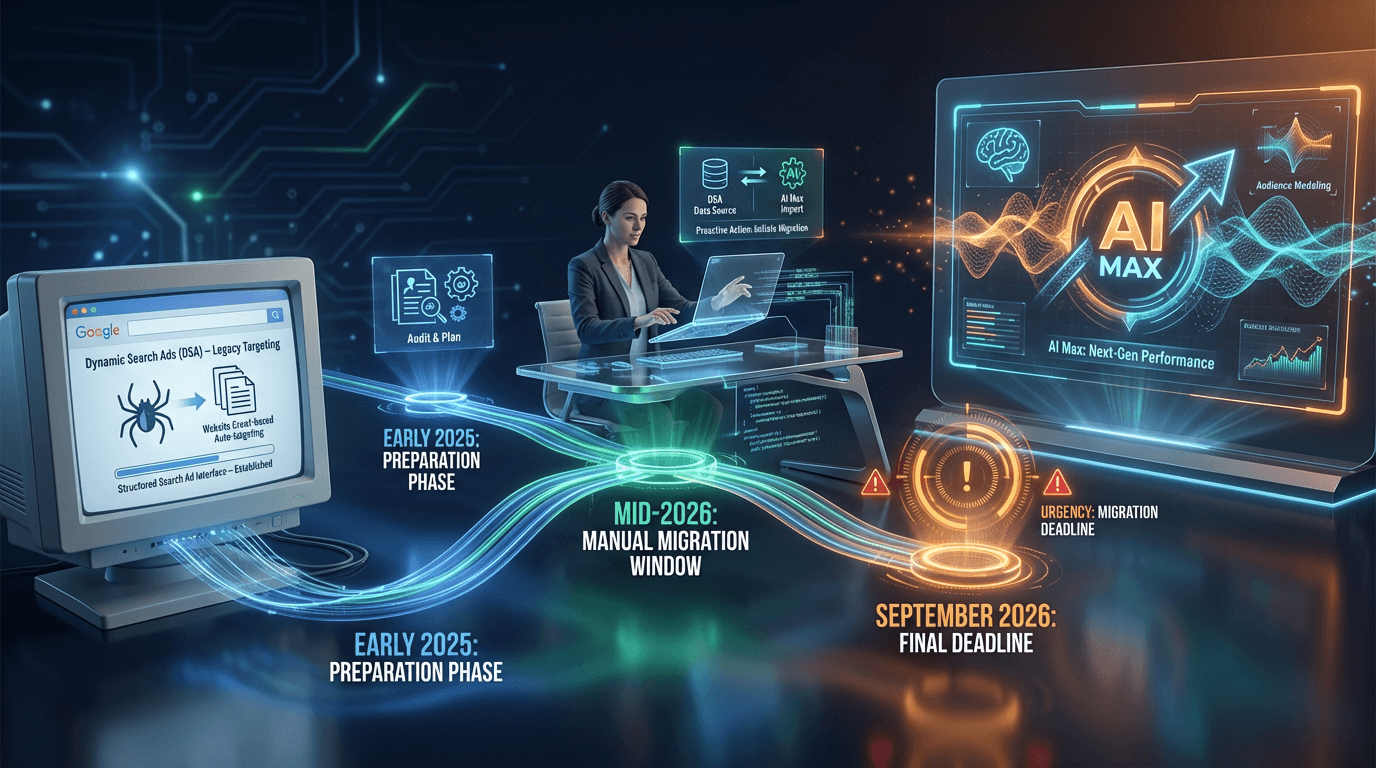
Google has officially announced that Dynamic Search Ads will be fully retired. Starting in September 2026, eligible DSA campaigns will be automatically upgraded to AI Max for Search. This is not a cosmetic name change. It is a fundamental shift from a system that primarily crawled your website to one driven by generative AI and broader intent signals. For SEM managers and business owners who need to replace Dynamic Search Ads with AI Max, the window to migrate on your own terms is open right now. Waiting for the forced upgrade risks budget waste, broken targeting, and performance dips that plagued past automatic migrations. This guide gives you the migration checklist, the key differences between DSA and AI Max, and the strategic playbook to make the transition cleanly and confidently before the deadline hits.
Below, you will find a breakdown of the technology differences between DSAs and AI Max, a step-by-step migration checklist, a comparison table, and guidance on what happens if you wait for the automatic switch.
What Dynamic Search Ads Actually Did (And Why Google Is Killing Them)
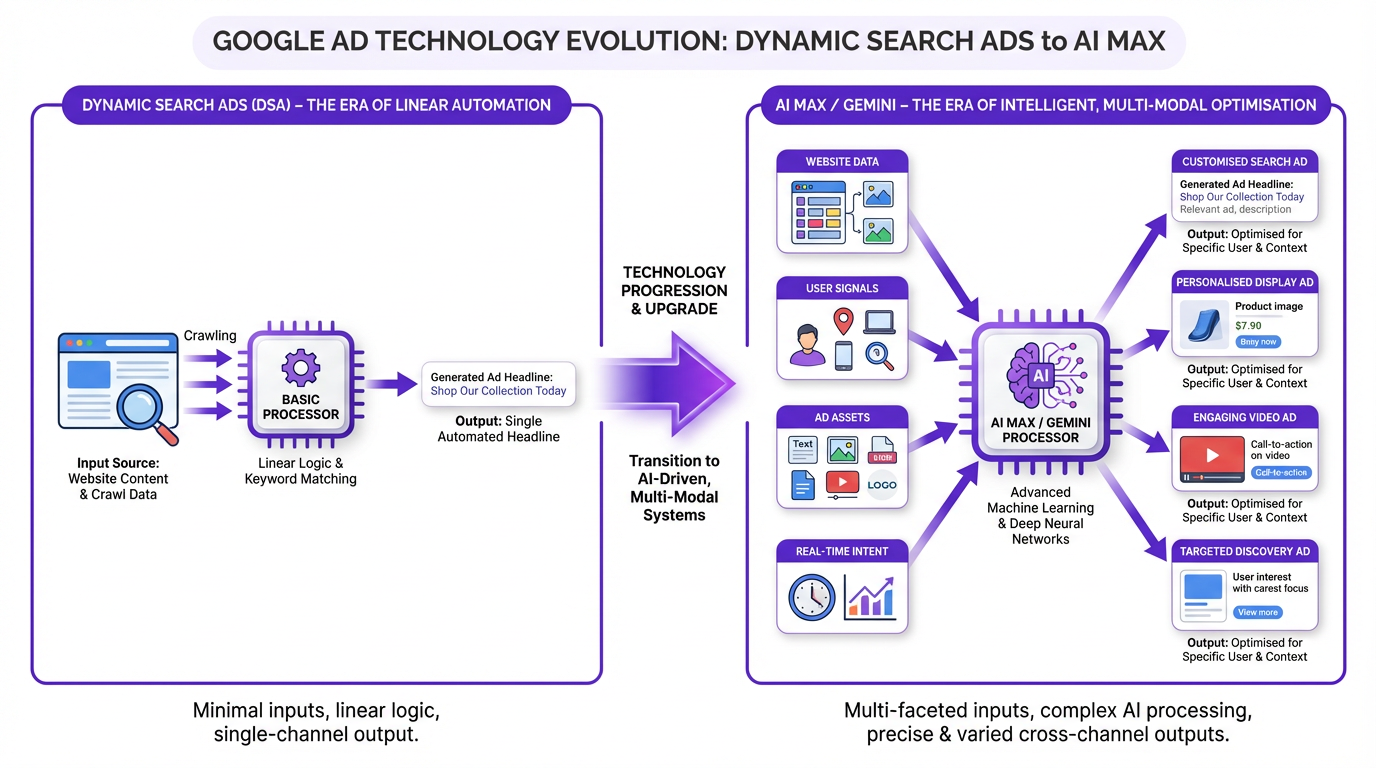
For anyone who inherited a DSA campaign, the function was straightforward. Dynamic Search Ads worked by crawling your website or a specific page feed. Instead of bidding on keywords, you let Google match user queries to your site's content and automatically generate a headline. This made DSAs an essential tool for advertisers with large product inventories or complex service offerings, ensuring coverage for long-tail searches that were impossible to target manually with individual keyword bids.
An honest assessment, though, reveals that DSAs were often powerful but clumsy. Common complaints included wasted ad spend on irrelevant pages (like clicks to an "About Us" page for a product query), mismatched headlines that confused users, and a frustrating lack of granular control over which queries triggered which ads. While effective at capturing broad traffic, DSA campaigns demanded constant vigilance with negative keywords and URL exclusions to deliver efficient results.
The sunset of DSAs makes strategic sense within Google's broader AI push. AI Max absorbs the core crawl-and-match logic but enhances it significantly. It uses Google's Gemini models for more sophisticated, context-aware creative generation and layers on a wider array of real-time intent signals beyond just your website content. The result is not a replacement of DSAs so much as an evolution of them into a smarter, more integrated function within standard Search campaigns.
Google AI Max for Search: What's Actually Different Under the Hood
AI Max is not a DSA rebrand. It is a feature suite that lives inside standard Search campaigns, changing how query matching and ad creation work at a fundamental level. Three core differences set it apart: Gemini-powered creative generation that writes contextually relevant headlines and descriptions, expanded search term matching that looks beyond your site's content to interpret broader user intent, and consolidation at the campaign level (no more separate Dynamic Ad Groups). Google states that advertisers who use the full AI Max feature suite see an average of 7% more conversions compared to using only its search term matching feature alone.
Understanding these differences is critical before you begin migration. The table below provides a direct comparison of DSA, AI Max, and Performance Max across the features that matter most to SEM managers.
| Feature | DSA | AI Max for Search | Performance Max |
|---|---|---|---|
| Query Matching | Based on website content/page feed | Website content + broader user intent signals | All Google signals across all channels |
| Creative Generation | Auto-generated headlines from page content | Gemini-powered headlines & descriptions | Fully automated asset mixing for all channels |
| Landing Page Selection | Dynamic based on query-to-page match | Dynamic, with Final URL Expansion toggle | Fully automated, very limited control |
| Negative Keywords | Full support | Full support | Limited support (campaign-level only) |
| Campaign Structure | Separate Dynamic Ad Groups | Integrated into standard Search campaigns | Standalone, all-in-one campaign type |
| Reporting Granularity | Good (search terms, landing pages) | Enhanced (asset reports, AI Max source) | Limited (“black box” feel) |
| Advertiser Control | Moderate | High (within Search) | Low |
AI Max for Search offers a middle ground, providing advanced AI features while retaining the control and transparency of traditional Search campaigns.
The key takeaway from this comparison: AI Max gives you the AI-driven reach of Performance Max with the transparency and control of standard Search campaigns. That combination is why this migration is worth doing proactively rather than waiting for the automatic switch.
The Two-Phase Timeline: DSA Migration 2026 Explained
Google has structured the transition into two clear phases, giving advertisers time to adapt. Knowing where you are on this timeline determines how much control you retain over the process.
- Phase 1 (Now through August 2026): Voluntary Upgrades. The migration tools are rolling out now. You can manually upgrade your DSA campaigns and ad groups to AI Max. This is the recommended path because it lets you port over historical settings, configure new controls, and test performance before going all-in.
- Phase 2 (Starting September 2026): Automatic Upgrades. Google will disable the creation of new DSA campaigns and begin automatically upgrading any remaining ones. These force-upgraded campaigns will have AI Max enabled with default settings. Based on past forced migrations, this automated process rarely captures the nuance of a carefully built campaign.
The message is clear: Phase 1 is your opportunity to own the transition. Phase 2 is Google owning it for you.
What Most Advertisers Get Wrong About This Migration
Drawing from past forced migrations (like Smart Shopping to Performance Max), the same mistakes tend to repeat. Here are the three most common pitfalls to sidestep:
- Assuming the auto-upgrade will work perfectly. The automatic process will not replicate your custom page feed logic or nuanced negative keyword structures with the same care you would apply manually. Waiting means letting Google's defaults dictate your strategy, and defaults are built for the average advertiser, not your specific account.
- Waiting until Q3 2026 to start testing. AI Max behaves differently from DSAs, especially during its learning phase. You need at least 4 to 6 weeks of parallel testing to gather enough data to understand its performance patterns. Starting early gives you time to iterate. Starting late gives you time to panic.
- Treating this as a PPC-only task. AI Max depends even more heavily on your site's content than DSAs did. Thin content, broken links, or poor SEO hygiene will be exposed when AI Max sends paid traffic to those weak spots. This transition requires coordination with your SEO or web development team. For guidance on optimizing your site's content foundation, consult Moz's guide on content auditing.
How to Replace Dynamic Search Ads With AI Max: Your Migration Checklist
This is the actionable core of the guide. Follow these four steps for a controlled, data-informed transition from DSAs to AI Max.
Step 1: Audit Your Current DSA Performance
Before touching anything, establish a benchmark. Pull at least 90 days of performance data from your DSA campaigns. Export search term reports, landing page reports, and conversion data. This becomes your baseline for measuring success after the migration. Identify which ad groups and search clusters drive real conversions (not just clicks) and archive this information now. Once the migration happens, historical DSA-specific reporting may become harder to access.
Step 2: Clean Up Your Site Before Google's AI Crawls It Again
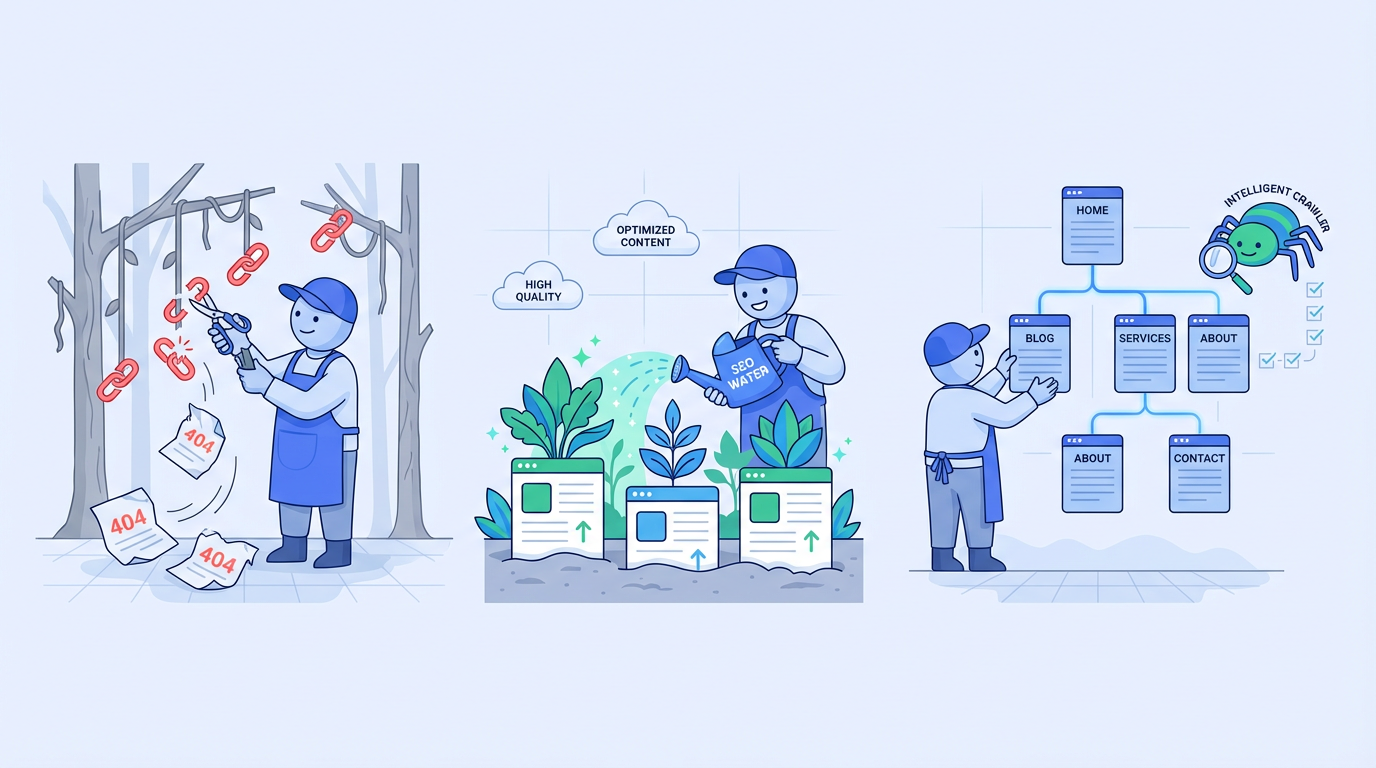
AI Max's performance is directly tied to your website's quality. Since Gemini will use your page titles and H1s to generate ad copy, ensure they are clear, specific, and intent-focused. Apply "noindex" tags on pages you do not want as landing pages (privacy policies, internal resources, career listings). If you use page feeds, audit and update them now to reflect your current product or service catalog. This is also the ideal time to align with your SEO team by building an AI-powered SEO strategy that ensures your most valuable pages are perfectly optimized for both organic and paid discovery.
Step 3: Run AI Max as a Parallel Test (Don't Just Flip the Switch)
The smartest move is not to upgrade your main campaign directly. Instead, create a campaign experiment or duplicate your DSA campaign and enable AI Max on the new version. Let it run alongside your existing DSA campaign for 4 to 6 weeks. This side-by-side comparison allows you to judge performance on key metrics like CPA, conversion rate, and ROAS. Monitor the search term insights report aggressively during this test. AI Max will surface new queries you have never targeted before, and you will need to build your negative keyword list early to prevent wasted spend on irrelevant traffic.
Step 4: Lock Down Your Controls
Before scaling up your AI Max budget, configure the new control features carefully. Set up brand exclusions to prevent showing for competitor terms (if that aligns with your strategy). Use URL-level exclusions to block specific pages from being used as landing pages. Most importantly, be cautious with the "Final URL expansion" setting. Starting with it wide open can cause performance problems as the AI sends traffic to untested pages. Begin with it turned off or restricted to a specific, vetted URL feed, then expand gradually as you gather data.
Opinionated Take: The Real Differentiator is Holistic Strategy, Not a New Button
Here is a real-world example of what this looks like in practice. For a B2B tech client, AI Max started pulling in traffic for hyper-specific technical queries that our organic content was not yet ranking for. It was a goldmine of top-of-funnel intent we had previously missed entirely. But it only became profitable once we connected it to our CRM. By setting up offline conversion imports, we trained the AI to optimize for "Sales Qualified Leads," not just "Demo Request" form fills. The cost per qualified lead dropped by 22% within six weeks. This is the new table stakes: the tool itself is not the advantage. The advantage comes from integrating it into your entire marketing and sales system.
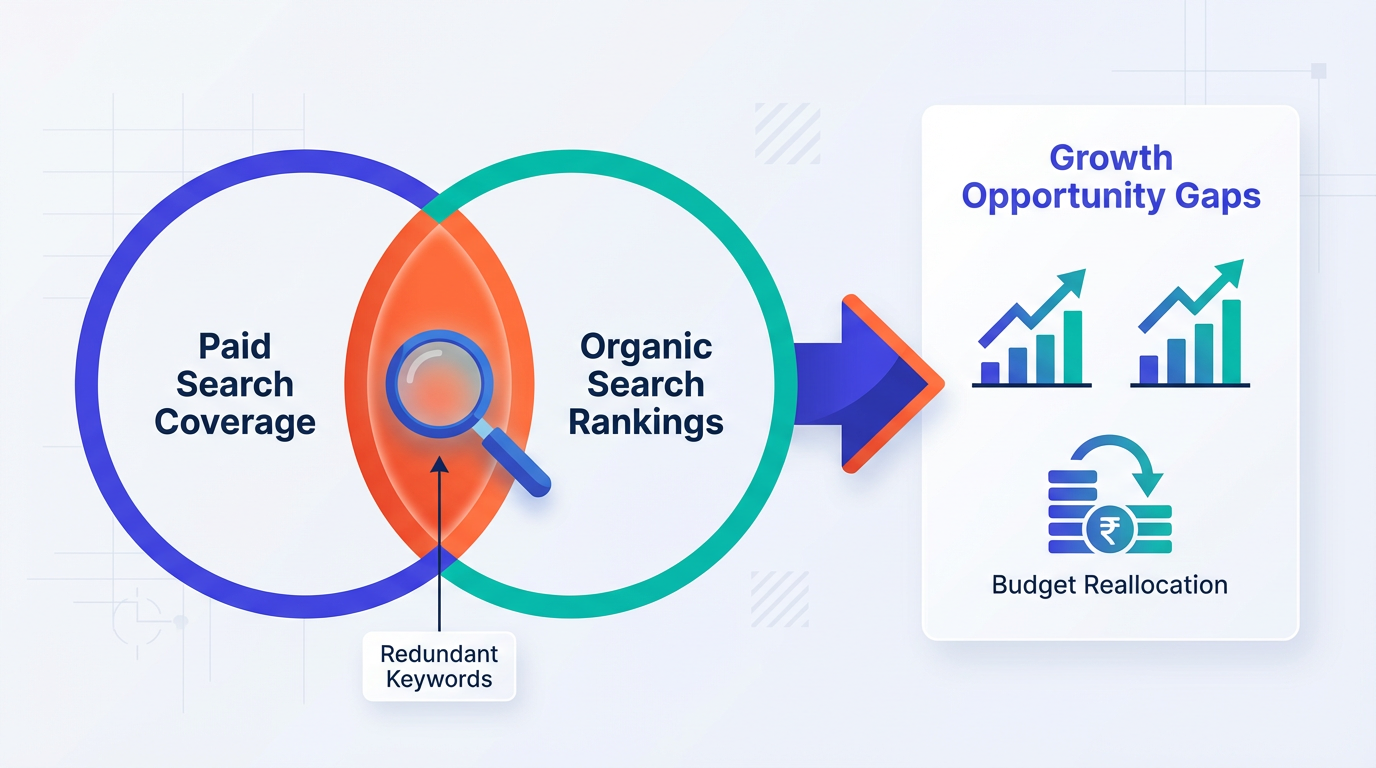
This is also where paid and organic strategies must intersect. AI Max will increasingly surface ads for queries where you already have strong organic rankings. Understanding this overlap is essential for efficient spending. Using an AI-powered organic marketing platform like Vizup can help you identify where your SEO is strong enough that paid coverage is redundant. That insight allows you to reallocate budget to fill genuine gaps where AI Max can drive incremental growth, a core principle of adapting to how AI is changing the search landscape.
Google Ads September 2026: What Happens If You Do Nothing
If you do nothing, your DSA campaigns will be automatically upgraded to AI Max in September 2026 with default settings you did not choose. Your ad group structures may be flattened. Your negative keyword lists may not transfer completely. Your carefully segmented page feeds could be ignored in favor of broad Final URL expansion. This is not speculation. It is the observed reality from past forced migrations in Google Ads (the Smart Shopping to Performance Max transition being the most recent example). Advertisers who waited through that migration often experienced 2 to 4 weeks of performance instability that proactive advertisers completely avoided.
The bottom line: waiting costs you control, data continuity, and potentially weeks of wasted budget during the learning period.
FAQ: Replacing Dynamic Search Ads With AI Max
Will my DSA negative keyword lists transfer to AI Max automatically?
Google states that settings will be ported over, but relying on this is risky. Best practice is to manually audit and apply your negative keyword lists to the new AI Max-enabled campaigns during a controlled test. Do not assume a perfect transfer.
Can I run Dynamic Search Ads and AI Max simultaneously during the voluntary phase?
Yes, and you should. The recommended approach is to use Google's campaign experiments feature to run an AI Max test alongside your existing DSA campaign. This allows you to compare performance directly for 4 to 6 weeks before committing to a full migration.
How is AI Max for Search different from Performance Max campaigns?
AI Max is a feature set within standard Search campaigns, giving you AI-powered enhancements while maintaining control over your search strategy. Performance Max is a separate, fully automated campaign type that runs across all of Google's channels (Search, Display, YouTube, etc.) with much less transparency and control. You can learn more about PMax on the official Google Ads Help page.
What happens to my DSA page feeds after the September 2026 migration?
Your page feeds can still be used with AI Max to control URL expansion. During the manual migration, you can specify that AI Max should only select landing pages from your feed. This is a key control lever, especially in the early stages of testing.
Do I need to rewrite my ad copy for AI Max, or will it generate everything automatically?
AI Max will use its AI to generate headlines and descriptions based on queries and your landing page content. However, you still provide responsive search ad assets (headlines and descriptions) that the AI uses as a foundation and inspiration. Your inputs guide the AI's output, making your provided assets more important than ever.
What is the best way to start the DSA to AI Max migration?
Start by auditing your current DSA performance data and cleaning up your website content. Then create a parallel AI Max test campaign and run it for 4 to 6 weeks alongside your existing DSAs. This phased approach lets you compare results and configure controls before fully committing to the new system.
Should I turn on Final URL expansion right away in AI Max?
Final URL expansion allows AI Max to send traffic to any page on your site it deems relevant, not just the pages you specify. Starting with it turned on broadly can lead to wasted spend on low-converting pages. Begin with it restricted to a vetted URL feed and expand gradually based on performance data.
Your Next Move
The transition from Dynamic Search Ads to AI Max is a mandatory evolution. Acting now puts you in control of how it unfolds for your account. The smart window for testing and migration is the next few months, well before the September 2026 deadline. Your plan to replace Dynamic Search Ads with AI Max boils down to four actions: audit your current performance, prepare your website, run a parallel test, and configure your controls before scaling up.
As you work through this shift, remember that generative AI for marketing is becoming central to both paid and organic channels. To get ahead, start exploring how a platform like Vizup can help you master the intersection of AI-powered search and paid media to drive holistic growth. For more foundational strategies on managing your campaigns effectively during and after this transition, learn how to reduce ad costs with smarter SEO campaign management.
