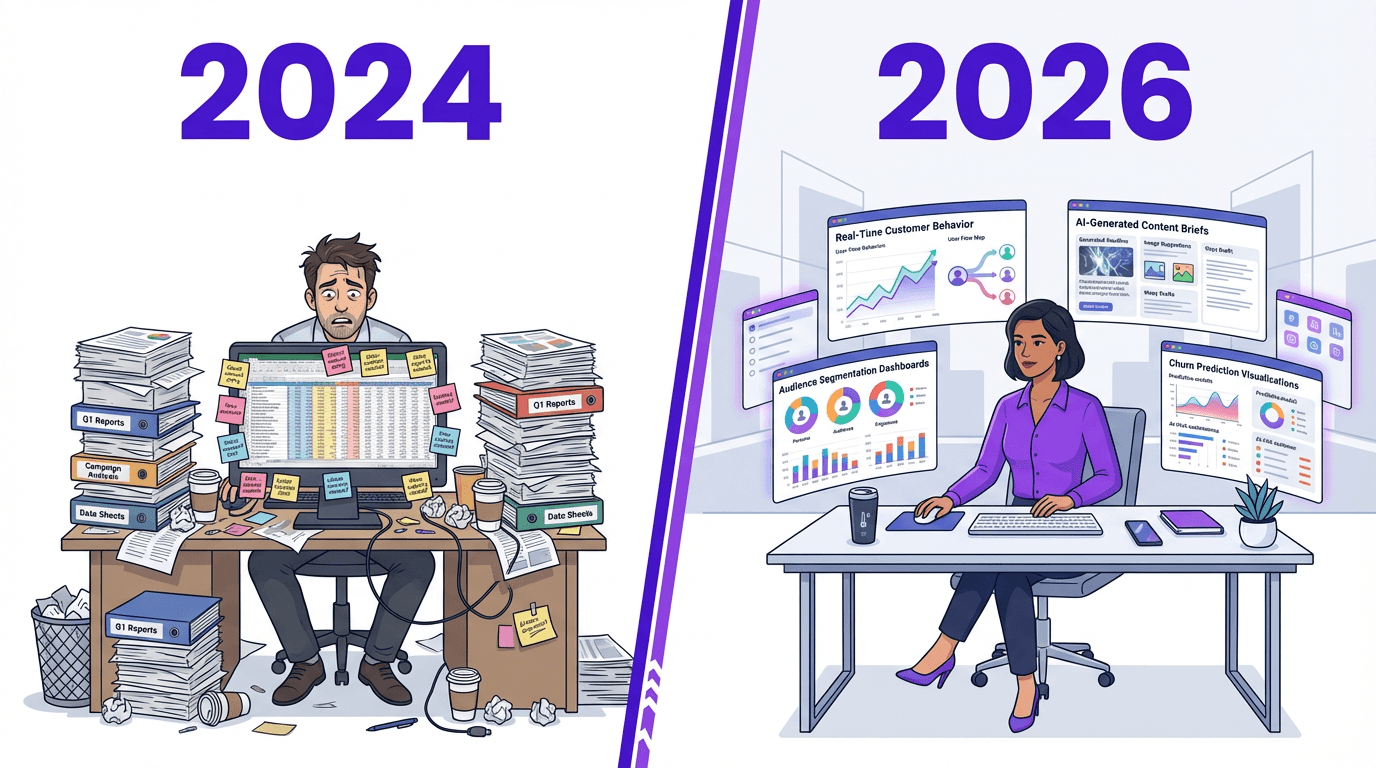
Four people. Two blog posts a month. One email campaign per quarter. I heard that exact story from a marketing lead last year, and the frustrating part was how normal it sounded. They weren't lazy, they were stuck in planning loops and reporting busywork.
By early 2026, with no new hires, that same team was producing 20 pieces of content a month, running personalized email sequences across six audience segments, and catching churn signals two weeks before customers actually left. The difference wasn't budget. It was how they used generative AI for marketing, not as a content vending machine, but as the connective tissue between their data and their decisions.
The goal here is simple: build a system where customer signals turn into decisions fast, and those decisions show up in content and campaigns that feel specific. Most teams start with writing tools, then wonder why the output feels hollow. Start with customer intelligence instead, then let content generation and automation earn their place.
What Generative AI for Marketing Actually Means in 2026
The first wave of AI in marketing (roughly 2021 to 2023) was mostly automation and basic personalization: insert first name, trigger an email on cart abandonment, score leads by firmographic fit. Useful, but incremental.
What changed is the reasoning layer. Generative AI, as McKinsey describes it, doesn't just retrieve or sort information; it creates new content, including text, images, and code. In a marketing context, that means a system can read 3,000 customer support tickets, identify the three emotional themes driving cancellations, and draft a retention campaign brief, in about four minutes.
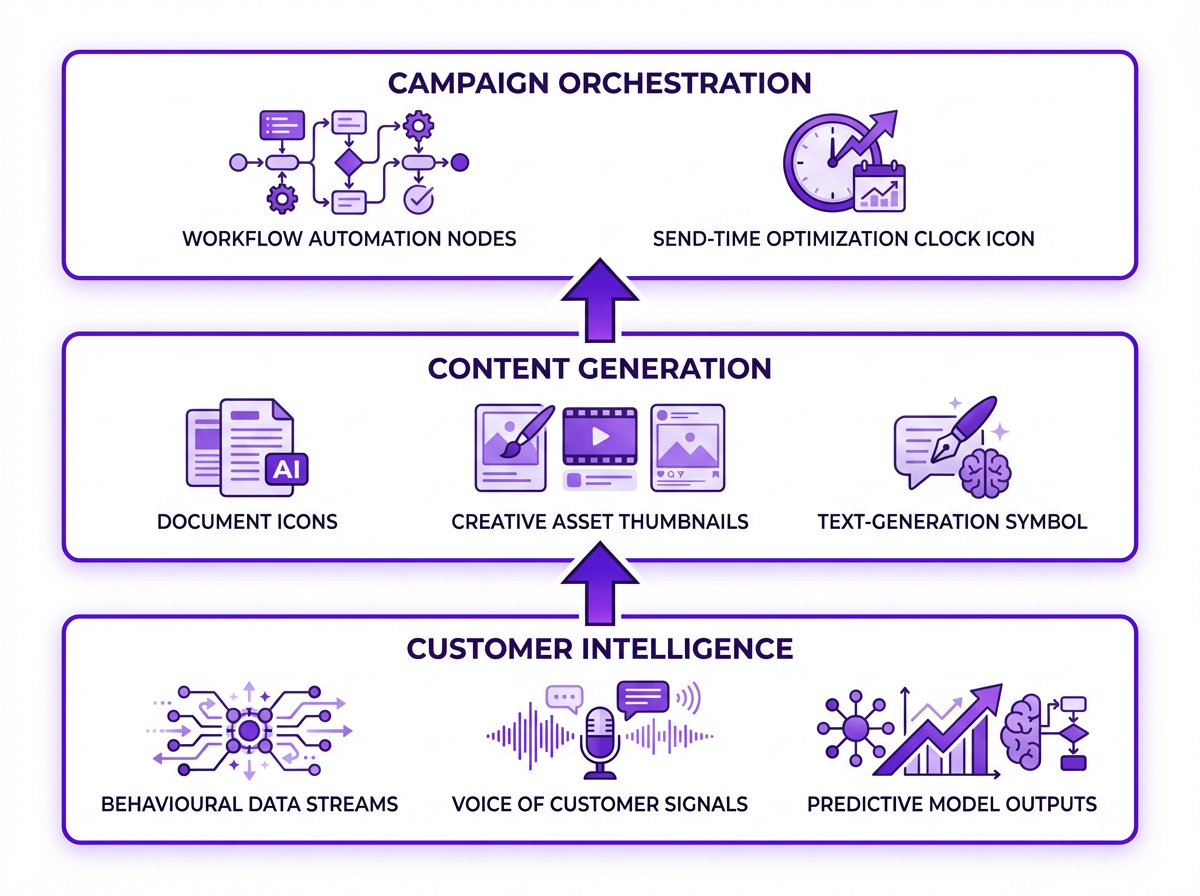
In 2026, three layers matter more than the rest: content generation (the obvious one), customer intelligence (the underused one), and campaign orchestration (the hard one). Teams pulling ahead aren't the ones collecting the most AI marketing tools. They're the ones connecting these layers into one workflow so insights actually change what gets shipped.
Building Your Foundation: AI-Driven Customer Insights Before Anything Else
The pattern is predictable. A team installs an AI writing tool, publishes more, and then stares at flat engagement. The content isn't terrible. It's just unmoored from what customers are doing, asking, and struggling with.
AI-driven customer insights are the foundation everything else sits on. Skip them and you're building campaigns on assumptions from 2022, then acting surprised when the market doesn't cooperate.
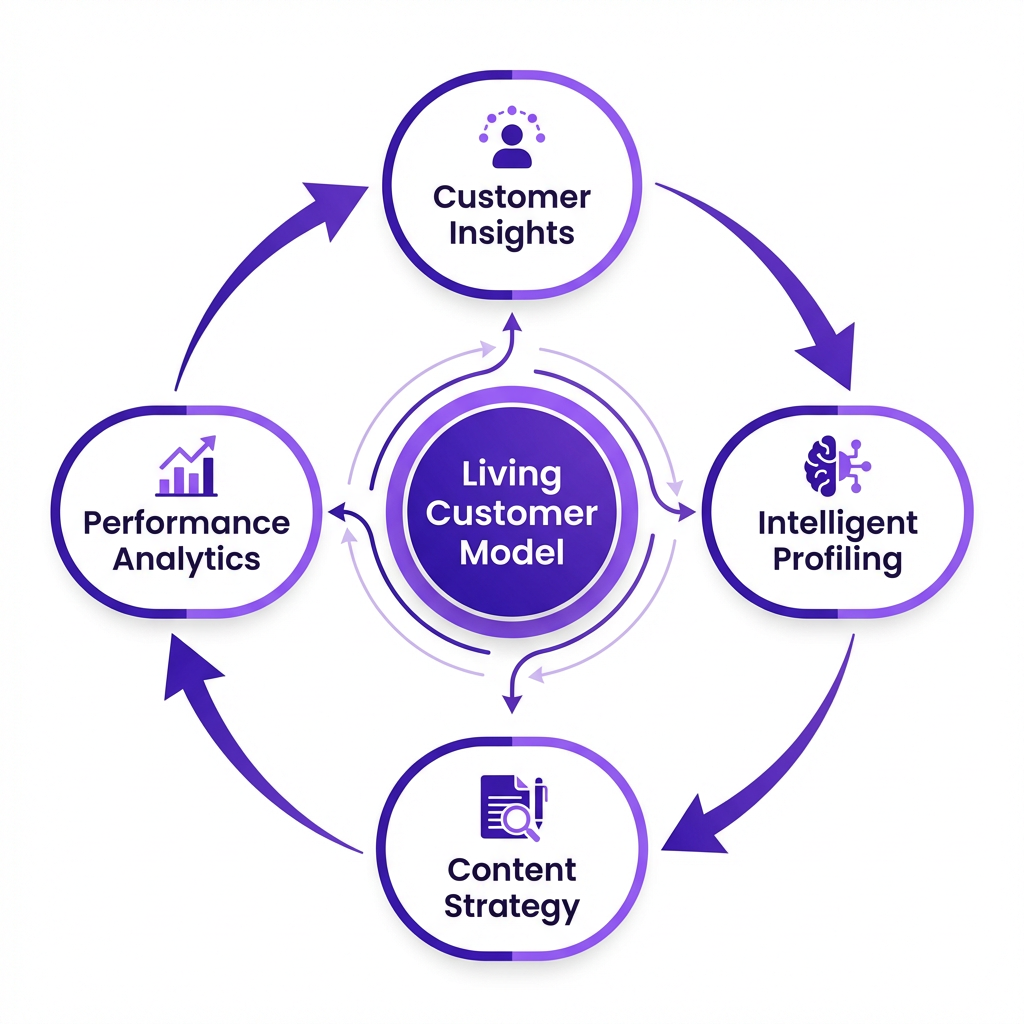
In practice, the foundation looks like a continuously updating picture of who your customers are, what they need right now, and where they're headed. Some teams call it a "living customer model." It pulls from behavioral signals on your site and product, intent data from third-party sources, support and sales conversation data, and cross-channel engagement patterns.
Not a quarterly persona refresh. Something that keeps pace.
Intelligent Customer Profiling: Beyond Demographics
Old-school persona building was educated guessing with a polished name. You'd run a survey, pull some CRM data, and produce a PDF called "Marketing Mary" that got used twice and then ignored.
Intelligent customer profiling replaces that with behavioral patterns, psychographic signals, and real-time context working together. The profile updates when a customer's behavior changes, not when someone remembers to schedule a research sprint.
Starting from scratch? Connect three sources first: your CRM activity log, website session data (especially scroll depth and exit pages), and email engagement history. That combination surfaces more useful segmentation than most demographic personas ever did.
Platforms like Vizup help automate this by generating detailed buyer personas from behavioral data rather than assumptions, connecting your CRM, analytics, and content engagement signals into a single profiling workflow.
Voice of Customer (VoC) Analytics with AI: Listening at Scale
A manual analyst working full-time might process 200 support tickets a week. An AI-assisted VoC workflow processes 10,000 and surfaces the top five friction themes by Friday afternoon. That's not a small efficiency win. It's a different category of visibility.
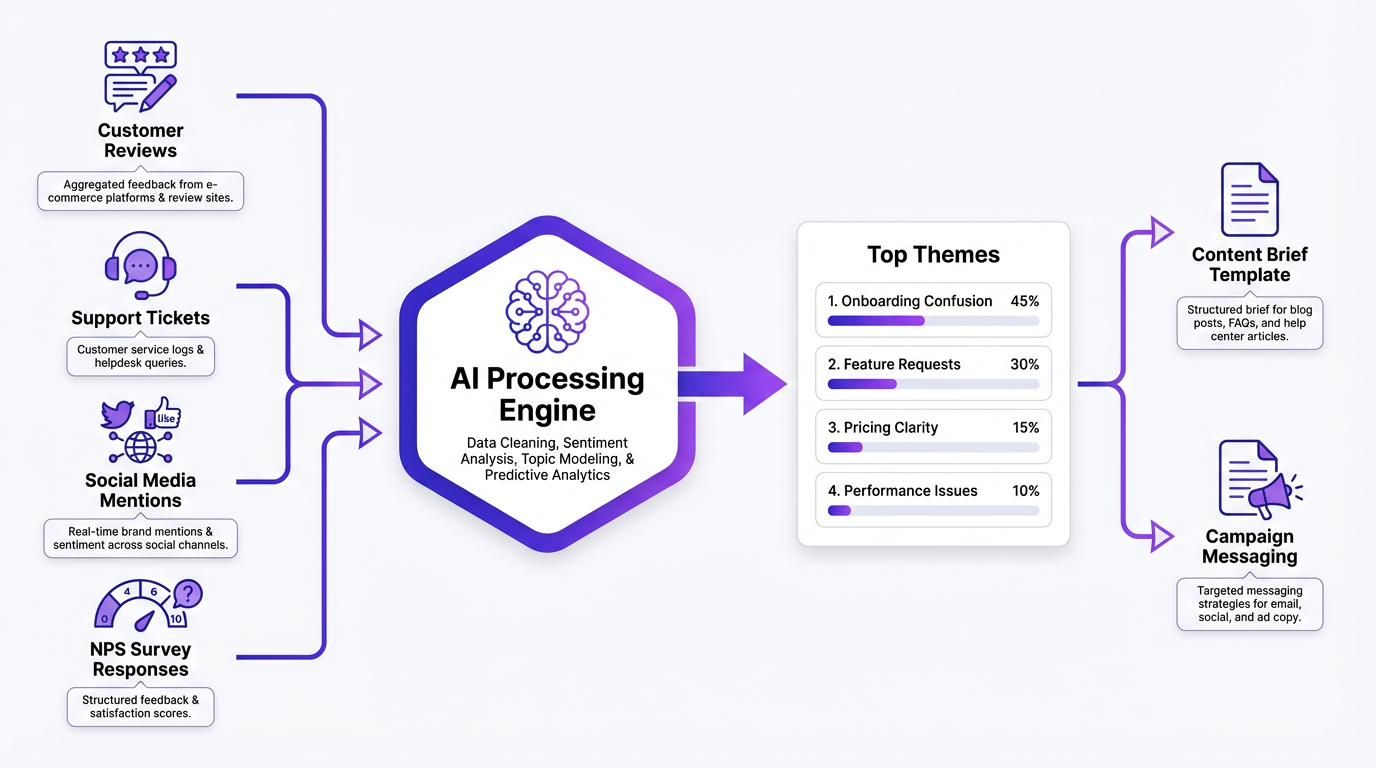
VoC analytics with AI pulls signal from reviews, support tickets, social mentions, NPS responses, and sales call transcripts, then returns a synthesized theme report instead of a spreadsheet nobody reads.
The part most people get wrong is what happens after the themes show up. A theme report that lives in a slide deck is just trivia.
Close the loop by piping VoC findings directly into your content brief template. If the AI surfaces "onboarding confusion" as a top theme three weeks running, your next three pieces of content should address that. Not because a strategist had a hunch, but because your customers keep telling you the same thing.
Predictive Customer Analytics: Stop Reacting, Start Anticipating
Predictive customer analytics changes the question from "who bought last month" to "who is likely to buy in the next 30 days, and who is about to leave." The three use cases that tend to show ROI fastest are churn prediction, next-best-action modeling, and lifetime value forecasting.
Churn prediction alone, wired into an automated retention workflow, can recover revenue that most teams don't even realize they're losing.
Customer Behavior Analysis with AI: Reading the Signals Your Team Misses
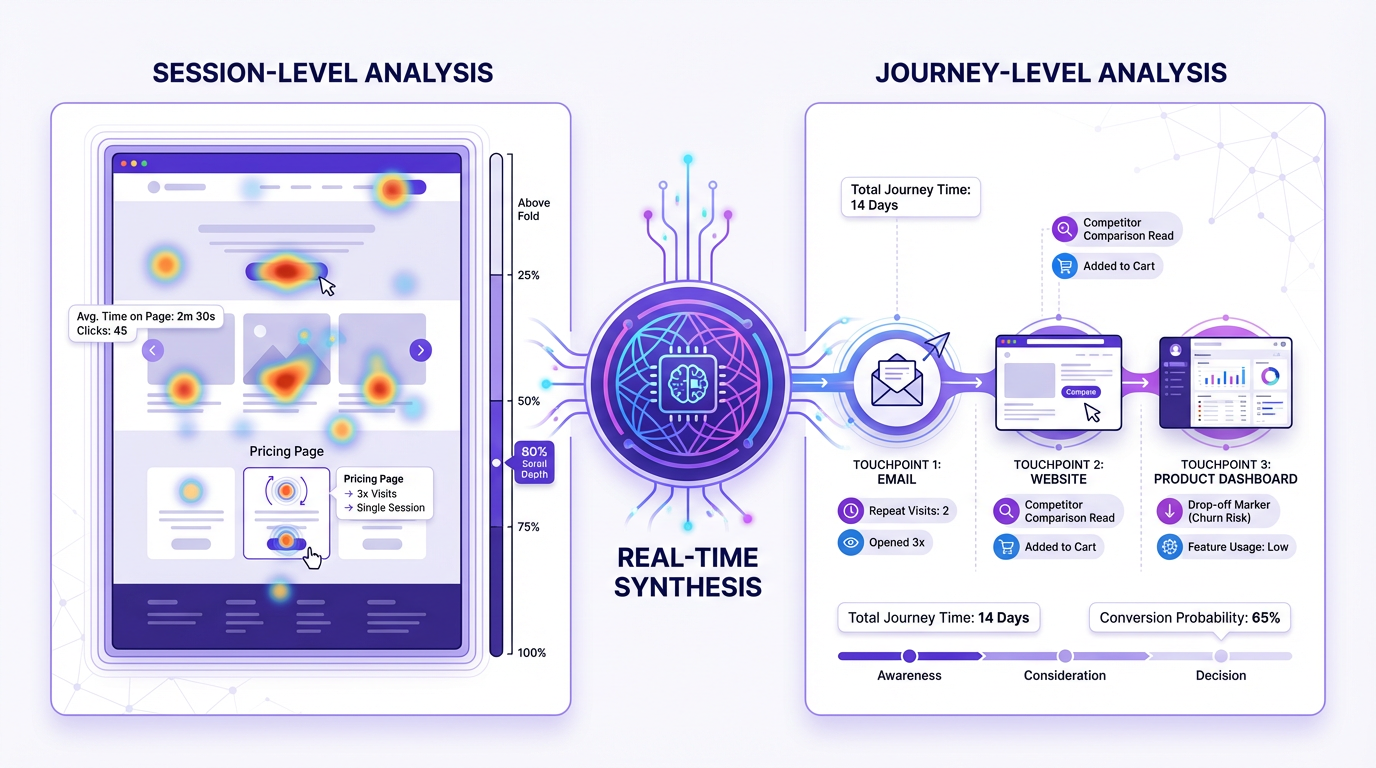
There's a class of behavioral signal humans rarely catch because it only becomes meaningful in aggregate. A single user who visits your pricing page three times in one session and then reads a competitor comparison post isn't a data point. Ten thousand users doing the same sequence in the same week is a buying intent signal your sales team should know about immediately.
Session-level analysis tells you what's broken in your UX. Journey-level analysis tells you what's working in your funnel. They answer different questions, so they should drive different decisions.
Keep the output blunt and operational. If a segment consistently drops off at a specific content type, stop producing that content type for them. If a micro-behavior predicts conversion, build an offer trigger around it. The contrarian bit: obsessing over average time-on-page is often a distraction. The sequence of actions matters more than the single metric.
Machine Learning in Marketing: The Engine Under the Hood
Most marketers are already using machine learning without realizing it. When your email platform picks the best send time for each subscriber, that's ML. When your ad platform adjusts bids in real time, that's ML.
The question isn't whether to use it. It's whether you're using it intentionally, with inputs you trust and outputs you actually act on.
Three ML-powered capabilities that genuinely move the needle in 2026 are dynamic segmentation (segments that update automatically as behavior changes, not just when you remember to rebuild them), content scoring (predicting which draft will perform best before you publish), and send-time optimization (not "Tuesday at 10am" for everyone, but per-subscriber timing based on individual open history).
These capabilities now sit inside most mid-tier marketing platforms, not just enterprise stacks. Vizup's AI-driven insights platform integrates content scoring and behavioral segmentation directly into its organic marketing workflow, so you don't need to wire up separate ML tools.
Custom model training is worth considering only if you have a genuinely unique data structure that off-the-shelf models don't handle well. Most teams are nowhere near that. The boring truth is that the built-in ML features they already pay for are underused.
AI Marketing Tools in 2026: Choosing What's Right for Your Stack
The tool landscape is crowded and easy to over-invest in. Teams running seven AI tools with overlapping capabilities often end up with a workflow more complicated than what they had before.
A practical evaluation comes down to three questions. Does it solve a real problem you have today? Can it connect to your existing data sources without a six-month engineering project? And does the price scale reasonably as you grow?
If you're tempted to stack point solutions, pause and map your "insight to content" path on a whiteboard. Where does it break? That's the tool you actually need.
Rather than stitching together separate tools for each function, look for a platform that handles the full pipeline. Vizup is built specifically for this: it connects behavioral data, CRM signals, and content performance into a single workflow, covering AI-driven customer insights, VoC synthesis, content brief generation, and SEO optimization. For SMB to mid-market teams focused on organic growth, it cuts the integration overhead that quietly eats weeks every quarter.
If your priority is building an AI-powered SEO strategy in 2026 and you want the insight-to-content pipeline in one place, Vizup is worth a serious look. The platform connects customer intelligence directly to content output, so the brief your writer receives already reflects what your audience actually cares about.
Match the platform to your bottleneck, not the feature list. Feature lists are how teams end up paying for three tools that all "generate content" and none that answer "what should we say."
Marketing Automation with AI: Where the Leverage Actually Lives
Reframe what automation is for. It's not about replacing tasks. It's about compressing the time between insight and action.
According to Salesforce, marketing automation uses technology to manage and streamline marketing activities across various channels. The AI layer makes those workflows dynamic, adjusting based on real-time behavior rather than static rules set six months ago.
One workflow that holds up in the real world looks like this: a VoC signal surfaces a new customer objection (say, pricing confusion), AI generates a content brief addressing that objection, a writer produces a draft the same day, and the piece goes live within 48 hours.
Without AI, that cycle takes two to three weeks. With it, you're responding while the conversation is still happening.
The common mistake is automating distribution before automating strategy. Teams set up email sequences and social scheduling first because it's visible and feels productive.
But if the content going into those sequences isn't informed by real customer intelligence, you're just distributing noise faster. Fix the insight layer first, then automate distribution.
A Workflow That Actually Works: Putting It All Together
Customer insights feed intelligent profiling. Profiling shapes content strategy. Content performance feeds back into analytics. Analytics refines the customer model.
It's circular by design. Each cycle makes the next one more accurate.
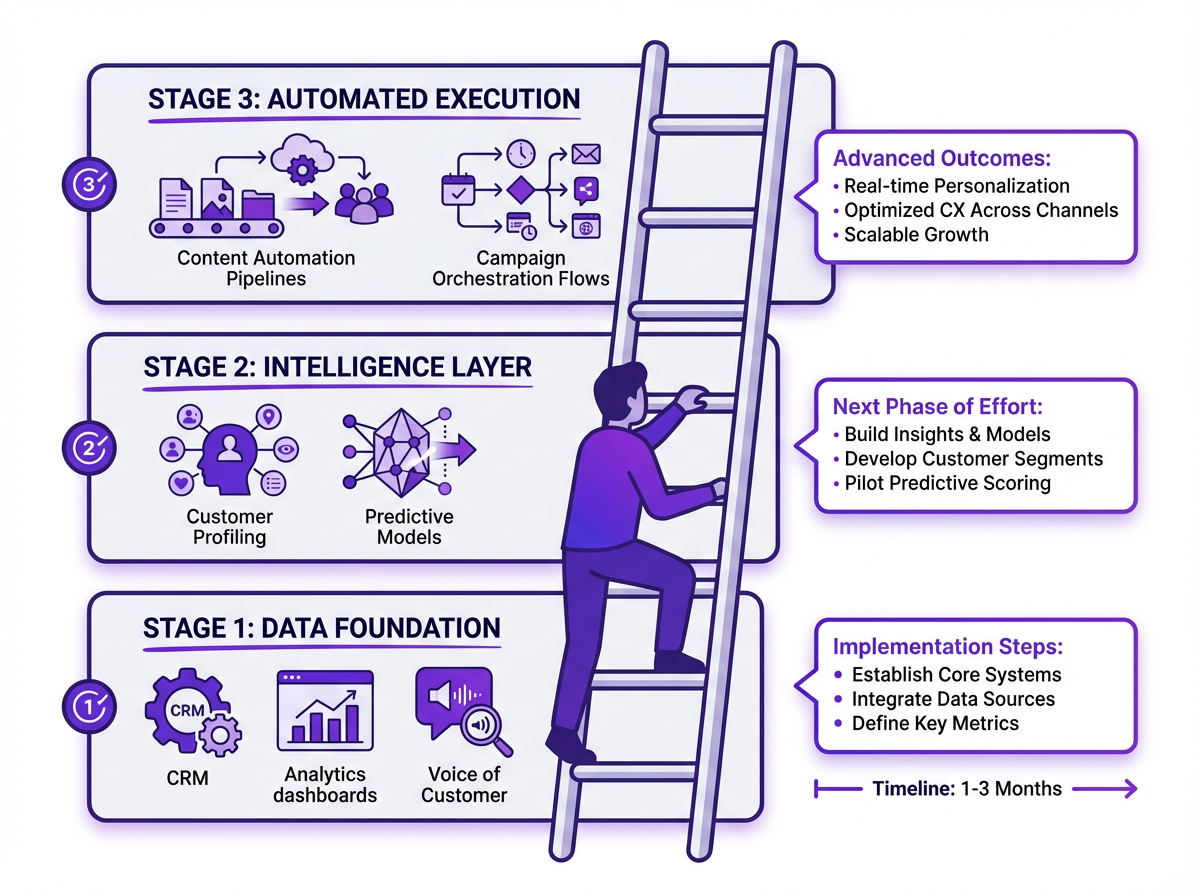
If you want a phased rollout that doesn't collapse under its own ambition, stage it.
Month one is about connecting data sources and getting a working VoC pipeline. Don't touch content automation yet. In the second quarter, layer in predictive analytics and start automating the brief-to-draft workflow. By the third quarter, you'll have enough behavioral data to run meaningful dynamic segmentation.
The biggest barrier is organizational, not technological. Someone has to own the insight layer, and that person needs the authority to redirect content priorities based on what the data shows.
I've seen teams spend weeks arguing about a content calendar while support tickets were screaming the real topics. Without ownership, AI tools become expensive toys that produce content nobody needed. The teams that see real returns from generative AI are the ones that also restructured who owns the data-to-decision workflow.
The Mistakes Most Teams Make When Adopting Generative AI for Marketing
Treating AI as a content volume machine is the most expensive mistake. Output quantity goes up, engagement goes down, and the team concludes that "AI doesn't work for us." It works fine. The strategy was wrong.
Skipping data quality work is a close second. If your CRM is a mess and your analytics tagging is inconsistent, every AI output built on that foundation will be generic at best and misleading at worst.
Teams that spend $40,000 on AI tooling and get outputs they could have generated with a basic template almost always share one thing in common: nobody cleaned the data first.
Third: buying too many tools before establishing a core workflow. Pick one workflow, run it end-to-end, measure it, and optimize it before adding anything else to the stack.
The teams winning with AI in 2026 are not the ones with the most sophisticated tech. They're the ones who figured out one loop that works and ran it consistently. If you want a practical starting point, the guide to AI marketing tools on Vizup's blog is a useful reference for evaluating what actually belongs in a lean stack.
Start Here, Not Everywhere
Early in adoption, start with one data connection and one insight workflow. Connect your support tickets to an AI summarization tool and run it for four weeks. Read the theme report. Then decide what content to create based on those themes.
That's the whole first phase. Most teams try to skip it, then spend months fixing the mess.
If you're further along and already using AI for content generation, the next move is backward, not forward. Go back and build the customer intelligence layer you probably skipped. Your content will immediately get more specific and more useful.
To see how this connects to revenue outcomes directly, the Vizup post on how to turn AI into a revenue pipeline lays out the business case clearly.
AI capabilities will keep compounding. The models available in late 2026 are meaningfully better than what existed 18 months ago, and that trajectory isn't slowing.
The teams building the habit of connecting insight to action now will have a structural advantage that's hard to close later. The technology is accessible. The discipline is the differentiator.
If you've tried generative AI for marketing and gotten generic output, don't assume the model is the problem. In most cases, the inputs were thin, the customer signals were scattered, or nobody owned the loop.
Frequently Asked Questions
What is generative AI for marketing and how is it different from traditional marketing automation?
Traditional marketing automation executes predefined rules: send this email when someone does that action. Generative AI for marketing reasons over data and creates new outputs, drafting content, synthesizing customer themes, generating campaign briefs, and adapting messaging based on behavioral signals. The difference is between a system that follows instructions and one that can interpret context and produce something new. IBM's overview of generative AI covers the underlying mechanics well, explaining that it can create original content like text, images, or code in response to prompts.
How do I start using AI-driven customer insights without a large data science team?
You don't need a data science team to start. Connect your support ticket system to an AI summarization tool (many CRM platforms have this built in now), run it for a month, and read the theme report. That's AI-driven customer insight in its simplest form. From there, add your email engagement data and website session data. Start with data you already have rather than waiting until you have a "complete" data infrastructure.
Which AI marketing tools are best for small to mid-sized marketing teams in 2026?
It depends on your primary bottleneck. If you need an insight-to-content pipeline for organic growth, Vizup is built specifically for that use case and scales well for teams of 3 to 20. It connects customer intelligence, VoC synthesis, and content brief generation in a single platform, so you're not stitching together multiple point solutions. The mistake most small teams make is buying several overlapping tools before they've established which bottleneck actually costs them the most. Start with one workflow and expand from there.
How does predictive customer analytics actually improve campaign ROI?
Predictive analytics improves ROI by concentrating spend on the highest-probability opportunities. Instead of sending the same campaign to your entire list, you identify the segment most likely to convert in the next 30 days and prioritize them. You also catch churn signals early enough to intervene with a retention offer before the customer leaves. The ROI improvement isn't from better creative; it's from better targeting. This use case has proven out consistently across industries, which is why predictive analytics adoption has grown significantly among marketing teams over the past two years.
Is Vizup suitable for teams that are just beginning to adopt AI in their marketing workflow?
Yes, and it's arguably better suited for earlier-stage adopters than teams with complex existing stacks. Vizup's AI-powered organic marketing platform is designed to connect the insight-to-content workflow without requiring you to integrate five separate tools first. If you're just starting out and want to understand what organic marketing in 2026 looks like with AI built in from the start, it's a practical entry point rather than an advanced add-on.
What data should I clean first to get better results from AI-generated marketing content?
Most teams see faster results by fixing inputs before prompts. Start with consistent CRM fields, clean lifecycle stages, and reliable analytics tagging. Then add a simple VoC pipeline (support tickets plus NPS responses is enough) and route the themes into your content brief template. Once those inputs are stable, content scoring and dynamic segmentation start producing outputs that feel genuinely specific instead of generic.
Do I need custom machine learning models for marketing, or are built-in tools enough in 2026?
For many teams, no. If your goal is better targeting and faster iteration, the built-in machine learning features in your existing marketing stack often cover dynamic segmentation and send-time optimization. Custom models usually make sense only when you have a unique data structure or a specialized prediction problem that off-the-shelf tools can't handle well.
