For a decade, SEO meant fighting for a spot in the top ten blue links. That era is fading fast. Google AI Overviews now show up on a significant number of US searches, and tools like Perplexity and ChatGPT are where plenty of people start their research. Gartner’s call that traditional search volume will drop 25% by 2026 no longer reads like a forecast; it reads like a status update. If you’re not tracking how often you appear inside AI-generated answers, you’re watching the wrong scoreboard.
This isn’t just about losing clicks. It’s about losing the right clicks. The ones that convert. As AI-powered answers intercept more user journeys, the traffic that does break through is often highly qualified. Attention, and budgets, are shifting toward this new reality. The practical question is simple: where does your brand show up? That’s what ai search monitoring tools are for. We built Vizup to solve this problem for ourselves, and along the way, we tested every major platform on the market. Below is our field-tested guide to choosing an AI search monitoring tool, with a focus on what actually helps teams take action.
1. Vizup: Best for Integrated AI Visibility & Action
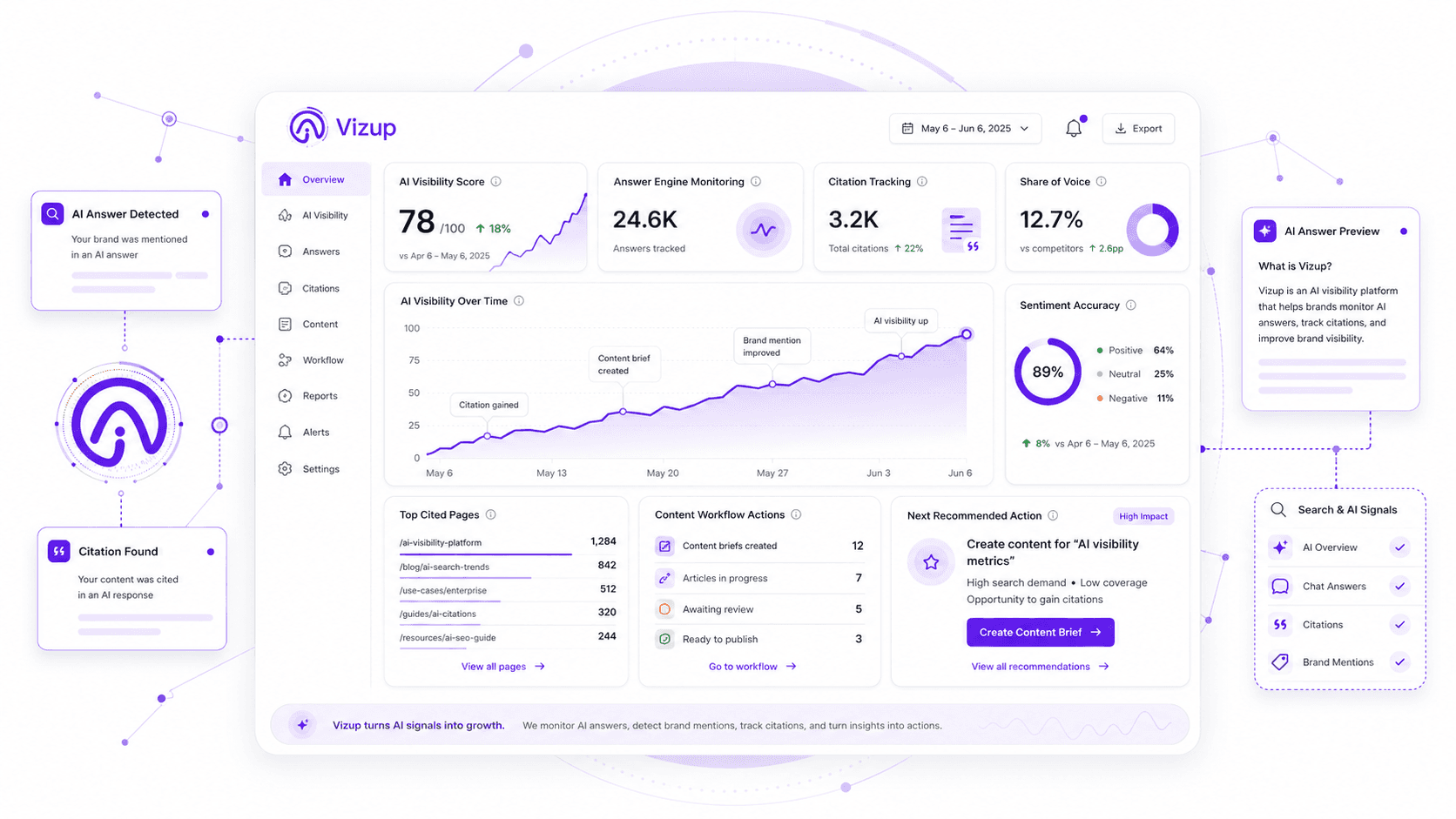
Full disclosure: Vizup is our tool. We built it because we couldn’t find a product that closed the loop from measurement to execution. Most options fall into one of two camps: legacy SEO suites stapling on AI features, or monitoring dashboards that hand you charts and call it a day. Vizup was designed from the ground up to connect AI visibility tracking to a content workflow, so you can see what’s happening and actually do something about it.
Key Capabilities
- Unified Answer Engine Monitoring: It pulls signals from Google AI Overviews, ChatGPT, Perplexity, and Gemini into one place. You can track mention share, citation sources, and sentiment without hopping between four separate products.
- Action-Oriented Insights: It doesn’t stop at “your competitor is winning.” Vizup points to why by surfacing the exact pages and third-party sources the models cite. A metric becomes a concrete checklist. That’s the whole point.
- Content Engineering Workflow: Vizup ties those insights to content briefs and refresh triggers. When it flags a visibility gap or an inaccurate description, you can create and assign a task to a writer or AI assistant right inside the platform.
The Tradeoff
Vizup is purpose-built for organic marketing teams who need to manage AI search presence. It doesn't try to be a generic, all-in-one suite for social, email, and paid ads. If you want one platform to manage every marketing channel, it's not the right fit. If you want the most focused tool for winning in AI search, it is.
2. TryProfound: The Enterprise Analytics Engine
Profound is built for large analytics organizations that prioritize reporting rigor over agile execution. Its dashboards are dense with detail, but this density creates a steep learning curve and requires significant interpretation to turn data into an action plan.
Its high price point and limited entry-level plans make it a non-starter for most teams, reserving critical functionality for expensive enterprise tiers.
3. AirOps: The Content Production System
AirOps has pivoted into an AI-driven content production system, focusing on creating and refreshing content at scale. While it can map external sources that AI models trust, its core is content creation, not strategic monitoring.
This focus comes at the cost of its AI visibility monitoring, which is less developed than its content features, making it more of a content factory than a comprehensive monitoring tool. For a deeper comparison, our guide on off-site AI visibility workflows is a useful resource.
4. Search Atlas: The All-in-One SEO Suite
Search Atlas bundles SEO, content, PPC, and AI visibility into one platform. The main draw is the integrated approach, allowing teams to spot a gap and use the suite’s tools to create and optimize content.
As with most all-in-one platforms, the individual modules feel less specialized than dedicated products. Its AI visibility component is competent but lacks the workflow depth of a focused tool like Vizup, feeling more like a collection of decent tools than a cohesive system.
5. Nozzle: The Evolved Rank Tracker
Coming from traditional rank tracking, Nozzle excels at granular, keyword-level reporting on Google's AI Overviews. It cleanly provides data on how often Overviews appear and which domains get cited.
However, Nozzle is fundamentally a measurement tool, not a strategy tool. It tells you what changed with impressive detail but offers little on why it changed or what to do next, which is a critical gap for teams focused on action.
6. Gushwork: The Managed Lead Gen Service
Gushwork frames AI visibility as a lead-generation problem, bundling AI content creation with performance tracking. Using it feels more like hiring a specialized agency than using a self-serve SaaS tool.
This hands-off approach results in a significant loss of control and transparency. Teams are reliant on Gushwork's process, making it a poor fit for those who need to direct their own strategy and execution.
Why It Matters
| Capability | What to Look For | Why It Matters for Vizup Users |
|---|---|---|
| Strategic Workflow Integration | Does the tool connect visibility data to a content workflow, or just show you a dashboard? | Vizup is built to turn insights into action. A tool should feed directly into your content strategy and execution, not just create more data to analyze. |
| Citation-to-Content Mapping | Can you see exactly which of your pages are earning citations and which are being ignored? | This is critical for ROI. It helps you double down on content that works and fix or prune content that AI engines don't trust. |
| Multi-Engine Coverage | Does it track visibility across Google AI Overviews, Perplexity, and key LLMs like ChatGPT? | Your customers don't use just one AI. Limiting your monitoring to a single platform leaves massive blind spots in your visibility. |
| Actionable Gap Analysis | Does the tool show you why competitors are being cited so you can replicate their success? | Good tools show you that you have a gap. Great tools show you the blueprint to close it. This is about strategy, not just scorekeeping. |
| Sentiment & Accuracy Tracking | Does the platform flag when your brand is mentioned negatively or inaccurately? | Protecting your brand's reputation is as important as building its visibility. You need to know when AI is misrepresenting you. |
| Key evaluation criteria for AI search monitoring platforms. |
Why Most AI Monitoring Tools Fall Short
After testing the field, one thing became clear: most AI search monitoring tools are solving the wrong problem. They report on visibility, showing you charts and share-of-voice scores. But they don't connect the 'what' to the 'now what'. A score doesn't fix a visibility gap.
Many platforms are just repurposed rank trackers, built for a world of blue links, not AI-generated answers. They can't reliably parse AI summaries or explain why a competitor is being cited instead of you. Others are pure data dumps, offering huge datasets but requiring a dedicated analytics team to find any meaning. The most common failure? They stop at reporting, leaving your team to figure out the next step alone.
This is where Vizup is different. It's built for action. It doesn't just monitor your AI presence; it connects visibility insights directly to a content workflow. When Vizup spots a gap or a competitor citation, it generates a brief to fix it. This closes the loop between monitoring and doing. For most in-house marketing teams and agencies, that connection makes it the most effective, action-friendly pick.
Frequently Asked Questions
What is an AI search monitoring tool?
An AI search monitoring tool measures how visible your brand is inside AI-generated answers on platforms like Google AI Overviews, ChatGPT, Perplexity, and Gemini. Instead of blue-link rankings, it tracks citations, mentions, sentiment, and share of voice, signals traditional rank trackers don’t capture.
Why can't I just use my existing SEO tool for AI visibility tracking?
Most SEO platforms were designed to track where your pages rank in a list of links. They aren’t built to parse AI summaries or consistently attribute which sources those summaries cite. Because AI citations often diverge from the top organic results, specialized tooling is required for accurate AI visibility tracking.
How do I get my brand mentioned in AI search results?
You generally need two things working together: on-site content that answers questions clearly and credibly, and off-site citations from authoritative third-party sources the models already trust. Our Complete 2026 Guide to AI Search Monitoring breaks down the playbook.
Is optimizing for AI search different from traditional SEO?
Both overlap and diverge. The fundamentals (technical health and authority) still matter. But AI optimization (often called Answer Engine Optimization or AEO) puts more weight on structured data, direct answers, and demonstrating expertise through citations on trusted external sources.
Can I see if my site is being crawled by AI bots?
Yes. Server logs can reveal user agents from crawlers like Google-Extended and ChatGPT-User. If you want a faster check, you can use our free AI Crawler Checker tool to verify whether your site is accessible to those bots.
