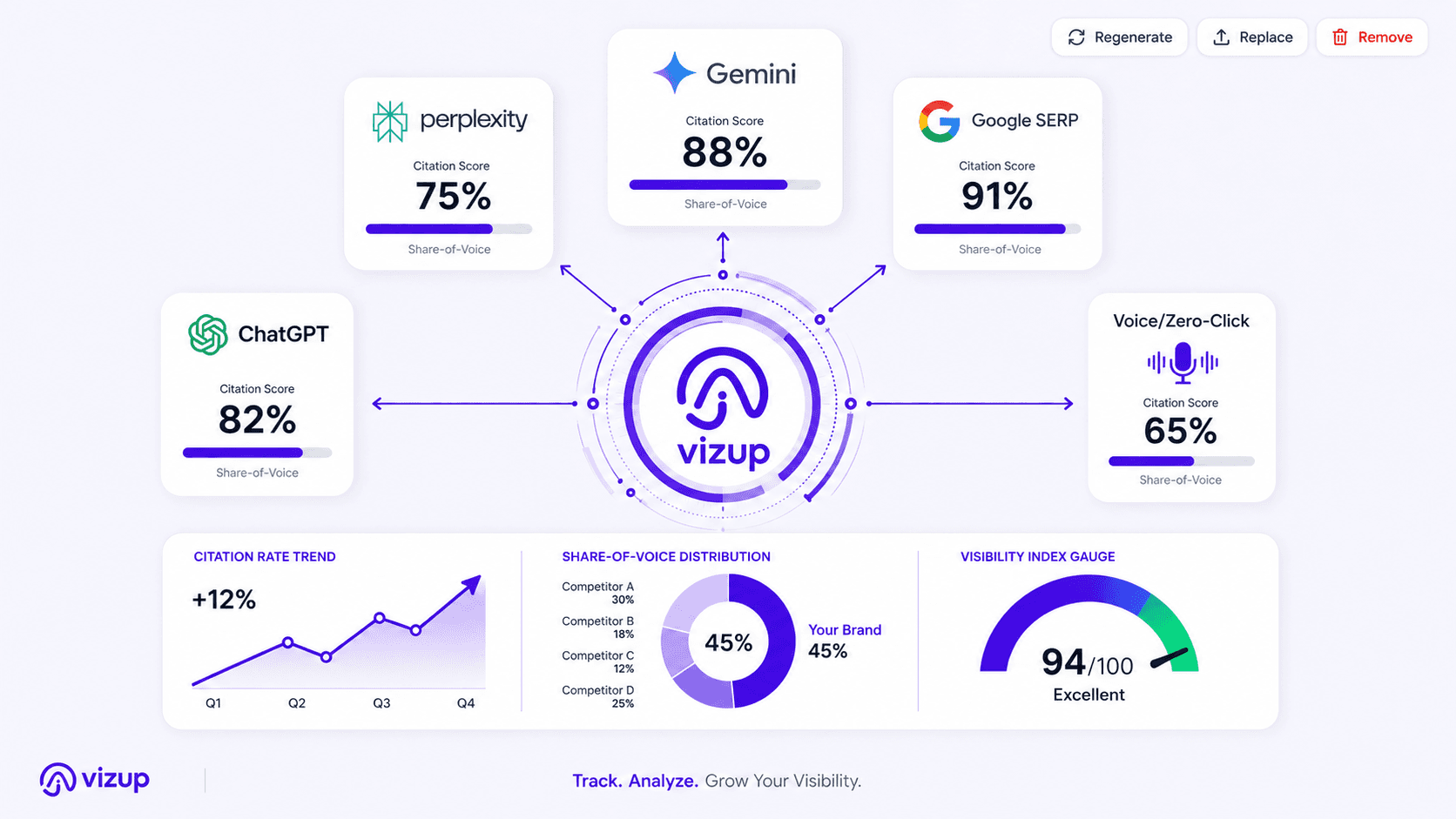
Google is still huge, but it no longer gets to be the whole story. A growing share of purchase research now starts inside ChatGPT, Perplexity, and Gemini, where the model decides which brands are worth citing and which never make the cut. Most teams haven’t updated their measurement habits: they’re watching rankings like it’s 2022 while prospects read AI answers that don’t mention them at all. This is for marketing leads, SEO strategists, and brand managers who want to close that gap with ai brand visibility optimization tools built for how search actually works in 2026.
You’ll walk away with a practical way to evaluate tools on the dimensions that matter, deploy them without ripping up your stack, and report visibility based on where attention has moved. The sections are sequenced on purpose: start with definitions, move into tool selection, then get into implementation and measurement, and finish with the hard parts like attribution.
Table of Contents
- What 'Brand Visibility' Actually Means in 2026. How the definition has expanded beyond rankings to citations, voice, and zero-click surfaces
- The Core Problem These Tools Are Trying to Solve. Why most marketing stacks built before 2024 are flying blind on at least one major channel
- How to Evaluate AI Brand Visibility Optimization Tools. A four-dimension framework covering answer engine monitoring, digital presence, and SEO-AEO integration
- What to Look for in an AI Visibility Platform. A breakdown of the core capabilities that separate tactical tools from strategic platforms
- How to Actually Implement an AI Visibility Stack. A three-step workflow for auditing, configuring, and connecting data to existing reporting
- Measuring What Actually Matters. The metrics replacing raw keyword rankings as primary KPIs
- Advanced Considerations. Attribution, entity optimization, and competitor monitoring at expert level
- Frequently Asked Questions. Five direct answers to the questions marketers ask most
What 'Brand Visibility' Actually Means in 2026
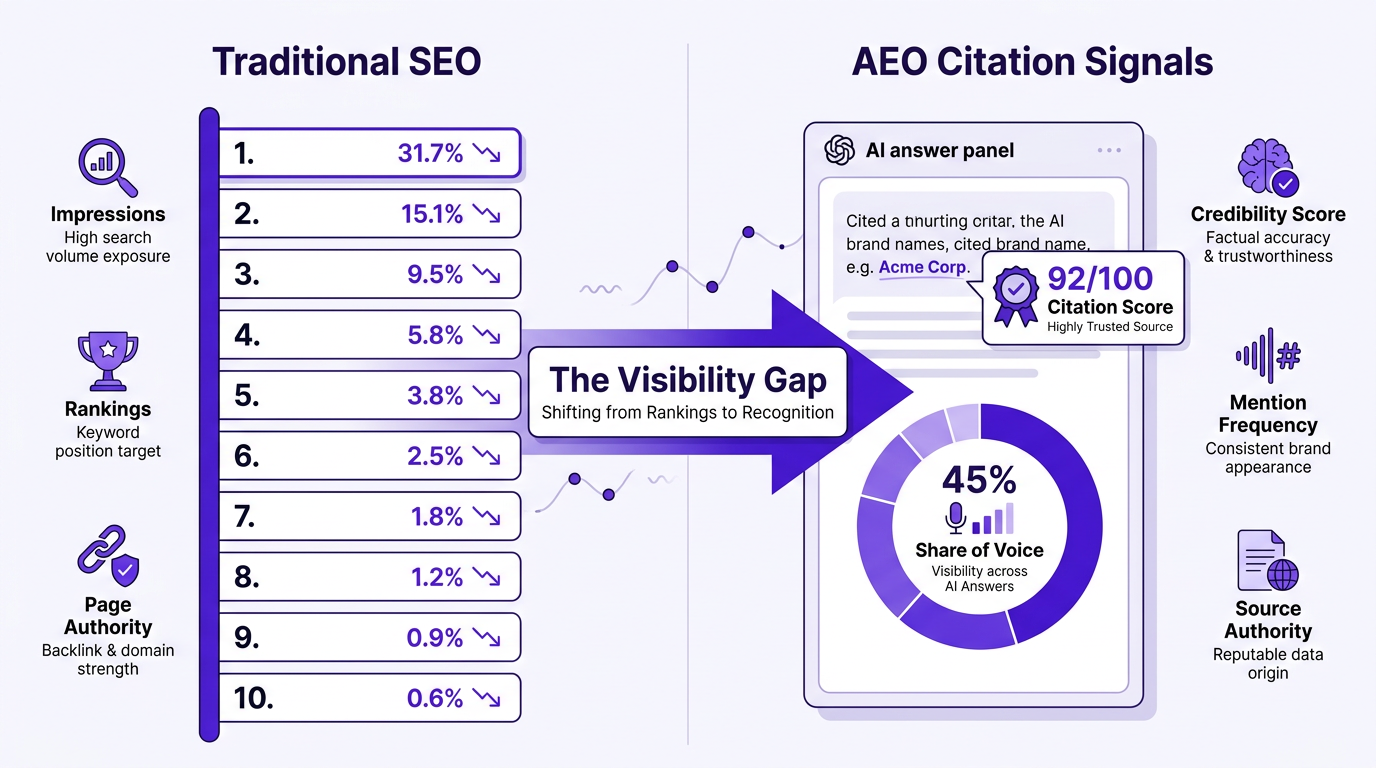
“Visibility” has stretched far past what most reporting frameworks were built to capture. It now includes classic SERPs, AI-generated answers across multiple large language models, voice assistant responses, and zero-click surfaces where your brand is either cited or quietly omitted. Recent analysis frames the shift bluntly: visibility is less about clicks and more about whether an AI system selects your brand as a credible source in its curated response. That’s a different win condition than “we’re on page one.” The new reality is that why organic marketing is beyond SEO in 2026 is because visibility now happens across a dozen surfaces that don't look like a Google SERP.
That move from “ranking” to “being cited” is the pressure point for modern brand strategy. Answer engine optimization (AEO) now sits alongside traditional SEO because the query often gets resolved inside the AI interface, not on your site. For more on how answer engine optimization works in 2026, see our complete guide. Marketers need content that’s authentic, specific, and quotable, because those traits correlate with getting pulled into AI-generated responses. This isn’t a vague “make better content” reminder; it’s the price of admission for showing up where branded intent gets intercepted before a click happens. For more context on the shift, see this guide on how to improve brand visibility in AI search.
The Core Problem These Tools Are Trying to Solve
A lot of brands are missing from AI answers and don’t realize it. That’s the monitoring gap these tools are built to close. A rank tracker can tell you where a page sits in Google; it can’t tell you whether ChatGPT mentions you when someone asks, “what is the best project management tool for remote teams?” Those signals live in different ecosystems, and most stacks built before 2024 were never designed to connect them. The impact of this shift is explained in our guide to Google AI Mode and its impact on SEO.
This demand is catching up to new surfaces that didn’t exist at scale a few years ago. Here’s the straightforward test: if your stack has rank tracking, social listening, and web analytics (but nothing purpose-built to monitor answer engines) you’re not collecting citation data from the channels where more brand discovery is starting to happen. For a step-by-step guide, see how to track brand mentions in AI search.
How to Evaluate AI Brand Visibility Optimization Tools
Evaluate tools in this category on four capability dimensions: answer engine monitoring, digital presence monitoring, SEO/AEO integration, and reporting depth. If you already have a working definition of AEO and digital presence monitoring, jump straight to the next section. If not, the sections below spell out what “good” looks like in each area.
Answer Engine Monitoring: Can It Track Where AI Cites You?
Start with coverage. At minimum, you want monitoring across ChatGPT, Perplexity, Gemini, and Microsoft Copilot. If a tool only watches Google’s AI Overviews and calls that “AI visibility,” you’re buying SGE tracking with a new label. Real answer engine monitoring surfaces citation gaps across platforms on an ongoing basis: which queries include your brand, which default to competitors, and which include no brand at all. Vizup’s Answer Engine Monitoring is built around that multi-platform requirement, so teams get a consolidated view of citation presence instead of doing manual spot-checks across four separate interfaces.
Digital Presence Monitoring: The Full-Spectrum Signal
Citations are the headline metric, but they’re not the whole input. Digital presence monitoring looks at brand sentiment, share of voice, and unlinked mentions across the broader web. That context matters for AEO because LLMs are trained on (and influenced by) the density and quality of signals around your brand. A company with steady, authoritative mentions across credible sources tends to show up more reliably in AI outputs than a brand that ranks well but has thin off-page presence. The loop is tight: presence signals influence content strategy, and content strategy shows up later in citation rates. For the stack-level view, the guide on how to enhance your digital presence with AI lays out the integration.
SEO and AEO Integration: One Stack or Two?
Unified tooling isn’t about convenience; it’s about avoiding blind spots. When a piece of content earns both a first-page ranking and a ChatGPT citation, you want that story in one report, not two dashboards that never quite reconcile. Look for real data bridging: keyword performance and answer-engine citation rates in the same view, at the same query-level granularity. If a platform just adds an “AI” tab to a rank tracker without connecting the underlying data, it’s not integrated in any meaningful way. The AI search visibility optimization playbook breaks down how to wire this into a working marketing workflow.
What to Look for in an AI Visibility Platform
This section highlights the core capabilities that define a strategic platform for AI visibility. Instead of a feature checklist, this breakdown focuses on the underlying philosophy and how that translates into a practical workflow. A true platform for this work is built for integrated monitoring, connecting citation data back to content workflows and business outcomes. It helps teams act on insights, not just view them.
A strong platform combines AI visibility monitoring with a broader suite of SEO tools. It tracks brand mentions, sentiment, and share of voice within AI answers and connects that data to content optimization and technical SEO workflows. This makes it suitable for teams looking for an all-in-one platform to manage both traditional SEO and AEO in a single system. Vizup, for example, is built on this integrated philosophy, providing a unified system for teams that need to connect visibility insights to execution speed.
How to Actually Implement an AI Visibility Stack (Without Starting Over)
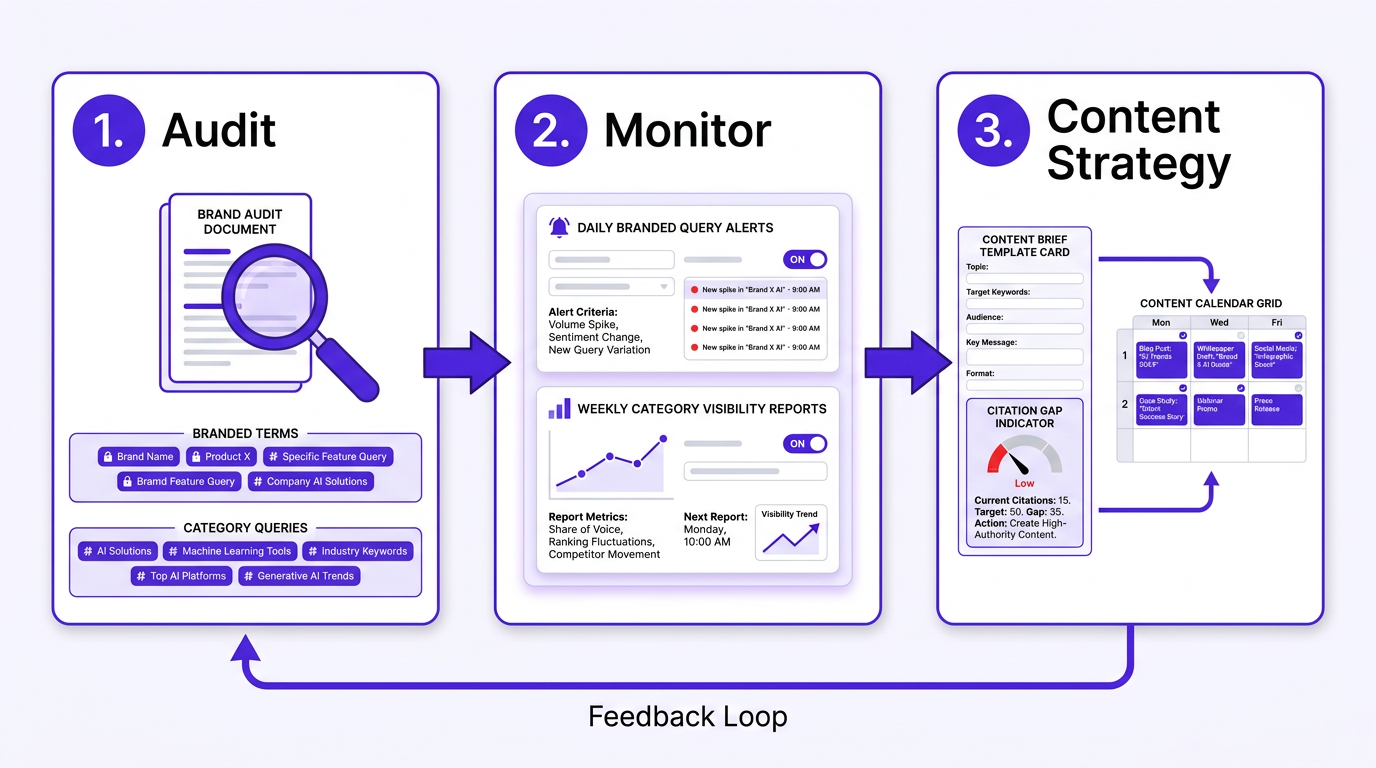
Most write-ups stop at “here are the tools.” The harder part is fitting them into how a marketing team already operates, without tearing down what’s working. The implementation pattern that holds up is simple: audit first, configure monitoring second, then connect the data to reporting.
Step 1: Audit Your Current Visibility Blind Spots
Before you buy anything, do a manual brand query audit across three AI platforms. You need this baseline because it becomes your “before” snapshot for every decision that follows. Track which queries surface your brand, which surface competitors, and which return no brand mention at all. Thirty queries across your core product categories usually takes about two hours, and it will quickly tell you whether you’re dealing with a citation problem or a content gap problem. Those are different fixes.
Step 2: Set Up Answer Engine Monitoring
With a baseline in hand, set up monitoring around your core query clusters, not just branded terms. The real opportunity (and risk) tends to sit in category queries like “best CRM for startups,” where prospects are still forming preferences. The suggested cadence for Vizup's free AI optimization tools is daily alerts for branded queries and weekly reporting for category visibility. That balance catches sudden drops without training your team to ignore alerts.
Step 3: Connect Visibility Data to Content and SEO Workflows
Citation gaps should turn into briefs, not screenshots. If monitoring shows a competitor getting cited for “enterprise data security” queries while you’re absent, that’s a content assignment, not merely an FYI. Pages that win AI citations tend to share a few consistent traits: they answer specific questions directly, they include quotable claims backed by data, and they show topical depth through internal linking. Building those traits into your calendar is the feedback loop most teams still don’t have. For a more structured system on how to structure content for AI citations, the AI content strategy frameworks guide lays out the brief-to-citation pipeline.
Measuring What Actually Matters: Visibility Metrics for 2026
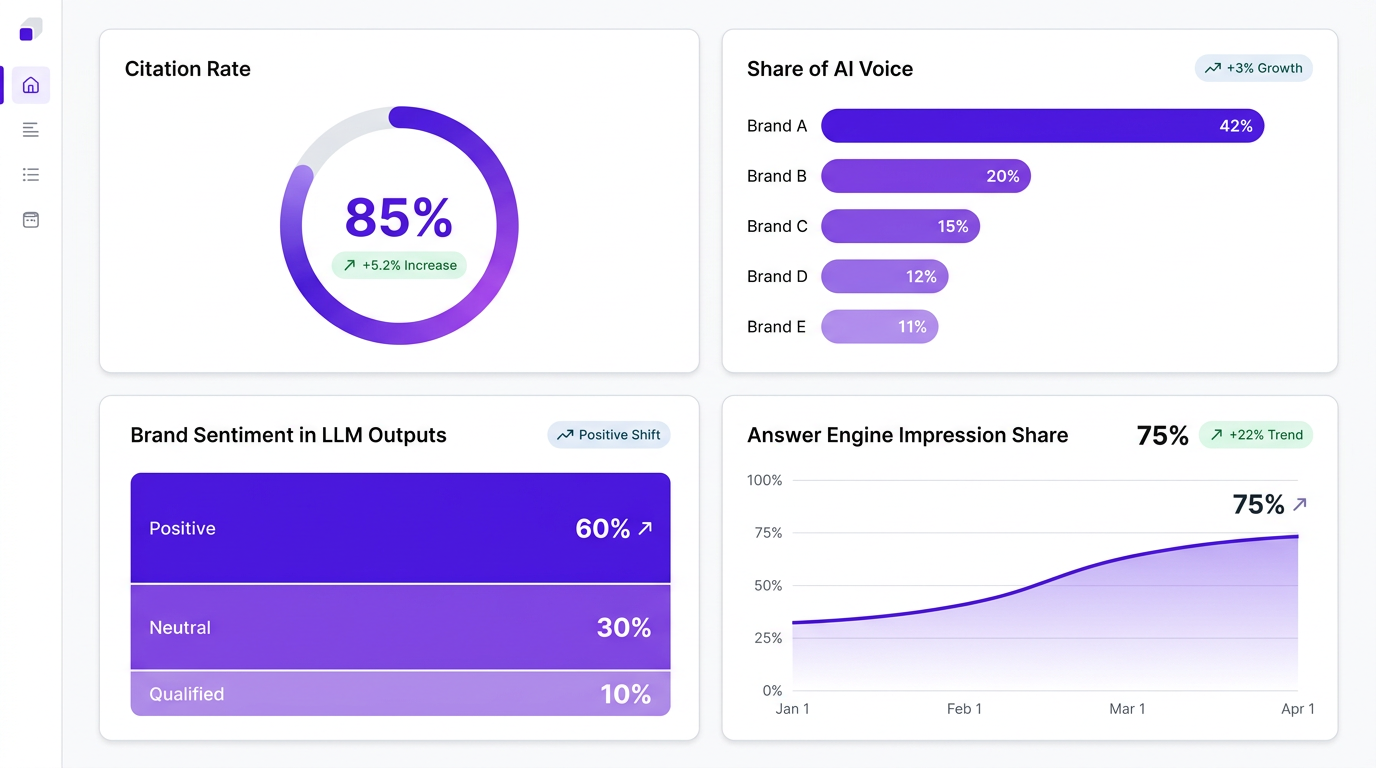
If you’re investing in AEO, raw keyword rankings can’t be the only north-star KPI anymore. The metrics that now carry the most weight are citation rate (the percentage of relevant AI queries that include your brand), share of AI voice (how often you’re cited versus category competitors), brand sentiment in LLM outputs (positive, neutral, or qualified framing), and answer engine impression share (estimated exposure across AI surfaces). None of this replaces SEO reporting; it sits next to it and fills in what rankings can’t see.
This measurement shows up in the numbers: you can increase citation frequency and still lose the narrative if the model mentions you with caveats or negative framing. Sentiment tracking inside LLM outputs is part of “visibility” now, not a nice-to-have add-on. For a curated list of platforms that support this measurement, see the best AI visibility tools roundup.
Advanced Considerations: Where Most Teams Hit a Wall
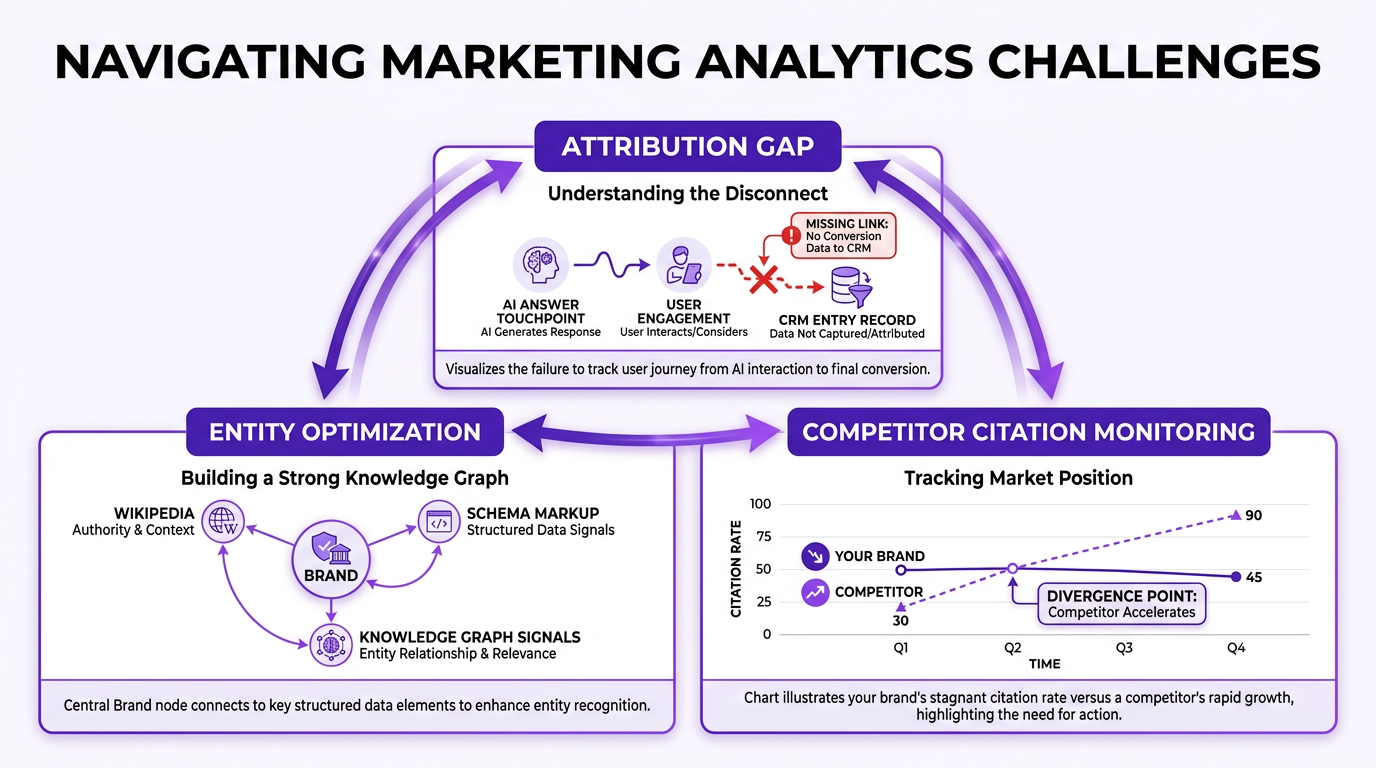
Attribution is still the hardest unsolved problem here. When a customer says, “I heard about you from ChatGPT,” tying that back to a specific page, prompt cluster, or optimization change means connecting answer-engine monitoring to your CRM and attribution model. Most teams aren’t wired for that yet, and the tooling is still catching up. The practical workaround is to treat citation improvements as leading indicators, then watch how they correlate with branded search volume and direct traffic over 60- to 90-day windows.
Entity optimization is where many teams chronically underinvest. Structured data markup, a maintained Wikipedia presence, and knowledge graph signals still flow into the data pipelines that shape how models understand your brand. Brands with a clean, well-structured entity tend to get cited more consistently than brands that exist only as a scattered set of web pages. This isn’t new SEO theory, it’s newly urgent because the downstream impact now lands in AI outputs, not just featured snippets.
Competitor monitoring needs to be a standing process, not an occasional check. Knowing when a rival starts winning citations in your category can be as strategically useful as tracking your own citation rate. If a competitor begins showing up in answers you used to “own,” that’s an early warning signal worth investigating before the gap becomes structural. Most brands are 12 to 18 months behind here, and early AEO movers are building citation authority that’s hard to unwind. Teams that treat AI visibility as a monitoring problem (not only a content problem) are accumulating durable advantages.
Key Takeaways and Your Next 30 Days
Five decisions that will shape your AI visibility program: (1) Treat brand visibility as something you monitor across AI citation surfaces, not just search rankings. (2) Compare tools on four dimensions: answer engine coverage, digital presence monitoring, SEO/AEO integration, and reporting depth. (3) Run a manual baseline audit before you spend. (4) Route citation gap data straight into your content brief workflow. (5) Promote citation rate and share of AI voice to primary visibility KPIs, with rankings as supporting context.
Your 30-day action plan:
- Week 1 (Audit): Manually query 30 category and branded terms across ChatGPT, Perplexity, and Gemini. Document citation presence, competitor mentions, and gaps. This is your baseline.
- Week 2 (Tool selection): Use the capability guide to shortlist two tools. Prioritize multi-LLM coverage and integration with your existing reporting stack. Review Vizup pricing and plans alongside alternatives.
- Week 3 (Setup): Configure your chosen tool around core query clusters. Set daily alerts for branded queries and weekly reports for category-level visibility. Tag your top 20 content pages for citation tracking.
- Week 4 (First measurement cycle): Pull your first citation rate and share of AI voice report. Compare against your Week 1 manual baseline. Identify the top three citation gaps and assign them as content briefs.
Teams that treat AI visibility as a monitoring discipline (not only a content initiative) are going to build compounding advantages over the next three years, while late movers scramble to catch up. The tools are already on the market, and the measurement model is clear enough to act on. What’s widening now is execution: the gap between brands that instrument this today and brands waiting for it to become painfully obvious. Start with the audit; it’s the one step that makes everything else concrete.
Frequently Asked Questions
Frequently Asked Questions
SEO vs. AEO: what’s the difference, and do I need separate tools?
SEO (Search Engine Optimization) is about ranking pages in traditional search results like Google. AEO (Answer Engine Optimization) is about earning citations inside AI-generated answers from systems like ChatGPT, Perplexity, and Gemini. The inputs overlap (strong content still matters) but the measurement diverges: SEO tracks rankings and clicks, while AEO tracks citation rate and share of AI voice. Whether you need separate tools comes down to your stack. Some platforms, including Vizup, report both in a single dashboard; others push you into separate systems. The downside of splitting them is attribution blind spots when the same content drives both a ranking and a citation.
How can tools track mentions in ChatGPT or Perplexity if those platforms don’t share search data?
They don’t rely on internal platform analytics (which aren’t publicly available). Instead, they programmatically run a defined set of brand-relevant prompts, capture the outputs, and analyze whether your brand appears, how it’s framed, and which competitors show up alongside (or instead of) you. Coverage quality depends on the breadth of your query set and how often the tool refreshes monitoring. For branded queries, most practitioners recommend a daily cadence.
How long does it take to see results after rolling out answer engine monitoring?
You’ll get monitoring results right away: baseline citation data typically lands within the first week. Improving citation rates after you act on that data usually takes 60 to 90 days, since content updates need time to be indexed, referenced, and incorporated into the retrieval or training signals AI systems use. Entity optimization work (structured data, knowledge graph updates) often takes longer. Treat the first 30 days as measurement and auditing, not “optimization wins.”
Is Vizup a fit for small businesses, or is it aimed at enterprise teams?
Vizup is positioned primarily for growth-stage and mid-market brands, with pricing and workflow complexity aligned to that segment. Small businesses with a focused set of core queries and a single brand can still use it effectively without a dedicated analytics team. Enterprise teams tend to benefit most from multi-brand and multi-market monitoring. For current plan details, see Vizup pricing and plans. If you want to sanity-check fit for your team size, contact us directly.
Can AI visibility tools explain why a competitor gets cited more than my brand?
Yes, this is one of the highest-leverage use cases. By comparing the pages and sources that earn your competitor citations against your own, you can spot structural and topical gaps. Common patterns include competitors publishing more quotable, specific claims; stronger entity signals (structured data, knowledge graph presence); or deeper coverage of the sub-questions AI systems use to assemble answers. Vizup’s citation gap analysis surfaces these patterns at the query level, so content teams get a prioritized list of gaps to close instead of a generic directive to “make better content.”
