
A line of AI-generated text on your site may soon carry an invisible signature. Under EU law enforceable from August 2, 2026, that is no longer theoretical. AI content watermarking has gone from research project to regulatory requirement, and Anthropic's August 2026 announcement that Claude will mark its outputs makes the shift hard to ignore.
This is not about AI detectors or plagiarism checks. It is about provenance, disclosure duties, and the changes publishing teams need to make before enforcement reaches their workflow. For content strategists, compliance leads, and in-house legal teams, the practical questions start with what Claude is actually doing.
What Exactly Did Anthropic Announce About Claude?
In August 2026, Anthropic said Claude models would mark AI-generated content in two ways: an imperceptible statistical watermark in text outputs, and C2PA provenance metadata on file-based outputs such as images and documents. The move responds directly to the EU AI Act's Code of Practice on transparency, finalized by the European Commission in June 2026, which recommends that combination of signals.
Anthropic Claude compliance is not a plan to identify bad actors after publication. It puts transparency into the generation process. Provenance - where content came from and how it was made - is being treated as a product capability rather than an afterthought.
Info: Anthropic's move sets a useful precedent. When a frontier model provider builds watermarking into its output pipeline, tools using that API inherit the behavior, including compliance products already used by marketing teams.
How Does This 'Invisible Watermark' Actually Work?
Two separate mechanisms are involved. Treating them as the same thing leads to poor policy, especially when teams write internal labeling rules.
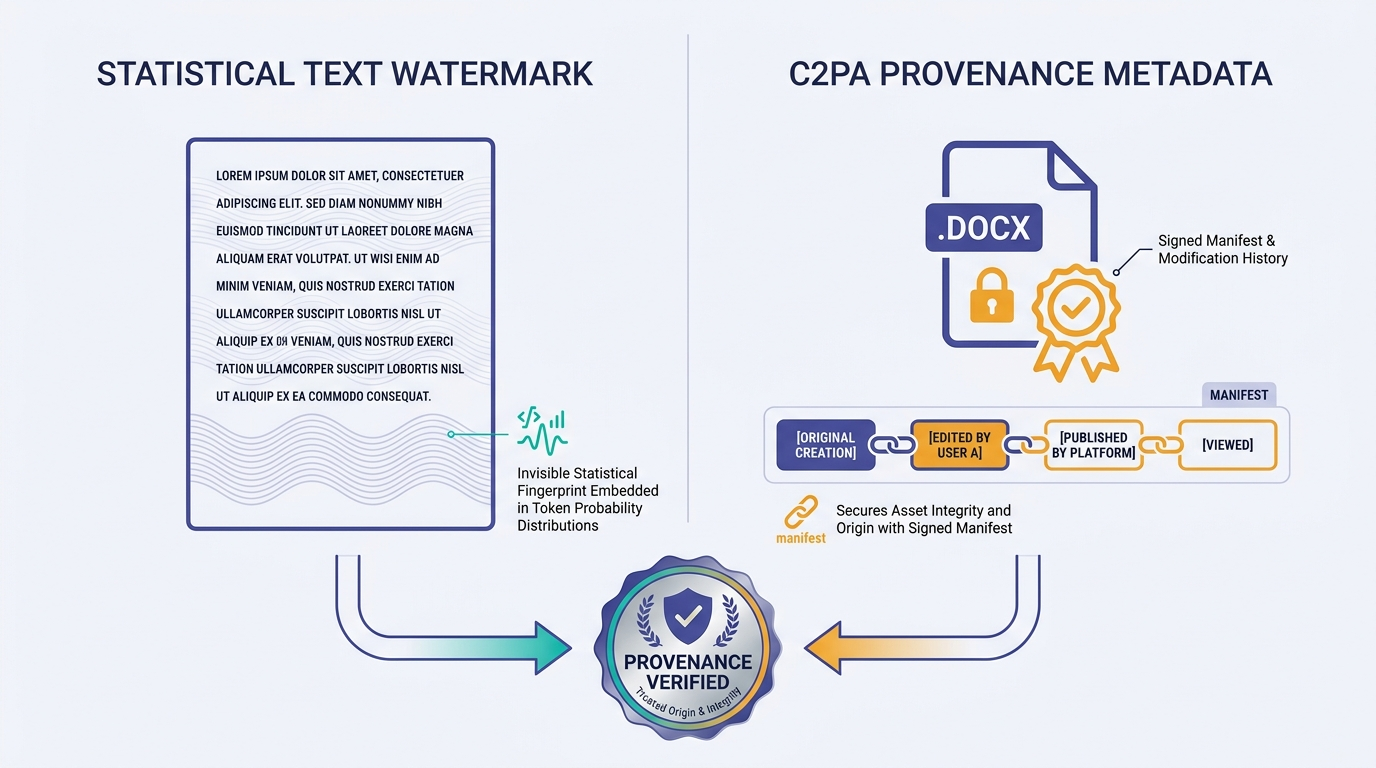
Method 1: The Statistical Text Watermark
An invisible text watermark subtly biases the probability of word and token choices during generation. The prose still reads naturally, but a designated algorithm can identify its statistical fingerprint. It is a pattern in the output that software, not readers, is built to recognize.
Editors usually ask how well that pattern survives revision. Small edits - correcting a typo, changing a synonym, or moving a sentence - generally leave enough signal for detection. Heavy paraphrasing is likely to break it. The mark is meant for automated checks on mostly intact output, not as a permanent stamp on every model-touched word.
Method 2: C2PA Provenance Metadata
The C2PA standard (Coalition for Content Provenance and Authenticity, founded 2021) is an open specification that adds a cryptographically signed manifest to a digital file. The manifest records its origin and modification history, creating a verifiable chain of custody. Unlike a text pattern, it travels with the file as documentation.
C2PA-based AI content provenance is sturdier than a text watermark: it survives format conversions and can be read by any C2PA-compatible tool, not only Anthropic's detector. It matters most for AI-generated images, PDFs, and rich documents, rather than copy-pasted text.
Why Is This a Bigger Deal Than Just Another AI Detector?
Many readers will file this alongside GPTZero or Turnitin. That is the wrong comparison, and it has legal consequences.
| Dimension | AI Watermarking | AI Detectors |
|---|---|---|
| Approach | Proactive, built into generation | Reactive, assessed after generation |
| Primary focus | Provenance and compliance | Detection and editorial review |
| Technical approach | Statistical marks / provenance metadata | Varies by detector |
| Legal relevance | Can support Article 50 provider obligations | Does not itself satisfy Article 50 |
| Who controls it | Model or content provider | Third-party detector |
| Resilience to editing | Varies by watermark type | Reliability varies significantly |
| Watermarking fulfills a legal duty; detectors support editorial or academic policy. |
EU AI Act Article 50 requires generative AI providers to make outputs machine-readable and detectable as artificially generated or manipulated. The obligation became enforceable on August 2, 2026. Penalties for non-compliance can reach 15 million euros or 3% of annual global turnover, according to European Commission guidance. Synthetic-content labeling is now a compliance category, not an editorial preference.
Detectors have no legal force. They can support editorial quality control, but they do not satisfy Article 50, and a passing detector score is not a defense. Data transparency needs to be treated as a structural requirement, not a feature switch.
What Does This Mean for Your Content Strategy?
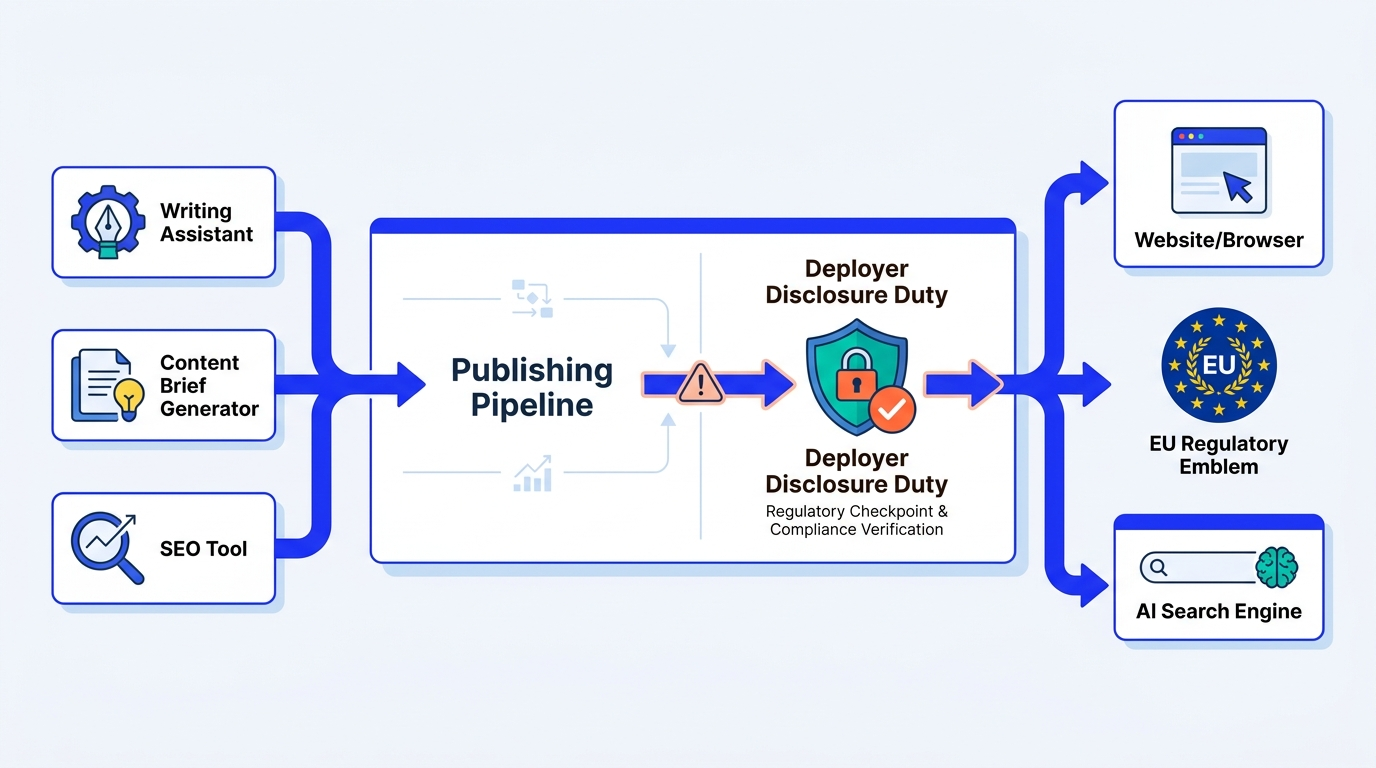
EU transparency rules also create obligations for certain deployers, but those duties are narrower than the provider marking requirement. Under Article 50, deployers must clearly label AI-generated or manipulated text when it is published to inform the public on matters of public interest and has not undergone qualifying human review or editorial control.
Writing assistants, content-brief generators, and SEO tools using Claude may increasingly produce watermarked output as Anthropic rolls the technology across applicable models. Organizations using these systems professionally should first determine whether their particular publishing use case falls within Article 50's deployer-labelling requirements. Checking which tools inherit this behavior is now compliance work. How AI search engines work also increasingly intersects with how marked and unmarked material is handled.
Your 3-Step Action Plan for AI Content Compliance
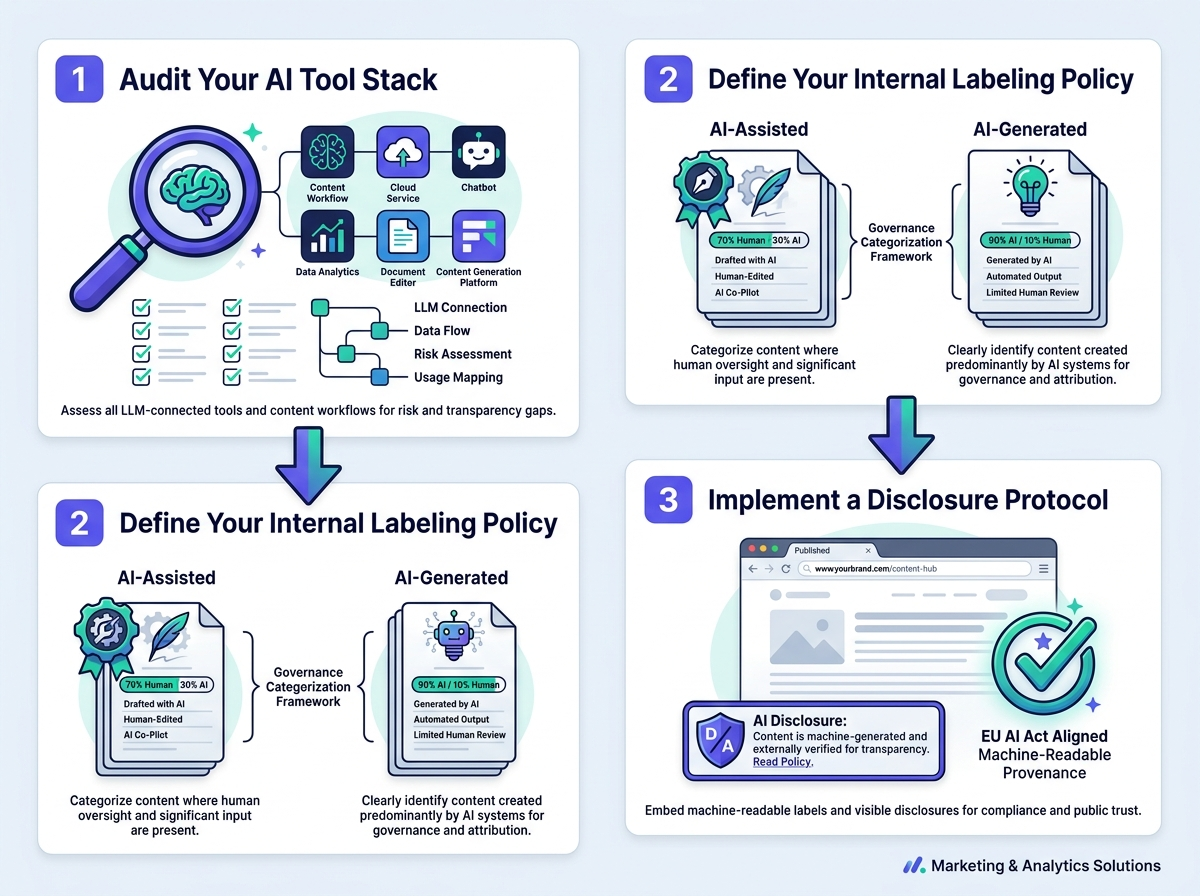
Step 1: Audit Your AI Tool Stack
Map every content-workflow tool that touches a large language model, then record its underlying model. Tools using affected Claude models may generate statistically watermarked content as Anthropic rolls the technology across applicable models. An AI content checker can establish a baseline for detectable AI signals in your existing library.
Step 2: Define Your Internal Labeling Policy
Write down the distinction between two categories. 'AI-assisted' content is human-led: a writer drafts, AI suggests edits or research, and the human makes final decisions. 'AI-generated' content is AI-led: the model creates the draft and a human reviews it. These categories can be useful for internal governance, but teams should assess disclosure requirements against the specific conditions in Article 50 and the Commission's guidance rather than relying on an internal label alone.
Step 3: Implement a Disclosure Protocol
Choose where readers will see AI-use disclosures: an article footer, a sitewide policy page, or both. EU transparency rules call for language that is clear, prominent, and machine-readable where possible. For AI search visibility, provenance is becoming a trust signal as well as a legal requirement. Machine-readable provenance could eventually become another signal available to search and answer systems, but there is not yet enough evidence to treat disclosure or watermark status as a confirmed ranking or citation factor.
Where Vizup Fits Into the New AI Transparency Workflow
AI transparency is becoming one part of a much broader discovery challenge. Brands need to know not only how content is created, but also where it appears, how it performs, whether AI answer engines cite it, and what should be improved next.
Vizup works as an Organic Autopilot for modern discovery, helping brands monitor, create, optimise, publish, and learn across Search, Social, Communities, AI Answer Engines, and Local Discovery. It combines AI agents, human experts, and live SEO, pSEO, AEO, and GEO tools in one connected workflow.
For teams adapting to AI provenance and transparency requirements, that means content governance does not have to sit separately from organic performance. Teams can improve content quality, monitor AI search visibility, strengthen citations and discoverability, publish consistently, and learn from performance in the same organic-first workflow. Paid ads are available as an optional amplification layer once the organic foundation is working.
Frequently Asked Questions
Will Google penalize my site for AI content with a watermark?
There is no evidence that Google penalizes content solely because it has an AI watermark. Google's stated position permits helpful, high-quality content regardless of production method. A watermark is a regulatory provenance signal, not a quality-demotion flag. Thin or unhelpful AI-generated material remains subject to the same quality signals as before.
Can I detect the Claude AI watermark myself?
Anthropic had not released a public detection API as of August 2026. The statistical watermark is intended for automated systems, not manual inspection. A third-party AI content checker can flag likely AI-generated passages, but cannot confirm the specific Claude watermark.
Does this apply to content created with Claude before the policy was announced?
Watermarking applies to outputs generated after the relevant feature is implemented for an applicable Claude model. The Commission states that content generated before August 2, 2026 does not need to be labelled retroactively, although deployers are encouraged to label it where possible. Teams can still review older AI-assisted content under their own internal transparency policies.
Are other AI models like GPT-4 or Gemini also implementing watermarks?
OpenAI and Google DeepMind have explored watermarking research, but neither had announced a production deployment equivalent to Anthropic's August 2026 commitment at the time of writing. The Code of Practice applies to providers serving EU users, so further announcements are likely as enforcement increases. Anthropic remains the clearest public example of Anthropic Claude compliance.
If I heavily edit AI-generated text, do I still need to disclose it?
The industry is moving toward stronger machine-readable provenance and marking because Article 50 creates transparency obligations for relevant generative AI providers serving the EU market. The exact technical approach may differ between providers, so teams should evaluate the provenance capabilities of the models and tools in their own stack rather than assume every platform uses the same watermarking method.
Key Takeaways
What content, SEO, and compliance leads need to know:
- EU AI Act Article 50 has applied since August 2, 2026. Machine-readable AI content marks are a legal provider requirement for EU users, with penalties up to 15 million euros or 3% of global turnover.
- Anthropic's dual approach - an invisible statistical watermark for text and C2PA provenance metadata for files - closely follows the AI Act Code of Practice.
- Watermarking and detectors do different jobs. Watermarks meet a legal duty; detectors support editorial policy. Mixing them up creates compliance gaps.
- Certain deployers also have transparency duties, particularly for AI-generated text on matters of public interest that lacks qualifying human review or editorial control. Teams should document their review and disclosure process so they can determine when Article 50 applies.
- Audit your AI tool stack, define AI-assisted and AI-generated categories, then put a reader-facing disclosure protocol in place under EU transparency rules.
