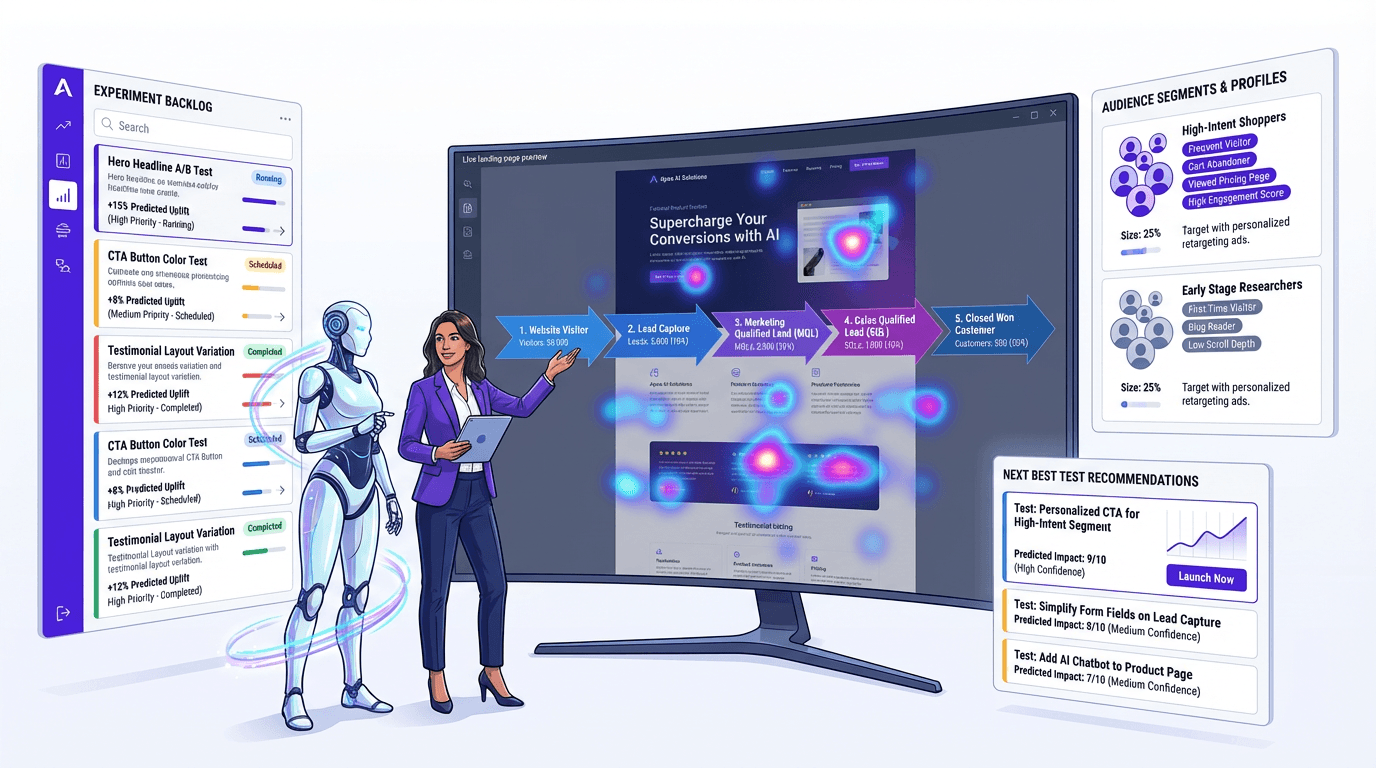
I recently worked with a SaaS growth team that had a 40-item testing backlog, weekly experiment reviews, and dashboards for days. Their conversion rate hadn't moved in over a year. The issue: they were optimizing for every visitor equally, burning cycles on people who were never going to convert. Once we shifted to AI for Conversion Rate Optimization, using behavioral clustering and predictive scoring to focus tests where they'd actually matter, trial signups climbed 22% in six weeks.
Most sites still convert under 3%, a number that's barely moved in a decade even as acquisition costs climb. The brands growing revenue from the same traffic aren't running one clever test. They've wired AI into the full funnel as infrastructure, not a side experiment.
Button color swaps and headline rewrites hit a ceiling fast when you're optimizing one variable at a time. What's actually pulling ahead: predictive personalization that adjusts content before a visitor bounces, real-time behavioral targeting, and autonomous experimentation running hundreds of variants at once. This piece covers what's genuinely moving conversion numbers in 2026, where teams are still wasting budget, and how tools like the Vizup CRO platform fit into a stack built to compound gains quarter over quarter.
CRO Fundamentals You Need Before AI Makes Sense
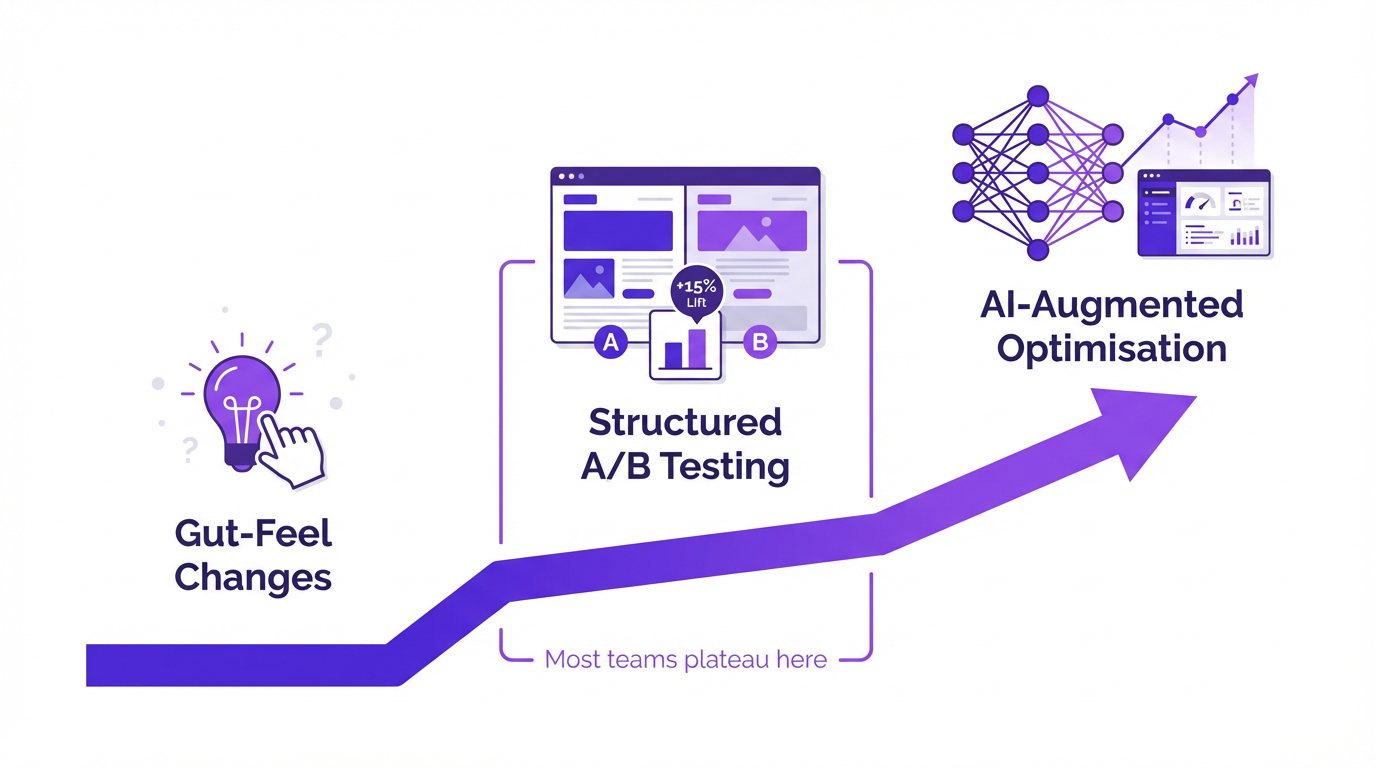
Conversion rate optimization boils down to getting more visitors to take a desired action. Simple enough in theory. Most teams start with gut-feel changes ("make the button bigger"), graduate to basic A/B testing, and then plateau. You run 50 tests, some win, some lose, and your overall conversion rate has moved maybe half a point in two years.
That's not a tool problem. It's a depth problem.
The vast majority of companies sit stuck in the middle of the CRO maturity spectrum, somewhere between structured testing and genuine optimization. AI doesn't replace this foundation. If your tracking is broken, your value proposition is unclear, or your traffic is a jumble of different intents, AI just helps you fail faster and with more confidence.
Here's something most CRO playbooks skip entirely: conversion isn't just a page problem. It's a traffic problem. If your acquisition strategy pulls in people who want an answer, not a product, your CRO ceiling is low no matter how clever your experiments get. Getting this right before you layer on AI tools saves months of wasted effort.
What Most People Get Wrong About AI for Conversion Rate Optimization
The biggest misconception is that AI will auto-optimize your site the way a self-driving car handles a highway. That is not how any of this works.
AI surfaces insights and runs experiments at scale, but a human still needs to interpret outputs, prioritize actions, and make judgment calls about brand fit. The algorithm doesn't know your enterprise buyers hate aggressive countdown timers, even if the data says they convert.
Traffic minimums are another persistent myth. The old rule held that you needed at least 10,000 monthly visitors for A/B testing to make statistical sense. Bayesian testing frameworks have lowered that threshold significantly in 2026. Many AI-powered CRO platforms now surface directional insights with far less traffic than traditional frequentist methods required. "We're too small for AI CRO" is usually a workflow excuse, not a math problem.
Honestly, the biggest waste of money in CRO right now is buying AI tools and plugging them into sites with no hypothesis framework. If you can't articulate why a change should improve conversion before you test, the AI output will just give you a more expensive version of random.
I've seen teams spend five figures on platforms they never used past the trial because nobody on the team could write a testable hypothesis. The tool wasn't the bottleneck. Thinking was.
How AI-Driven Customer Insights Are Changing CRO
| Capability | Traditional Analytics | AI-Driven Insights (2026) |
|---|---|---|
| Data Processing | Historical and descriptive | Predictive and prescriptive |
| Segmentation | Demographic groups | Segments of one (individual behavioral paths) |
| Feedback Loop | Monthly reports | Real-time sentiment synthesis |
| Actionability | Analyst interprets, then recommends | AI recommends, human validates |
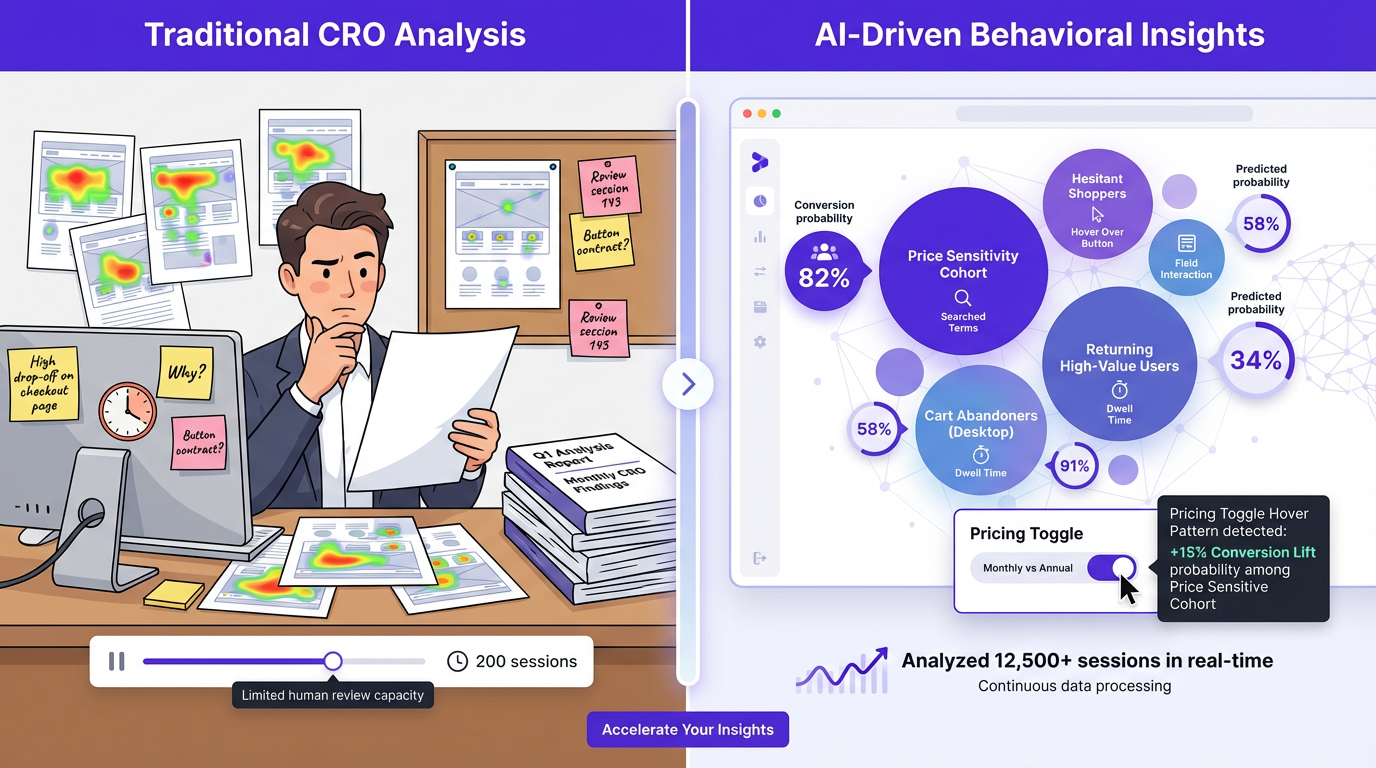
Traditional analytics told you what happened. AI-driven customer insights tell you why, and what's likely to happen next.
The old workflow involved heatmaps, session recordings, and a lot of manual tagging. A UX researcher would watch 200 session recordings, take notes, and synthesize patterns over several days. Now, AI clusters behavioral patterns across thousands of sessions simultaneously, flagging which micro-interactions actually predict conversion or drop-off.
A concrete example: a mid-market SaaS company used AI behavior analysis to discover that users who hovered over their pricing toggle more than twice were 4x more likely to bounce. Manual session review had missed it entirely because no human was going to catch a two-second hover pattern across 8,000 sessions. The team added a contextual tooltip explaining the pricing difference and saw a 17% lift in trial signups within three weeks.
The insight wasn't genius. It was just something only AI could surface at that scale.
Predictive behavior models take this further. The AI watches what a user does in the first 15 seconds on a page and assigns a predicted conversion probability. High-intent users get one experience. Hesitant users might see a softer CTA, a social proof block, or a live chat prompt.
Real-time behavioral prediction is one of the highest-impact applications of machine learning in digital commerce. Vizup's user behavior pattern analyzer is a practical entry point for teams that want to start extracting behavioral patterns without a six-figure platform commitment.
AI Tools That Actually Move Conversion Numbers in 2026
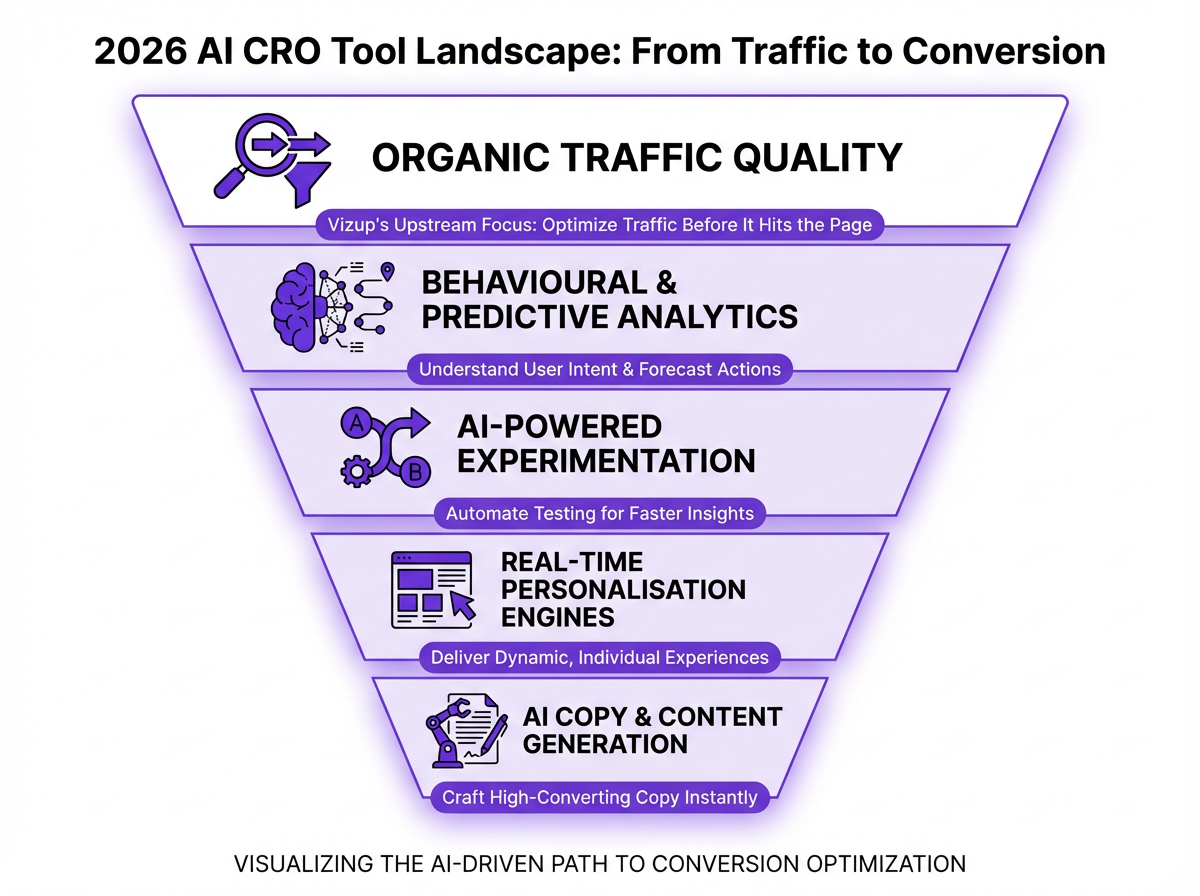
The AI tool market for CRO has gotten crowded, and most "best tools" lists rehash the same vendor talking points. What actually matters is matching the right tool category to your specific bottleneck.
A team drowning in session data but starving for test ideas has a completely different need than a team with great hypotheses and no traffic to test them on.
| Category | Core AI Capability | Typical Traffic Minimum | Pricing Tier | Best For | What to Watch For |
|---|---|---|---|---|---|
| Behavior Analytics | AI session summarization, heatmap clustering, insight generation | ~1K/mo sessions | Free to Mid-tier | SMBs, SaaS, agencies | Session summaries save real time but recommendations tend to stay surface-level |
| A/B Testing Platforms | Bayesian engines with AI-generated hypotheses and auto-allocation | ~5K/mo sessions | Mid to Enterprise | SaaS, ecommerce | Look for platforms where the stats engine is genuinely trustworthy, not just fast |
| Full-Stack CRO Platforms | Feature flagging, multivariate testing, AI-driven experiment prioritization | ~10K/mo sessions | Enterprise | Large ecommerce, enterprise SaaS | Powerful but priced for teams with dedicated CRO headcount |
| Personalization Engines | Account-based or continuous AI personalization without manual test setup | ~5K-20K/mo sessions | Mid to Enterprise | B2B SaaS, enterprise ecommerce, DTC | Exceptional for ABM and high-traffic sites; overkill for most SMBs |
| Copy Optimization Tools | Generative AI for CTA variants, headline testing, landing page copy | None | Free to Mid-tier | Any team running copy tests | Fast for generating variants but always needs human editing before shipping |
| Organic Traffic Optimization | AI-driven content strategy that improves traffic quality upstream | None | Mid-tier | SaaS, content-driven brands | Addresses the traffic quality problem most CRO tools ignore entirely |
| Pricing tiers and traffic minimums are approximate as of April 2026. Ranges vary significantly by vendor. |
These categories overlap more than vendors want you to believe. The practical question isn't "which category do I need?" but "where is my biggest bottleneck right now?"
If you're drowning in session data but starving for test ideas, a generative copy tool pays off faster than yet another analytics dashboard. If your traffic is high-volume but low-intent, no amount of on-page tweaking will compensate. For a broader view of how these pieces connect, Vizup's guide to AI marketing tools lays it out well.
Where Vizup Fits: Organic Traffic Quality as a CRO Lever
Most CRO guides treat traffic as a fixed input. You have X visitors, now optimize for them. That framing misses something critical: the quality of your traffic sets a hard ceiling on your conversion rate.
Pull in visitors who were never going to buy, and no amount of button-color testing will rescue your numbers.
This problem is getting sharper in 2026 as search behavior shifts toward conversational interfaces and answer engines. The clicks that do come through skew toward people who are either high-intent or completely misaligned.
Vizup's AI platform focuses on that upstream lever, helping teams attract higher-intent organic visitors before they ever reach the page being optimized. Better traffic quality produces better conversion data, which feeds smarter optimization, which informs content that attracts even better traffic. That compounding loop is something CRO-only tools can't create on their own.
3 AI-Powered CRO Strategies You Can Implement This Week
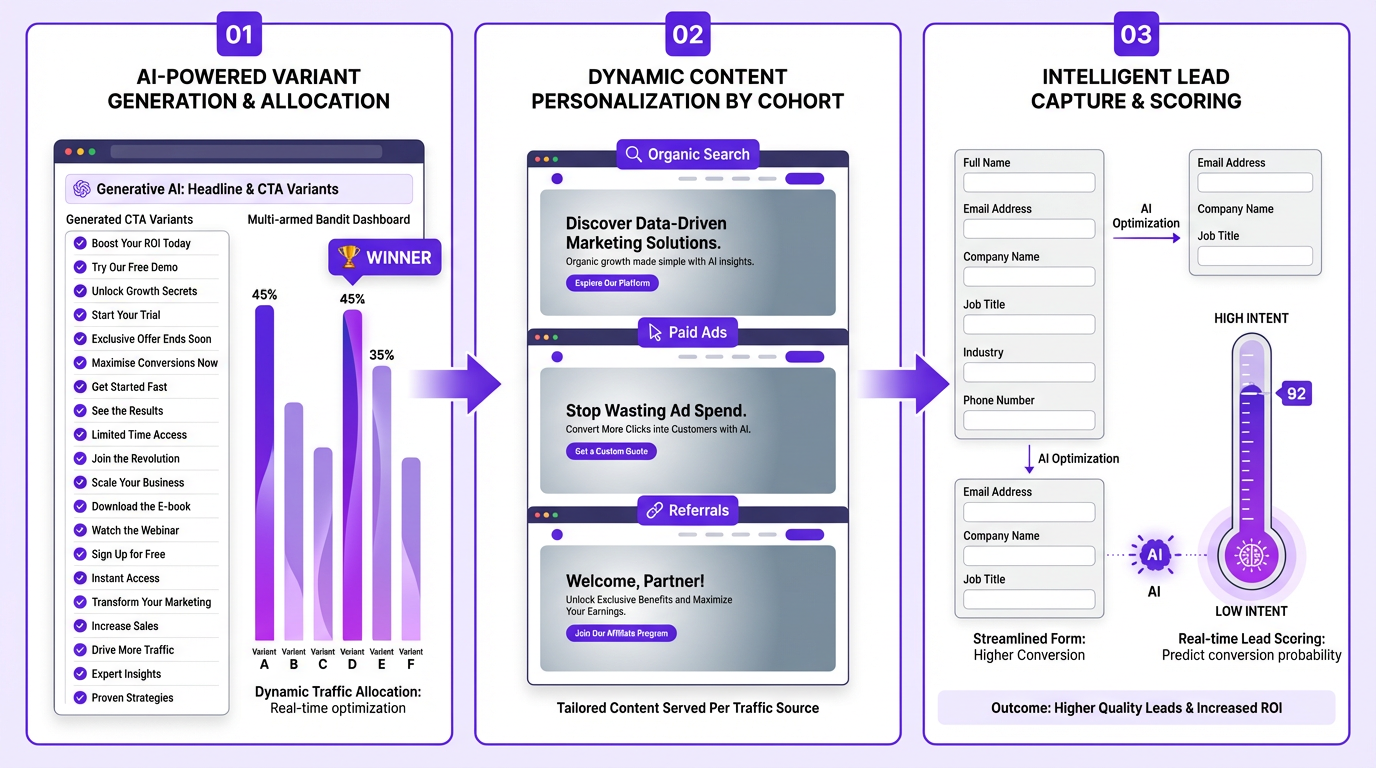
Strategy 1: AI-powered headline and CTA testing. Stop writing three variants by hand. Use a generative AI tool to produce 20+ headline and CTA variants in under an hour, then feed those into a multi-armed bandit testing setup. The bandit algorithm automatically shifts traffic toward winning variants in real time.
The win isn't just "more variants." It's better coverage of angles you'd never think to try manually. Ask the model for benefit-led versions, objection-handling versions, and versions that mirror the exact words your sales team hears on calls. Run it for 7 to 10 days. Directional results in days beat perfect results in six weeks.
Strategy 2: Dynamic personalization based on traffic source. Organic visitors, paid visitors, and referral visitors have fundamentally different intent profiles. Showing them the same hero section is leaving conversion on the table.
Even a basic UTM-based personalization setup in your CMS can serve different headlines to paid versus organic visitors. Three cohorts is plenty to start. You don't need a full personalization engine to get meaningful results from this kind of AI-informed segmentation.
Strategy 3: Predictive lead scoring on landing pages. AI can analyze behavioral signals in real time and adjust form length or offer based on predicted visitor intent. A high-intent visitor who has scrolled 80% of your page and spent 90 seconds reading gets a full demo request form. A low-intent visitor who bounced off the hero gets a lower-friction "get the guide" offer instead.
The conversion rate improvement here comes from matching the ask to the readiness.
Contrarian take: don't obsess over the lift on the low-intent path. The money is usually in not scaring off high-intent people with unnecessary friction. If you've tried to "simplify the form for everyone" and watched lead quality crater, you're not alone. Protecting the high-value path matters more than rescuing the low-value one.
Building a CRO and UX Feedback Loop
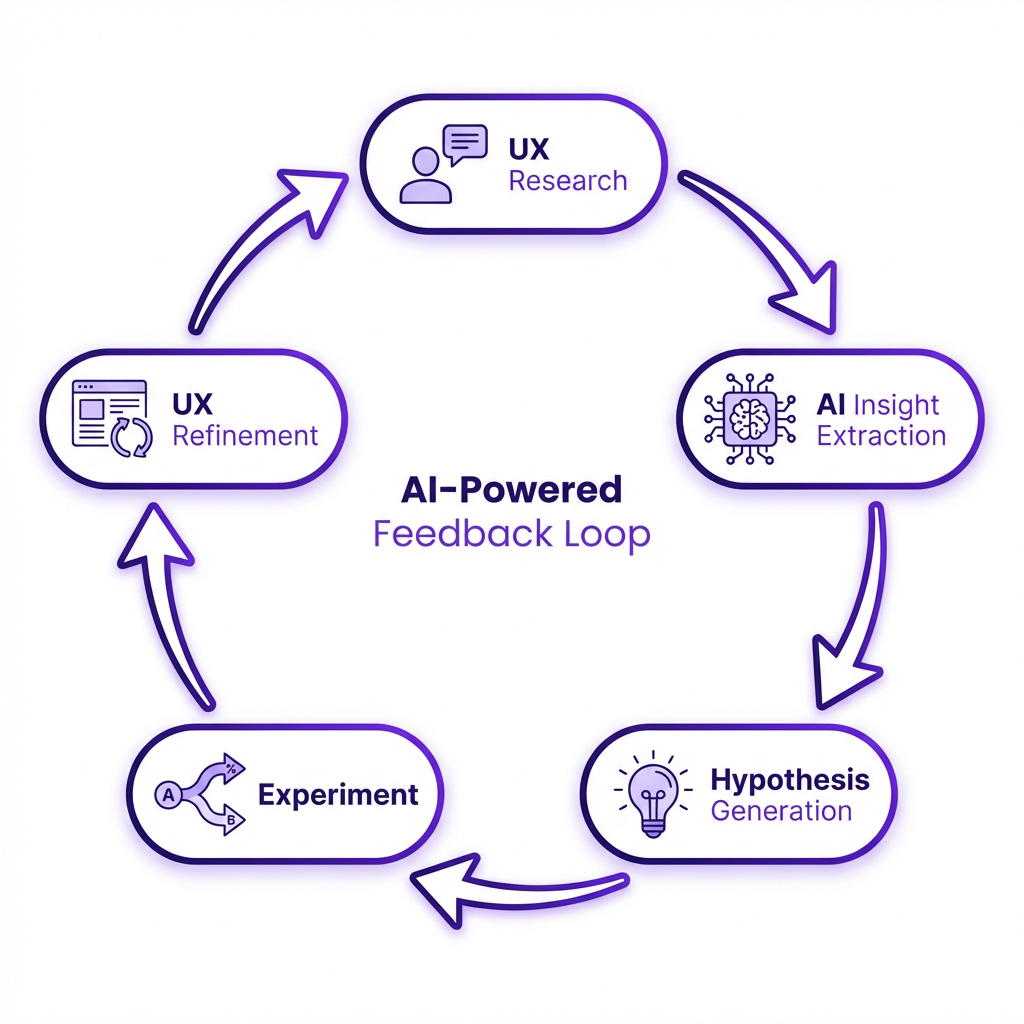
In most organizations, CRO and UX live in separate silos. The CRO team runs tests. The UX team does research. They share findings in a quarterly meeting and operate in parallel the rest of the time.
That disconnect costs more than people realize.
The teams consistently outperforming in 2026 have merged these functions, with AI as the connective tissue. Behavioral data from CRO experiments feeds directly into UX research priorities. Qualitative findings from UX generate hypotheses for CRO tests.
A practical way to start: schedule a 30-minute weekly "AI insight review." One person pulls the top behavioral anomalies from your analytics tool and adds the top three findings directly to your UX research backlog. Thirty minutes a week, done consistently, compounds into a real advantage over teams still running quarterly syncs. Foundational research on iterative design from the Nielsen Norman Group supports this kind of rapid-cycle approach.
Edge Cases That Separate Good CRO from Great
AI recommendations will sometimes conflict with your brand guidelines. An algorithm might learn that aggressive urgency messaging converts better short-term, but if your brand is built on trust, that creates a long-term problem nobody wants to clean up.
The fix is guardrails. Most enterprise CRO platforms let you set content rules that exclude certain message types or require human approval. Set these up before you start, not after you've shipped something that makes your brand team furious.
The "local maximum" trap is real. AI can over-optimize for immediate conversion at the expense of long-term customer lifetime value. A checkout flow optimized purely for conversion rate might use dark patterns that increase short-term purchases but destroy retention.
The solution is building LTV signals into your optimization model, not just conversion events. Pass revenue and retention data back into your testing framework so the AI is optimizing for customer quality, not just volume. I've seen teams celebrate a huge win on a landing page, then spend the next quarter explaining why churn spiked. Same root cause every time.
On privacy: GDPR has continued evolving, and cookieless tracking is now the default. Before deploying any behavioral AI tool in the EU, verify that it supports server-side event collection, has a documented data processing agreement, and doesn't rely on third-party cookies. The GDPR Enforcement Tracker is a valuable resource for staying current on enforcement actions.
As cookies become a relic, conversational AI is stepping in as a "value-exchange" broker, gathering zero-party data (preferences shared directly by the user) in exchange for personalized value. Your proprietary customer data becomes the real moat, not the tools you run on top of it.
Running AI-assisted CRO with under 10K monthly visitors? Focus on Bayesian testing frameworks, qualitative AI analysis of session recordings, and synthetic cohort modeling rather than traditional statistical significance. Directional insights from small samples beat waiting 18 months for significance you'll never reach.
From SEO to Answer Engine Optimization: Why It Matters for CRO
Search engines have become answer engines. By 2026, a significant share of search volume has shifted to conversational interfaces, and if your brand isn't part of the AI's "mental model," you're invisible to a growing share of your potential audience.
The goal is no longer just ranking for keywords. It's being the primary source cited by AI agents.
The strategy involves structuring your data with advanced schema, providing clear answers to complex queries, and ensuring your content is scannable for both humans and large language models. Clear headings, FAQ schemas, and unambiguous claims aren't just UX best practices anymore. They're how you stay visible in a synthesized-answer world.
Because the traffic that clicks through from answer engines tends to be higher-intent, optimizing for Answer Engine Optimization has a direct downstream effect on your conversion rates. Vizup's guide on how to build an AI-powered SEO strategy covers how to approach both disciplines together.
An Opinionated Take: The Real Moat Isn't the Tool
I worked with a DTC skincare brand that had gone all-in on an AI personalization engine. Impressive tech. Real-time variant serving, predictive scoring, the works.
Three months later, their conversion rate had moved exactly 0.4 percentage points. Why? Every competitor was using the same class of tool and running the same plays. The AI was just executing a commoditized playbook, faster.
Within 18 months, basic AI-driven A/B testing and personalization will be table stakes. The tools are getting cheaper and more automated. According to McKinsey's 2023 analysis of generative AI's economic potential, marketing and sales are among the highest-value areas for AI productivity gains, which means every major platform is racing to add these features. By the time a capability feels novel, it's usually about to become a default checkbox.
So where does the advantage live? Strategy, brand, and the quality of your ideas.
An AI can run 500 tests. It cannot tell you why a customer hesitates at the pricing page because they don't trust your support team will pick up the phone. It cannot craft a story that resolves that specific fear. And it won't suggest a core product decision, like offering a money-back guarantee, that removes the hesitation entirely.
The human value is providing the context and creativity your competitors can't copy because it comes from your customers, your product, and your unique point of view.
The Marketing Manager of 2026 is less of a doer and more of a director. Your job is to set the vision, define the ethical guardrails, and let the AI handle execution. But the vision has to be genuinely yours. That's the part that doesn't scale.
[Author Video Summary] A short video from the author recapping the three key themes of this article: (1) AI for CRO is only as good as the hypothesis framework feeding it, (2) traffic quality is the upstream lever most teams ignore, and (3) the durable competitive advantage is strategic judgment, not tool access. The video walks through the pricing-toggle case study and shows a live example of multi-armed bandit testing in action, with a brief demo of how Vizup's pattern analyzer surfaces behavioral insights. [Embed placeholder for production video upload.]
If you want to audit your current tool stack against what's actually available, our roundup of the best AI marketing tools covers the landscape well.
Frequently Asked Questions About AI for CRO
How much traffic do I need before AI-powered CRO tools are worth using?
Less than you probably think. Traditional A/B testing required 10K+ monthly visitors for statistical significance. Bayesian testing frameworks can surface directional insights with 1,000 to 2,000 monthly visitors. For behavioral AI tools, even smaller sites get value from session clustering and AI-generated summaries. The threshold varies by tool, but "we're too small" is rarely the real blocker anymore.
Can AI fully replace human CRO strategists, or do I still need a team?
AI replaces the manual, repetitive parts of CRO: session review, variant generation, statistical analysis, and traffic allocation. It does not replace strategic judgment, brand context, qualitative user research, or the ability to identify when a test result is technically significant but practically wrong. The strategist role shifts from execution to interpretation and hypothesis quality.
What's the difference between AI A/B testing and traditional A/B testing?
Traditional A/B testing uses frequentist statistics: you run a test, wait for significance, and pick a winner. AI-assisted testing uses Bayesian models and multi-armed bandit algorithms that continuously shift traffic toward better-performing variants in real time, reducing the cost of running losing variants. AI also automates hypothesis generation and can run multivariate tests at a scale that would be manually impossible.
How do AI CRO tools handle user privacy and GDPR compliance in 2026?
Most reputable platforms have moved to server-side tracking, consent-based data collection, and cookieless session modeling. Before deploying any behavioral AI tool in the EU, verify: server-side event collection support, a signed data processing agreement, and no reliance on third-party cookies. Check the vendor's documentation portal, not just their marketing site. When in doubt, consult your legal team before deployment.
What's the fastest way to see ROI from AI for Conversion Rate Optimization?
Start with copy and CTA testing using generative AI to produce variants, then run a multi-armed bandit test on your highest-traffic landing page. This requires no new tracking setup and can show results within 7 to 14 days. The second fastest lever is traffic quality. If your current visitors are low-intent, no optimization will fix your numbers. Explore Vizup for the traffic quality side of this equation.
What are the best AI tools for conversion rate optimization in 2026?
The most effective AI CRO tools in 2026 span five categories: behavioral analytics platforms for session clustering and insight generation, Bayesian A/B testing platforms with AI-generated hypotheses, real-time personalization engines, generative copy optimization tools, and organic traffic quality platforms like Vizup that improve the intent profile of visitors before they reach your conversion pages.
How does AI personalization improve conversion rates on landing pages?
AI personalization uses real-time behavioral signals (scroll depth, time on page, click patterns, traffic source) to dynamically adjust what a visitor sees. High-intent visitors might get a direct demo request form, while hesitant visitors see a softer offer like a free guide. This approach treats each visitor as a segment of one rather than applying the same experience to everyone.
How does Answer Engine Optimization (AEO) affect conversion rates?
Answer Engine Optimization (AEO) focuses on structuring content so AI-powered search interfaces cite your brand as a primary source. Because users who click through from answer engines tend to have higher purchase intent, AEO directly improves the quality of traffic reaching your conversion pages. Combining AEO with on-page CRO creates a compounding loop: better traffic, cleaner data, smarter tests.
What are common mistakes when implementing AI for CRO?
The most common mistake is deploying AI CRO tools without a hypothesis framework. If your team can't articulate why a change should improve conversions before testing, the AI will optimize noise. Other frequent pitfalls include ignoring traffic quality, over-optimizing for short-term conversion at the expense of customer lifetime value, and skipping brand guardrails that prevent off-brand messaging from going live.
Key Takeaways and Your Next Move
The most important things to carry forward:
- AI amplifies CRO fundamentals; it doesn't replace them. Broken tracking and unclear value propositions don't get fixed by better tools.
- Behavioral AI surfaces micro-interaction patterns (like pricing toggle hovers) that manual session review will never catch at scale.
- The traffic minimum for AI CRO has dropped significantly. Bayesian frameworks make meaningful testing accessible to sites with under 5K monthly visitors.
- The fastest ROI path is usually AI-powered copy testing on your highest-traffic page, not a full platform overhaul.
- Traffic quality is the upstream lever most CRO guides ignore. Optimizing for better visitors is often more valuable than optimizing for more conversions from the wrong ones.
- Answer Engine Optimization is converging with CRO. Structure your content for synthesis, not just ranking.
- Your proprietary data, unique customer insights, and brand voice are the durable advantages.
Your next move is concrete: audit your current CRO stack against the tool comparison table above. Identify the single biggest gap (behavior analytics, testing infrastructure, personalization, or traffic quality) and run one AI-assisted experiment in the next 14 days. Not a full platform migration. One test. That's how momentum starts.
If you're missing the traffic quality piece entirely, address that first. Better visitors make every downstream experiment cleaner and every conversion metric more trustworthy. Vizup's AI-powered organic marketing platform is built specifically for that upstream problem, and their AI content checker is a practical starting point for auditing what your current content is actually doing for conversion intent.
