
Google's AI Mode hotel booking feature lets users research, compare, and reserve hotels without leaving the chat interface. Google Pay handles payment, while a select group of OTAs and hotel partners fulfills the transaction. Announced August 27, 2026, the update also added flight-price tracking and loyalty award-pricing search, turning AI Mode into a full-funnel travel assistant.
For travel marketers and OTA SEO managers, this is more than another booking feature. It redraws the line between discovery and transaction while pulling the consideration data into Google's system. The immediate questions are who gets distribution, who loses it, and what non-partners can still influence.
What Exactly Is Changing with Google's AI Travel Features?
Earlier versions of AI Mode surfaced travel information and sent users to booking sites. The August 2026 release removes that handoff for a growing partner set. A traveler can describe a trip, get an itinerary covering flights, hotels, and activities, then complete a reservation in the same session. That is agentic booking: the system takes the booking action rather than merely presenting choices.
The launch also put fare monitoring directly in the conversation and introduced award-pricing search for points and miles. American Airlines AAdvantage, Hilton Honors, and Wyndham Rewards support the loyalty feature at launch. Google's broader partner-integration pattern is visible in connected apps in AI Mode.
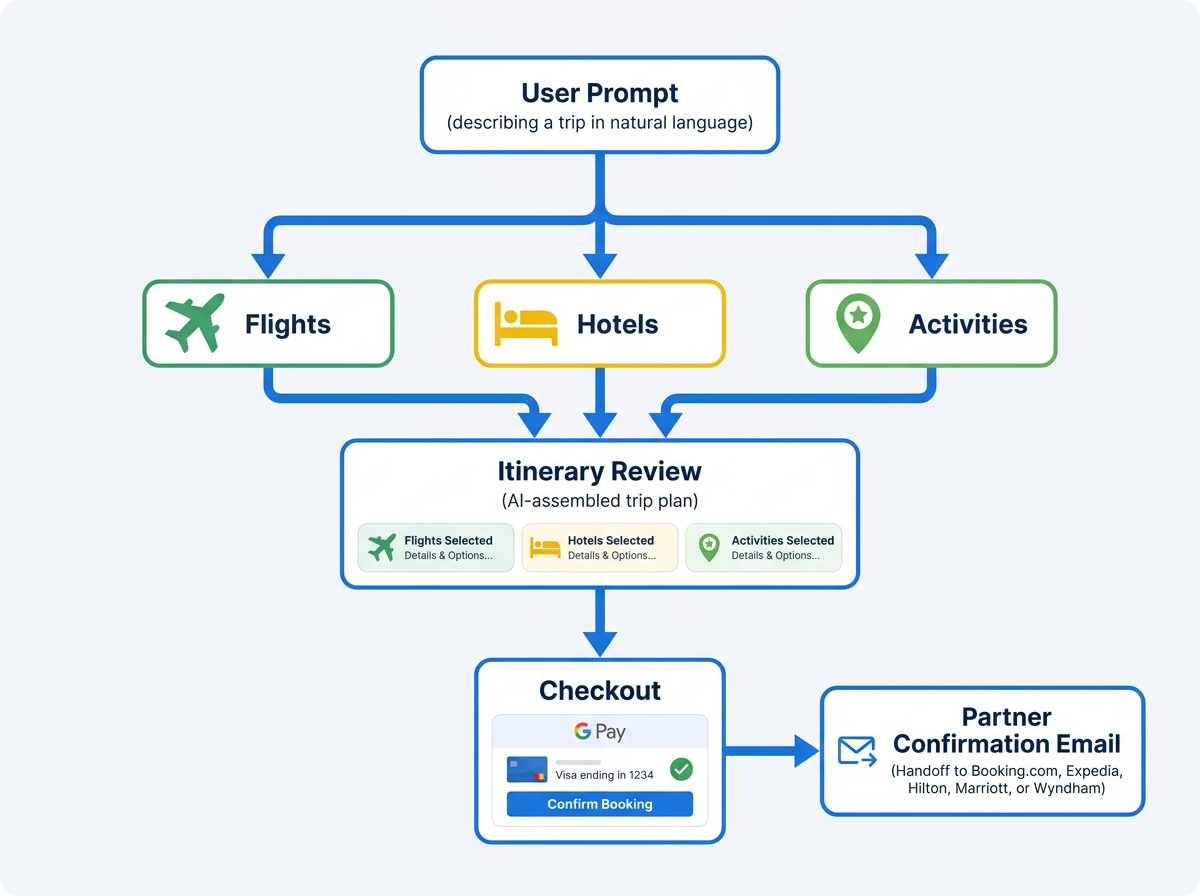
The Booking Flow: Continue on Google and the Merchant of Record Question
After a user picks a hotel in AI Mode, Continue on Google collects payment through Google Pay and sends the confirmed reservation to the partner. The initial travel partners are Booking.com, Expedia, Hilton, Marriott, and Wyndham. The hotel or OTA remains the merchant of record, responsible for payment processing, customer service, and cancellations, not Google. That matters for liability and operations; it does not solve the data issue.
Warning: Merchant-of-record status puts refunds and tax compliance with the partner. It does not give that partner the pre-booking journey data or control of the customer relationship; Google retains both.
The Partner Data Problem: What Brands Lose When Google Owns the Funnel
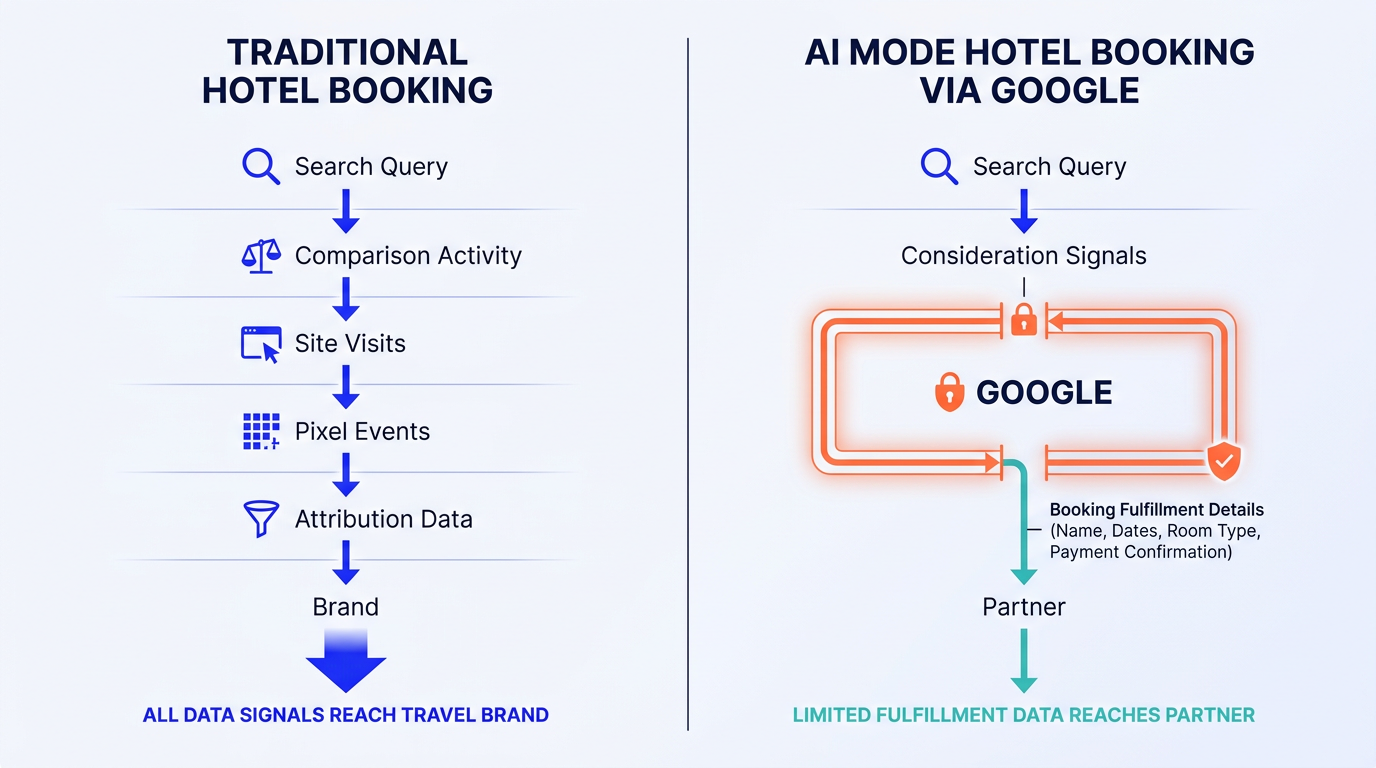
The data transparency problem in platform commerce gets sharper when the platform also owns search. A direct site or OTA normally sees the query, comparisons, session length, and referral source before booking. In AI Mode, Google holds that consideration phase. The partner gets what it needs to fulfill the stay: name, dates, room type, and payment confirmation.
That gap reaches well beyond reporting. A brand cannot build retargeting audiences from visitors who never arrive on its site, and its personalization systems lose the behavioral inputs they rely on. Google now occupies the travel-search transaction layer, leaving standard attribution unable to value the AI Mode touchpoint when conversion happens off-site.
| Dimension | Traditional OTA or Direct Site Booking | AI Mode Hotel Booking via Google |
|---|---|---|
| Customer Data Captured | Full session: query, comparisons, time on page, referral source | Fulfillment data only: name, dates, room type, payment confirmation |
| Brand Touchpoints | Multiple: ads, organic listings, site pages, email capture | No pre-booking touchpoints; partner gets a post-booking notification |
| Retargeting Capability | Pixel data supports segmentation and remarketing | No site visit, no pixel fire, and no retargeting audience |
| Attribution Model | Last-click or multi-touch models cover the funnel | Conversion happens in Google; standard models cannot track it |
| Data positions as of August 2026 based on reported partner terms for the AI Mode hotel booking rollout. |
Who Is In and Who Is Out: The Visibility Risk for Non-Partners
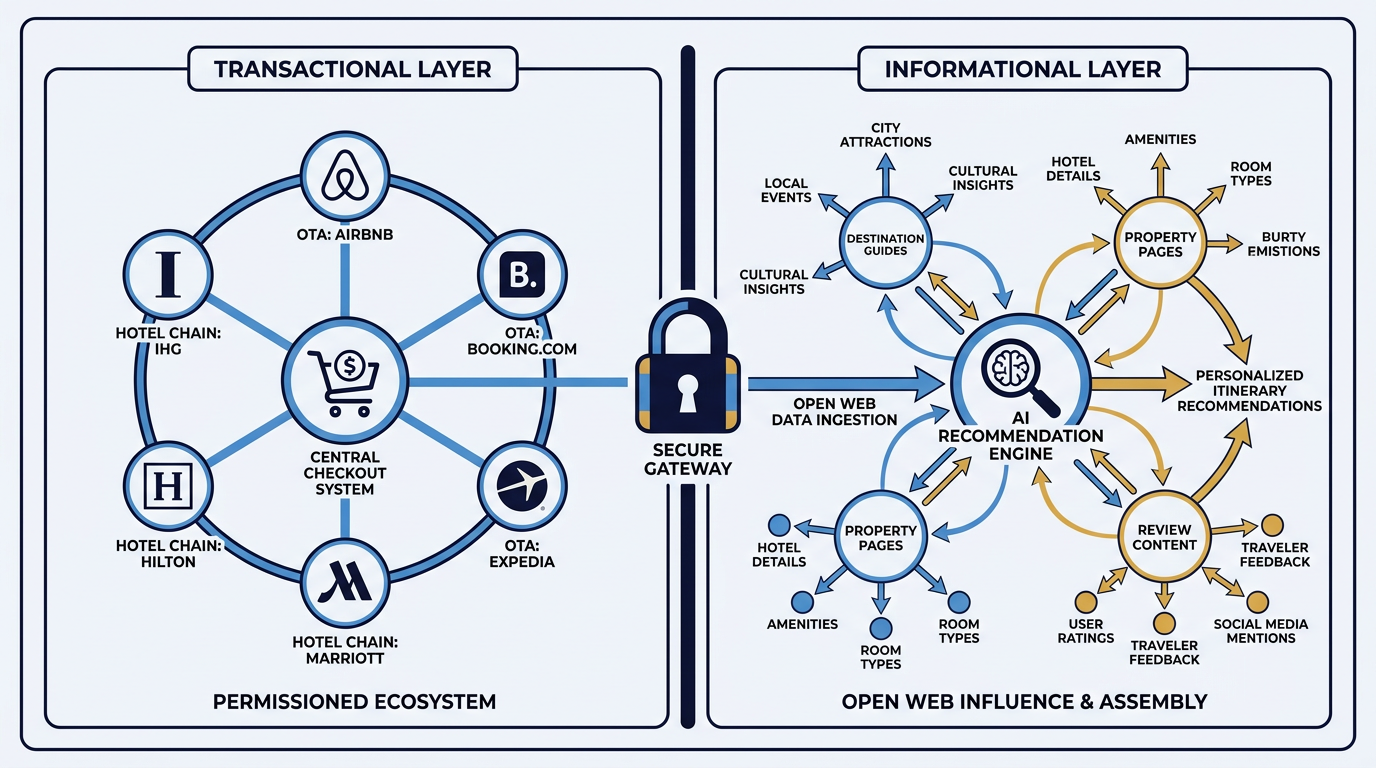
AI Mode's transactional layer is closed to brands outside the launch list. Google has not publicly documented a self-serve application process for hotels or OTAs seeking Continue on Google checkout placement. Award-pricing search launched with just three loyalty programs, leaving the rest absent at a moment of high traveler intent.
That divides OTA visibility in AI search. Partners receive transactional placement; everyone else competes in the informational layer: destination guides, property descriptions, and experience content used to assemble recommendations. A travel brand's AEO strategy is therefore the main lever for non-partners. The pattern described in how AI Mode changes SEO holds across verticals: informational authority comes before transactional access.
How Travel Brands Should Respond Right Now
The response runs on two tracks: earn a place in the consideration phase with structured, machine-readable content, then turn AI-assisted discovery into direct relationships before the next booking cycle.
Practical steps for travel marketers and OTA SEO managers:
- Audit your structured data. Hotel schema, FAQ schema, and offer markup give AI systems the property details they need for itinerary recommendations. Missing markup reduces citation opportunities.
- Publish destination content alongside property pages. AI Mode builds itineraries from several sources. Local experiences, transport, and seasonal guidance create more opportunities for your brand to appear during planning.
- Make direct booking worthwhile. A traveler who reaches your site from AI Mode needs a reason to book direct next time. Rate-parity guarantees, loyalty perks, and exclusive packages are practical options.
- Invest in Answer Engine Optimization (AEO). Clear, extractable facts about amenities and cancellation policies are the non-partner route to Google's AI Mode for hotel booking visibility.
- Track AI Mode citations. If you do not measure when your content appears in planning responses, you cannot assess the work. Monitoring across answer engines is now basic operating practice.
Paid placement is another part of the commercial picture: how ads appear in AI Mode is relevant for travel brands weighing paid amplification alongside organic AEO. Vizup's Answer Engine Monitoring tracks how AI models retrieve and cite content, giving teams a measurable AEO signal.
Key Takeaways
- AI Mode hotel booking is live in the U.S. for English-language users, with Google Pay checkout and partners including Booking.com, Expedia, Hilton, Marriott, and Wyndham.
- Continue on Google makes AI Mode both the discovery surface and transaction layer, limiting the journey data passed to hotel and OTA partners.
- Loyalty programs outside the launch list are absent from conversational points-and-miles searches, a high-intent query category.
- Non-partners must compete in the informational layer through structured content, schema markup, and AEO.
- Current attribution and retargeting models fail when the booking completes in AI Mode; brands need measurement that accounts for this dark-funnel touchpoint.
- For brands without transactional partner status, a travel AEO strategy remains the most actionable route to consideration-set visibility.
Frequently Asked Questions
What does agentic travel booking mean in Google's AI Mode?
It describes an AI system that completes an action rather than only listing options. In AI Mode, a natural-language prompt can produce an itinerary, hotel and flight options, and a hotel booking through Google Pay within the chat. That differs from conventional search, where the user leaves for a third-party site to finish the work.
How does Continue on Google affect hotel customer data?
The hotel or OTA receives the data required to fulfill the stay: guest name, dates, room type, and payment confirmation. Searches, comparisons, and time spent considering properties remain in Google's system. Hotels consequently lose the site-session signals used for personalization, retargeting, and longer-term relationship building.
My hotel is not a Google partner. How can it appear in AI Mode results?
Non-partners can still compete in AI Mode's informational layer. Structured property pages, destination guides, FAQ schema, and hotel schema give the model material to cite in itinerary recommendations. A travel AEO strategy focuses content on clear factual answers, while citation tracking shows whether that work is producing visibility.
Can users book flights with points and miles in Google AI Mode?
Yes. The August 2026 update added award-pricing search, so users can ask about availability with points and miles in the chat. At launch, American Airlines AAdvantage, Hilton Honors, and Wyndham Rewards are supported. Programs outside that set do not appear in those award-pricing queries.
How do SEO and AEO differ for travel brands?
SEO aims for rankings in link-based results that send users to a site. Answer Engine Optimization (AEO) aims to have content selected, cited, and summarized in AI-generated answers. SEO can drive visits; AEO shapes what AI Mode says about a property during planning, including sessions where no click occurs.
