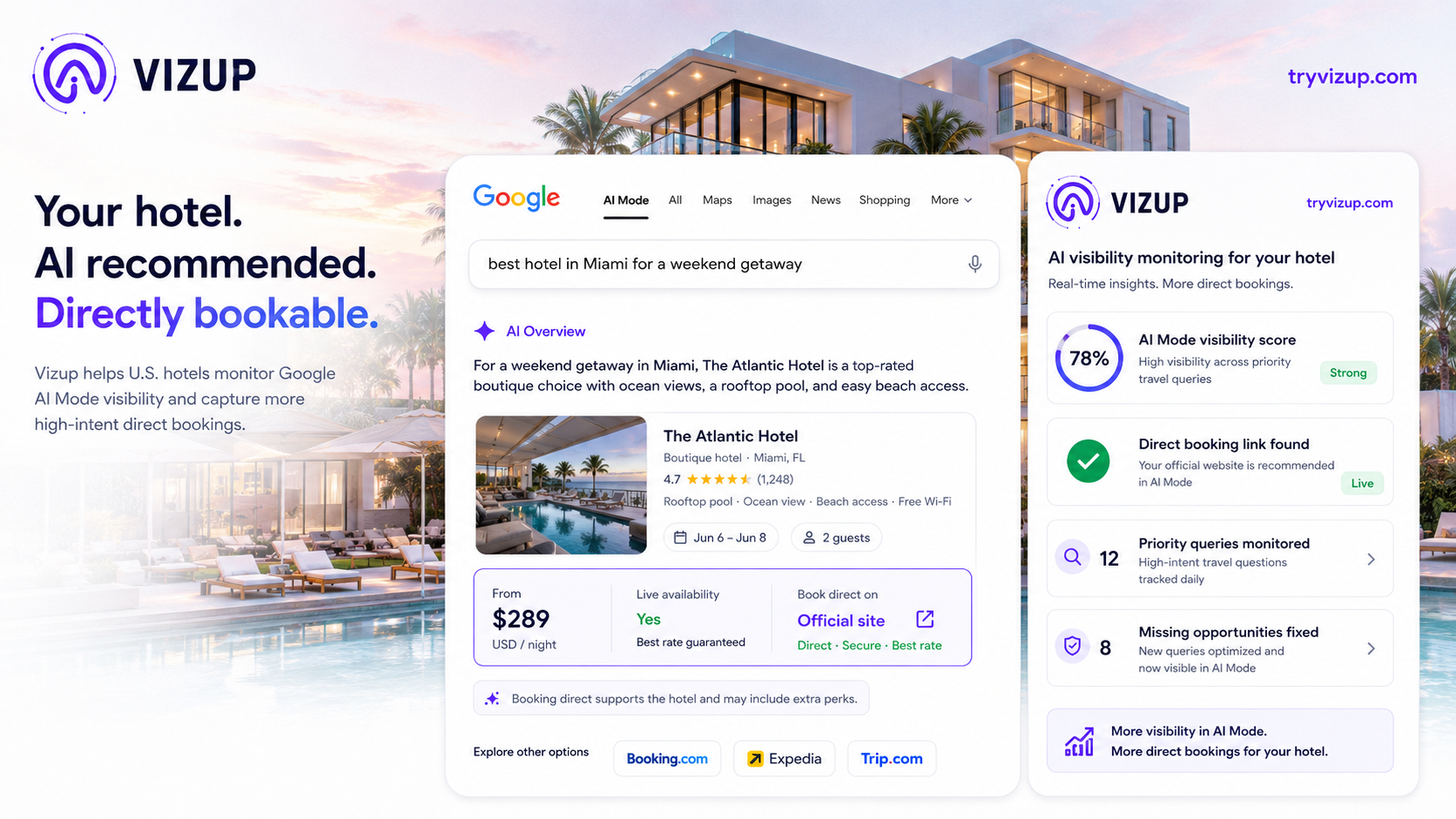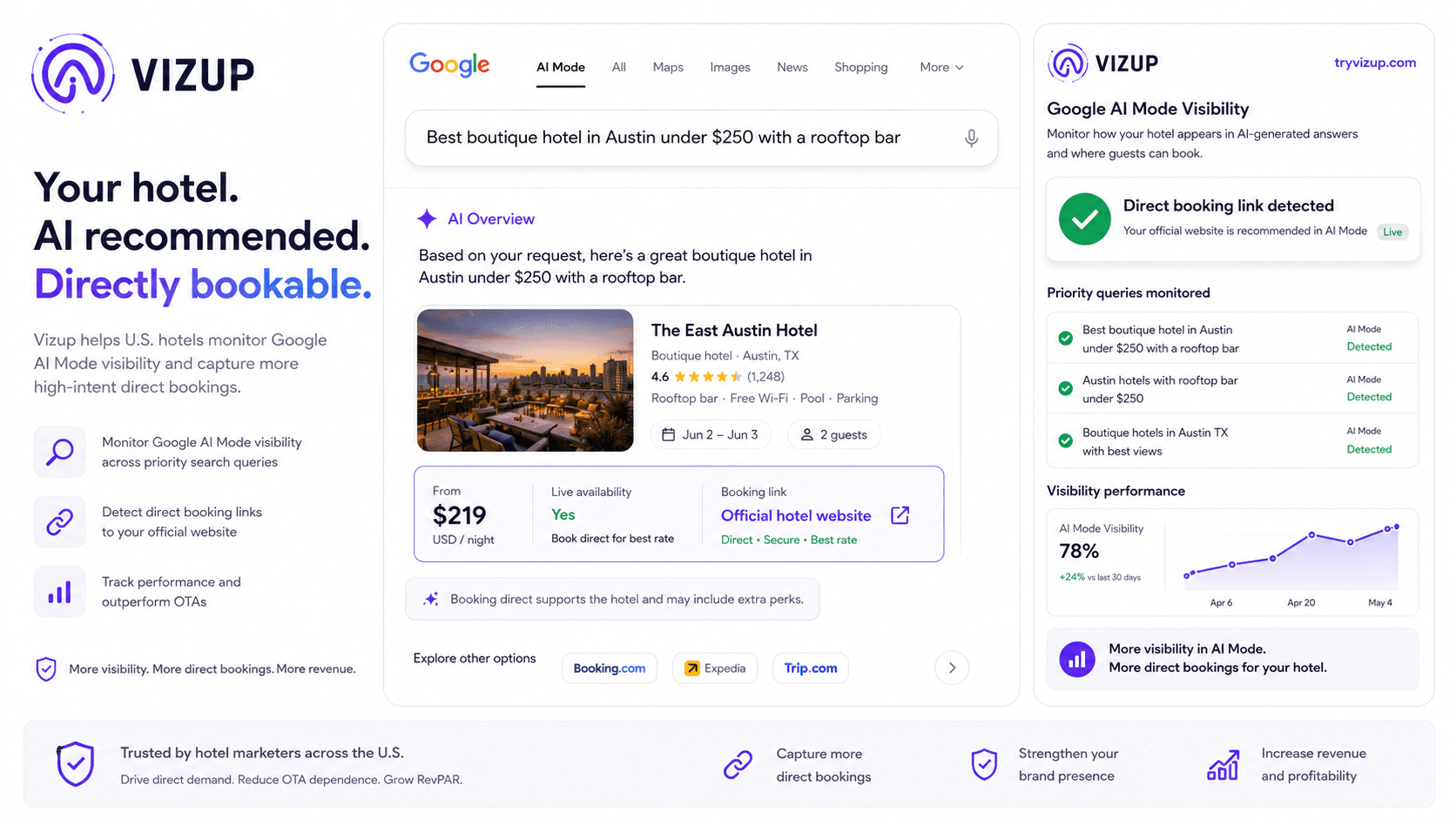
Info: Featured Insight: Google is testing showing direct booking links from official hotel websites inside AI Mode responses — this could become one of the most important shifts in hotel search visibility since Google Hotel Ads. Hotels with Google Hotel Ads integration appear with live rates, availability, and direct reservation links embedded in AI-generated answers.
Google AI Mode hotel booking is moving from speculation into early testing. As of May 2026, Search Engine Roundtable reported early testing that Google appears to be testing direct hotel booking links inside AI Mode responses, surfacing official hotel website links with live pricing rather than defaulting to OTA aggregators. For anyone working in travel SEO or hotel distribution, this could become one of the most important shifts in hotel search visibility since Google Hotel Ads.
This overview is for hotel marketers, travel SEO leads, OTA managers, and hospitality brand owners who need a clear picture of what is changing, why it matters, and what to do about it. It covers what the new AI Mode experience looks like, how it compares to traditional hotel search, who wins and who loses in the OTA vs direct booking dynamic, and how to monitor your visibility before this becomes the default search experience for travel.
What Google AI Mode Hotel Booking Actually Looks Like Right Now
AI Mode is not AI Overviews. If you have only seen the summary box that occasionally appears above blue links, that is a different product. AI Mode is a full conversational interface, accessible via the AI Mode tab in Google Search, where users ask complex multi-part questions and receive synthesized answers. The critical difference for hotels: those answers now include embedded booking cards.
A user asking 'best boutique hotel in Lisbon under $200 with a rooftop bar near Alfama' does not get ten blue links. They get a curated AI response that names specific properties, explains why each fits the query, and embeds a booking card showing live rates, available dates, and a direct reservation link to the hotel's official website. According to Google's own roadmap, the company plans to enable full in-interface booking completion for hotels, meaning the transaction may eventually never leave the AI panel.
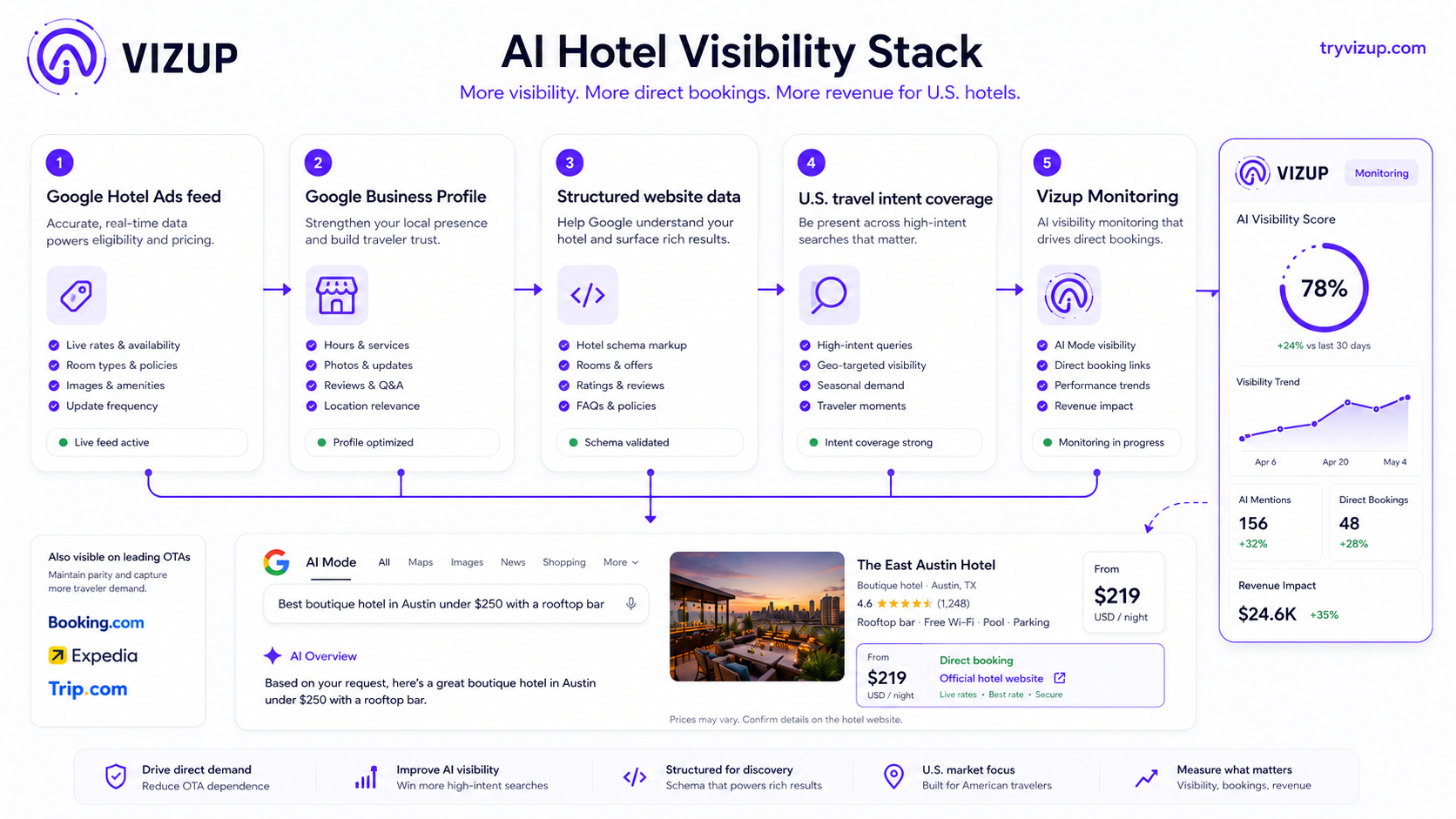
The data feeding these cards comes from three sources: an active Google Hotel Ads feed pushing live rates and availability, the hotel's Google Business Profile for entity attributes and reviews, and structured data from the official website confirming property details. Remove any one of those three and the booking card either does not appear or appears incomplete. Understanding how Google AI Mode changes SEO at a structural level is the foundation for everything that follows.
OTA vs. Direct Booking in AI Search: Who Actually Wins in 2026?
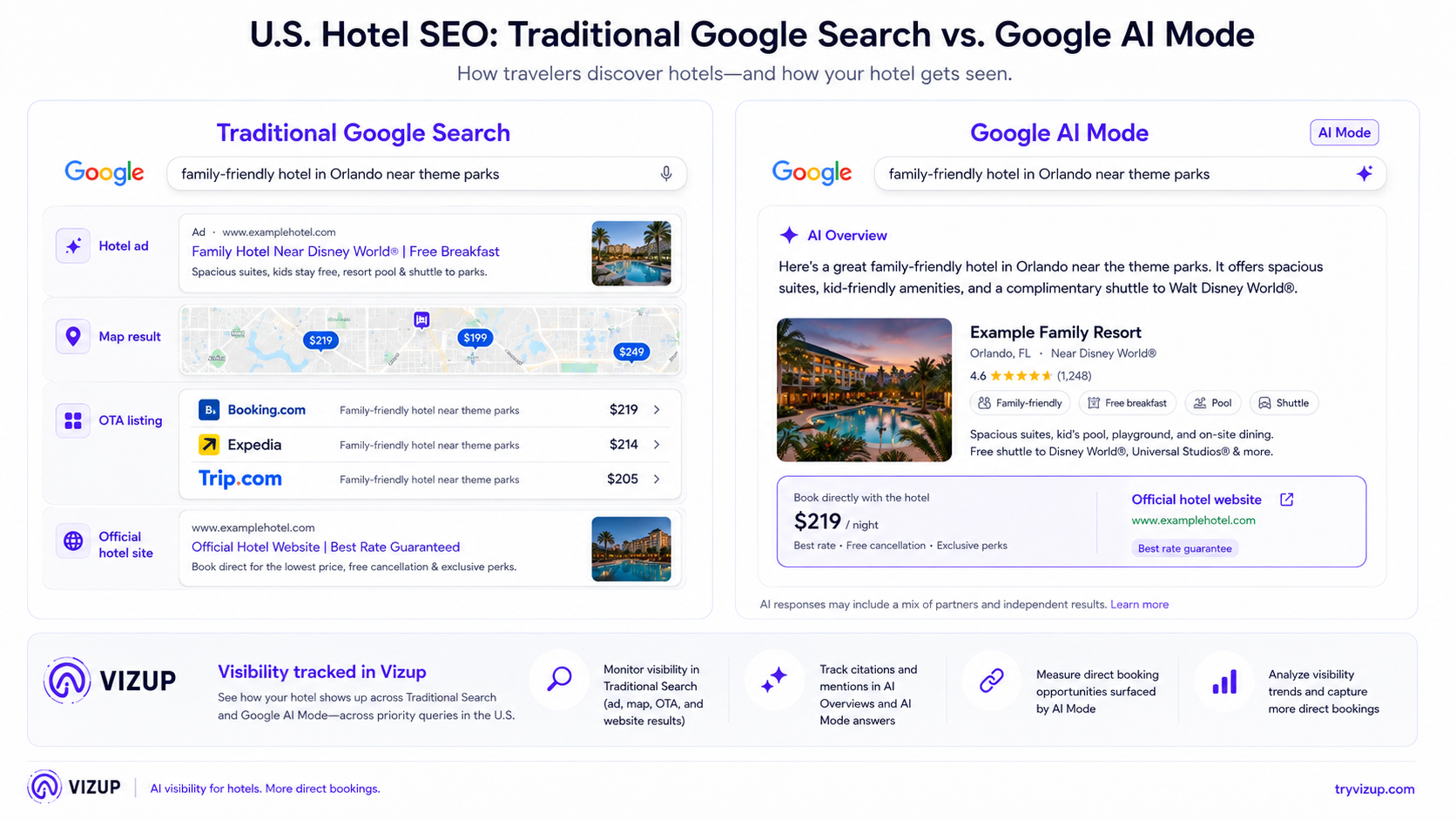
For hotels, the practical opportunity is clearer direct visibility inside AI-generated travel answers. Many travelers who begin their research on an OTA ultimately book directly with the hotel. If Google AI Mode travel links consistently surface official hotel websites over OTA listings, that trend will accelerate. The standard 15-25% commission model faces genuine structural pressure for the first time in a decade.
| Dimension | OTA Listing | Direct Hotel Booking |
|---|---|---|
| Visibility in AI responses | Deprioritized in testing; AI favors official site links | Prioritized when GHA feed and structured data are active |
| Commission / cost structure | 15-25% per booking | Only Google Hotel Ads CPC cost |
| Data ownership | OTA owns guest data | Hotel owns full guest profile |
| Booking path length | OTA site adds steps and cross-sell friction | Direct link to hotel booking engine |
| Rate parity risk | OTA contracts may restrict direct pricing | Full pricing control, but contract review needed |
| Google Hotel Ads dependency | OTAs have their own GHA feeds | Hotel must maintain its own active GHA feed |
| Comparison based on current AI Mode testing behavior as of May 2026. OTA visibility in AI responses may vary as rollout continues. |
There is an important nuance here that most coverage misses. Smaller independent hotels without Google Hotel Ads integration or strong hotel official website AI search signals may actually become more dependent on OTAs as AI Mode scales, not less. If your property has no active GHA feed and thin structured data, you will not appear in AI Mode direct results at all. OTAs will remain your only path to AI-surface visibility. That is a real risk for independent properties sitting on the sidelines.
The Hotel AI Mode Readiness Checklist
This is the part that matters most. Each step below is a dependency, not a suggestion. Skip one and the chain breaks.
Step 1: Google Hotel Ads Setup with Live Rates
Google Hotel Ads integration is the non-negotiable foundation. Without an active GHA feed pushing live rates and availability, your property generates no booking card in AI responses. Industry analysis from late 2025 confirms that hotels must feed inventory into Google Hotel Ads to appear with live pricing in AI Mode. Connect via a certified connectivity partner or a direct API integration. Verify that your rate sync windows are within one hour and confirm your property appears correctly in Google Hotel Center.
Step 2: Google Business Profile Optimization
AI Mode pulls entity data directly from your Google Business Profile: amenities, photos, star ratings, review sentiment, and location attributes. An incomplete profile gives the AI less signal to match your property against complex, layered queries. Fill every attribute field. Respond to reviews consistently (AI Mode references aggregate sentiment). Upload recent high-quality photos. Confirm that your name, address, and phone number are identical across your GBP, your website, and your GHA feed. Inconsistency here creates entity confusion that suppresses AI recommendations.
Step 3: Structured Data and Official Website SEO
Implement LodgingBusiness schema, FAQ schema, and Review schema on your official website. This is how Google confirms your site as the authoritative source for your property rather than an OTA's listing page. Hotel official website AI search visibility also depends on clean technical SEO: fast Core Web Vitals, mobile-first design, and crawlable booking engine pages. Many booking widgets render inside iframes that Googlebot cannot parse, which means your rates and availability are invisible to the crawler even if your GHA feed is active. Check how deep links work to ensure your booking pages are directly accessible and not buried behind JavaScript walls.
Warning: The most common mistake: hotels invest heavily in Google Hotel Ads but neglect their own website's structured data and technical SEO. AI Mode needs both signals. The GHA feed delivers rates; the website delivers entity authority. One without the other produces incomplete or absent AI responses.
What Most Hotels Get Wrong About AI Mode Visibility
Three mistakes come up repeatedly when auditing hotel digital presence for AI Mode readiness.
- Assuming GHA alone is sufficient. The ad feed gets you the booking card mechanism. Your website's content and structured data determine whether AI Mode selects your property as a recommendation in the first place. Both layers must be active.
- Optimizing for short-tail queries only. Hotels optimize for 'hotel in Paris' but AI Mode users ask 'where should I stay in Paris for a long weekend with kids near the Marais that has a pool.' Your content needs to answer those layered, conversational queries. Check whether your website is AI-agent friendly before assuming your current SEO setup transfers.
- Treating AI Mode like another SERP feature. There is no position 1 through 10. Either you are in the AI answer or you are not. The optimization model is closer to Answer Engine Optimization than traditional SEO. As of early 2026, PhocusWire reported that 39% of U.S. travelers were already using AI to research and plan trips, a figure projected to exceed 50% by year-end. The audience is already there.
Monitoring Your Visibility in Google AI Mode Travel Links
You cannot optimize what you cannot measure, and traditional rank tracking does not capture AI Mode appearances. A tool reporting your position for 'boutique hotels Lisbon' in standard organic results tells you nothing about whether your property surfaces in an AI Mode conversational response for that same query.
Vizup's Answer Engine Monitoring and Digital Presence Monitoring tools are built specifically for this gap: track whether your hotel appears in AI Mode responses for target travel queries, monitor which properties surface consistently and where your hotel is missing from AI answers. The practical workflow is straightforward: configure monitoring for 20-30 high-intent travel queries per property, review weekly, and cross-reference findings with GHA performance data in Hotel Center.
Most legacy SEO platforms still focus on tracking traditional blue-link rankings. While the market for AI visibility tracking is still developing, the need to measure performance in AI-generated results is clear. The hotels and agencies that establish a measurement infrastructure now will have a significant analytical advantage when Google AI Mode becomes the default travel search experience. Understanding how to monitor AI-era paid search competition is part of the same competitive picture.
Advanced Considerations: Rate Parity, Attribution, and the Long Game
Rate parity clauses in OTA contracts create friction when AI Mode begins surfacing your direct rate alongside or instead of OTA rates. If your OTA agreements require rate parity, showing a lower direct rate in an AI response could trigger penalties. Review your distribution agreements now, before AI Mode scales further.
Attribution is also murky in ways that will surprise revenue managers. A booking that originates in an AI Mode response and completes on your official site may not be tracked correctly in GA4 without proper UTM parameters and referral exclusions for Google's AI surfaces. Set this up proactively. Google's incentive here is transparent: direct booking links keep users inside Google's ecosystem and generate Hotel Ads revenue without OTA intermediaries taking a cut. Expect the direct booking AI search 2026 trend to expand, not contract. Hotels that treat this as a temporary test are likely to be caught flat-footed.
Frequently Asked Questions
Do I need Google Hotel Ads to appear in AI Mode hotel booking results?
Yes. An active Google Hotel Ads feed is the mechanism that generates live rate and availability cards inside AI Mode responses. Without it, your property has no booking card to display, regardless of how strong your website SEO or Google Business Profile is. Connect via a certified connectivity partner and verify your feed in Google Hotel Center before doing anything else.
Will AI Mode replace traditional Google Hotel Search and metasearch results?
Not immediately. AI Mode is currently a separate tab experience, and traditional hotel search modules still exist in standard Google Search results. However, Google's stated roadmap includes enabling full booking completion inside AI Mode. The trajectory is toward consolidation, and hotels should prepare for AI Mode to become the primary discovery channel for high-intent travel queries within the next 12-18 months.
How does Google AI Mode decide which hotels to recommend in its responses?
Google AI Mode synthesizes signals from multiple sources: the relevance and completeness of your GHA feed, the quality and completeness of your Google Business Profile, structured data on your official website, review sentiment, and how well your property's content matches the specific query intent. A hotel asking 'why am I not appearing in AI Mode' almost always has a gap in one of these four areas.
Can independent hotels without big marketing budgets compete in AI Mode direct booking results?
Yes, but only if they complete the technical foundation. Google Hotel Ads operates on a cost-per-click model, not a fixed budget requirement, so smaller properties can participate. The bigger barrier is often the structured data and website SEO work, which requires time rather than large spend. Independent hotels that complete the readiness checklist can compete effectively against larger chains for specific, location-based queries in AI Mode.
How do I track whether my hotel is appearing in Google AI Mode travel links?
Standard rank tracking tools do not capture AI Mode appearances. You need purpose-built answer engine monitoring. Vizup's Digital Presence Monitoring tracks AI Mode visibility across target queries, showing which properties appear in AI responses and which competitors surface consistently. Set up monitoring for your highest-priority travel queries and review results weekly alongside your GHA performance data.
Key Takeaways and What to Do This Week
Google AI Mode hotel booking is reshaping travel search distribution by favoring direct booking links from official hotel websites over OTA listings inside AI-generated answers. The competitive landscape does not have ten positions anymore. You are either in the answer or you are not.
Three actions to take before the end of this week:
- Audit your GHA feed. Confirm live rates are syncing within one hour and your property appears correctly in Google Hotel Center. This is the single highest-leverage action.
- Run your official site through a structured data validator. Check for LodgingBusiness schema, confirm your booking engine pages are crawlable, and fix any iframe-blocked rate content.
- Set up AI Mode visibility monitoring. Use a tool like Vizup to track whether your property appears in AI Mode responses for your 20-30 most important travel queries. You need a baseline before you can measure improvement.
The hotels moving now, while AI Mode is still in testing, will have a structural visibility advantage when it becomes the default travel search experience. That window is open. The question is whether you use it.