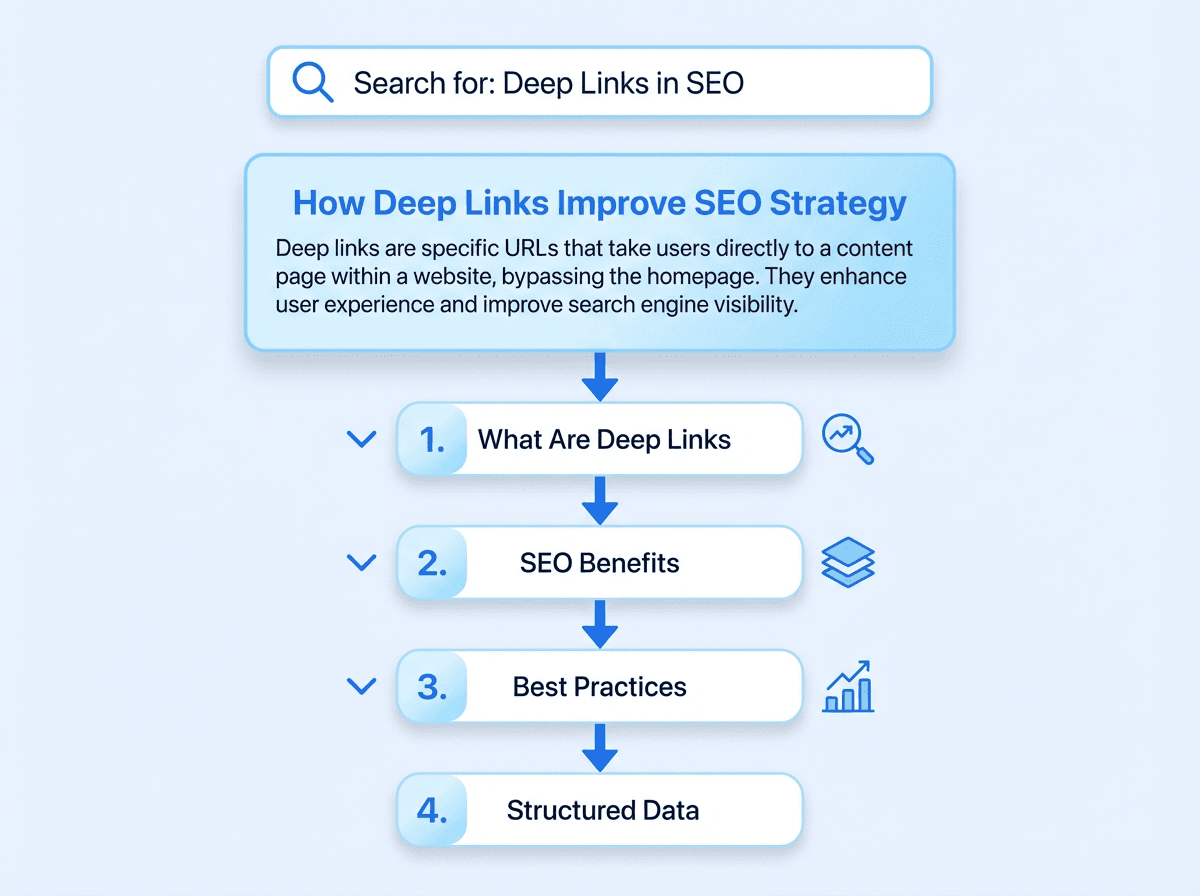
Google's search results page has evolved far beyond a simple list of ten blue links. Today it is a dynamic interface where AI Overviews, knowledge panels, and rich snippets compete for user attention. Among the most valuable of these features are Google Read More deep links: clickable jump-links inside a search snippet that transport users directly to a specific section of your page. Earning these links is a critical part of modern snippet optimization, and it plays a central role in any serious digital presence management strategy.
This playbook is built for SEO specialists, frontend developers, bloggers, and content strategists who want to control how their content appears in search and capture more qualified traffic. Below, you will find the mechanics behind deep link generation, five actionable optimization techniques, common mistakes to avoid, and advanced strategies that connect snippet optimization to the broader AI search landscape.
| Section | What You'll Learn |
|---|---|
| What Google Read More Deep Links Are | The precise definition and how they differ from sitelinks and app deep links. |
| How Google Generates Snippet Deep Links | The technical mechanics behind how Google identifies and surfaces deep links. |
| Structured Data for Snippets | The role of schema in supporting (but not directly triggering) deep links. |
| The Snippet Optimization Playbook | Five actionable techniques you can implement today to earn deep links. |
| What Most People Get Wrong | Common mistakes and misconceptions that undermine optimization efforts. |
| Advanced: SERP Features & AI Overlap | How deep link optimization connects to Answer Engine Optimization (AEO). |
| Snippet Optimization with Vizup | How Vizup helps you monitor, measure, and improve your SERP presence. |
| A guide to the sections in this article. |
What Google Read More Deep Links Actually Are (And What They Aren't)
A "Read More" deep link is a clickable link inside a search result snippet that takes a user to a specific section of that same page. Google algorithmically generates this feature to help people quickly find relevant information within long-form articles, guides, or reports. In April 2026, Google formalized its guidance on this feature in its official Search documentation, clarifying the technical best practices site owners should follow.
It is important not to confuse these with other link types. SEOs often mistakenly group them with sitelinks (which are links to different pages on your site) or app deep links (which open a specific screen in a mobile app). "Read More" deep links are exclusively for navigating within a single HTML page. Recognizing this distinction is the first step toward optimizing for them effectively.
Info: Quick distinction: Sitelinks point to different pages on your domain. App deep links open screens inside a mobile application. Google Read More deep links jump to a specific section within the same page. All three appear in SERPs, but each requires a different optimization approach.
How Google Generates Snippet Deep Links: The Mechanics Behind the SERP Feature
You cannot manually request deep links. Google's systems algorithmically analyze your page's structure and content to decide if any sections deserve a direct link. The process relies heavily on clean HTML, a logical heading hierarchy, and content that is relevant to potential sub-queries a user might have.
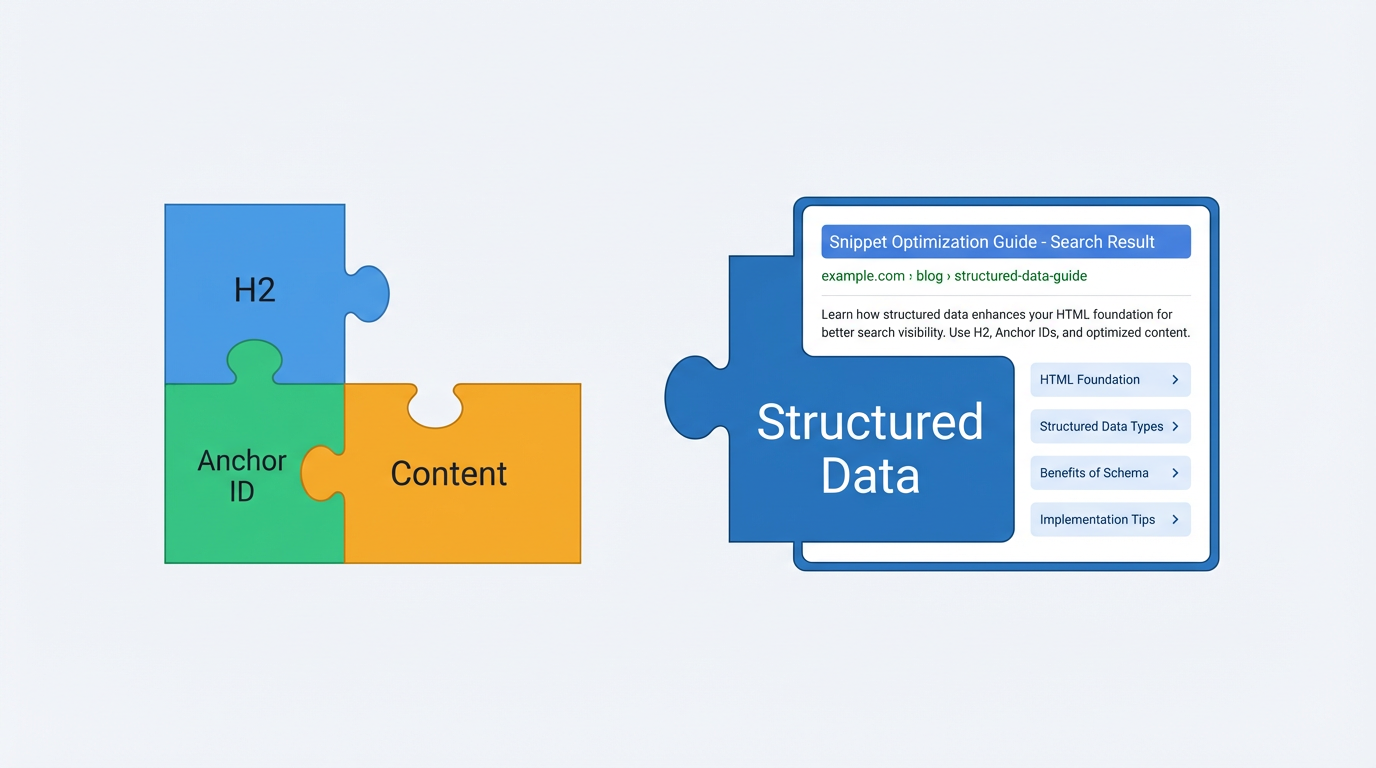
Google's crawlers parse your page's structure, focusing on headings (H2s, H3s) and their associated anchor IDs. The system evaluates whether specific sections under those headings independently answer a user's query or a related sub-intent. If a strong match is found, Google generates a deep link in the snippet, often using the heading text as the link's anchor text. Understanding this process is foundational to any AI Search Visibility Optimization strategy.
Three factors carry the most weight in this evaluation:
- Heading clarity: Descriptive, query-aligned headings signal to Google that a section answers a specific intent.
- Anchor ID presence: Unique, descriptive anchor IDs on headings give Google a reliable URL fragment to link to.
- Content independence: Each section should deliver a self-contained answer. If a section only makes sense when read alongside other sections, Google is less likely to surface it as a standalone deep link.
Info: Google's official documentation, updated in April 2026, confirms three core best practices: ensure the target content is immediately visible (not hidden in accordions), avoid JavaScript that hijacks scroll position, and preserve the URL's hash fragment. This guide's playbook builds on that foundation.
Structured Data for Snippets: What Helps, What Doesn't, and What's Overhyped
A common misconception is that adding a specific piece of structured data will automatically enable "Read More" deep links. The reality is more nuanced. Structured data is not a direct trigger, but it helps Google confirm your content's structure and meaning, which indirectly supports deep link generation.
Clean HTML structure does roughly 80% of the work. Schema is the remaining 20% that helps Google connect the dots. The most relevant schema types for snippet optimization are:
- WebPage & Article Schema: These define the overall page and can use the
hasPartproperty to identify named sections, reinforcing the signals from your heading structure. - FAQ Schema: While mainly for generating FAQ-specific rich results, properly marked-up questions and answers signal that your page is structured to answer specific queries.
- HowTo Schema: For step-by-step guides, this schema explicitly outlines the sequence of actions, making it easier for Google to identify individual steps as potential deep link targets.
Info: Practical tip: If you only have time for one schema implementation, start with Article schema and the
hasPartproperty. It directly maps to the heading-and-section structure that Google already uses to evaluate deep link eligibility.
The Snippet Optimization Playbook: 5 Moves That Actually Earn Google Snippets Deep Links
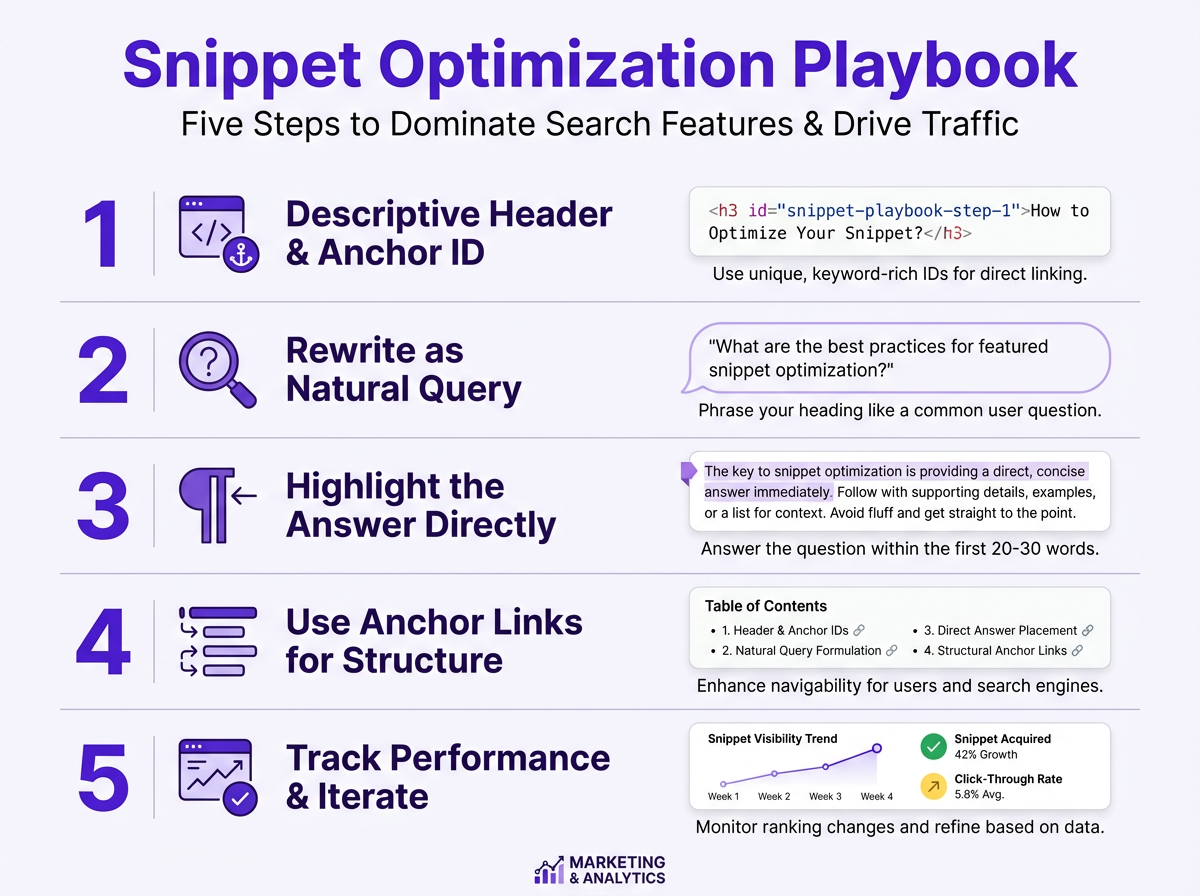
Earning Google Read More deep links requires deliberate, structural optimization. The five techniques below are grounded in Google's best practices and real-world SERP patterns observed across 2025 and 2026.
1. Anchor IDs That Match User Intent, Not Your CMS Defaults
Most content management systems auto-generate generic anchor IDs like #section-3. These are meaningless to search engines and to users who see the URL in their browser bar. Replace them with descriptive, keyword-rich anchors that mirror the section's content and the query a user would type.
Before: <h2 id="post-section-4">Implementation Details</h2>
After: <h2 id="how-to-implement-read-more-deep-links">How to Implement Read More Deep Links</h2>
This small change gives Google a clear, human-readable fragment to include in the deep link URL. It also improves the user experience when someone bookmarks or shares the link.
2. Write Headings Like Mini Search Queries
Your H2 and H3 headings should function as standalone answers to questions. Since Google often uses the heading text as the anchor for the deep link, a clear, question-based heading is far more likely to be selected than a vague label.
Weak Heading: Our Process
Strong Heading: How We Audit Your Site for Snippet Opportunities
A useful test: paste your heading into Google as a search query. If the results that appear are topically relevant to your section's content, you have a strong heading. If the results are scattered or unrelated, rephrase.
3. Front-Load Section Value (The 40-Word Rule)
Google's snippet generation often favors the first 40 to 50 words immediately following a heading. To optimize for this, answer the section's core question directly in the first sentence. Provide the key takeaway upfront, then use the rest of the paragraph to elaborate with supporting detail. This inverted-pyramid writing style aligns with how search engines extract answers and how users scan content.
For example, if your heading is "What Is a Canonical Tag?", the first sentence should define it. Do not open with background context or a story. The definition is what Google (and the reader) wants first.
4. Table of Contents with Jump Links: The Underrated Signal
An HTML table of contents (TOC) with clickable anchor links is one of the strongest signals you can send to Google about your page's structure. It provides an explicit map of your content, reinforcing the relationship between headings and their corresponding sections. SERP patterns from 2025 and 2026 show that pages with a well-structured TOC are significantly more likely to earn multi-link snippets.
When building your TOC, use native HTML anchor links rather than JavaScript-driven scroll behavior. Google's crawlers can follow standard <a href="#section-id"> links reliably, but JavaScript-based smooth scrolling can sometimes prevent the hash fragment from being indexed.
5. Test and Monitor Your Google Search Snippet Optimization
Use Google Search Console's Performance report to identify which pages already earn rich results. Filter by search appearance to analyze what is working and where gaps exist. For continuous tracking, Vizup's Digital Presence Monitoring is purpose-built for this task. It lets you monitor how snippets appear for different queries over time, helping you catch when deep links appear or disappear after a content update. This ongoing visibility is a key part of any serious effort at AI Search Visibility Optimization.
Info: Pro tip: After making structural changes to a page, request re-indexing through Google Search Console. Then monitor the page weekly for at least four weeks. Deep link appearances can fluctuate as Google re-evaluates your content against competing pages.
What Most People Get Wrong About Read More Deep Links
Avoid these common pitfalls:
- Assuming you can "request" them. You cannot. You can only create the ideal conditions for Google's algorithms to grant them. There is no toggle, tag, or meta directive that forces a deep link to appear.
- Keyword-stuffing headings. Over-optimizing your H2s to the point they become unreadable is a red flag for both users and Google. A heading like "Best SEO Deep Link Snippet Optimization Guide 2026 Free" will hurt, not help.
- Ignoring mobile rendering. Deep links behave differently on mobile SERPs. Layout shift, content hidden behind tabs, or collapsed accordions on mobile can cause deep links to fail or not appear at all. Always test your page on mobile devices after making structural changes.
- Neglecting page speed. If your page loads slowly or relies on heavy client-side rendering, Google may not fully index all sections. A fast, server-rendered page gives every section the best chance of being evaluated for a deep link.
- Treating optimization as a one-time task. SERPs change constantly. A deep link that appears today may vanish next week if a competitor publishes a better-structured page. Ongoing monitoring is essential.
Advanced: SERP Features, Deep Links, and the AI Search Overlap
The optimization work you do for "Read More" deep links has a powerful secondary benefit: it also optimizes your content for AI Overviews. When Google's generative AI pulls a section of your page to construct an answer, the deep link to that section often serves as the citation. This makes snippet optimization a core component of Answer Engine Optimization (AEO), a topic covered in depth in our guide on what is an AI-powered answer engine and how to optimize for it.
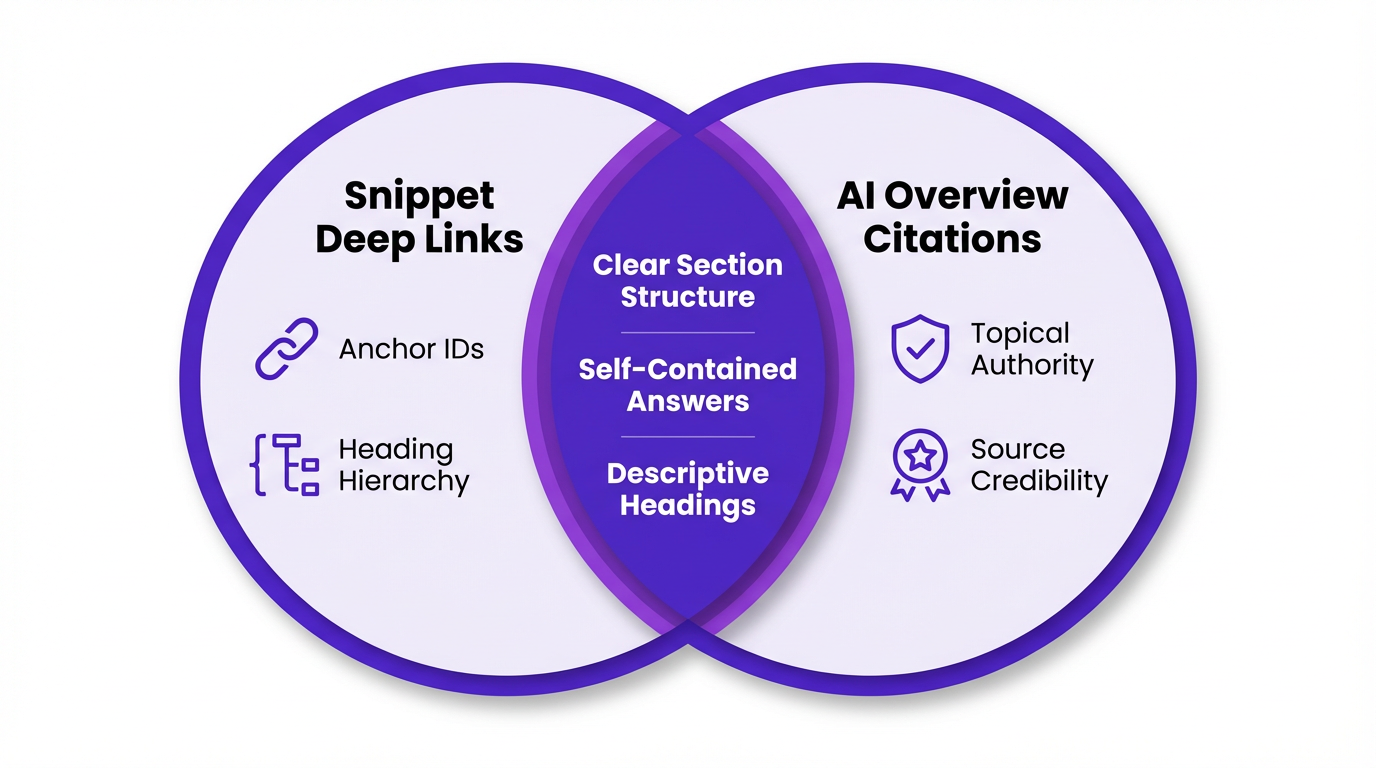
The overlap is significant. Pages that earn deep links tend to share several characteristics with pages cited in AI Overviews: clear section structure, self-contained answers under descriptive headings, and strong topical authority. Optimizing for one channel reinforces the other, creating a compounding visibility advantage.
This connection means that tracking your snippet presence is now inseparable from tracking your citations in AI-generated answers. Vizup's Answer Engine Monitoring is built for exactly this purpose, giving you a unified view of your visibility across organic results, deep links, and AI summaries on the modern SERP.
Snippet Optimization with Vizup
Choosing the right tool is critical for executing a successful snippet optimization strategy. While Google Search Console provides a baseline, a dedicated platform is necessary for historical tracking, competitive analysis, and understanding the overlap with AI-generated results. Vizup is an integrated platform designed for this modern reality. It provides automated monitoring for deep links and other SERP features, validates structured data implementation, and includes a dedicated Answer Engine Monitoring module to track your brand's visibility in AI Overviews.
For teams running snippet optimization at scale, Vizup offers three capabilities that matter most:
- SERP Feature Tracking: Monitor which of your pages earn deep links, featured snippets, and other rich results across target keywords. Track changes over time to correlate content updates with SERP gains or losses.
- Structured Data Validation: Confirm that your schema markup is correctly implemented and aligned with the content Google is indexing. Catch errors before they affect your snippet eligibility.
- AI Overview Citation Monitoring: See when and where your content is cited in Google's AI-generated answers. Understand which sections are being pulled and how your visibility compares to competitors.
This gives teams a comprehensive view of their digital presence and the data needed for effective Answer Engine Optimization across both traditional and AI-driven search results.
FAQ: Google Read More Deep Links & Snippet Optimization
Can I manually add Read More deep links to my Google search snippet?
No, they cannot be added manually. "Read More" deep links are generated algorithmically by Google. Your role is to optimize your page's structure and content by using clear headings, descriptive anchor IDs, and a table of contents to make your page eligible for this feature.
Do Read More deep links work for all types of pages, or only long-form content?
They are most common on long-form content like guides and in-depth articles where navigating to a specific section is helpful. However, any well-structured page with distinct, clearly-headed sections has the potential to earn them, regardless of total word count.
How long does it take for Google to start showing deep links after I optimize my page?
There is no set timeframe. After you optimize a page, Google must re-crawl and re-index it, which can take from a few days to several weeks. Even after re-indexing, the display of deep links is not guaranteed; it depends on the search query and Google's assessment of your page relative to competing results.
Does adding FAQ schema increase my chances of getting Google snippets deep links?
Indirectly. While FAQ schema is primarily for the FAQ rich result, implementing it reinforces to Google that your page is structured to answer specific questions. This can support the overall signals for section-level relevance that Google uses to generate deep links, but it is not a direct cause.
Are Read More deep links the same as sitelinks or app deep links?
No, they are different. "Read More" deep links point to a specific section within the same page. Sitelinks point to different pages on your website. App deep links are designed to open a specific screen within a mobile application.
Does optimizing for Read More deep links also help with AI Overviews?
Yes. The structural optimization that earns deep links (clear headings, self-contained section answers, descriptive anchor IDs) also makes your content more likely to be cited in Google's AI Overviews. Optimizing for one channel reinforces the other.
How important is a table of contents for earning snippet deep links?
A table of contents with anchor links is one of the strongest structural signals you can provide. It gives Google an explicit map of your page's sections and reinforces the relationship between headings and content. Pages with a well-built TOC are more likely to earn multi-link snippets.
Key Takeaways and Your Next Steps
In 2026, snippet optimization is not a nice-to-have. It is the new standard for meaningful organic visibility. Earning Google Read More deep links gives you a competitive edge, driving more qualified traffic directly to the answers users are seeking. The same structural work that earns deep links also positions your content for citations in AI Overviews, making this one of the highest-ROI optimization investments you can make.
To get started, focus on these five actions:
- Audit your anchor IDs and rewrite them to be descriptive, keyword-aligned fragments.
- Rephrase your headings to sound more like the search queries your audience actually types.
- Structure your sections with the direct answer in the first sentence (the 40-word rule).
- Implement a clickable table of contents on every long-form page using native HTML anchor links.
- Monitor your performance using Google Search Console and Vizup's Digital Presence Monitoring to track deep link appearances over time.
Begin by performing an SEO audit of your top 10 traffic-driving pages. Apply the principles from this guide, then use Vizup's monitoring tools to track the impact week over week. As your snippet presence grows, you will see how this level of optimization connects to the broader shift in why organic marketing is beyond just SEO in the current digital ecosystem.
