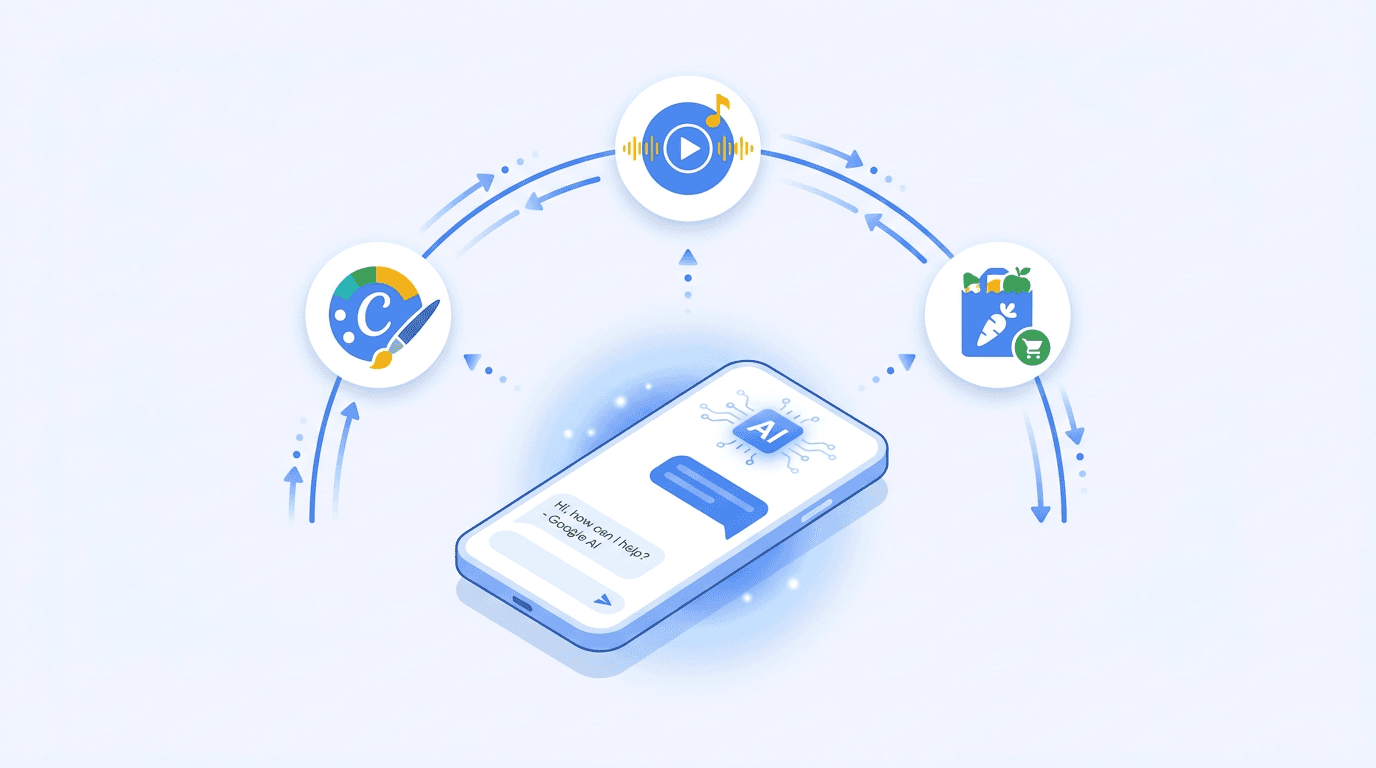
Google AI Mode Connected Apps allow eligible users to connect services such as Canva, YouTube Music, and Instacart to complete supported tasks from an AI Mode conversation. Depending on the integration, users can create design projects, build or save playlists, and turn grocery requests into a shoppable Instacart cart. The expansion reflects Google's broader move from simply returning information toward helping users act on their intent directly from Search.
Marketers, SEO pros, and creators should treat this as more than another feature drop. If you want the baseline on what Google's AI Mode is before zeroing in on Connected Apps, that primer makes the shift easier to see. The quick read is that Google is trying to become a "do engine," and Connected Apps are one of the clearest signs of that ambition.
What Are Connected Apps? (And What They're Not)
Connected Apps are third-party services that users authorise AI Mode to access for supported data and actions. Once an app is connected, AI Mode can use the functionality made available by that specific integration to help complete a request. Google initially announced support for Instacart, Canva, and YouTube Music, covering grocery shopping, design creation, and playlist curation.
It's easy to confuse this with app deep links or the familiar search integrations Google has shipped for years, but that's not what's happening here. Classic integrations mostly point you somewhere else: a link, a card, maybe a structured snippet. Connected Apps are about two-way, conversational exchange: the AI can read account-specific content, keep the request's context in mind, and execute tasks. In other words, Google isn't just telling you where to go; it's taking steps alongside you.
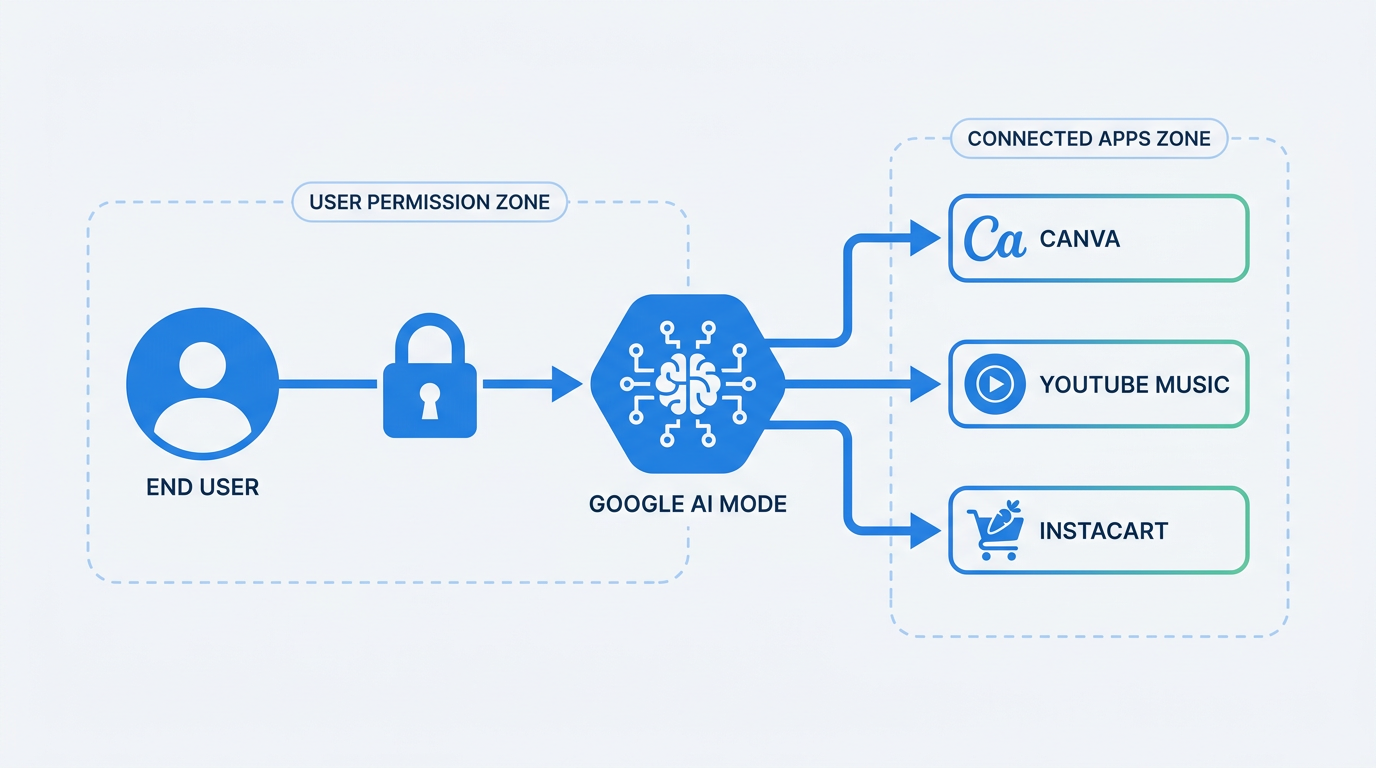
None of this runs in the background by default. Connected Apps are opt-in, app by app, and you can revoke access whenever you want. Unless a user grants permission, the app doesn't share data with Google AI. That boundary is central to how the feature is presented, and it's also the line users will judge it on.
Connected Apps vs. Personal Intelligence: A Critical Distinction
Google's AI in Search is now drawing from two adjacent systems that look similar on the surface but behave differently under the hood. Connected Apps cover third-party services. Personal Intelligence is about your private Google data, specifically Gmail, Google Docs, and Google Drive. For users and marketers alike, the difference matters because it defines what data is in play and which privacy controls apply.
| Feature | Connected Apps | Personal Intelligence |
|---|---|---|
| Data Source | Third-party apps (Canva, YouTube Music, Instacart) | Private Google data (Gmail, Docs, Drive, Calendar) |
| Primary Purpose | Add real-time, external context to AI answers | Retrieve and surface your personal information on request |
| User Control | Opt-in per app; access can be revoked anytime | Single on/off toggle for the whole feature |
| Example Action | Add groceries to an Instacart cart from a recipe | Summarize emails about a specific project |
| AI Training Use | Not used to train Google's AI models | Not used to train Google's AI models |
| Both systems are opt-in and do not use your data to train Google's AI models. |
They can also stack. A request routed through a Connected App can still benefit from Personal Intelligence context, such as details from your Google Calendar, to make the result more situationally relevant. For example, if you ask Google AI to schedule a grocery delivery through Instacart, it could use your calendar availability to suggest a delivery window. The layers can cooperate, but the controls remain separate, which is the point.
What You Can Do with Google AI Mode Connected Apps
Specs and positioning only tell you so much. The case for Google AI Mode is easier to evaluate when you look at the kind of everyday friction it targets: the small, repetitive hops between tools that eat up time. The three launch partners are useful precisely because they cover very different jobs.
For the Creator: Designing with Canva
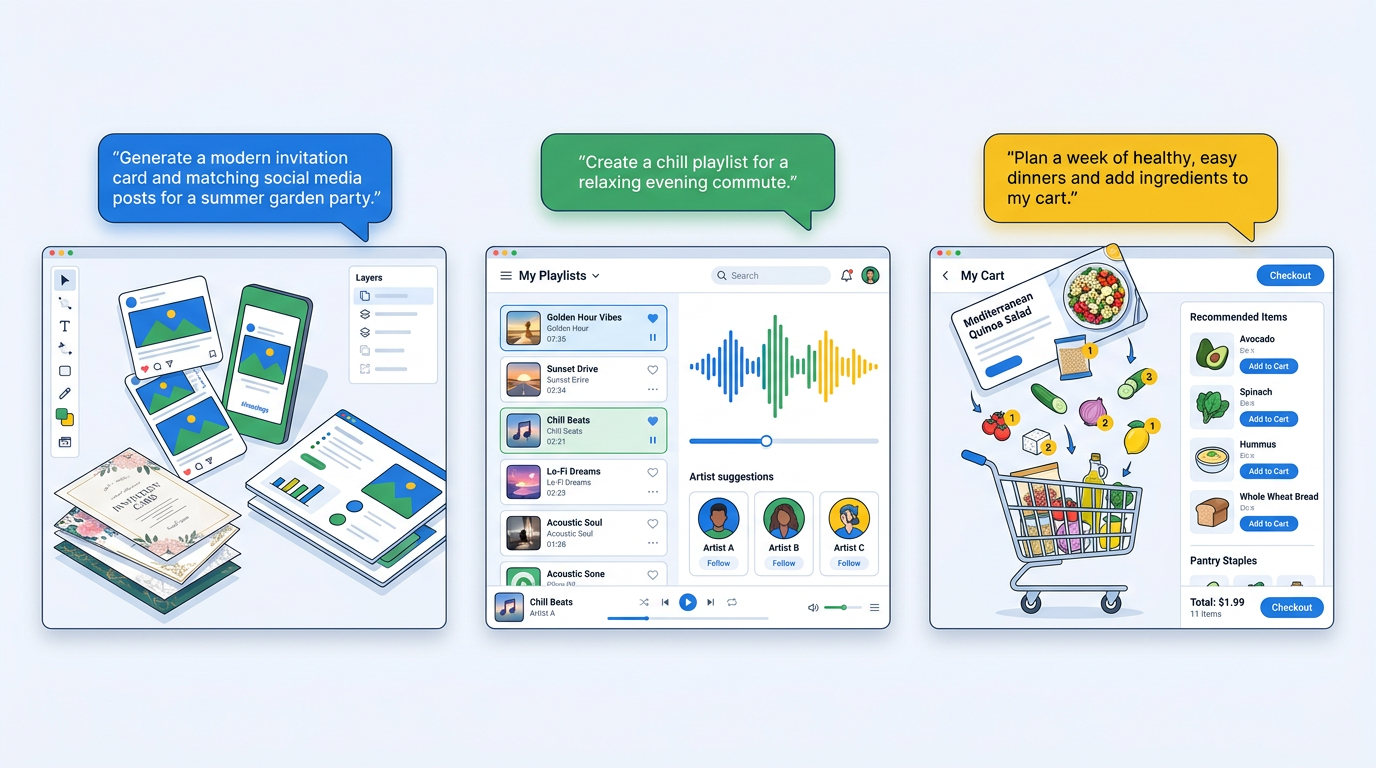
With Canva connected, a user can ask AI Mode to help create a design project, such as an invitation, presentation, or social media asset. According to Google's Connected Apps announcement, the resulting project can be opened in Canva for further editing. The exact information and actions available depend on the functionality and permissions supported by the integration, so the article should not imply unrestricted access to a user's complete Canva library.
That's the practical difference between a generic writing assistant and an assistant that can see your working set. Instead of offering broad "best practices," the AI can operate like a collaborator inside your asset library, where the real context lives. For teams juggling multiple campaigns, that kind of awareness cuts down on the constant switching between Search, a chat tool, and Canva itself.
For the Listener: Curating with YouTube Music
With YouTube Music connected, users can describe the mood, audience, genre, or occasion they have in mind and ask AI Mode to create a suitable playlist. Google's Connected Apps announcement confirms that playlists can be created and saved through the integration. Unless additional product documentation is cited, the article should avoid claiming that AI Mode examines a user's complete listening history or deliberately excludes previously heard artists.
That is a different interaction than the usual recommendation loop, which tends to feed you more of what you've already played. A conversational prompt makes room for nuance: mood, novelty, and guardrails in the same request. If you're tracking the bigger shift, how AI could change YouTube search isn't just about query boxes; it's about turning intent into an action the service can execute.
For the Planner: Shopping with Instacart
Shopping is where the action-oriented nature of Connected Apps becomes most concrete. A user can describe what they need for a meal, event, or household task and ask AI Mode to prepare a shoppable grocery cart. According to Instacart's official announcement, recommendations can account for household shopping preferences, requested dietary adjustments, quantities, and availability at nearby stores. The user can then review the cart and continue to Instacart to complete the purchase.
Checkout remains within Instacart. AI Mode can help users assemble and refine a grocery cart, but the user is directed to Instacart's app or website to review the order and complete the transaction. This behaviour is confirmed for the Instacart integration and should not automatically be presented as the operating model for every current or future Connected App.
What This Means for SEO and Marketing
For SEOs and digital marketers, Connected Apps point to something bigger than another Search UI tweak. If Google AI can complete steps inside third-party apps for a user, the classic journey from query to website to conversion gets shorter - and in some cases, disappears. That changes where brands compete for attention and how value gets captured.
This is where Answer Engine Optimization (AEO) becomes part of a broader organic discovery strategy. Brands need accurate, useful, and well-structured content that AI systems can interpret and cite, alongside the technical foundations required for conventional search visibility. Structured content does not guarantee inclusion in an AI-generated response, but it can make a brand's information easier to understand and retrieve. A similar shift can be seen in other AI Mode integrations, such as hotel-booking experiences that reduce the distance between a user's question and a commercial action.
The practical question is whether search engines, social platforms, communities, and AI answer engines can reliably understand and surface what a brand publishes. Addressing that challenge requires more than connecting tools or completing a one-time technical audit. Vizup's Organic Autopilot for modern discovery helps brands monitor, create, optimise, publish, and learn across Search, Social, Communities, AI Answer Engines, and Local Discovery using AI agents, human experts, and live SEO, pSEO, AEO, and GEO tools. Paid ads are available as an optional amplification add-on rather than a replacement for the organic foundation.
Key Takeaways
What to remember about Google AI Mode Connected Apps:
- Google AI Mode Connected Apps let Google's AI access and take actions within third-party services like Canva, YouTube Music, and Instacart, so Search can return personalized answers that lead directly to a task.
- The feature began rolling out in the U.S. the week of July 16, 2026, with Instacart, Canva, and YouTube Music as the first integration partners.
- Connected Apps are separate from Personal Intelligence: Connected Apps use third-party account data, while Personal Intelligence pulls from private Google data in Gmail, Docs, and Drive.
- Everything is opt-in. You approve each app individually, can disconnect at any time, and data from Connected Apps is not used to train Google's AI models.
- Purchases and other final actions still happen in the partner app (for example, Instacart checkout), not inside Google Search.
- For marketers and SEO professionals, the direction of travel is clear: API readiness, structured data, and AEO matter more as Search shifts from links to actions.
Frequently Asked Questions
Is data from Connected Apps used to train Google's AI models?
No. Google says data accessed through Connected Apps is not used to train its AI models, and the same policy applies to Personal Intelligence. Data from Canva, YouTube Music, Instacart, or any other connected service is used to fulfill your request, not to train the model.
How do I turn Google AI Mode Connected Apps on or off?
You manage Connected Apps in your Google account settings within AI Mode in Search. Each app is an individual opt-in, and you can disconnect any app at any time from the same settings area. Nothing is connected by default; you have to choose to link each service.
Which apps will be added next?
Google has not shared a confirmed list of future integration partners beyond Instacart, Canva, and YouTube Music. Because the feature builds on Connected Apps that first appeared in the standalone Gemini app, that ecosystem hints at direction, but specific partners should wait for official announcements.
Can Google AI buy things or change my designs without approval?
Based on what Google has announced, the AI can set up and prepare tasks, but it does not complete final transactions on its own. With Instacart, for example, it can populate your cart, while checkout remains in Instacart's environment where you approve the purchase. For Canva, changes would show up as suggestions or drafts rather than irreversible edits.
How is this different from Google Assistant app integrations?
Google Assistant integrations were built around predefined voice commands and developer-registered actions. Google AI Mode Connected Apps use a conversational model that can interpret multi-step requests, carry context, and combine information from multiple sources (including Personal Intelligence context like Calendar) to complete the task. It's a broader, less scripted approach than the Assistant-era action model.
