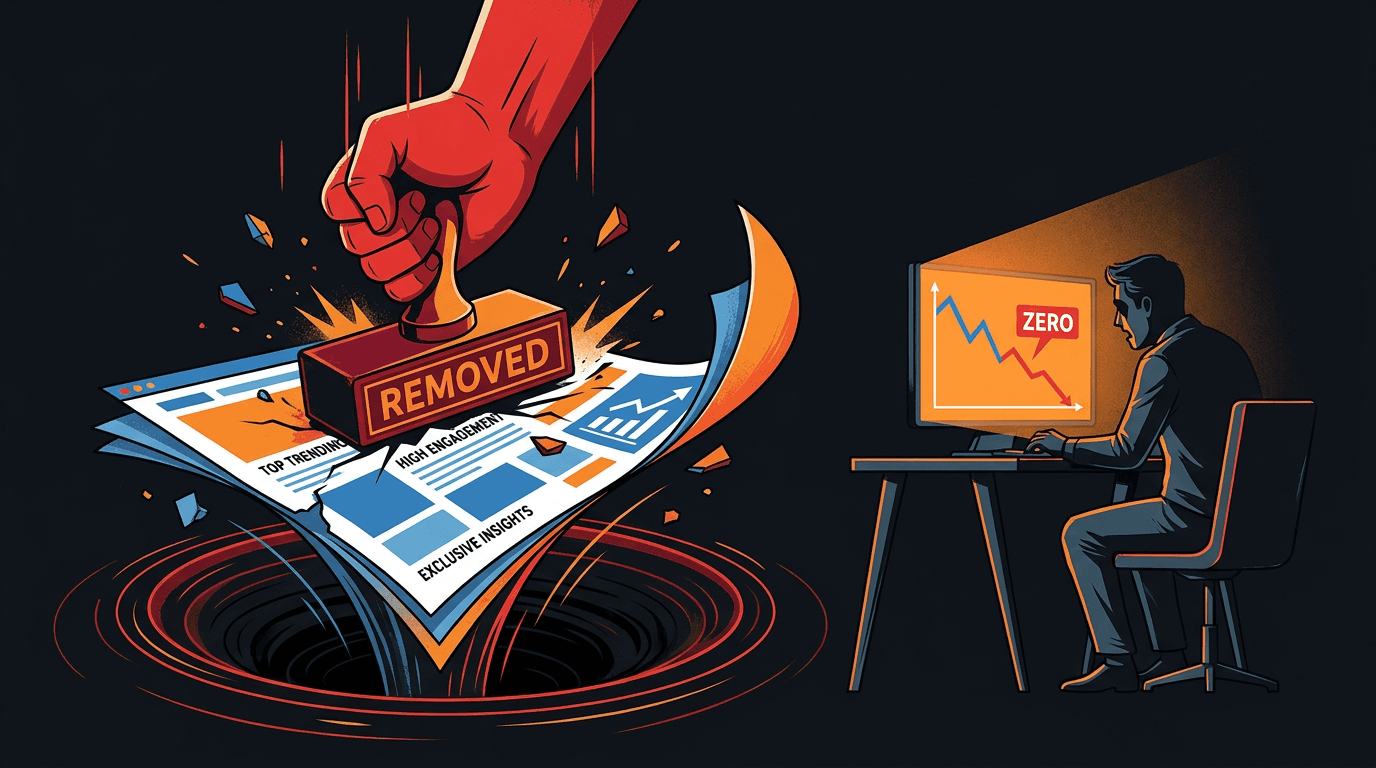
A fraudulent DMCA takedown is a knowingly false copyright complaint intended to remove a legitimate page from Google Search results. Attackers may use fabricated ownership claims, copied content, false identities or misleading publication dates to make an original publisher appear to be the infringer.
You wake up, check your numbers, and your top-performing story looks like it never existed. Clicks are gone. Impressions are gone. You run through the usual checklist: technical breakage, a manual action, an algorithm shift. Nothing lines up. This is not a bug. Someone pointed a fake copyright claim at your URL and Google pulled it from the index. Fraudulent DMCA takedowns are becoming a standard negative SEO tactic, and the pace is picking up. In July 2026, SEO professionals and outlets including Search Engine Land and Press Gazette reported a significant increase in these attacks being used as a negative SEO weapon (Joseph Charnin, 2026). The stakes are plain: rankings disappear, revenue follows, and recovery can drag out for weeks if you do not already know the steps.
How a Fake Copyright Claim Weaponizes Google Against You
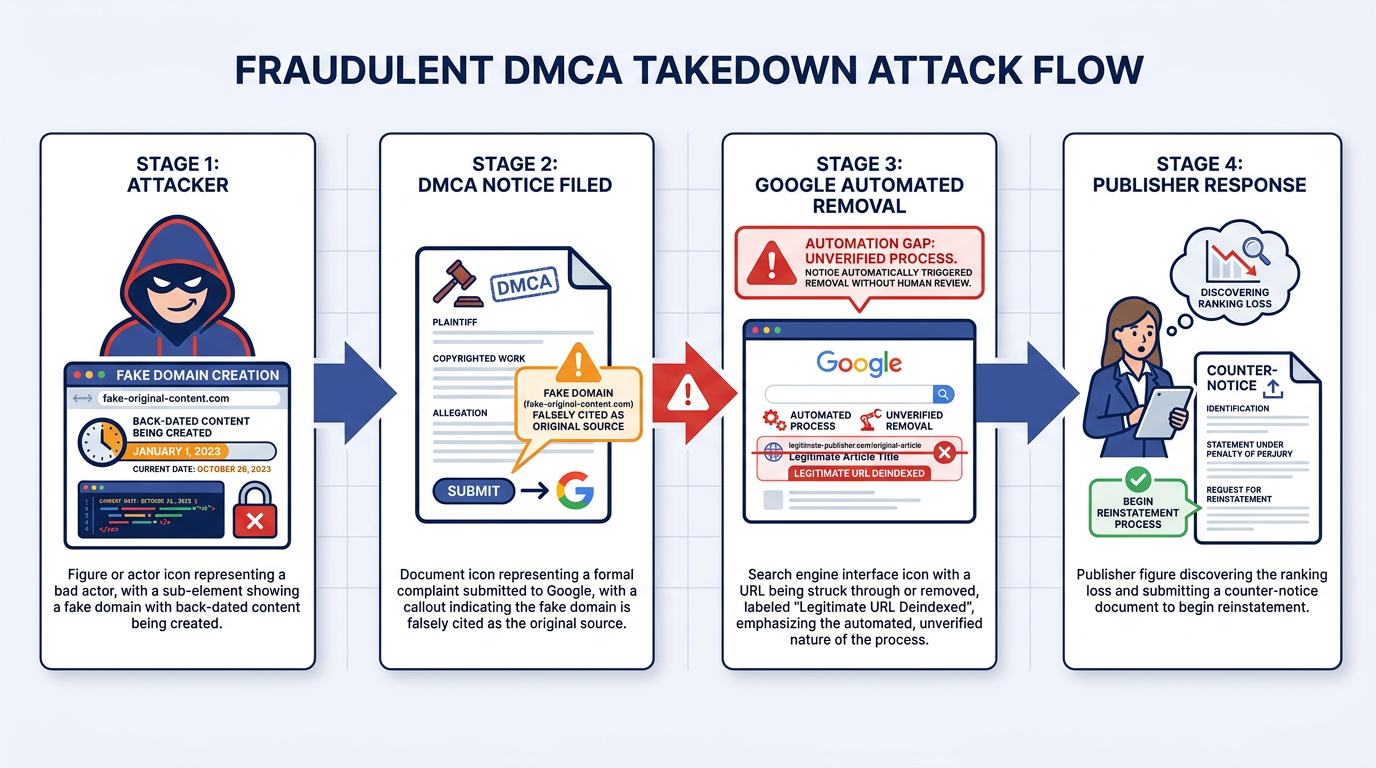
Google handles copyright complaints through its copyright removal and counter-notice process. Under the Section 512 notice-and-takedown framework, online services may restrict access to reported material after receiving a facially valid complaint. However, the initial review may not fully resolve disputes involving authorship, ownership or publication history. This creates an opportunity for bad actors to submit misleading claims against legitimate pages.
A common pattern involves copying an original article onto another domain and presenting the copied version as the earlier publication. The filer may then submit a copyright complaint using a false identity, disposable contact details or manipulated dates. If the legitimate URL is removed from search results, the publisher must provide evidence showing that the complaint was mistaken or fraudulent. Lumen Database research into organised fraudulent DMCA noticesidentified tens of thousands of notices that appeared to form part of a coordinated attempt to misuse copyright procedures.
Fraudulent copyright complaints have also been offered as paid reputation-management or takedown services. In response, Google has taken legal action against fraudulent takedown schemes. The risk is not limited to small websites: established publishers and high-visibility pages may also be targeted because removing a strongly ranking URL can affect traffic, revenue and public visibility.
The Silent Killer: How to Detect a Fraudulent Takedown
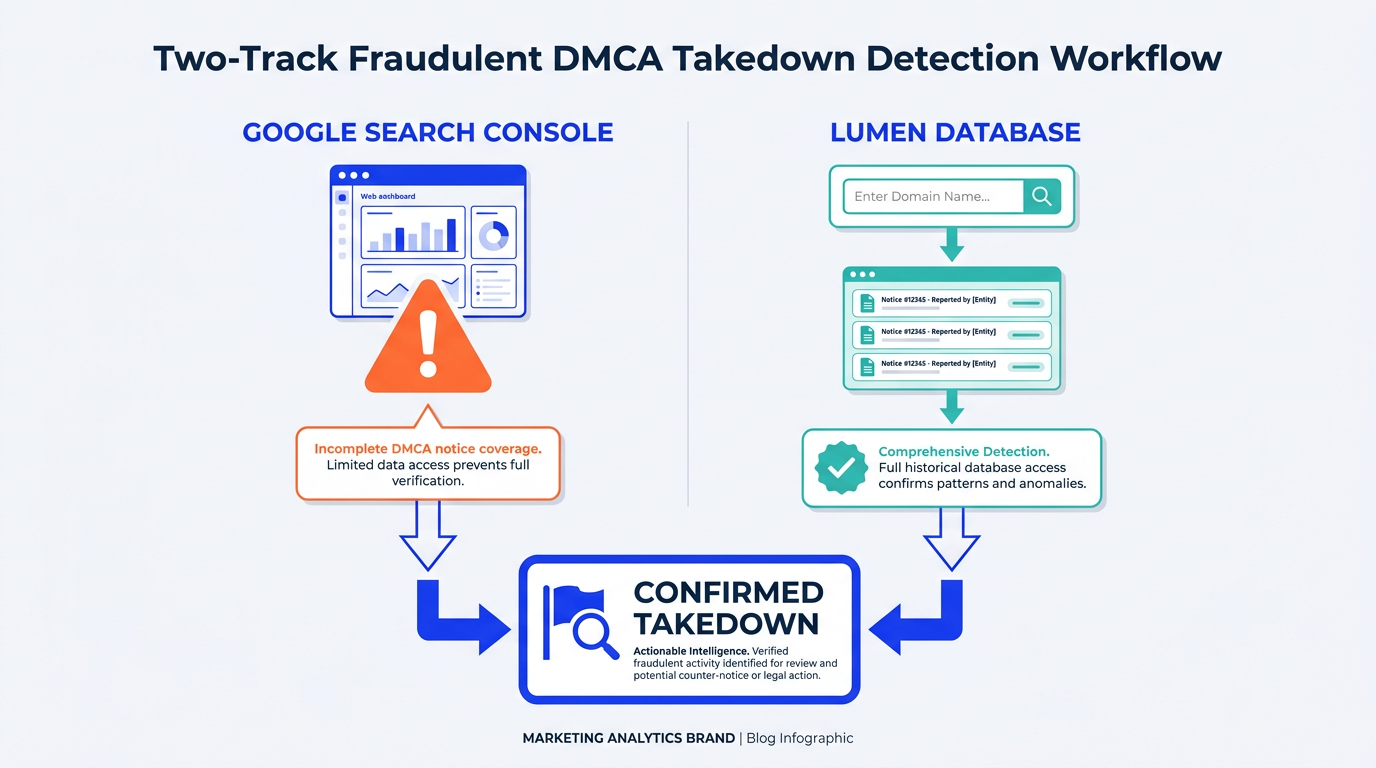
Detection is the part that tends to hurt, because Google's own surfaces do not consistently show every DMCA action. If you rely on Search Console's "Removals" or "Security & Manual Actions" sections as your early-warning system, you are leaving a gap. A URL can be delisted due to a copyright notice without a clean, obvious alert in your dashboard.
Why GSC Is Not Enough
The first thing you usually see is a sharp, isolated traffic collapse on a single page. Not a sitewide slide (which points to an update or a technical problem), but one URL that drops to zero impressions overnight. The natural reflex is to start debugging crawling and indexing. Do that, but first make sure you are not chasing the wrong failure mode: rule out a DMCA removal early. If you are also dealing with broader GSC reporting inconsistencies, our guide on what to do when GSC shows data anomalies can help you tell a takedown apart from a reporting glitch.
This is where Vizup's Organic Autopilot for modern discovery can support a broader visibility workflow. Vizup helps brands monitor, create, optimise, publish and learn across Search, Social, Communities, AI Answer Engines and Local Discovery. Its AI agents, human experts and live SEO, pSEO, AEO and GEO tools help teams identify sudden visibility losses, investigate affected URLs and strengthen content performance after recovery. Paid ads are available as an optional amplification add-on rather than a replacement for organic visibility.
Proactively Monitor the Lumen Database
The Lumen Database provides a searchable transparency archive of many copyright notices submitted to online platforms, including notices relating to Google Search. Search for your root domain and review any notices that list your pages as allegedly infringing URLs. The available record may include the claimant, targeted URLs and submission details, although Lumen should not be treated as a guaranteed record of every complaint. Combine regular Lumen reviews with Vizup's bulk index checking workflow to identify affected pages and investigate unexpected URL-level visibility losses.
Your Step-by-Step Response Plan
Once you have confirmed the notice is real and targets your URL, the job is to get the page reinstated. Treat it like a process, not a fight: your goal is to give Google enough clear evidence that the complaint was wrong so the URL can be restored.
Step 1: Gather Your Evidence
Your objective is to establish a reliable publication timeline and demonstrate your ownership or authorised use of the content. Gather evidence such as:
- Timestamped Wayback Machine snapshots of the original page.
- Original CMS publication and revision records.
- Drafts, editorial records, or internal communications showing when the content was created.
- Search Console crawl information and historical performance data.
- Original images, research notes, source files, or author records connected to the page.
Search Console crawl data can support the timeline, but it should not be described as definitive proof of the first date on which Google discovered the page.
For larger sites, assess whether the incident affects more than one URL. You can check whether affected pages remain indexed with Vizup and create a complete list of potentially affected pages before submitting a response.
Step 2: File a DMCA Counter Notice
A DMCA counter-notice is a formal response stating that material was removed because of a mistake or misidentification. Use Google's copyright counter-notice form and provide the removed URLs, the required declarations and clear supporting evidence.
Describe the publication history accurately and attach timestamped archives, CMS records or other ownership evidence where the process permits. A counter-notice may require personal contact information and sworn statements, and that information may be shared with the original claimant. Consider obtaining qualified legal advice when the claimant is identifiable, the ownership history is complicated or the dispute could lead to litigation.
Warning: This is not legal advice. The counter-notice process described here is standard under the DMCA, but complex cases, repeat offenders, or situations involving real legal risk warrant consultation with qualified legal counsel.
What Happens Next: The Reinstatement Timeline
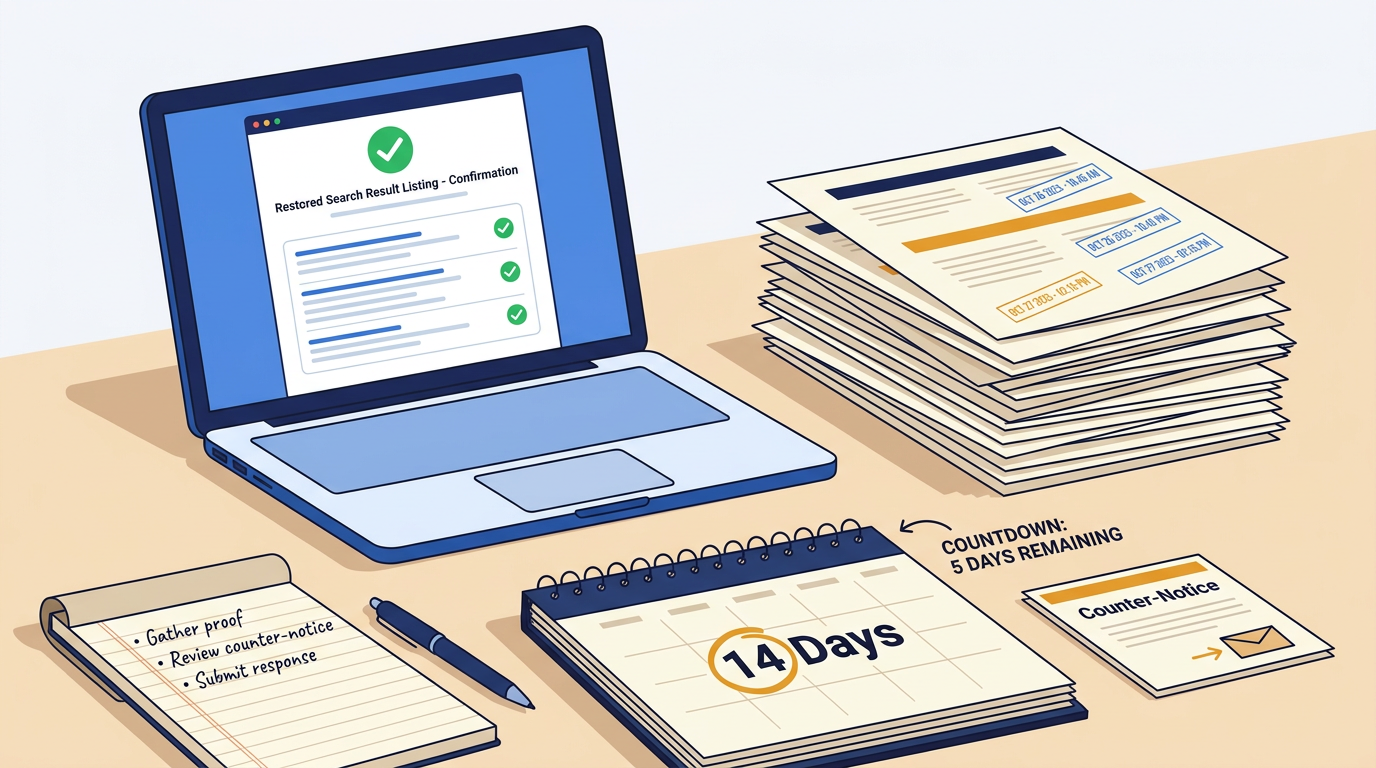
After a valid counter-notice is processed, it is generally forwarded to the original claimant. The statutory counter-notice waiting process gives the claimant an opportunity to notify the service provider that court action has been filed. If the required notice of legal action is not received within the applicable period, the material may be eligible for restoration. Restoration timing is not guaranteed, so avoid promising that every URL will return within a fixed number of days.
| Stage | Typical Timeframe | What Happens |
|---|---|---|
| Fake claim filed | Day 0 | Attacker submits a fraudulent notice to Google |
| Page deindexed | Hours to 1-2 days | Google removes the URL from search results |
| Publisher detects removal | Days to weeks | Found via Lumen Database, GSC, or a sudden traffic drop |
| Counter-notice filed | Same day as detection (ideal) | Publisher submits evidence showing original authorship |
| Waiting period | 10-14 business days | Google gives the claimant time to file court action |
| Page reinstated | ~2-3 weeks after counter-notice | If no court action is filed, the URL returns to the index |
| The entire cycle from attack to reinstatement typically spans 3-5 weeks. |
Even when you win, you still eat the downtime. Weeks of lost traffic is a real cost. The one lever you control is speed: keeping timestamped archives of original work reduces the scramble for evidence and gets your counter-notice out the door faster.
Common Misconceptions About Fraudulent DMCA Takedowns
"Google verifies claims before removing content." It does not. DMCA safe harbor incentives push platforms to take content out of circulation quickly and sort out disputes later. The verification step, if it happens at all, is triggered by the publisher filing a counter-notice.
"Only small sites get targeted." Press Gazette and Search Engine Land are well-established publications, and both were hit in 2026. Attackers pick targets based on ranking value and visibility, not on whether a domain feels "small."
"Filing a counter-notice is automatically safe." A counter-notice is the formal mechanism for disputing a mistaken removal, but it includes legal declarations and may disclose the respondent's identity and contact information to the claimant. Section 512(f), which covers knowing material misrepresentations, may provide a basis for damages in some fraudulent-claim cases. However, liability is fact-specific, and pursuing a claim normally requires legal advice and court action.
Key Takeaways
- Fraudulent DMCA complaints may be used to remove legitimate URLs from Google Search results, even when the underlying page remains live.
- Search Console may reveal a sudden visibility loss without clearly identifying a copyright complaint as the cause.
- The Lumen Database can help investigate possible complaints, but it may not contain every notice.
- A counter-notice should be supported by accurate publication, ownership and authorship evidence.
- Restoration is not automatic or guaranteed within a fixed timeframe.
- Vizup helps brands monitor and improve discovery across Search, Social, Communities, AI Answer Engines and Local Discovery, while legal responses should be handled through the appropriate platform process and qualified counsel.
- The EFF's overview of DMCA rights and risks and official Copyright Office resources provide useful background information.
Frequently Asked Questions
What is the difference between a legitimate and a fraudulent DMCA takedown?
A legitimate DMCA takedown comes from the actual copyright holder (or an authorized agent) and targets material that truly infringes their work. A fraudulent takedown is filed to knock down someone else's original reporting or commentary, using fake identities, falsified "original" URLs, and back-dated copies as props. The paperwork can look the same either way, which is why Google's automated intake treats them similarly.
Can I sue someone for filing a fake DMCA claim against my site?
In principle, yes. Section 512(f) of the DMCA says a party that knowingly and materially misrepresents infringement may be liable for damages, including legal fees. The practical hurdle is attribution: fraudulent notices often use fake names and disposable contact details, so identifying the real person can be difficult. Treat this as a legal strategy question, not a self-serve remedy, and involve counsel.
How long does it take for Google to reinstate a page after a counter-notice?
Google has to wait 10 to 14 business days after forwarding your counter-notice to the claimant. If the claimant does not file a court action during that window, Google restores the URL. In practice, many pages return to the index within two to three weeks of filing the counter-notice.
Will filing a DMCA counter notice reveal my personal information?
Yes. A counter-notice typically requires your name, address, and contact information, submitted under penalty of perjury, and Google forwards it to the claimant. If privacy is a concern, having an attorney submit the counter-notice on your behalf is a common approach. This is also why formal steps are worth taking with legal guidance.
Besides the Lumen Database, are there other tools to monitor for deindexed pages?
Yes. Regularly check if your pages are indexed with bulk indexation tools so you catch sudden URL-level drops quickly. Search Console's URL Inspection and Performance reports can also surface losses, even when they do not explicitly label the cause as a DMCA removal. The most complete coverage comes from combining Lumen checks with automated index-status monitoring.
