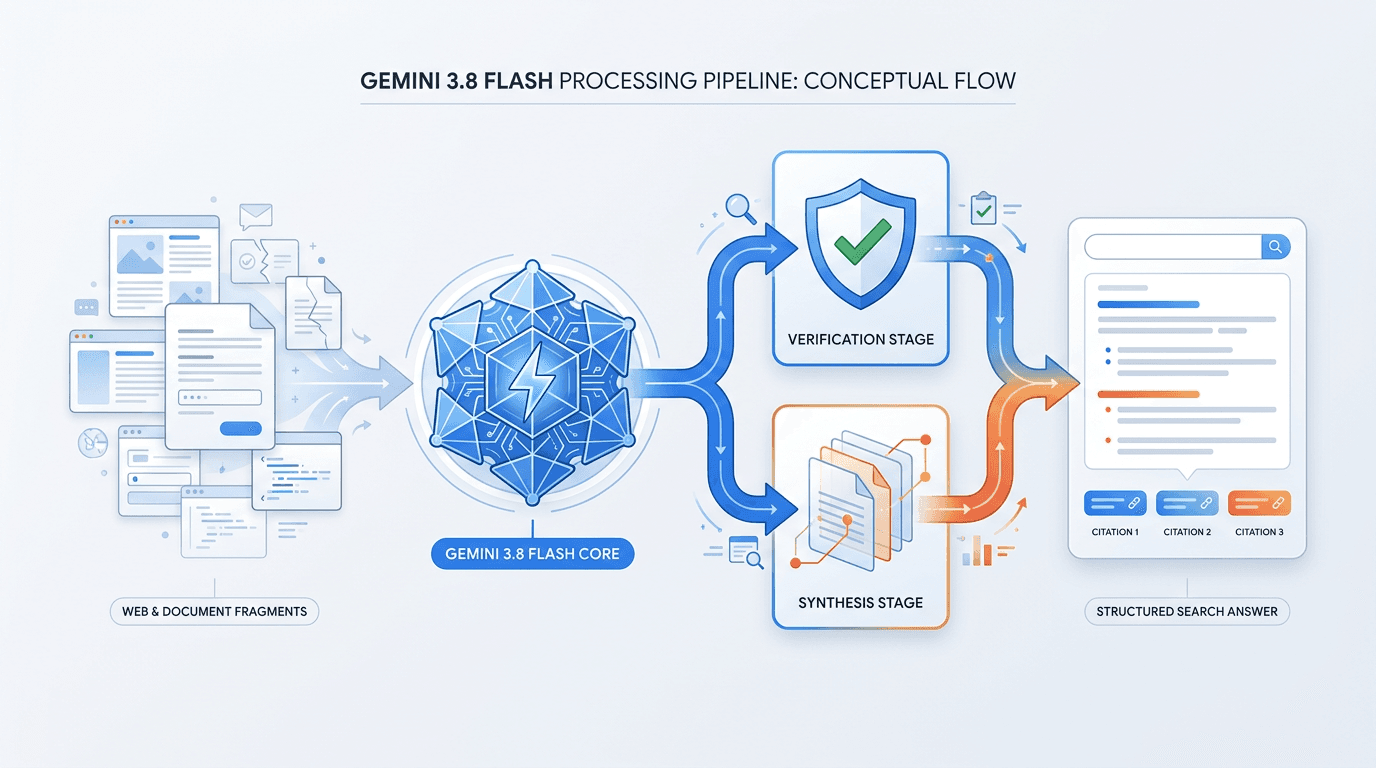
Gemini 3.8 Flash is Google's latest lightweight, high-speed AI model, now available in its AI Mode search experience. Released on September 2, 2026, it is built for rapid multi-step tasks, with advances in reasoning, software engineering, and security that shape how AI-driven search collects, evaluates, and summarizes information.
For marketers, the release matters less as another model name and more as a signal of Google's direction. AI Mode is becoming more agentic, more resistant to manipulation, and better equipped to resolve complex queries. The practical question is whether content and production workflows need to change.
What changed from Gemini 3.7 Flash?
Google released three Flash models within six weeks, according to Vellum's 2026 release analysis. The official Gemini 3.8 Flash announcement emphasizes stronger reasoning, coding, tool use, and security. A grounded Gemini 3.7 Flash comparison therefore centers on task completion rather than treating the update as a simple speed bump.
| Attribute | Gemini 3.7 Flash | Gemini 3.8 Flash | Marketing implication |
|---|---|---|---|
| Reasoning capability | Simple synthesis | Multi-step agentic reasoning | Better handling of layered intent |
| Primary use case | Quick answers and generation | Complex task execution | More useful research and workflow automation |
| Agentic capability | Earlier-generation Flash capabilities | Stronger multi-step reasoning and agentic task execution | More complex user intents can be handled within AI experiences |
| This is a marketer-oriented interpretation, not a claim that every AI Mode query follows the same process. |
Note: The AI Mode Gemini model update does not prove that Google changed ranking systems or citation rules. Model capability, retrieval, ranking, and citation selection are related layers, but they are not interchangeable.
Why the agentic workflow model is the real story
An agentic workflow model does more than generate a response from one prompt. It plans intermediate steps, retrieves information, calls tools, checks results, and synthesizes an answer. In search, that supports queries such as comparing products under several constraints, planning a local visit, or troubleshooting a technical problem across multiple sources.
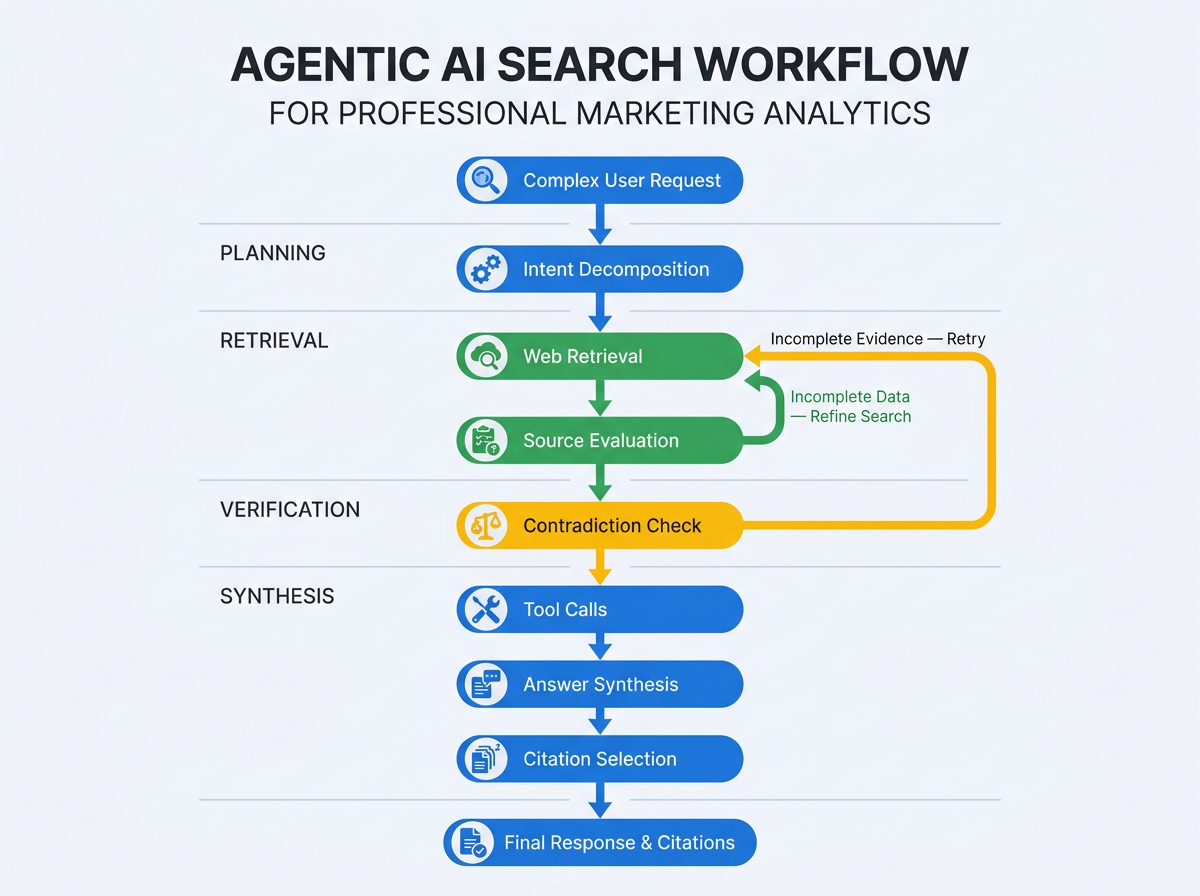
Content built for this environment should provide:
- Resolvable steps: Clear procedures, prerequisites, decision points, and expected outcomes.
- Extractable evidence: Specific claims supported by dates, named sources, examples, and original data.
- Logical structure: Descriptive headings, direct definitions, comparison tables, and consistent terminology.
- Entity clarity: Unambiguous relationships among brands, products, locations, people, and claims.
A stronger reasoning model can synthesize more complex retrieved evidence, but it still depends on the retrieval system surfacing useful, trustworthy passages. Teams should measure whether pages are retrieved and cited, not merely whether they rank. Vizup's analysis of how AI search engines retrieve and cite content explains that distinction, while its overview of how AI Mode changes SEO covers the surrounding search experience.
How security upgrades and Flash pricing affect marketers
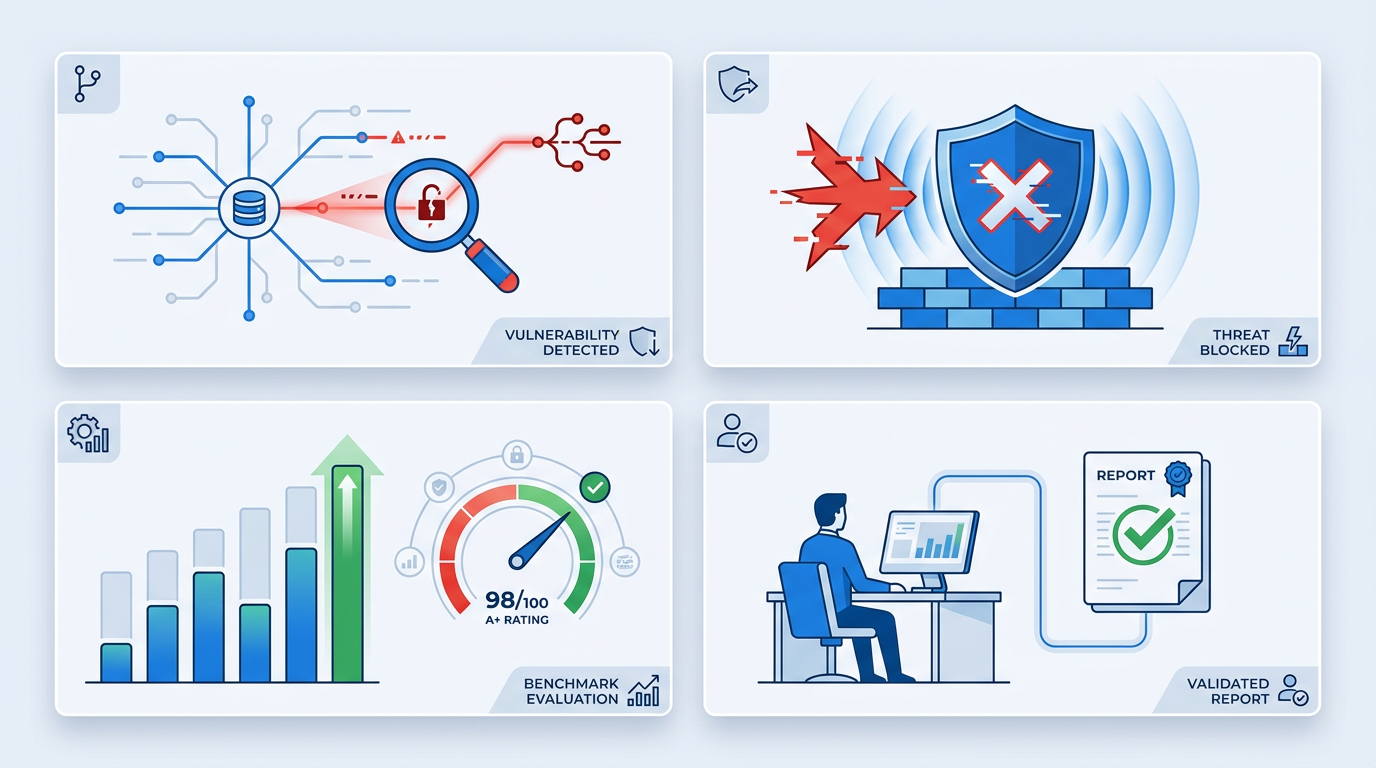
Google also introduced Gemini 3.8 Flash Cyber, a specialized vulnerability detection AI model for cybersecurity tasks. Google reported results on the CyberGym benchmark and long-horizon software engineering evaluations. On the DeepSWE v1.1 benchmark, Vellum reported a 73.7 percent score, compared with 65.3 percent for 3.7 Flash.
Fairwind access and frontier safety
Gemini 3.8 Flash Cyber is available to vetted partners through the Google Fairwind Program, not as an unrestricted marketing tool. Most teams cannot evaluate it directly. Its relevance is directional: Google is investing in prompt injection robustness as agents gain access to browsers, code, data, and external tools.
The models incorporate safeguards aligned with the Google Frontier Safety Framework, which describes protocols for identifying and managing severe model capabilities. That does not establish that the Cyber model itself powers AI Mode. It signals that security controls are becoming part of Google's broader agentic infrastructure.
Gemini Flash pricing tokens
Introductory API pricing is $0.75 per million input tokens and $3.75 per million output tokens through December 31, 2026, according to Google. Those Gemini Flash pricing tokens keep high-volume classification, content analysis, extraction, and generation economically practical. Production teams should still test total task cost, because long contexts, retries, tool calls, and verbose outputs can outweigh a low headline rate.
Warning: Common misconceptions: A benchmark win does not prove better citations. A new AI Mode model does not automatically change organic rankings. Stronger security does not make AI-generated answers immune to factual errors or unsafe retrieved content.
Key takeaways for Gemini 3.8 Flash and 2026 content strategy
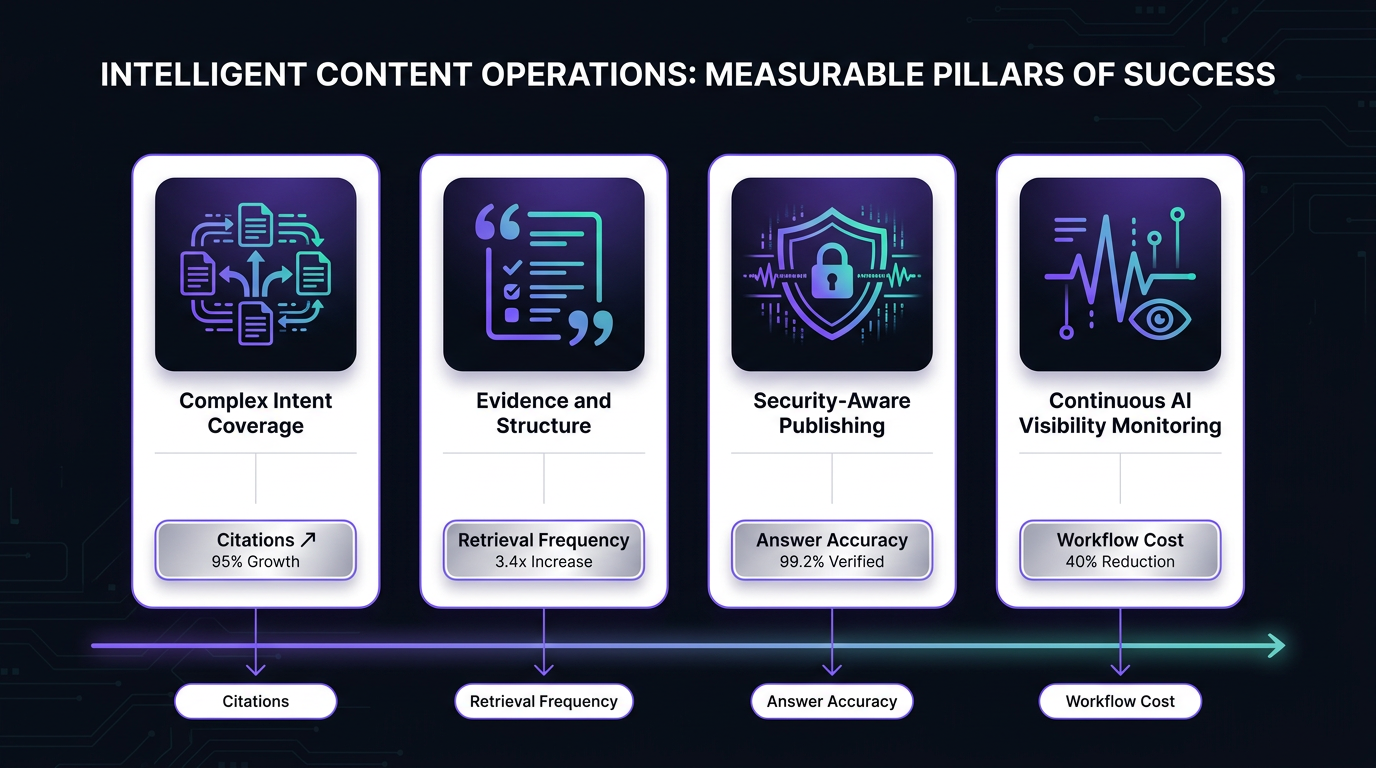
The release points to four practical priorities:
- AI Mode is getting smarter, not only faster. Publish complete solutions that address constraints, alternatives, and sequential decisions.
- Security is becoming an infrastructure consideration. As AI systems become more agentic and interact with external tools, websites, data, and workflows, resistance to prompt injection and malicious instructions becomes increasingly important.
- Expertise must be machine-readable. Use clear authorship, precise claims, supporting evidence, and sections that stand independently when retrieved.
- Do not chase every version. The AI model release cadence in 2026 rewards monitoring and controlled testing over immediate production migrations.
This is also why discovery teams need an operating system rather than another single-channel SEO tool. Vizup acts as an Organic Autopilot for modern discovery, helping brands monitor, create, optimise, publish, and learn across Search, Social, Communities, AI Answer Engines, and Local Discovery. Its Watcher, Strategist, and Operator agents combine visibility monitoring, prioritisation, and execution with human expertise and live SEO, pSEO, AEO, and GEO workflows. Paid media can then be used as an amplification layer rather than the foundation of the strategy.
If your team already uses Gemini 3.7 Flash through the API, avoid migrating production workflows solely because a newer version exists. Test 3.8 against your own evaluation set for quality, latency, token usage, and total task cost first. For discovery strategy, track citations and answer changes across Search, Communities, Social, AI Answer Engines, and Local Discovery. Teams can also review practical methods for making content discoverable in AI engines rather than optimizing around one release announcement.
Frequently Asked Questions
Do I need to overhaul my SEO strategy because of the Gemini 3.8 Flash update?
No immediate overhaul is justified. Strengthen complex-intent coverage, evidence, structure, and citation monitoring, then test whether visibility changes across representative queries.
What is an 'agentic workflow model' and how does it affect search?
It plans and executes multiple steps, including retrieval, tool use, verification, and synthesis. Search answers can therefore resolve more complicated requests across several sources.
Can I use Gemini 3.8 Flash Cyber for my own marketing tools?
Not through general access. The Cyber variant is limited to vetted Google Fairwind Program partners. Standard Flash remains the relevant API option for most marketing teams.
How does this AI Mode Gemini model update affect how my content gets cited?
It increases AI Mode's synthesis capacity, but Google has not announced a new citation formula. Clear evidence, retrievable passages, and entity consistency remain sound priorities.
