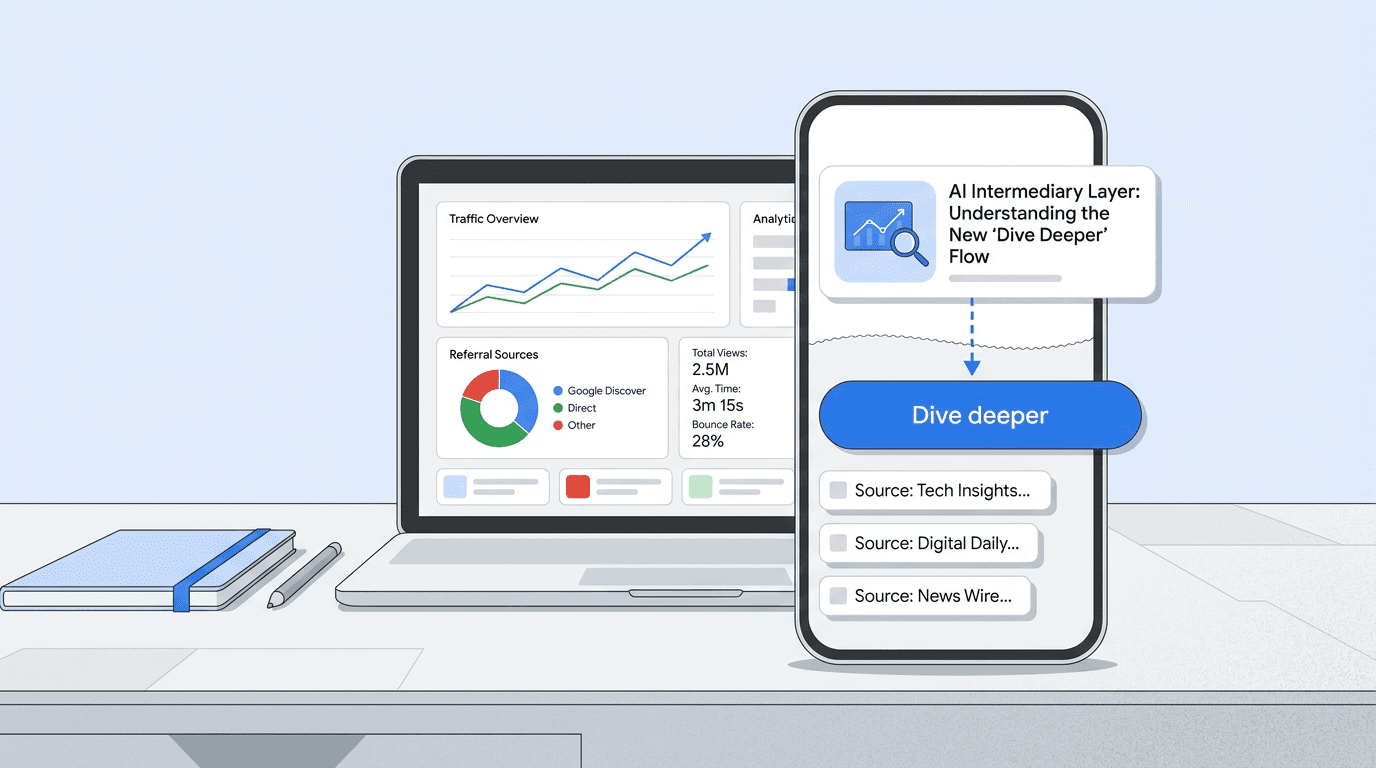
Google Discover's "Dive deeper" button is a reported video-first test that changes the usual route from selected Discover cards to publishers. Rather than immediately opening a news article, the button leads to an AI-generated topic overview inside Google's app. The Google-controlled page combines material from multiple sources, carries a "generated with AI" label, and places publisher links in source cards with shortened headlines below the overview.
That deserves close attention from editorial teams and traffic analysts for whom Discover is a meaningful referral source. Search Engine Journal reported the feature in September 2026. The early evidence identifies a limited experiment beginning with video-first topics, not a confirmed replacement for regular Discover publisher cards. Some parts of the test are visible, while many details that matter to publishers remain undisclosed.
What Exactly Is Google Testing With the "Dive Deeper" Button?
The reported experiment creates a different user journey for selected video-first topics. In the standard Discover flow, tapping a publisher card takes a reader to the publisher's site. In the test, certain cards show a "Dive deeper" call to action. Tapping it opens a new screen in the Google app rather than immediately opening the publisher page. The initial version presents relevant video content followed by an AI-generated topic summary.
The experiment was announced by Robby Stein, Google Search's VP of Product, and begins with video-first topics. Stein positioned it as a way for people to explore a subject further without leaving Discover. Each summary includes the warning: "Generated with AI, which can make mistakes." A carousel below links to source articles, but the synthesized response receives more prominent placement. Google has not confirmed a broader rollout.
How Does the AI-Generated Overview Feed Work in Practice?
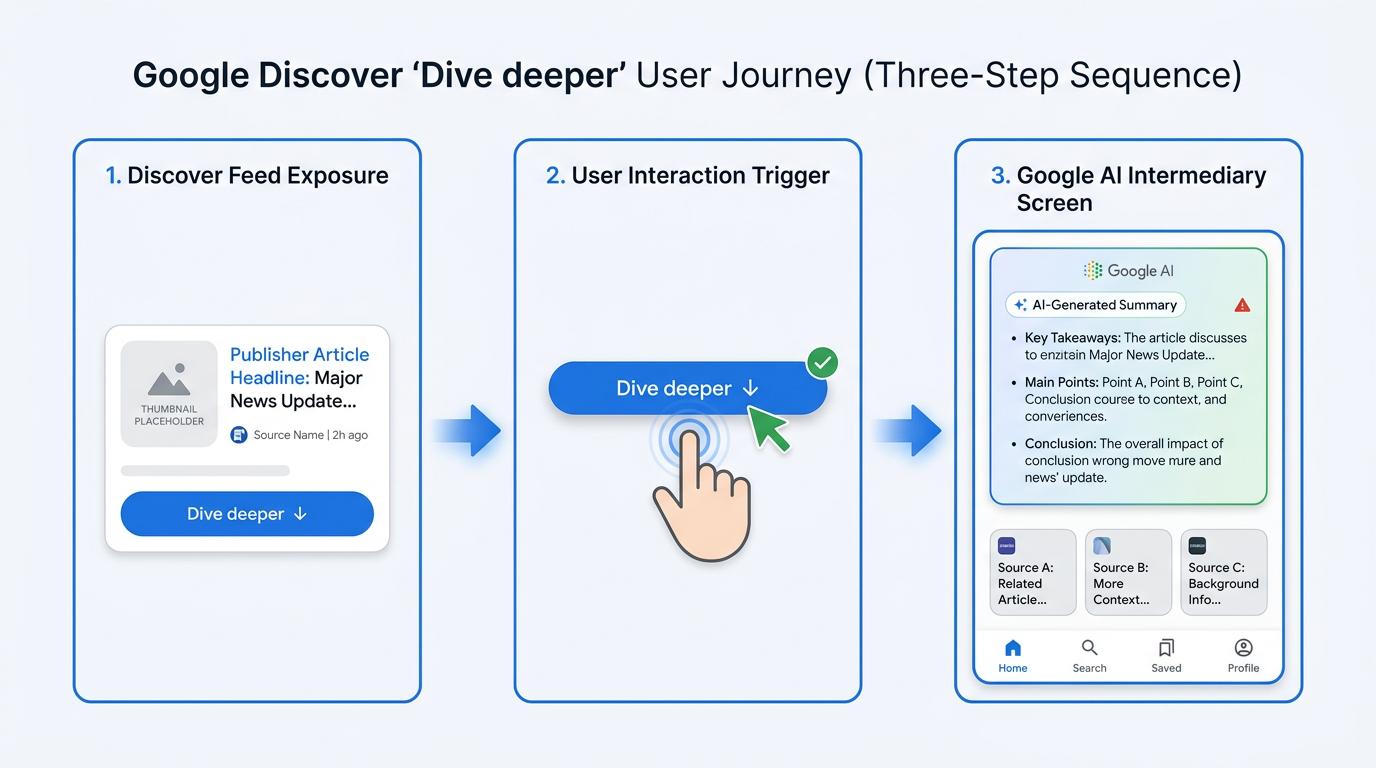
The AI-generated overview draws from several publisher articles and turns that material into a single narrative presented before the source links. The original reporting remains available through cards beneath the answer. Shortened headlines and limited space can make it harder for readers to identify the outlet behind the reporting or understand why the full article is worth opening.
The visual hierarchy is clear in the reported examples. Google's summary takes the prominent space, while publisher links appear farther down the screen. That design introduces an additional decision point before a publisher visit. Whether it materially changes Discover click-through rates is not yet known.
What Questions Has Google Left Unanswered?
For publishers, much remains unspecified. Google has not publicly identified all markets or user segments included in the test. It has not explained the AI model behind the summaries, how sources are selected, or whether some publishers receive more visibility than others. Google also has not announced a control specific to this experiment that lets publishers exclude their work from these overviews.
Google Search Console does include performance from generative AI features in its overall Discover reporting, as described by Google Search Central's Discover documentation (2025). It does not provide a separate filter or dimension for the specific "Dive deeper" experiment. Publishers therefore cannot use Search Console to isolate how often their content appears in this flow, how its source cards perform, or whether the test changes overall referrals. That measurement gap contributes to broader concerns about publisher traffic.
Warning: Search Console includes generative AI performance within overall Discover reporting, but it does not isolate the "Dive deeper" experiment. Publishers cannot currently separate this test's impressions and clicks from other Discover activity.
Why Could Discover Publisher Traffic Face More Pressure?
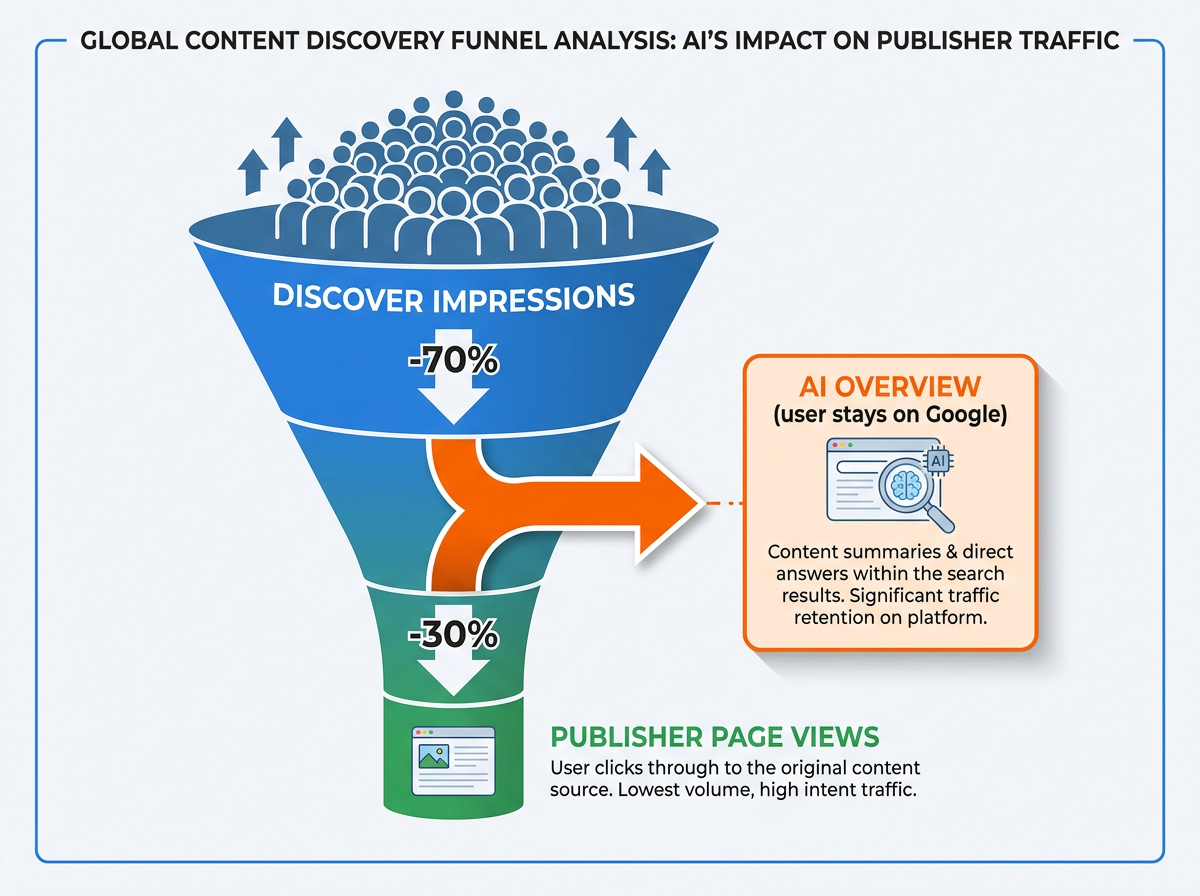
The publisher concern is straightforward, but the outcome is not established. If an AI overview satisfies a user's immediate need, that person has less reason to open a source article. The test could therefore place pressure on click-through rates, but Google has not released data showing that Discover traffic has declined because of this experiment. Results from AI Overviews in Search should not be treated as proof of Discover performance.
Discover dependency varies widely by publisher, content category, audience, and season. For ad-supported outlets, any sustained reduction in visits would affect the monetization chain through fewer page views, ad impressions, and on-site engagement opportunities. For now, that remains a potential risk rather than a measured result. The concern also reflects the industry's wider debate about referral traffic and Google's AI Overviews, even though Search and Discover are distinct products.
What Can Publishers Do to Prepare Right Now?
Publishers do not need to assume a broad rollout to prepare responsibly. Teams can work from the verified details, preserve a clear performance baseline, and strengthen their visibility across discovery channels while the scope and effects of the experiment remain unclear.
Priority actions for publisher and editorial teams:
- Reduce single-channel dependency. Invest in newsletters, push notifications, direct visits, and other audience relationships. Revenue planning should account for volatility in platform referrals without assuming a specific decline.
- Monitor organic visibility across discovery surfaces. Vizup is positioned as an Organic Autopilot for modern discovery, helping brands monitor, create, optimise, publish, and learn across Search, Social, Communities, AI Answer Engines, and Local Discovery using AI agents, human experts, and live SEO, pSEO, AEO, and GEO tools. Paid ads are available as an amplification add-on. This broader monitoring does not directly isolate Google's "Dive deeper" experiment.
- Prioritize content that offers value beyond a summary. Exclusive data, proprietary analysis, distinct authorial perspectives, and interactive elements give readers a clearer reason to visit the original page.
- Audit your Discover performance baseline now. Record current Discover impressions, clicks, click-through rates, traffic, and revenue attribution before any possible expansion of the test.
- Track broader changes to the Discover feed and recent Google updates together. Clean annotations and channel-level data help teams separate a Discover change from a wider algorithm update.
Common Misconceptions About the Discover AI Test
"Google is replacing every Discover publisher card." The reported test begins with selected video-first topics. A wider rollout has not been confirmed, and regular publisher-card journeys remain part of Discover.
"A citation guarantees meaningful publisher value." A source card can provide attribution and a route to the original article, but its commercial value depends on whether users click. The current evidence does not show how often people open these cards or how the experiment affects publisher revenue.
"Blocking AI training will prevent my content from appearing." No confirmed opt-out exists specifically for Discover AI topic overviews. Google's documentation for Google-Extended explains that the token controls certain uses related to Gemini models and does not affect inclusion or ranking in Google Search. Google has not said that blocking Google-Extended prevents content from appearing in this Discover experiment.
Key Takeaways
- The reported Google Discover "Dive deeper" experiment begins with selected video-first topics and opens a Google-hosted AI overview before a user chooses whether to visit a publisher.
- Source cards appear below the synthesized response, creating an additional step in the publisher journey, but the effect on click-through rates is not yet known.
- Google has not disclosed complete test markets, source-selection rules, a test-specific opt-out, or plans for a broader rollout.
- Search Console includes generative AI activity in overall Discover performance reporting, but it does not isolate this particular experiment.
- Publishers should establish Discover baselines, diversify audience sources, and create work that gives readers a reason to visit beyond an AI-generated summary.
Frequently Asked Questions
What is the Google Discover "Dive deeper" feature?
It is a reported test on selected Discover cards, beginning with video-first topics. When tapped, the button opens a Google-hosted screen containing videos and an AI-generated topic overview rather than taking the reader directly to a publisher website. The overview combines information from multiple sources and includes a "generated with AI" disclaimer.
Will the Discover AI topic overview replace publisher websites?
No. The reported experiment applies to selected video-first topics, and Google has not confirmed a broader rollout. It adds an intermediary layer for those cards, with publisher links still available as source cards below the overview.
How does this Discover AI test affect publisher traffic and revenue?
The feature introduces another step before a publisher visit. If users get enough information from the overview, some may decide not to click a source card, which would create traffic and revenue pressure. Google has not released evidence showing that the experiment has already reduced publisher visits or revenue.
Can publishers opt out of having their content used in Discover AI overviews?
As of September 2026, Google has not announced an opt-out specific to Discover AI topic overviews. Blocking Google-Extended has not been confirmed to change inclusion in this experiment.
How can I track if my content is appearing in these new AI overviews?
Google Search Console includes generative AI activity within overall Discover performance reporting, but it does not provide a separate filter for the "Dive deeper" experiment. Publishers can monitor total Discover trends and maintain annotated baselines, but they cannot currently isolate this test's appearances, clicks, or traffic through Search Console. Vizup supports broader organic visibility and action across modern discovery channels, but it should not be treated as a direct measurement tool for this specific Google experiment.
