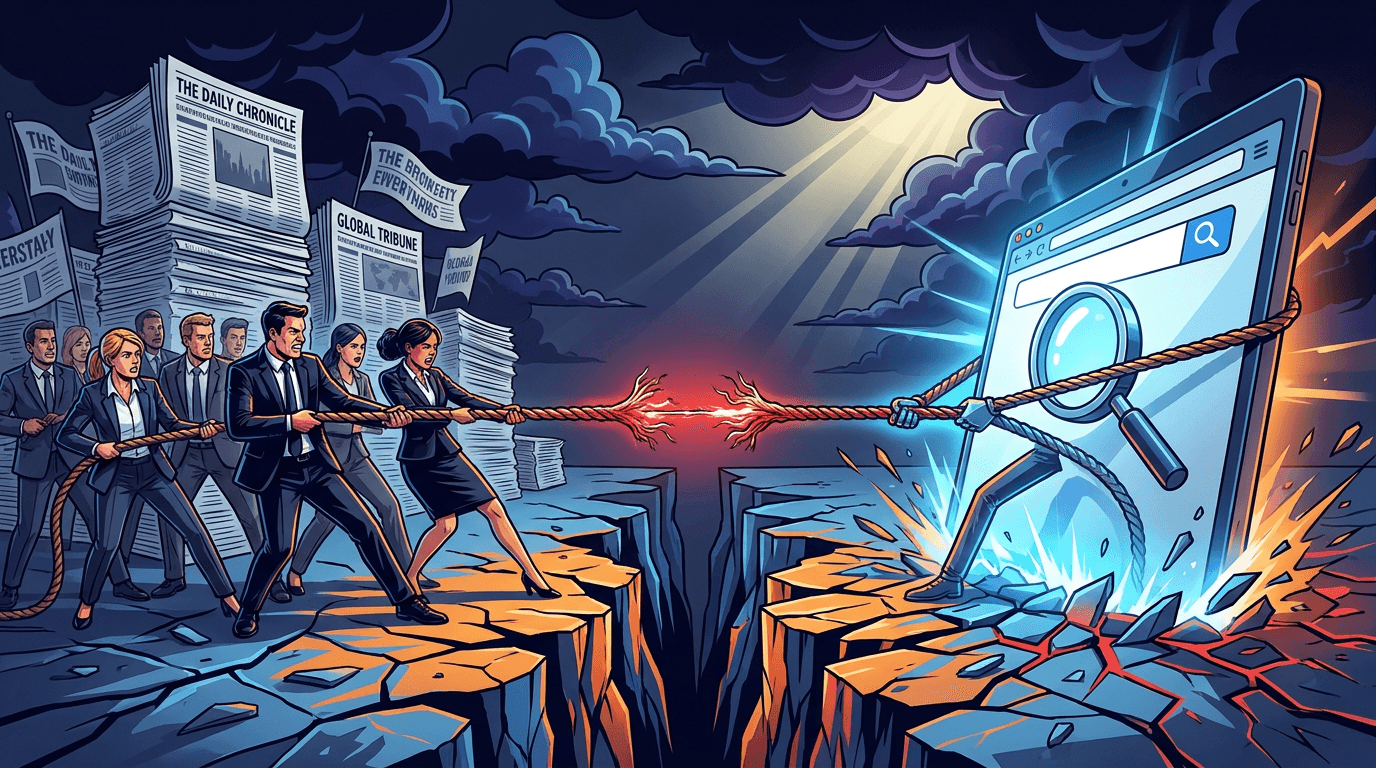
For two decades, the arrangement was easy to explain: publishers made the work, Google delivered the audience. That deal is now being renegotiated out loud, and it is getting ugly. Major publishers blocking Google search is no longer an academic thought experiment. Per Wall Street Journal reporting from the week of July 21, 2026, it is a live topic in boardrooms at USA Today, Reuters, Politico, The Economist, People Inc., and Reddit.
Most of the hot takes miss the point. This is not a playbook. It is a flare. The publishers willing to threaten Googlebot tend to sit on proprietary content corpora that give them real leverage. Most brands do not. For almost every content-led business, the right move is not to imitate the tactic but to take the warning seriously: if your growth plan is built on rented traffic, it was always brittle, and the breakage is now hard to deny.
The Great Unraveling: Why the Old Bargain Broke
The numbers are too significant to ignore. Third-party traffic estimates cited by the Wall Street Journal show that organic US Google traffic fell by 18% for USA Today's national site between June 2025 and June 2026. Politico declined by 20%, while CNN and Business Insider each declined by 31%. These are substantial losses for publishers that depend on search referrals and advertising revenue.
The people reading those charts are not speaking in careful euphemisms. USA Today Co. CEO Mike Reed said it is time to take a stand and say enough is enough. People Inc. CEO Neil Vogel said turning them off and blocking them entirely is 100% on the table. Time COO Mark Howard described the work as serving two audiences, humans and bots, then asked whether the bots are paying their share. That is what a publisher Google standoff sounds like once it has moved beyond polite bargaining.
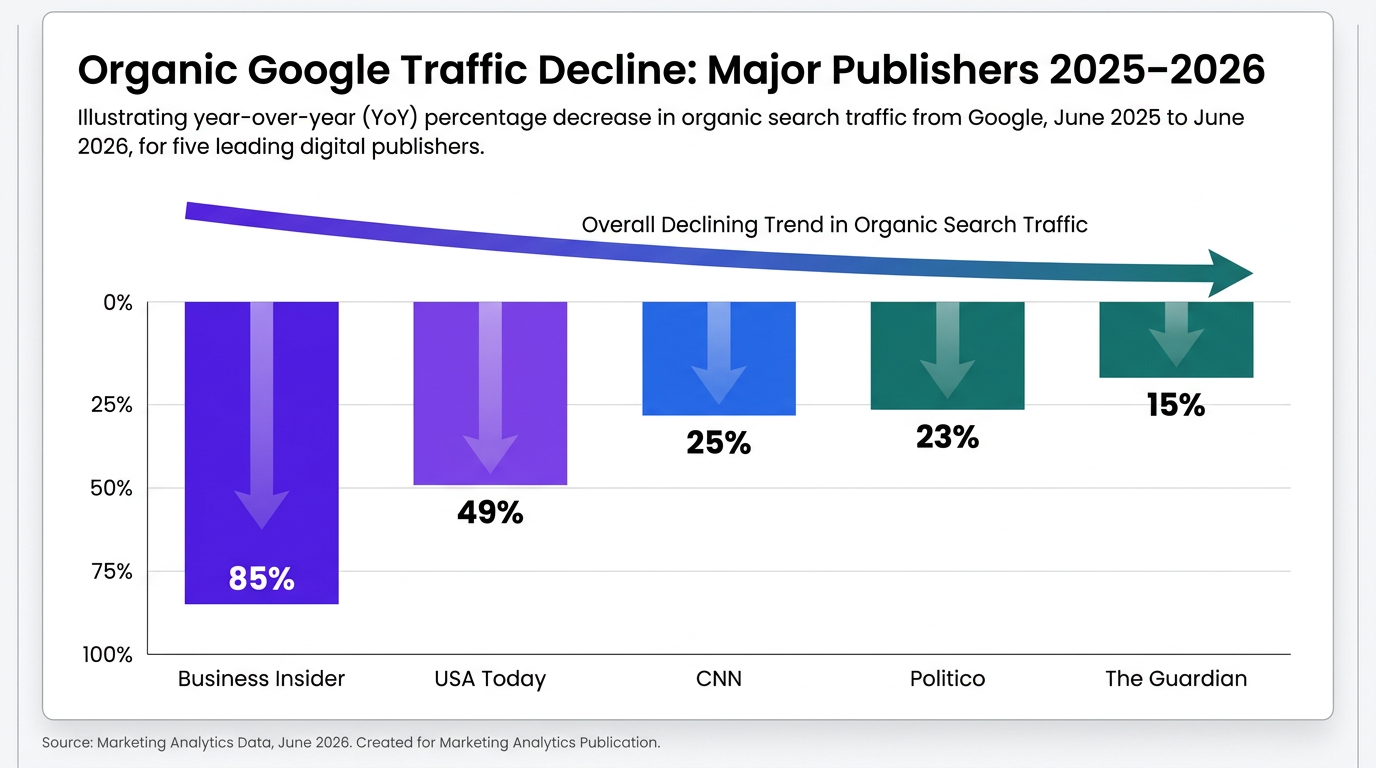
None of this came out of nowhere. Zero-click behavior in European markets pointed to the destination well before AI Overviews put the pedal down. What changed is the pace. Google's AI features now pull from publisher material, synthesize an answer, and present it on the results page, which gives users fewer reasons to visit the source. The record number of Google queries paired with falling clicks shows the underlying appetite for search is still there. The problem is where the value lands: fewer clicks make it back to publishers.
The Leverage Play: Who Can Actually Afford to Block Google?
A Googlebot block is leverage, not a growth strategy. That difference is the entire story. The publishers floating the idea tend to control something Google's AI systems want and cannot simply recreate: proprietary, hard-to-replace content. Without that, blocking Google is not a negotiating tactic. It is opting out of visibility.
Reddit's Licensing Gambit
Reddit controls one of the internet's largest collections of public, candid human conversations. Its threads make a prime dataset for large language models, and Google treats them accordingly. The Reddit Google licensing deal, reported at roughly $60 million per year in 2024, is now up for renewal. Reddit has discussed restricting Google's access for AI use, which would force Google to either pay materially more or give up one of the internet's richest conversational corpora.
You could see the premium Google puts on Reddit in the site's May 2026 visibility surge, when Reddit threads crowded the top of results across categories. That spike demonstrates the growing search value of community-led content, although visibility data alone cannot prove why Google's systems elevated Reddit. The licensing negotiations now test what access to that content is worth.
The News Wire Position
Reuters, The Economist, and Politico publish original, verified reporting. That is source material, not interchangeable aggregation. When these organizations threaten to block Googlebot publisher access, they are testing whether Google can keep synthesizing current events without licensing the journalism underneath. The move is simple: raise the cost of using high-trust information by threatening to cut off supply. If you understand how AI search engines retrieve and cite content, you also understand why original reporting is among the hardest categories for AI to replace cleanly.
| Dimension | Leverage Players (Reddit, Reuters) | Traffic Dependents (Most Brands, Niche Sites) |
|---|---|---|
| Core Asset | Proprietary, hard-to-replace corpus | Commodity or semi-commodity content |
| Strategic Goal | Pressure for a licensing deal or improved terms | Grow direct audience and reduce platform dependence |
| Viable Tactic | Threaten or execute a Googlebot block | Diversify channels and invest in owned audience |
| Primary Metric | Licensing revenue and negotiating leverage | Owned audience growth and depth of engagement |
| Risk of Blocking | Containable (Google needs them more) | Disastrous (they need Google more) |
| The asymmetry between leverage players and traffic-dependent publishers defines who can afford this fight. |
The Counterargument: Google's Side of the Table
Google's case should be heard on its own terms. The company says its AI features still send billions of visits to publishers each week. It says it is paying more than 200 publishers for AI access. It also points to controls: Google-Extended lets publishers opt out of AI training, and robots.txt can block crawling outright. Google has told the UK's Competition and Markets Authority it will test settings that let publishers opt out of AI features without losing traditional search rankings (TweakTown, June 2026).
The controls are changing. Google-Extended can limit certain uses of content for model training, while traditional controls such as noindex and nosnippet affect how content appears in Search. Separately, Google began testing a Search Console control in June 2026 that lets selected UK publishers opt out of AI Overviews, AI Mode, and generative AI in Discover without affecting rankings in traditional Search. The UK Competition and Markets Authority has required Google to provide effective controls, although publishers who opt out will still give up traffic and impressions from Google's generative AI features.
Note: When your organic traffic has already collapsed by 85%, the question shifts from "Can we afford to block Google?" to "What visibility are we actually protecting?" The math changes when the denominator approaches zero.
The Real Lesson for Everyone Else: Don't Block, Build
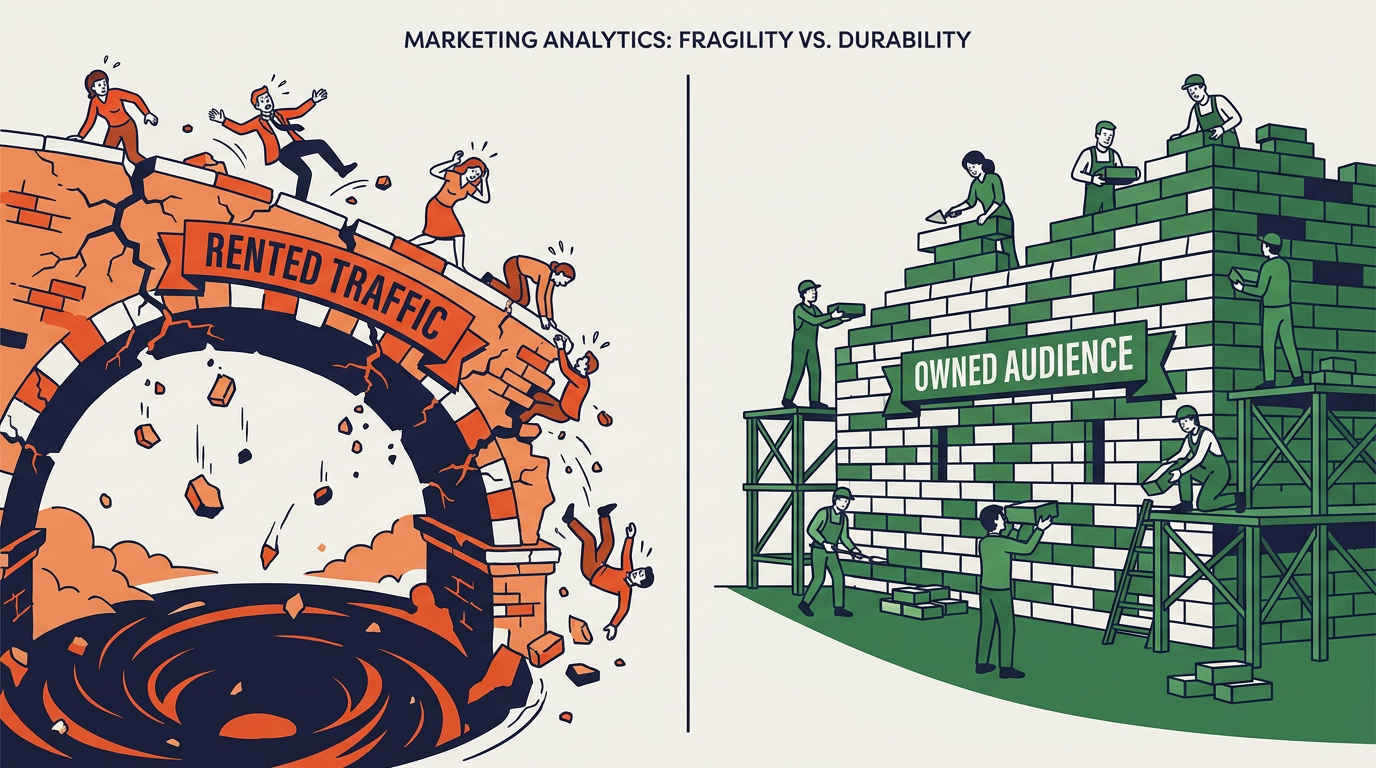
This is where bluntness is warranted, because the most tempting takeaway is also the most dangerous. If you run a SaaS blog, an e-commerce content hub, or a niche publication, the publisher standoff over blocking Google is a warning, not a template. You do not have Reddit's conversational monopoly. You do not have Reuters' reporting apparatus. Your content, even when it is excellent, is probably substitutable. Blocking Google would not create leverage. It would create quiet.
The lesson is structural, not tactical. A model that depends on platform traffic is fragile; a model that pairs visibility with an owned audience is sturdier. The businesses that make it through the post-traffic era will be the ones measuring what they can actually influence: their presence in Google's evolving discovery features, their share of voice in answer engines, and their ability to turn a searcher into a subscriber or a lead. Traffic numbers are already giving a distorted picture. Visibility metrics, which capture whether your brand shows up even when nobody clicks, are closer to the truth.
Google's own Preferred Sources program is a useful tell. The publishers who get the most out of Google's ecosystem tend to be the ones Google cannot easily replace. Everyone else is in a more transactional relationship, and it is becoming more one-sided. So the strategic response is not to fight for a nicer seat at a table where you have no chips. It is to build a table you control.
Practically, that means investing in first-party data, email audiences, community, and brand recognition that does not rise and fall with an algorithm tweak. It means tracking how AI search is reshaping SEO and packaging content for new surfaces, not just the old ten blue links. Vizup works as an Organic Autopilot for modern discovery, helping brands monitor, create, optimise, publish, and learn across Search, Social, Communities, AI Answer Engines, and Local Discovery. It combines AI agents, human experts, and live SEO, pSEO, AEO, and GEO tools in one connected workflow. Paid ads are available as an amplification add-on when brands want to extend proven organic work.
The End of the Traffic-for-Content Era
The headline-grabbing threats from major publishers are not a cue for everyone to unplug from Google. They are confirmation that the traffic-dependent model has cracked. The content-for-traffic bargain worked when Google needed publishers to stock its index and publishers needed Google to reach an audience. AI Overviews changed the symmetry. Google can absorb the content while sending less traffic back, and the Semrush data suggests that is exactly what is happening.
Publishers blocking Google search will remain a viable move for a small set of organizations with irreplaceable content and enough runway to stomach short-term pain. For everyone else, the future is not about winning yesterday's game. It is about building a new one where you own the audience, not just the content. The companies that come out stronger will treat this standoff less as a fight to join and more as a clear reason to build a brand that can survive without anyone's permission.
