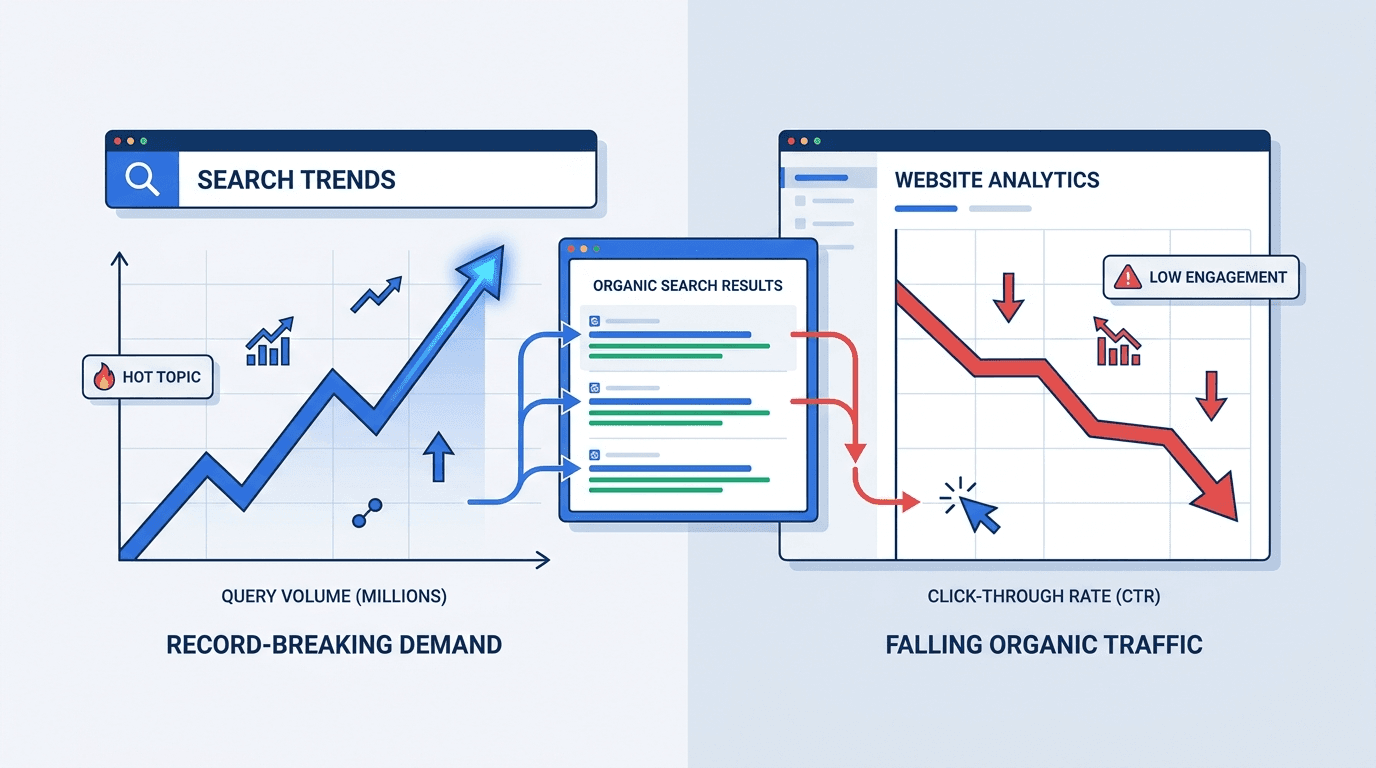
On July 7, 2026, Argentina scored a stoppage-time winner against Egypt in the World Cup Round of 16. Seconds later, Google Search reportedly set an all-time usage record. In that same quarter, your analytics dashboard probably told a very different story: organic clicks kept sliding, slowly and predictably. Both can be true at once. They are tracking different systems, and mixing them up is one of the pricier mistakes a marketing leader can make right now.
That contradiction is now sitting in the middle of every budget conversation about organic. Leadership sees headlines about search being bigger than ever, then hears from the team that traffic is shrinking. The doom camp declares Google finished; the triumphalists treat the record like a victory lap. Neither view holds up. The practical response is the same in both cases: stop grading performance with the wrong yardstick. The case that traffic metrics mislead and visibility metrics hold up just got a clean, public example.
What Google Actually Said (and the Number It Didn't Publish)
Start with the exact claim. Nick Fox, Google's SVP of Knowledge and Information, posted on X on July 8th that Search broke prior usage records and hit its highest usage ever right after Argentina's winning goal. Robby Stein, VP of Product for Search, echoed it. A Google spokesperson told CNBC the company saw its most queries per second immediately following the goal.
What Google did not provide is the part analysts actually need: a number. No queries-per-second figure. No percent lift. No baseline for comparison. That is not new; Google made a similar, unquantified claim after the 2022 World Cup final. This is PR, not a data release, and the difference matters: without specifics, you cannot verify the size of the spike, only that Google says it occurred. For context, Google processes approximately 13.7 to 16.4 billion searches per day (SQ Magazine, DemandSage, 2026), so even a small percentage jump during a global moment still adds up to a staggering absolute count.
The spike itself is easy to predict. Put a billion-plus people in front of the same drama, and a meaningful chunk of them will reach for a search box the instant it happens. That is an infrastructure stress test, not a read on day-to-day commercial intent. Still, the claim tells us something useful, just not what either side of the argument wants to hear.
The Category Error Everyone Is Making
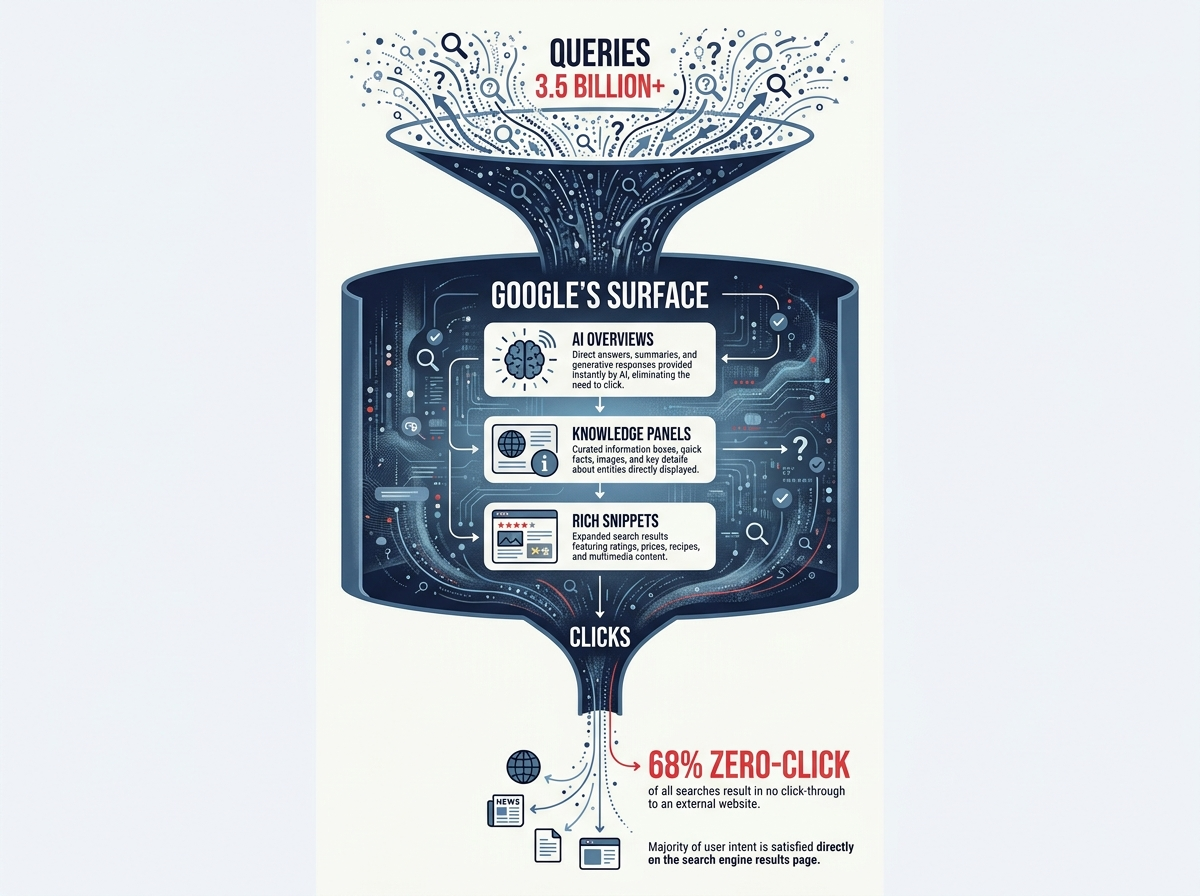
The misunderstanding is straightforward. "Usage" and "queries" describe demand for Google's product: how often people ask Google for an answer. Clicks describe distribution: how often Google sends someone off its property and onto yours. Those were never the same metric, but for two decades they tended to rise together, so the industry acted like they were interchangeable. That coupling is gone.
As Google's AI Overviews, rich snippets and knowledge panels expand, Google can resolve more queries on its own surface. The gap between search usage and clicks is structural, not a temporary dip. Research based on Similarweb clickstream data found that 68% of U.S. Google searches ended without a click to a third-party website in early 2026, while Google's global search market share remains above 90%. People are not abandoning Google; they are completing more journeys without leaving it.
Info: When someone asks "is Google search dying?" they are asking the wrong question. Google is not dying. The click is what's dying, and those are very different problems with very different solutions.
What the Record Genuinely Rebuts
The "Google is dead" storyline does not hold up. Even without hard figures, a record tied to a peak global moment indicates that people still turn to Google Search when curiosity spikes. Claims that AI answer engines or social discovery platforms have already replaced Google as the default information source are overstated. By Google's own account, Search usage reached a record level during this event, although the company did not publish the underlying query volume or methodology.
For marketers, that is the good news: demand for answers is not the bottleneck. The urge to search, confirm, and discover is still there, and it is not slowing down. The audience is present. The open question is whether your brand appears when they go looking.
What the Record Does Not Rebut
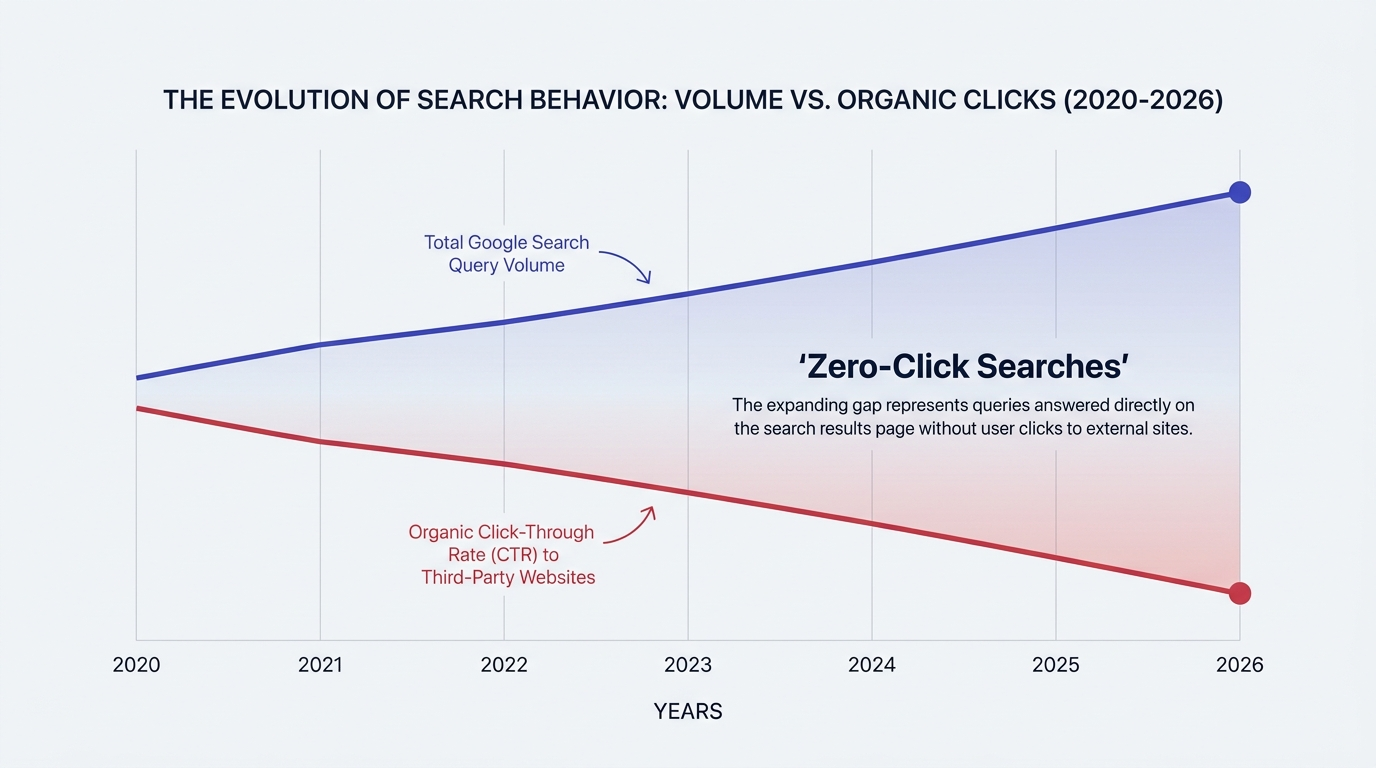
Where the victory-lap interpretation collapses is equally clear. A usage record does nothing to contradict the decline in organic CTR for many query types or the rise of zero-click behaviour. If your reports show falling clicks, they are not wrong because Google announced a usage spike. The zero-click map of Europe shows meaningful market-by-market variation, while the desktop versus mobile CTR picture in 2026 demonstrates why blended click-through data can hide important differences.
If your SEO model still depends on harvesting clicks from blue links, this record is not a feel-good headline. More people searched, and a smaller share of those searches turned into visits. The denominator grew while your share did not. That is not validation; it is a sharper signal that the distribution model has moved on.
The Strategic Read: Demand Is Intact, Attention Is Contested
What do you do with that reality? Three moves, and they require changing how you explain organic performance to leadership.
First, separate search demand from organic traffic in your reporting. They are decoupled now, so treat them that way. Show the board that category search volume is stable or growing (it almost certainly is). Then show, explicitly, that attention inside the results has been reallocated. That shifts the conversation from "search is dying" to "search distribution changed," which is both true and actionable.
| Dimension | Old SEO Model | New Visibility Model |
|---|---|---|
| Primary Metric | Clicks and sessions from organic search | Appearances in AI Overviews and answer panels |
| What It Measures | Traffic delivered to your domain | Whether your brand shows up inside the answer |
| Rankings Focus | Position 1-10 on the blue-link SERP | Presence and prominence in generative results |
| Branded Mentions | Tracked only in brand campaigns | Tracked as a core organic KPI across queries |
| Strategic Goal | Maximize inbound visits | Maximize brand visibility where users actually look |
| The shift from click-based to visibility-based measurement |
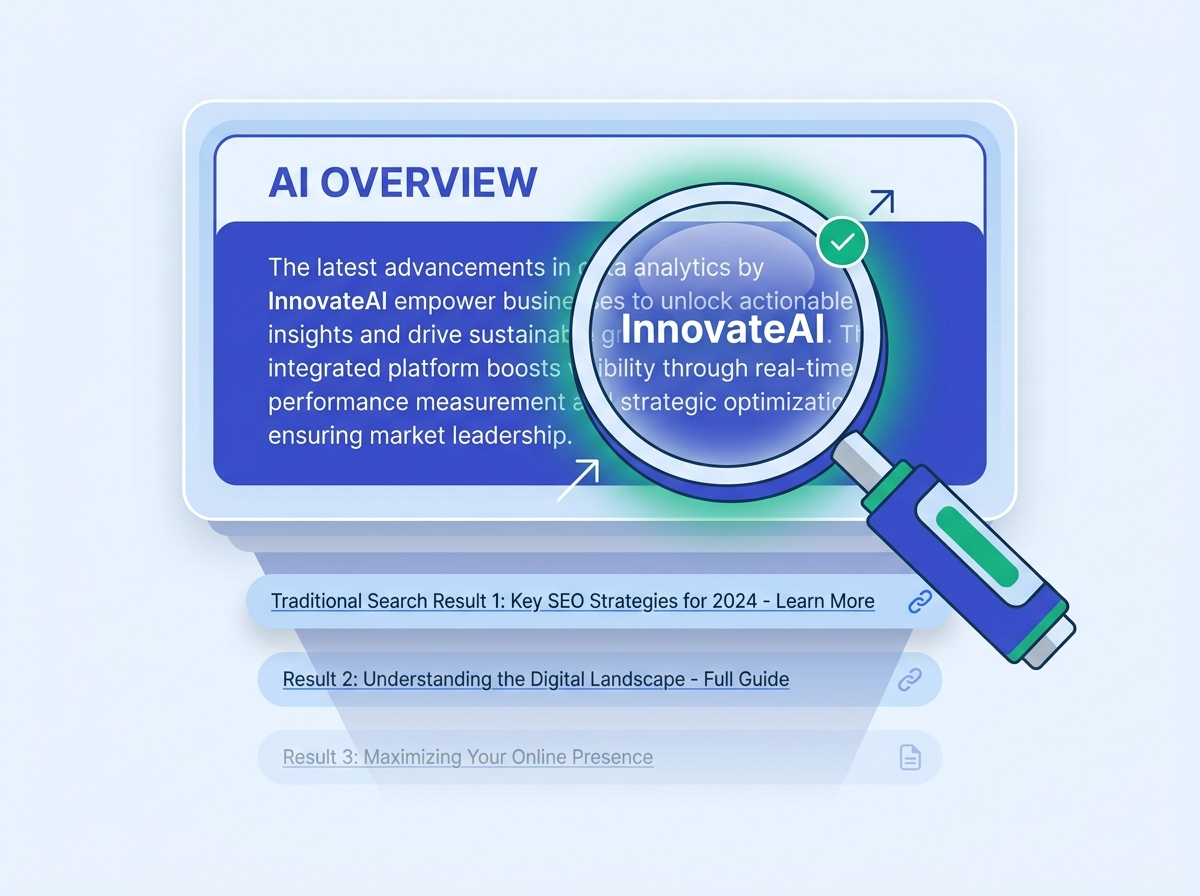
Second, treat visibility as a primary discovery KPI alongside clicks, conversions, pipeline and revenue. Are you appearing in AI Overviews? Are your messages showing up accurately in answer panels? These interactions can influence awareness and consideration even when they do not produce an immediate website visit. With the right instrumentation, teams can measure generative AI performance and build a more complete view than Google Analytics sessions provide on their own.
Third, run Answer Engine Optimization alongside traditional SEO and GEO, not as a replacement for proven search fundamentals. The target is no longer only to rank as a blue link; it is also to be understood, trusted and included in the answer. That requires content that is easy to extract, authority that AI systems can verify and ongoing monitoring of visibility in the agentic search era, where a user may never engage with a classic results page.
Vizup acts as an Organic Autopilot for modern discovery, helping brands monitor, create, optimise, publish and learn across Search, Social, Communities, AI Answer Engines and Local Discovery. It combines AI agents, human experts and live SEO, pSEO, AEO and GEO tools so teams can move from identifying a visibility gap to acting on it in one connected workflow. Paid advertising is available as an amplification add-on when brands want to extend the reach of proven organic work.
The Right Question for 2026 and Beyond
The Google search usage record is not a fabrication. Your falling traffic report is not a mistake, either. Together they point to a basic change in how information gets distributed online. The only truly bad move is insisting one of them must invalidate the other.
"Is Google Search dying?" is the wrong question. The better question is: how does your brand win when Google and other discovery surfaces increasingly deliver answers before a website visit occurs? If users receive an answer directly on the discovery surface, does your brand appear accurately and prominently within it, and can you measure that presence? Demand is not disappearing; discovery is becoming more distributed and less dependent on the click. Vizup's Organic Autopilot helps brands monitor, create, optimise, publish and learn across the surfaces where modern discovery happens.
Frequently Asked Questions
Is Google Search dying in 2026?
No. Google's global search market share remains above 90%, and the company reported record Search usage in July 2026. The "Google is dead" narrative often confuses declining outbound clicks with declining search usage. People are still searching, but a growing share of those journeys can end on the results page instead of becoming visits to third-party websites.
Why are my website's clicks from Google going down if search usage is at a record high?
Because the metrics describe different things. Usage measures demand for Google, while clicks measure the traffic Google distributes to external websites. With AI Overviews, knowledge panels and rich snippets answering more queries directly, Google can complete more journeys on its own surface. Research based on Similarweb clickstream data found that 68% of U.S. Google searches ended without a click to an external website in early 2026. Falling clicks can therefore reflect a change in distribution rather than a disappearance of search demand.
What is the difference between search usage and search clicks?
Search usage (queries) counts how often people ask Google something. Search clicks count how often a user leaves Google to visit a third-party site. For years those lines moved together, but they no longer do. Usage can climb while clicks fall when Google resolves more queries without sending users elsewhere.
How do I measure "visibility" in search if I can't just count clicks?
Visibility answers a broader question: does your brand appear accurately and prominently in AI Overviews, answer panels and other discovery experiences, even when no click occurs? Vizup's Organic Autopilot helps brands monitor mentions, citations, sentiment and presence across Search, Social, Communities, AI Answer Engines and Local Discovery. It then connects those insights to content creation, optimisation, publishing and continuous learning. Google Search Console provides useful impression data for Google surfaces, while Vizup helps teams understand and improve discovery across a wider set of channels.
What is Answer Engine Optimization (AEO) and how is it different from SEO?
Traditional SEO is built around ranking as a blue link and earning the click. AEO is built around being included in AI-generated answers, featured snippets, and knowledge panels. That shifts the work toward structured, extractable content, topical authority, and entity signals that make AI systems comfortable citing your brand. AEO does not replace SEO; it extends it to the surfaces where users increasingly stop.
